

Canada has become an attractive market for entrepreneurs. The area of operations is broad: payments, money transfers, foreign exchange, virtual currency, and other financial services. For a founder who does not live in Canada, the first question emerges: can a non-resident register an MSB in Canada? The answer is yes, but it depends on whether an entrepreneur runs a business on a global scale or if there is a presence in Canada. A non-resident entrepreneur can work through a Canadian business structure or, under specific circumstances, qualify for a foreign money services business (FMSB). The requirements are not the same, and the choice of a route will be necessary before the beginning of the application process.
For Indian entrepreneurs in particular, Canada can offer an interesting option for building an international financial services business. However, setting up the business is only one part of the process. The founder also needs to consider eligibility, documentation, compliance, banking, tax and the practical requirements of operating with Canadian customers.
This guide explains non-resident MSB registration Canada from a practical perspective, including the available structures, documents, process, costs and common challenges.
Can a Non-Resident Register an MSB in Canada?
Yes. A non-resident can potentially establish and register an MSB structure connected with Canada, provided the business meets the applicable requirements. The important point is that Canadian rules distinguish between a money services business (MSB) and a foreign money services business (FMSB).
Generally, an MSB has a place of business in Canada. This can include being incorporated in Canada, having a physical location in Canada, or having employees, agents or branches in Canada. An FMSB, on the other hand, does not have a place of business in Canada but directs its money services to people or entities in Canada and provides those services to clients in Canada.
So, the question is not simply whether the founder lives in Canada. A founder living in India, the UAE, the UK or another country may still be able to operate a business that falls within Canada’s MSB or FMSB framework. This is why MSB registration in Canada for non-residents should be planned around the actual business model rather than the founder’s residential address alone.
Recommended Reading:
Before exploring the registration options, it is important to understand what an MSB in Canada is, the services it covers, and how the Canadian framework applies to these businesses.
Canadian MSB vs Foreign MSB: Which Route Applies?
For non-resident entrepreneurs, understanding the difference between a Canadian MSB and a foreign MSB is important before choosing a registration route. The key difference is whether the business has a place of business in Canada and how it provides money services to Canadian customers.
Factor | Canadian MSB | Foreign MSB (FMSB) |
Business presence | Has a place of business in Canada | Does not have a place of business in Canada |
Business location | May be incorporated or operating through a Canadian presence | Established outside Canada |
Canadian customers | Can provide covered MSB services to Canadian customers | Provides covered services to clients in Canada |
Canadian representative | Generally not required solely because it is a Canadian MSB | Must have a representative for service in Canada |
Typical use case | Suitable for founders establishing a Canadian operation | Suitable for an existing foreign business serving the Canadian market |
Registration route | Registers as an MSB where the business meets the Canadian MSB definition | Registers as a foreign MSB where the FMSB criteria apply |
Best suited for | Entrepreneurs planning a genuine Canadian business presence | Foreign businesses that want to serve Canadian customers without establishing a Canadian place of business |
The right option depends on the actual business model, not simply on where the founder lives. A non-resident entrepreneur planning a Canadian operation may consider the Canadian MSB route, while an existing overseas business serving Canadian customers without a Canadian place of business may need to assess whether it falls under the foreign MSB in Canada framework.
Can Indians Register an MSB in Canada?
Yes, an Indian entrepreneur can potentially set up an MSB business in Canada, but being an Indian citizen does not automatically make the business eligible or ineligible. What matters more is how the business is structured, where it operates, what services it provides, and whether it meets the applicable Canadian requirements.
For example, suppose an entrepreneur based in India wants to start a money transfer or foreign exchange business targeting customers in Canada. The founder could explore setting up a Canadian business structure and then determine whether the proposed activities fall within the Canadian MSB framework. In this case, the business would need to establish the appropriate compliance and operational arrangements before starting its regulated activities.
Another situation is where an Indian company is already operating successfully in India and wants to expand into Canada. Instead of immediately creating a new structure, the business should first determine whether its Canadian activities could make it a foreign MSB (FMSB). A foreign business that does not have a place of business in Canada but directs covered money services toward Canadian clients may fall under the FMSB framework. This means an Indian founder generally has two practical routes to evaluate:
- Create a Canadian business presence: Establish a suitable Canadian entity and assess whether it should register as an MSB.
- Expand an existing foreign business: Keep the existing overseas company and determine whether its Canadian activities require foreign MSB registration.
There is also an important point that Indian entrepreneurs should not overlook. MSB registration is only one part of the setup. The founder may also need to plan for corporate structure, banking, AML/KYC procedures, transaction monitoring, tax obligations and ongoing compliance. Indian founders should separately consider any Indian foreign-investment or remittance rules that may apply when investing in or expanding a business overseas.
What Structure Should an Indian Founder Choose?
For an Indian founder, the right structure depends on whether you want to build a business in Canada or serve Canadian customers from an existing overseas business. In practical terms, you can consider:
- Canadian MSB structure: Suitable if you plan to establish a Canadian company and build a local presence, operations or long-term business in Canada.
- Foreign MSB structure: May be relevant if you already have an Indian or overseas company and want to serve Canadian customers without establishing a place of business in Canada.
Before choosing, look at your business model, target customers, Canadian presence and future expansion plans. The structure should support both your current operations and your long-term goals.
What Documents Does a Non-Resident Need?
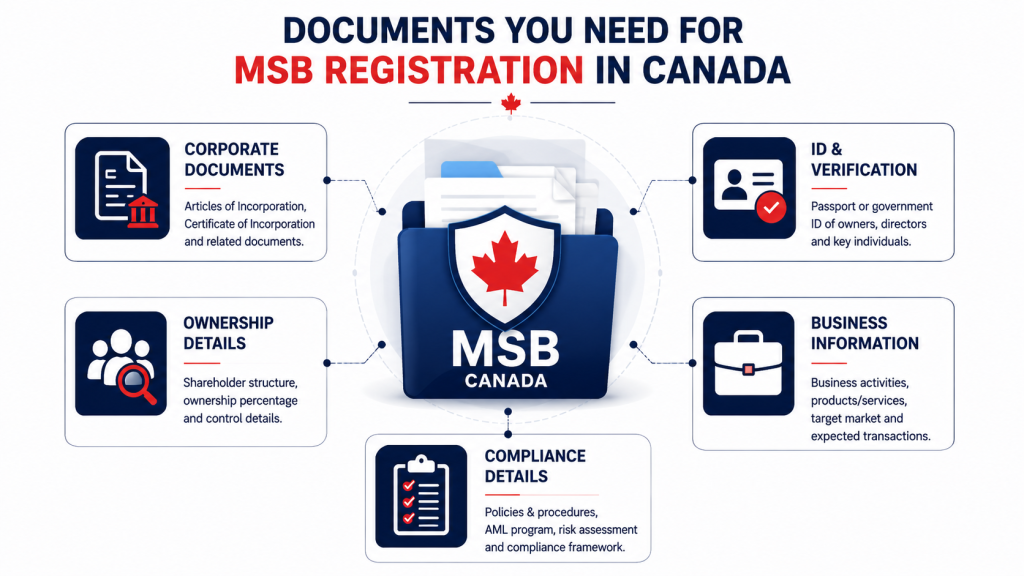
When you are applying from outside Canada, the documents should clearly show who owns the business, who manages it and what the business plans to do. Having this information organised beforehand can make the registration process much smoother. Depending on the structure of the business, you may need documents and information covering:
- Business identity: Company incorporation details and registered business information.
- Ownership: Details of shareholders, owners and controlling individuals.
- Management: Information about directors, key managers and the person responsible for compliance.
- Business activities: A clear description of the MSB services you intend to offer and your expected transaction activity.
- Canadian connection: Details of your Canadian office, agents or representative, where applicable.
Foreign MSBs have an additional consideration: they must provide details of their Canadian representative for service. That representative must reside in Canada and be authorised to accept FINTRAC-related notices and inquiries on behalf of the business. For non-residents, it is particularly important that documents are clear, consistent and properly prepared before submission. Incomplete applications can be closed and the applicant may need to submit a new application.
How Does the Process Work for a Non-Resident?
The MSB registration process Canada follows a defined registration procedure. The first step is not simply submitting a form and waiting for approval. The business needs to determine whether it is an MSB or FMSB and prepare the required information first. The general process involves:
- Determine the business classification
First, establish whether the proposed operation is a Canadian MSB or a foreign MSB.
- Review eligibility
The owners and business should meet the applicable eligibility requirements. Certain individuals or entities are not eligible to register, including those covered by specific criminal offence restrictions.
- Prepare the business information
Gather incorporation, ownership, management, compliance and operational information required for the application.
- Submit the pre-registration request
FINTRAC’s current process begins with a pre-registration form. A compliance officer then contacts the applicant and provides the registration form to complete.
- Submit the completed application and documents
The completed information and supporting documents are submitted through the method provided by FINTRAC.
- Respond to clarification requests
If FINTRAC requires clarification, the applicant needs to respond appropriately. Registration can be denied or revoked in certain circumstances, including failure to respond to clarification requests or being ineligible.
Most importantly, registration must be completed before the business begins operating in Canada where registration is required.
Recommended Reading:
If you are planning to establish an MSB in Canada, our detailed guide on how to register an MSB in Canada explains the key steps involved in setting up and registering the business.
What Costs Should You Consider Before Starting an MSB?
When calculating the MSB registration cost Canada, entrepreneurs should understand that the government registration itself is not necessarily the biggest expense. FINTRAC currently states that it does not charge a registration fee for MSB or foreign MSB registration. However, starting an MSB can involve other business expenses. Depending on the structure and business model, entrepreneurs may need to budget for:
- Company incorporation or restructuring
- Legal and professional consultation
- Compliance programme development
- KYC and AML systems
- Accounting and tax support
- Banking and payment infrastructure
- Canadian representative arrangements for an FMSB
- Technology and transaction monitoring
- Ongoing compliance and record keeping
Therefore, MSB setup cost in Canada should be viewed as a broader business-planning expense rather than simply a registration fee.
The actual cost will vary considerably depending on the type of services, transaction volume, technology requirements and whether the founder creates a new Canadian operation or uses an existing foreign business.
Does MSB Registration Give You Permission to Operate in Canada?
Not exactly. MSB registration does not mean you automatically receive a general licence or permission to carry out every financial activity in Canada. It means your business has completed the applicable MSB registration requirement under Canada’s anti-money laundering and terrorist financing framework. It is important to understand the difference:
- MSB registration: Allows the business to meet its registration obligation where Canadian rules require it.
- Business licence: May be a separate requirement depending on the activity and jurisdiction.
- Other approvals: Certain financial, payment, tax or provincial requirements may apply depending on your business model.
FINTRAC also makes clear that registration is not an endorsement or licence issued by FINTRAC. Therefore, before starting operations, a non-resident founder should check whether any additional federal, provincial or industry-specific requirements apply to the planned services.
What Should Entrepreneurs Check Before Applying?
Before starting an application, it is worth stepping back and reviewing the entire business model. The key questions include:
- What exact money services will the company provide?
- Who are the target customers?
- Where are customers located?
- Will the business have a Canadian office, employees, agents or branches?
- Is the business better classified as an MSB or FMSB?
- Who owns and controls the company?
- Who will act as the compliance officer?
- How will customer identification and verification be handled?
- How will transactions be monitored and reported?
- How will business records be maintained?
- What banking and payment partners will the company need?
These questions help founders understand their Canadian MSB registration requirements before committing money and resources to the setup. A well-prepared compliance structure can also make the business easier to manage after registration rather than treating compliance as paperwork that ends once registration is completed.
Recommended Reading:
Understanding the applicable requirements before applying can make the process smoother; you can also explore our guide on FINTRAC MSB registration requirements and process in Canada for a more detailed overview.
What Challenges Can Non-Residents Face When Registering an MSB in Canada?
For a non-resident, the main challenge is usually not just completing the registration—it is building a setup that works properly from outside Canada. Before applying, founders should be prepared for areas such as:
- Business structure: Deciding between a Canadian MSB and a foreign MSB based on how the business will operate.
- Cross-border documentation: Providing clear ownership, director and business details when the founders or company are based overseas.
- Canadian presence: Understanding when a Canadian address, representative, agent or other local arrangement may be required.
- Banking and payments: Finding suitable banking and payment partners and completing their additional due-diligence checks.
- Ongoing compliance: Maintaining AML/KYC processes, transaction records, monitoring and required reporting after registration.
The key is to plan these requirements before registration, so the business is not registered first and then forced to solve operational and compliance issues later.
Why Choose Vorx for Canada MSB Setup?
Setting up an MSB in Canada as a non-resident can involve several moving parts, from choosing the right business structure to preparing documents and understanding compliance requirements. Vorx Consultancy helps entrepreneurs navigate these steps with practical guidance based on their business model and expansion plans.
For Indian and international founders, Vorx provides support across the wider Canada business setup process, helping coordinate company formation, documentation, MSB registration and related compliance requirements. The aim is to make the setup more organised and easier to manage, so entrepreneurs can focus on building their business while the necessary setup work is handled systematically.
Planning to launch a Money Services Business in Canada? Start with the right structure.
Book a Strategy Call: (Calendly Link)
Visit: www.vorxcon.com
Email: support@vorxcon.com
Final Thoughts
So, can a non-resident register an MSB in Canada? Yes, potentially. Canadian rules provide a framework for both Canadian MSBs and foreign MSBs, but the correct route depends on where the business is established, whether it has a place of business in Canada and how it serves Canadian customers.
For Indian entrepreneurs, the opportunity can be attractive, but the setup should be approached as a complete business and compliance project rather than a simple registration exercise. Before starting, understand your MSB classification, choose an appropriate structure, prepare your documents, assess the MSB registration cost Canada, plan your compliance framework and make sure you understand what registration does and does not allow you to do.
With the right preparation, a non-resident founder can build a clearer path toward establishing and operating an international money services business connected with the Canadian market.