


For Indian entrepreneurs venturing into overseas expansion, with 100% foreign ownership can be a crucial consideration factor for selecting a destination for incorporation. It not only provides the founder with total control of the business, but also ensures that a local shareholder is not automatically entitled to benefits.
However, just because a company is 100% owned and controlled by the founder does not mean that it can operate free of local rules and regulations. Licensing, directors, registered office, sector-specific approvals, tax registration and reporting obligations can all apply. As a result, the right jurisdiction should be based on both ownership as well as operational considerations.here are 10 countries where Indians can obtain 100% foreign ownership.
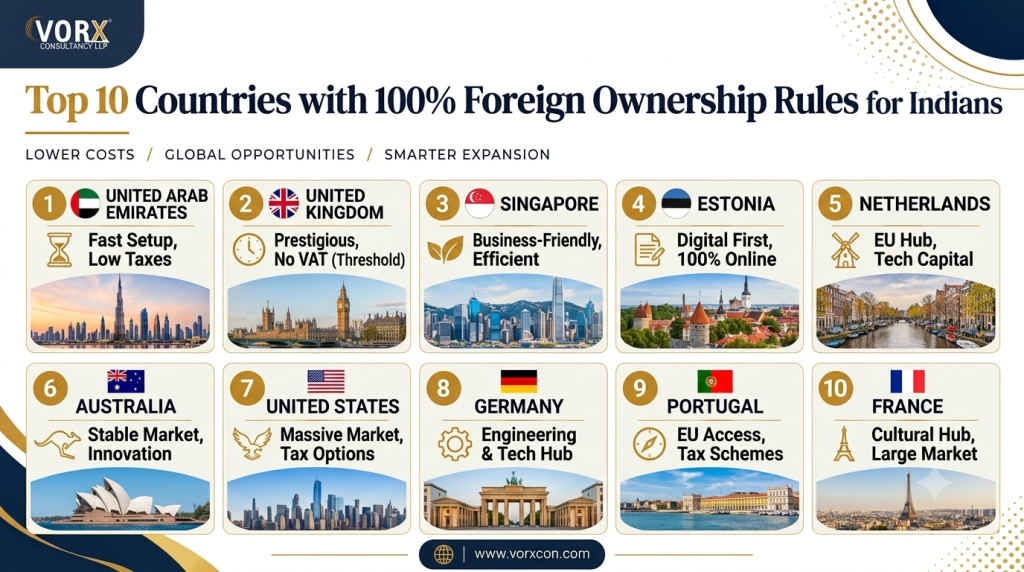
1. United Arab Emirates
The UAE continues to be one of the most attractive jurisdictions for Indian entrepreneurs seeking full foreign ownership. Foreign investors can own 100% of eligible mainland companies, while free zones also provide full foreign ownership for many activities. The UAE has removed the previous requirement for an Emirati majority shareholder across most eligible activities.
This makes the UAE particularly relevant for entrepreneurs who want to build a regional business while maintaining direct ownership and management control.
Key Consideration: Strategic sectors such as defence, telecommunications, banking, insurance and certain other regulated activities can have separate ownership or licensing requirements.
2. United Kingdom
The UK is a well-established option for foreign entrepreneurs because a company can generally be owned entirely by overseas shareholders. An Indian entrepreneur can therefore establish a UK company without automatically giving shares to a UK national.
The country’s mature legal and commercial environment can also make it useful for businesses targeting international clients, investors or the wider European market.
Key Consideration: Full ownership does not remove ongoing corporate obligations. A UK company still needs to meet requirements relating to directors, registered office details, statutory records and regular filings.
3. Singapore
Singapore allows foreign entrepreneurs to establish companies with complete foreign ownership in many sectors and is therefore an appealing option for Indian businesses looking out to establish a foothold in the Asia-Pacific region.
Its robust regulatory framework can be particularly advantageous to businesses that do not just want to register an overseas entity, but want to build a credible regional structure.
Key Consideration: A Singapore incorporated company must have at least one ordinarily resident director, even when the shareholders are entirely foreign-owned.
4. Estonia
Estonia has created one of Europe’s most digitally accessible business environments. Its official e-Residency programme allows foreigners to establish and manage an Estonian company digitally, and foreign-owned companies operate under the same legal framework as other Estonian companies.
For Indian entrepreneurs running location-independent businesses, this can make Estonia particularly interesting as an EU-based corporate structure.
Key Consideration: E-Residency is a digital business identity, not a residence permit. It does not automatically provide physical residency, citizenship, EU entry rights or personal tax residency.
5. Netherlands
The Netherlands is another established European jurisdiction for international businesses and foreign investors. Its position within the EU can make it useful for entrepreneurs who want to establish a European operating or holding structure.
However, ownership should be considered alongside the company’s actual activities, management and presence in the country.
Key Consideration: Entrepreneurs should assess UBO registration, tax obligations and the company’s required level of local substance before deciding on the Dutch structure.
Recommended Reading:
Choosing the right jurisdiction is an important first step when expanding abroad. Explore Best Country to Incorporate a Company from India to understand how Indian founders can evaluate different countries for company incorporation.
6. Australia
Australia allows foreign entrepreneurs to establish companies with foreign ownership, making it a potential option for Indian businesses entering the Australian market.
The country can be particularly relevant when the objective is not simply incorporation but establishing a genuine operating presence, hiring locally or serving Australian customers.
Key Consideration: Foreign-investment rules can apply to particular investments, assets and regulated sectors, so the ownership position should be checked against the nature of the proposed business.
7. United States
The United States is another major jurisdiction where Indian entrepreneurs can establish businesses while retaining complete ownership. The exact structure—such as an LLC or corporation—can have important consequences for taxation, reporting and administration.
For technology, consulting, SaaS and international e-commerce businesses, the US can also provide access to one of the world’s largest commercial markets.
Key Consideration: Foreign ownership can create additional reporting obligations. For example, certain 25% foreign-owned US corporations and foreign-owned disregarded entities can have Form 5472 reporting requirements for reportable transactions.
8. Germany
Germany permits foreign entrepreneurs to establish companies with foreign ownership, including structures such as a GmbH. This can make it relevant for Indian businesses looking for a serious European operating base.
Germany’s strong industrial and commercial ecosystem can be attractive for companies planning long-term operations rather than a purely administrative presence.
Key Consideration: German companies operate within a formal compliance environment covering accounting, taxation, commercial registration and, depending on the activity, sector-specific permissions.
9. Portugal
Portugal offers another route for foreign entrepreneurs who want to establish an EU-based business. Foreign ownership can make the country relevant for Indian founders seeking European market access while retaining control over their company.
However, the decision should distinguish between company formation and personal immigration objectives.
Key Consideration: Owning a Portuguese company does not automatically give the shareholder a residence permit. Business ownership and immigration status are separate matters and should be planned accordingly.
10. France
France can also accommodate foreign-owned businesses and offers access to the wider European market. For Indian entrepreneurs, it may be relevant when the business has a clear commercial connection with France or wants to establish a presence within a major EU economy.
The country’s structured regulatory environment means that incorporation should be planned around the company’s actual business model.
Key Consideration: Foreign-owned companies must still comply with French tax, accounting, employment and sector-specific regulatory requirements.
Recommended Reading:
Before incorporating overseas, read Company Formation Mistakes to Avoid Abroad in 2026 to avoid unnecessary complications later.
How VORX Helps Indian Entrepreneurs Plan Global Expansion?
VORX Consultancy helps Indian entrepreneurs to approach international company formation as a strategic business decision, not a mere regulatory exercise. Focus is placed on comparing jurisdictions, understanding ownership and compliance requirements, selecting an appropriate business structure and aligning company formation with international expansion, tax and residency objectives.
The objective is simple: help the entrepreneur create a structure that benefits his/her current business, while also being practical as the company expands overseas.
Planning to set up a company abroad? Let VORX help you choose the right jurisdiction and structure for your global expansion.
Book a Strategy Call: (Calendly Link)
Visit: www.vorxcon.com
Email: support@vorxcon.com
Final Thought
For Indian entrepreneurs, choosing a country with 100% foreign ownership is about more than keeping full control of the company. It is about finding a jurisdiction where ownership, business operations, compliance and future expansion work together.
The strongest international structures are not necessarily built in the country with the easiest incorporation process. They are built where the jurisdiction makes sense for the business today—and continues to make sense as the business grows tomorrow.
