


For many entrepreneurs and investors, international expansion is no longer limited to merely establishing the company in another country. Enhancing access to a new market, increased international mobility, family relocations and long-term residency planning can also become key aspects of one and the same decision.
That is why an Investor Visa can be crucial. However, a programme of this kind is not necessarily about simply investing in a country and obtaining residency. Immigration systems are different in different countries and each of them has its own requirements and criteria for investment, eligibility and ongoing obligations.
The understanding of how these mechanisms work is critical when it comes to looking beyond the value of an investment and evaluating how a specific stream of investment fits into the bigger picture.
What Is an Investor Visa?
An Investor Visa is an immigration route designed for individuals who make a qualifying investment or contribution under a country’s applicable immigration framework. Depending on the programme, the investment may be connected to a business, an approved investment vehicle, capital contribution or another qualifying category. Some routes are temporary, while others may provide a route towards permanent residence.
The important distinction is that investment is only one part of the immigration assessment. The applicant may also need to demonstrate financial capacity, legitimate source of funds, personal eligibility and compliance with the programme’s conditions.
How Does an Investor Visa Work?
The process usually starts before the investment is made. An investor first needs to understand which immigration route matches their financial position, business objectives and intended duration of stay.
A typical process may involve:
Profile assessment → Route selection → Eligibility review → Source-of-funds verification → Documentation → Investment → Visa/residence application → Ongoing compliance
The order and requirements can vary between jurisdictions. Some programmes are closely connected to active business involvement, while others focus more directly on qualifying investment. This makes the initial assessment important. Choosing a route simply because it has a particular investment threshold may overlook other conditions that could affect the applicant later.
What Are the Different Types of Investor Visa?
Investor visa options can broadly be grouped according to how the investment is connected to the applicant’s right to stay. The main distinction is whether the route is temporary, linked to permanent immigration, or based on obtaining residence through investment.
Temporary Work-Based Investor Visas
These routes are generally designed for investors who want to run, develop or actively manage a business while living in the destination country. The U.S. E-2 Treaty Investor Visa is one example of this model, where the investor’s involvement in the qualifying business is an important part of the route.
Permanent Residency Immigrant Visas
These programmes connect investment with a long-term immigration status rather than temporary business activity. The U.S. EB-5 programme, for example, is an immigrant investor route through which qualifying investors can pursue permanent residence subject to the applicable requirements.
Residence-by-Investment or Golden Visa Programmes
Golden Visa programmes generally offer a residence route to eligible investors who meet specified investment conditions. Portugal’s ARI programme is an example, with qualifying investment options defined under its current framework.
While these categories may all involve investment, they can provide very different rights, durations and long-term outcomes. Therefore, investors should look beyond the investment amount and understand what immigration status the particular route actually provides.
Who Can Apply for an Investor Visa?
An Investor Visa is generally designed for individuals who have the financial capacity to make a qualifying investment and meet the immigration conditions of the selected programme. It may be relevant for:
- Entrepreneurs and business owners looking to establish or expand their presence internationally.
- Investors with sufficient capital seeking an investment-linked residence option.
- High-net-worth individuals considering international mobility and long-term residency planning.
Beyond financial capacity, applicants may need to demonstrate a legitimate source of funds, provide supporting documentation and meet applicable background, investment and compliance requirements. Eligibility ultimately depends on the specific programme and the applicant’s individual profile.
What Are the Key Investor Visa Requirements?
While requirements vary, most investor routes involve a combination of financial, personal and immigration-related criteria. Common requirements may include:
- Qualifying investment
- Proof of legitimate source of funds
- Financial and personal documentation
- Background and due-diligence checks
- Compliance with investment or residence conditions
The details can vary significantly between programmes. Investors should therefore review both the entry requirements and the obligations that continue after approval.
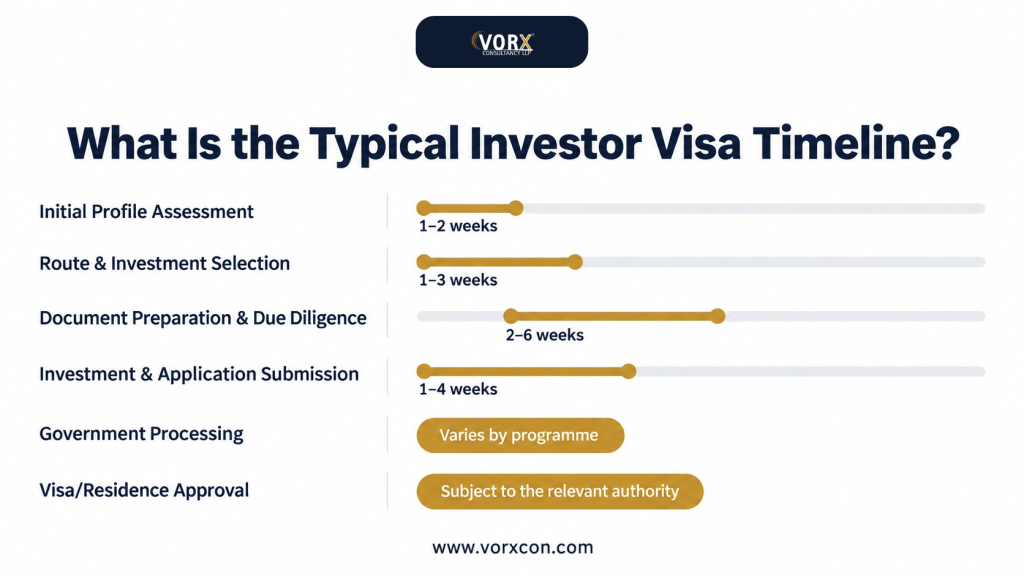
What Is the Investor Visa Process?
While the exact procedure differs between investment programmes, the overall journey generally involves several key stages:
- Profile Assessment
Understanding the applicant’s financial position, investment objectives, business background and long-term residency plans. - Route Selection
Identifying an investment and immigration route that aligns with the applicant’s objectives and eligibility. - Due Diligence & Documentation
Reviewing the source of funds, personal records, financial documents and other supporting information required for the application. - Investment & Application
Completing the qualifying investment in accordance with the programme rules and submitting the relevant immigration application. - Government Review
The relevant authority assesses the application, investment and supporting documents before reaching a decision. - Approval & Ongoing Compliance
After approval, the applicant receives the applicable visa or residence status and must continue meeting any investment, residence or reporting conditions.
What Are the Benefits of Investor Residency?
The value of investor residency can extend beyond obtaining permission to live in another country. For some investors, it can become part of a wider international strategy.
International Mobility
Depending on the programme, residency may provide greater flexibility to live and travel internationally, subject to the applicable immigration conditions.
Business Opportunities
Investor residency can complement international business plans by giving entrepreneurs a presence in a new market and a base from which to explore commercial opportunities.
Family Inclusion
Certain programmes allow eligible family members to obtain residence alongside the main applicant. This can make an investment-based route relevant to wider family relocation planning.
Long-Term Planning
Some investment-based programmes can provide a pathway towards permanent residence or citizenship, where the relevant legal conditions are subsequently met. These outcomes should not be assumed and need to be assessed separately.
Recommended Reading:
For investors considering long-term residency options beyond investment-based routes, our guide on the easiest countries for Indians to get PR provides further insights into permanent residency pathways.
Investor Visa vs. Other Residency Routes
Residency Route | Main Basis | Generally Suited To |
Investor Visa | Qualifying investment | Investors and business owners |
Entrepreneur Route | Business activity | Individuals establishing or operating a business |
Employment Route | Eligible employment | Professionals working for qualifying employers |
Digital Nomad Route | Remote work | Individuals working remotely for overseas businesses |
Skilled Migration | Skills and qualifications | Professionals meeting migration criteria |
What Should You Check Before Choosing an Investor Visa?
Before selecting a programme, consider:
What exactly qualifies as an investment?
How long must the investment be maintained?
What residence conditions apply?
Can eligible family members be included?
What are the tax and compliance implications?
Does the route provide any pathway towards permanent residence?
Programme rules can also change, making it important to assess the current framework before making a financial commitment.
Recommended Reading:
If retirement is also part of your international relocation plans, explore our guide to countries offering retirement visas for Indians to understand alternative residence options.
How Can Vorx Consultancy Help with Investor Visa Planning?
At Vorx Consultancy, investor immigration is approached from a wider perspective rather than treating the visa as an isolated application.
The initial step is to understand the details of the investor’s profile, capacity, business objectives and the preferred jurisdiction and long-term vision for their international expansion. The appropriate aspects of business setup, residency and immigration strategy can then be considered in parallel with these key points.
Where relevant, Vorx Consultancy can assist clients with a wide range of services to support their international business setup and expansion, immigration and residency strategy, as well as ongoing compliance and administration.
Planning your next move? Speak with Vorx Consultancy to explore an Investor Visa strategy
Book a Strategy Call: (Calendly Link)
Visit: www.vorxcon.com
Email: support@vorxcon.com
Final Thought
An Investor Visa may begin with an investment, but the decision behind it is often much broader. For an entrepreneur or investor, the destination can influence business opportunities, mobility, family planning, taxation and long-term residency goals. That is why the right question is not simply “How much do I need to invest?”
It is “Does this investment and immigration route make sense for my wider international plans?”
Understanding that difference can help investors approach residency by investment with greater clarity and make decisions based on their actual objectives rather than simply the headline investment figure.