


Opening a business bank account overseas usually involves major complicated parts for Indian entrepreneurs. Although a company is incorporated abroad, obtaining a bank account is not always a given. The financial institution will always analyze the company’s jurisdiction, ownership structure, business activity, source of funds, expected transaction volume and the nationality of its shareholders or directors before granting any approval.
If you are in search of an international business bank account for Indian partners, consider the following financial institutions in terms of their international presence, onboarding options and support for foreign business owners.
1. HSBC
HSBC is one of the more established names for companies building operations across multiple countries. Its international subsidiary banking division combines everyday corporate banking with trade, cash-management and growth-related services.
Why consider it: HSBC can be useful when an overseas subsidiary needs access to the wider banking infrastructure of an international group.
What to know: Account opening involves business assessment, company documents and checks around source of wealth and source of funds.
2. Standard Chartered
Standard Chartered has a significant presence across Asia and the Middle East, making it relevant for Indian businesses expanding into these regions.
Why consider it: Its business banking offering combines everyday transactions, payments, cash management and international banking support.
What to know: Different business account structures have different balance, documentation and eligibility requirements, so founders should compare the account conditions before applying.
3. DBS
DBS is particularly noteworthy because it has a dedicated account-opening route for businesses with foreign ownership. The bank explicitly covers foreign-incorporated companies, businesses owned by foreign corporate shareholders and companies owned by individuals who are not Singapore residents.
Why consider it: Foreign founders can receive assistance from a relationship manager during onboarding.
What to know: Certain foreign-owned structures cannot use the standard self-service application and require bank-assisted onboarding.
4. OCBC
OCBC provides a relatively structured route for overseas entrepreneurs establishing banking relationships in Singapore.
Why consider it: Eligible foreign-owned Singapore companies and companies registered outside Singapore can receive remote account-opening support without visiting a branch.
What to know: Remote onboarding does not mean automatic approval. Ownership, business activity and corporate documentation are still reviewed by the bank.
5. UOB
UOB is another major Singapore banking option for overseas entrepreneurs. It supports business account applications involving foreign directors as well as foreign-incorporated entities through dedicated application processes.
Why consider it: Founders can access established corporate banking, digital business banking and cross-border transaction services within one banking relationship.
What to know: The onboarding route changes depending on whether the company is Singapore-incorporated or incorporated overseas. Additional requirements can apply to foreign companies.
Recommended Reading:
If travelling abroad for account opening is a concern, read our guide on how to open a business bank account abroad without traveling to understand remote onboarding and the key compliance considerations for Indian entrepreneurs.
6. Emirates NBD
Emirates NBD is one of the major business banks to consider when establishing a company in the UAE.
Why consider it: It offers multiple business banking packages and digital account management through its business banking platform.
What to know: Applicants are expected to provide a valid UAE business licence, corporate documents, shareholder identification, address evidence and banking history where applicable.
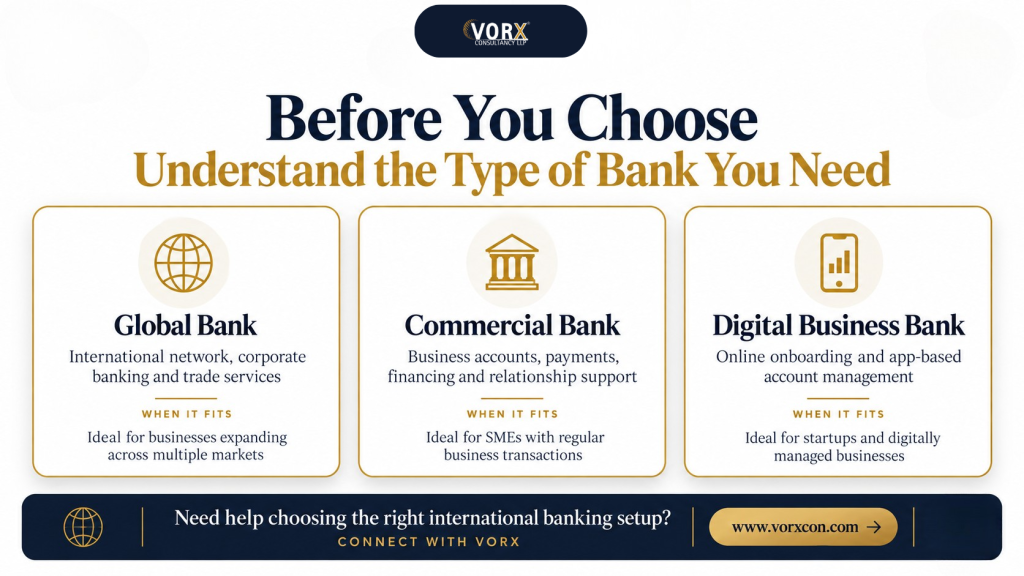
7. Mashreq NEO BIZ
Mashreq NEO BIZ takes a more digital-first approach to UAE business banking. Applications can be initiated online, with company documents uploaded digitally before the bank completes its review and verification.
Why consider it: The onboarding process is designed around entrepreneurs and SMEs that prefer online account management.
What to know: Applicants generally need corporate registration documents, company address evidence and identification of owners or partners. Approval remains subject to the bank’s review.
8. RAKBANK
RAKBANK has a strong SME focus and offers different account structures for startups, growing businesses and established companies.
Why consider it: Its business banking ecosystem extends beyond a basic account to digital banking, financing, payroll and financial-management tools.
What to know: Account conditions vary depending on the business banking package selected, so founders should compare ongoing requirements before applying.
Recommended Reading:
If Australia is one of your target markets, explore our guide on opening a business bank account in Australia for a closer look at the account-opening process and requirements for foreign entrepreneurs.
9. Wio Bank
Wio offers a different banking experience from traditional branch-led institutions. Its business platform is built around digital onboarding and app-based account management.
Why consider it: Features include team permissions, expense controls, invoicing, payroll, payments and other business-management tools within the same platform.
What to know: Wio states that its account-opening process is fully digital, but companies still go through document verification and eligibility checks. Wio Bank is licensed and regulated by the Central Bank of the UAE.
10. Citi Commercial Bank
Citi Commercial Bank operates at a different level from many startup-focused business banking products. Its commercial banking division focuses on mid-sized companies that are growing internationally and need more sophisticated financial infrastructure.
Why consider it: Citi supports businesses with areas such as global banking, working-capital management, trade flows and expansion into new markets.
What to know: It is more relevant to established businesses with meaningful operations than to newly incorporated companies seeking a basic overseas account.
What Should Indian Founders Compare Before Choosing a Bank?
- Foreign ownership policy: Check whether the bank accepts non-resident shareholders and directors.
- Company jurisdiction: Some banks primarily onboard locally incorporated businesses, while others have processes for foreign entities.
- KYC requirements: Understand what the bank expects regarding source of funds, ownership and business activity.
- Business activity: Certain industries may face additional compliance reviews or restrictions.
- Transaction profile: Your expected payment volume, customer locations and supplier network should match the bank’s capabilities.
- Digital access: Look for approval workflows, team access, cards, payroll and accounting integrations where relevant.
- Physical presence: Check whether an in-person meeting, local office or resident signatory is required.
How VORX Can Help With International Business Banking?
VORX helps entrepreneurs plan international company formation and prepare for the corporate banking process, including jurisdiction assessment, incorporation support, document preparation and coordination during account opening.
This is particularly important because banks may ask detailed questions about the business model, shareholders, source of funds, expected transactions, customers and reasons for establishing the company in a particular jurisdiction. Preparing these details before submitting the application can make the onboarding process more organised and reduce avoidable compliance queries.
Final Thoughts
Opening a business bank account abroad is an entrepreneurial decision, not something you ought to do after incorporation as an Indian business owner. The right banking partner depends on the jurisdiction of your formation, ownership structure, the nature of your work and intended mode of international transactions. What works for a Singapore incorporated business entity may be unsuitable for a UAE consultancy or a multi-jurisdictional parent company structure.
The point of opening a business bank account abroad is not just to facilitate your day-to-day operations. It has to serve as a reliable onboarding partner for future expansion into new markets, additional customers and international revenues.
