

Relocating for work, study, business or long-term residency can be a big decision, especially if loved ones need to make the move with you.
If you are wondering what a dependent visa is, it is a visa or residence permission that may enable qualifying relatives to accompany or join their primary visa holder overseas. This guide provides information about the various types of dependent visas, requirements, documents, application process, visa fees and processing timescales.
What Is a Dependent Visa?
A dependent visa allows qualifying relatives of a primary visa holder—also known as the sponsor—to live with them in another country. Depending on the destination’s immigration rules, eligible dependents may include a spouse, recognised partner, children and, in limited cases, parents.
The dependant’s immigration status is generally linked to the sponsor’s visa or residence permit. However, the rights attached to a family dependent visa vary by country. Some routes allow dependents to work or study, while others require separate permission.
What Are the Main Types of Dependent Visas?
Dependent visas are generally classified according to the immigration status of the primary visa holder.
Dependent visa type | Usually linked to | Potential applicants |
Work Visa Dependant | Employment or skilled-worker visa | Spouse, partner and eligible children |
Student Dependant | Qualifying student visa | Partner and children, subject to restrictions |
Business or Investor Dependant | Entrepreneur, investor or business route | Eligible immediate dependants |
Permanent Resident Dependant | Permanent residence status | Qualifying relatives under local rules |
Spouse or Partner Visa | Citizen, resident or eligible visa holder | Recognised spouse or partner |
Recommended Reading:
For professionals planning to work remotely abroad, explore our Digital Nomad Visa for Indians guide to understand eligibility, requirements and available options.
Can Your Family Join You on a Dependent Visa?
Your family may be able to join you if your immigration route permits dependents and each applicant meets the relevant conditions.
A dependent visa for a spouse generally requires evidence of a genuine and legally recognised relationship. A dependent visa for children usually covers unmarried children within a specified age limit who remain financially dependent on the sponsor.
A dependent visa for parents is less widely available. Applicants may need to demonstrate financial, medical or practical dependency. Some countries only allow citizens or permanent residents to sponsor their parents.
What Are the Eligibility Requirements for a Dependent Visa?
Although dependent visa eligibility differs between countries, immigration authorities commonly assess whether:
- The sponsor holds a valid and eligible visa or residence status.
- The applicant has a genuine qualifying relationship with the sponsor.
- The required income, savings or maintenance conditions are met.
- Suitable accommodation is available where required.
- The applicant has appropriate health insurance.
- Age and financial-dependency conditions are satisfied.
- Medical and character requirements are met.
These dependent visa requirements should be reviewed before starting the application because conditions can differ considerably between countries and visa categories.
Recommended Reading:
If your relocation is connected to overseas investment, read our Investor Visa Explained guide to learn how investment-based visa routes work and who may qualify.
Which Documents Are Required for a Dependent Visa?
The dependent visa documents needed will depend on the country and the type of visa you are applying for. Applicants generally need valid passports, recent photographs and a copy of the sponsor’s visa or residence permit. Documents confirming the relationship—such as a marriage certificate for a spouse or a birth certificate for a child—are also essential.
Additional documents may include:
- Proof of the sponsor’s income or savings
- Accommodation and health insurance records
- Medical or police clearance certificates, where required
If any documents are not in English they will usually need to be officially translated, notarised and/or legalised. It is important that the name, date of birth and other personal details on all documents are the same.
How Long Does a Dependent Visa Take to Process?
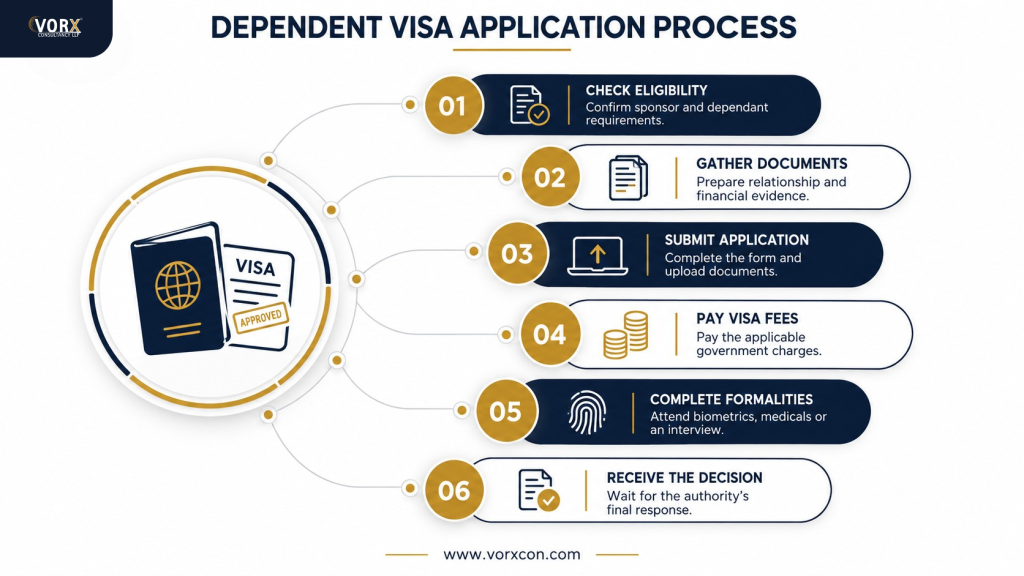
The dependent visa processing time depends on the immigration system, application category and complexity of the case. However, applicants can use the following general ranges for planning:
- Regular Applications: 6–12 weeks
A complete and straightforward application may receive a decision within this period. - Priority Applications: 1–6 weeks
Some immigration authorities offer an expedited service for an additional fee, subject to availability. - Complex Applications: 6–12 months or longer
Applications involving additional background checks, unclear documentation or significant processing backlogs may take considerably longer.
What Can Extend the Processing Time?
Incomplete documents, delays in biometric appointments, additional verification requests and high seasonal application volumes can all affect the timeline. Any request for further evidence may pause or extend the assessment process.
Note: These timelines are general estimates only. Actual processing times vary by country, visa category, application location and individual circumstances.
How Much Does a Dependent Visa Cost?
There is no universal dependent visa cost because government charges and supporting expenses differ by country and visa category.
Cost component | What it may cover |
Government application fee | Official visa or residence application charge |
Biometrics fee | Fingerprint and photograph enrolment |
Medical and insurance costs | Medical tests or mandatory health coverage |
Document preparation | Translation, certification, notarisation or apostille |
Post-arrival fees | Residence card, permit issuance or local registration |
Professional support | Optional assistance with documents and application preparation |
How Can Vorx Support Your Dependent Visa Application?
Dependent visa application processes can be complex if immigration, financial, and documentary prerequisites must be considered together.
Vorx can assist in determining the most appropriate visa category, country-specific eligibility criteria and compiling a comprehensive list of supporting documents. Additional support may be available in relation to application processing, document collation, compliance advice and response to supplementary information requests.
While the immigration authorities retain overall responsibility for assessing an application, careful preparation can help to avoid common pitfalls and streamline the application process.
Planning a dependent visa application? Connect with Vorx for expert guidance at every step.
Book a Strategy Call: (Calendly Link)
Visit: www.vorxcon.com
Email: support@vorxcon.com
Final Thoughts
It is important to note that the dependent visa can only be given to qualified relatives of the visa holder, and the application process can be lengthy. Besides, specific requirements, documents, costs, work permits, and processing times depend on the country and the type of visa.
Consequently, it is essential to make sure that the application has passed all stages of screening before deciding to take it to the immigration authorities. Furthermore, complying with the regulations and giving correct information about the relationship and the financial support that the main applicant will provide to the dependent visa holder can save a lot of time and effort.