
A company can have a perfectly clear shareholder register and still leave one question unanswered: who is the person behind the shares? When businesses own other businesses, the name on the register may be only the first link in a longer ownership chain. In other cases, a person may have little equity but considerable influence over the company’s decisions.
That distinction matters when a company files ownership information or opens a business bank account. The people reviewing the disclosure need to understand who ultimately owns or controls the business, and how the company reached that answer. In this guide, we explain what beneficial ownership disclosure means, the different ways a person may qualify, the documents commonly requested and the steps involved in preparing an accurate disclosure.
What Is Beneficial Ownership Disclosure?
A beneficial owner is an individual who ultimately owns or controls a company, directly or through another arrangement. Beneficial ownership disclosure means identifying those individuals and providing the information required by a regulator, company register or financial institution.
The shareholder named in a company’s records may be another business. A director may manage operations without owning shares. Neither name, on its own, necessarily identifies the people who must be disclosed. The company needs to follow the ownership and control trail until it reaches individuals.
Types of Beneficial Ownership in a Company
Direct ownership : this is the simplest case. An individual holds shares or voting rights in their own name. Their interest is visible in the company’s records, although the applicable rules still determine whether they must be reported.
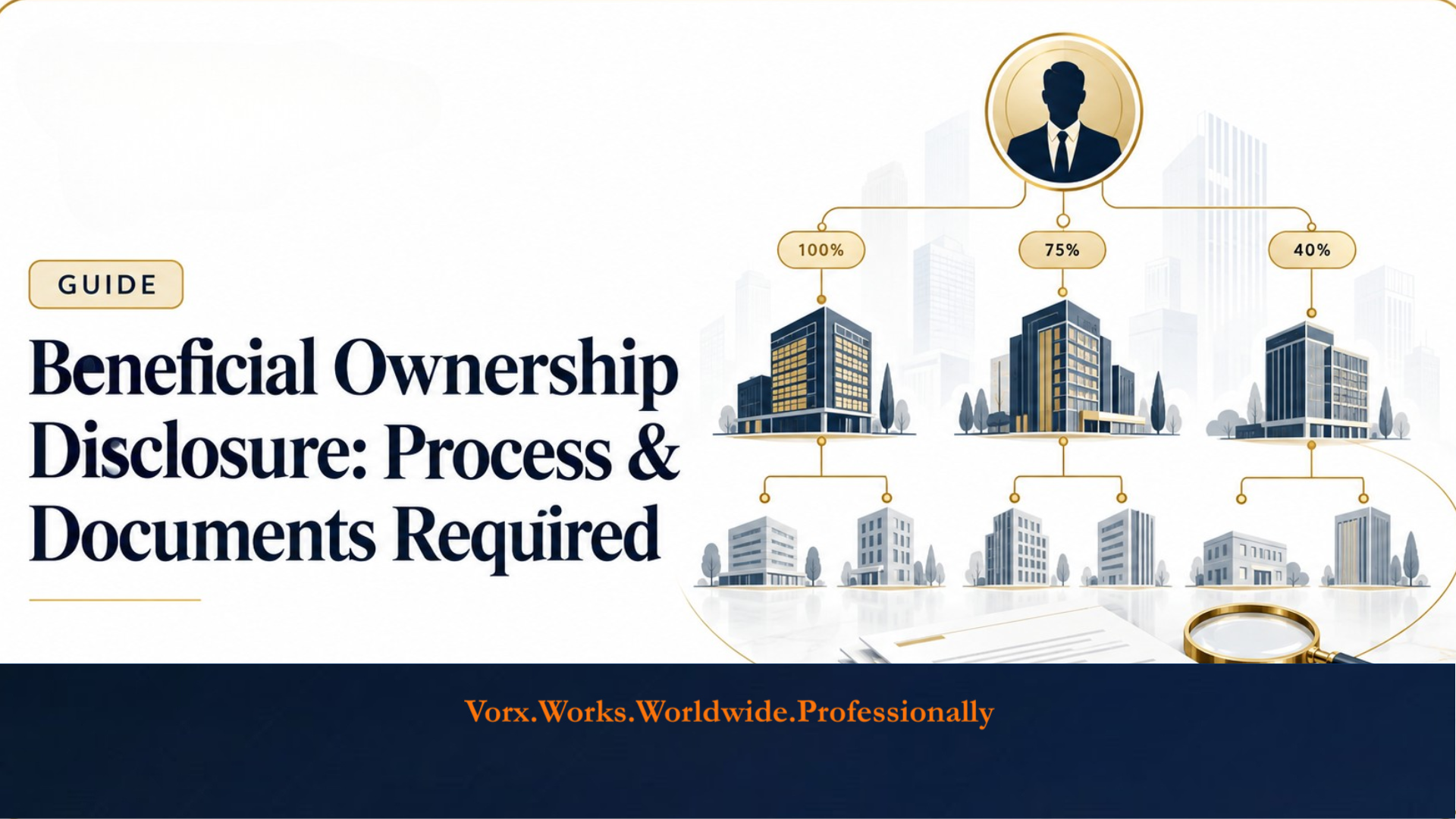
Indirect ownership: this ownership involves another entity between the person and the company being reviewed. Suppose Priya owns 75% of a holding company, which owns 60% of an operating company. Priya’s indirect ownership interest in the operating company is 45%. A review that stops at the holding company would miss her.
Control through other means: this requires a closer look at how decisions are made. Someone may hold a small shareholding but have contractual rights to appoint key decision-makers or influence major business decisions. That person may need to be considered even when a simple share calculation does not identify them.
These categories can overlap. Ownership charts help with the numbers; agreements and governance records help explain control. The relevant legal definition and threshold depend on the jurisdiction.
Need help with beneficial ownership disclosure? Speak with Vorx Consultancy.
Why Is Disclosure Required?
Beneficial ownership rules make it harder to hide the people behind a company through layers of entities or nominees. Authorities use this information to understand corporate structures and investigate potential misuse.
Banks have a related reason for asking: they need to understand who owns or controls a business customer as part of their due diligence. A request from a bank, however, is separate from a government filing. A business may have to provide similar information to both, using different forms and procedures.
Need help with beneficial ownership disclosure? Speak with Vorx Consultancy.
When Is Disclosure Required?
A company may be asked for beneficial ownership information during registration, a required regulatory filing or bank account opening. A later transfer of shares or change in control may also mean its information needs reviewing and updating.
There is no single worldwide filing deadline or ownership percentage that fits every company. Before preparing a disclosure, establish which country’s rules apply, which entity is being assessed and who is requesting the information. That prevents a common error: treating a bank’s document request as if it were the same as a filing obligation.
Recommended Reading:
“For a closer look at how banks review ownership and other business details, read our guide to opening a business bank account abroad remotely.”
Beneficial Ownership Disclosure Requirements
Requirements vary, but the company will generally need to establish:
- Who must be identified: Individuals meeting the applicable ownership or control test.
- What must be provided: Their identifying details and the nature of their ownership or control.
- Where the information goes: To the relevant register or authority, to a bank, or to both if separate obligations apply.
- When it must be updated: According to the applicable filing rules or the institution’s request.
Some jurisdictions also provide exemptions for certain entities. An exemption should be checked against the specific rules rather than assumed from the company’s size or activities.
Documents Commonly Required
Document or record | Why it may be needed |
Passport or accepted identity document | To verify an individual |
Address and personal details | To complete the requested disclosure |
Shareholder registers and company records | To establish direct holdings |
Group ownership chart | To show indirect holdings |
Shareholder or governance agreements | To assess voting and control rights |
For a company with several corporate shareholders, keep the chart consistent with the underlying records. If the percentages or names differ, resolve the discrepancy before filing.
Recommended Reading:
“If you are preparing to set up a company overseas, review this pre-registration compliance checklist alongside your beneficial ownership documents.”
Common Mistakes to Avoid
Even a straightforward company can make mistakes if it treats disclosure as a form-filling exercise. Watch for these issues:
- Stopping at a corporate shareholder instead of tracing ownership to individuals.
- Looking only at share percentages and overlooking significant control rights.
- Assuming every director is a beneficial owner without checking their actual ownership or control.
- Using another country’s rules for thresholds, exemptions or deadlines.
- Forgetting updates after a share transfer or change in decision-making rights.
A brief internal review before submission is usually more useful than correcting an inconsistent disclosure later.
How Vorx Consultancy Helps With Beneficial Ownership Disclosure?
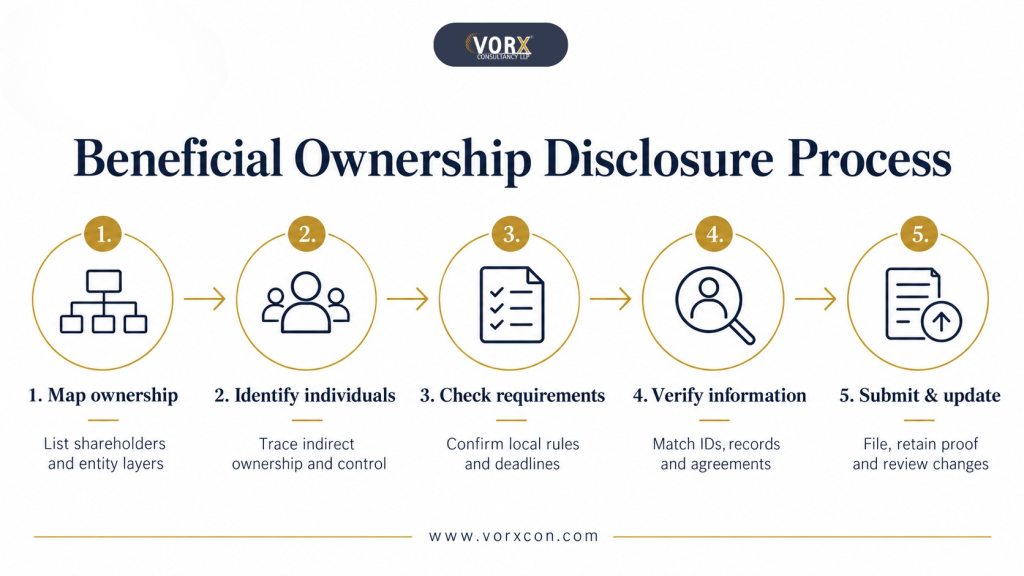
Tracing ownership through multiple companies takes more than collecting shareholder names. Vorx Consultancy helps businesses identify the individuals behind their ownership structure and prepare the information needed for a specific filing or bank review.
Our support includes mapping direct and indirect ownership, reviewing shareholding and control documents, organising identity records, and preparing a clear ownership chart. For businesses with entities in more than one country, we help coordinate the documents and disclosure requirements relevant to each jurisdiction. We can also support updates when shareholders or control rights change, so the information provided remains consistent with the company’s records.
Before you file, know exactly who must be disclosed. Speak with Vorx Consultancy
Book a Strategy Call: (Calendly Link)
Visit: www.vorxcon.com
Email: support@vorxcon.com
Final Thought
Beneficial ownership disclosure becomes more manageable when the company starts with its records rather than the form. Follow each layer of ownership until you reach the individuals behind it. Then check whether anyone else has meaningful control through voting rights, appointments or agreements.
Only after that should you apply the rules for the relevant country or respond to the bank’s specific request. Keep the ownership chart and supporting documents together, so the company can explain its disclosure if questions arise. If ownership or control changes later, revisit the assessment instead of relying on an old filing.
