


When setting up overseas, many entrepreneurs encounter the concept of nominee director for the first time. For some companies, it may be mandatory due to local corporate laws. Whereas for others, it can be an integral element of the ownership/governance structure.
The term nominee director refers to a person appointed to a company’s board of directors but who is not actually entitled to the ownership of the company. A thorough comprehension of this concept is crucial before finalizing the decision to appoint such an agent in a foreign jurisdiction company.
However, it is important to understand what a nominee director is? and what are his duties? Who needs them and when do they need them? This guide explains every term of this.
What Is a Nominee Director?
A nominee director is a person appointed to the board of directors of a company on behalf of another person. In other words, it is an individual who formally sits on the board but does not have any beneficial interest in the company. The name of a nominee director can be entered in the official documents of the company, for example, the register of members.
The above definition refers mainly to international company formation matters, where there are requirements relating to local directorships.
It is vital to make a clear distinction between the director and the beneficial owner in this case. The director is a person who is involved in the management and control of the company, while the beneficial owner is someone who effectively owns and controls the business.
Why Do Companies Use Nominee Directors?
Companies may nominate directors for specific legal, governance, or business reasons. Examples of such cases are:
- Local Director Requirements: Some countries have specific laws that require a company to have a director who will be able to meet local residency requirements.
- International Business Expansion: An overseas entrepreneur may need local support and direction at the board level when dealing with unfamiliar markets.
- Investor Representation: An investor or shareholder may need a representative on the board of directors.
- Corporate Structures: Groups of companies may appoint a professional director to act as a director of a subsidiary company.
- Business Continuity: The presence of a nominee director may be required to maintain a quorum on the board of directors while the business develops its local presence.
Set up your international business with the right corporate structure — explore Vorx Consultancy.
When Do You Actually Need a Nominee Director?
The question is not simply whether a nominee director is available, but whether there is a genuine legal or commercial reason to appoint one. You may need a nominee director when:
- Local corporate law requires a director who meets a particular residence condition.
- A shareholder or investor has a legitimate requirement for board representation.
- The company’s corporate structure requires local board-level involvement.
- A professional director is needed to fulfil genuine governance responsibilities.
On the other hand, you may not need a nominee director if another legally acceptable arrangement can satisfy the relevant requirement.
For example, depending on the jurisdiction, a company secretary, authorised representative, local manager, or another permitted structure may address a particular administrative requirement without requiring an additional director.
Recommended Reading:
Understanding local director requirements is an important part of planning an overseas company structure. Read our guide on [local director requirements for overseas companies] for more details.”
Nominee Director vs Resident Director vs Shadow Director: Are They the Same?
| Nominee director | Resident director | Shadow director | |
|---|---|---|---|
| Meaning | An appointed director who acts on behalf of a person or entity called the nominator. | An appointed director who meets the jurisdiction’s local residency requirement. | A person whose directions the appointed directors are accustomed to follow, even though that person is not formally appointed. |
| Main distinction | Describes on whose behalf the director acts. | Describes where the director resides for legal purposes. | Describes how the person influences the board in practice. |
| Formally appointed? | Yes. | Yes. | Usually no; the classification can arise from actual conduct. |
| Can the roles overlap? | Yes. A nominee may also qualify as a resident director. | Yes. A resident director may be a nominee. | A person behind a nominee arrangement could raise shadow-director questions, depending on the facts and local law. |
| Key point to check | Disclosure of the nominator and the director’s legal duties. | The jurisdiction’s residency test and director duties. | Who actually directs decisions, and what legal responsibilities that conduct may create. |
What Are the Responsibilities of a Nominee Director?
A nominee director cannot be considered only as a fiction required to satisfy a company formation requirement. A person who has been nominated by the company may have to perform the duties as the director of the company at the time of his appointment. Key responsibilities may include:
- Board Participation: Taking part in relevant board decisions and discussions.
- Document Review: Reviewing corporate documents before signing or approving them.
- Legal Compliance: Acting in accordance with applicable company laws and regulations.
- Conflict Management: Identifying and appropriately handling potential conflicts of interest.
- Corporate Governance: Supporting proper governance and maintaining appropriate oversight of the company.
- Company Understanding: Having sufficient knowledge of the company’s activities and affairs.
The fact that a director was appointed as a nominee does not automatically remove the responsibilities attached to their position.
Set up your international business with the right corporate structure — explore Vorx Consultancy.
What Are the Risks of Using a Nominee Director?
A nominee director can help a company meet local requirements, but the arrangement carries risks if the person’s authority is unclear. The nominee is a legally appointed director, so their duties do not disappear simply because they act on someone else’s behalf.
Disagreements over signing documents or approving decisions can delay operations, while incomplete disclosure of the nominator or beneficial owners can create compliance and banking problems. The company should also plan for the nominee’s resignation or loss of eligibility. A written agreement, accurate disclosures and a clear replacement process help manage these risks
Recommended Reading:
“Resident director rules can vary significantly by jurisdiction. Explore our guide on resident director requirements in Canada to understand the key considerations before incorporation.”
How to Structure a Nominee Director Arrangement Properly?
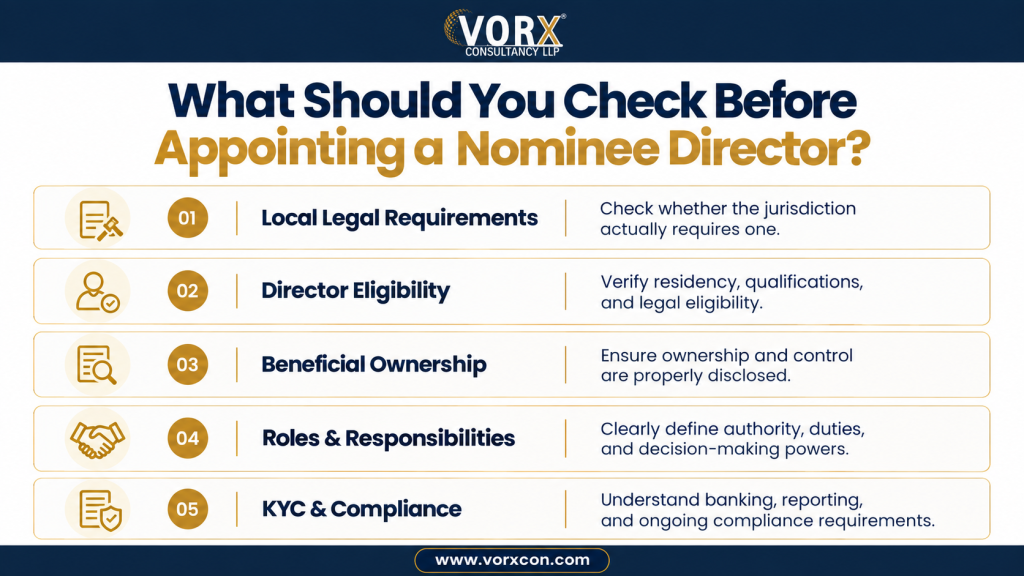
- Check Local Requirements: Determine whether the jurisdiction actually requires a nominee or resident director.
- Identify the Beneficial Owner: Ensure ownership and control information is correctly disclosed.
- Define the Role: Clearly establish the nominee’s responsibilities and authority.
- Complete Documentation: Prepare the required corporate and KYC documents.
- Establish Governance Procedures: Set clear signing and decision-making procedures.
- Understand Legal Duties: Ensure the nominee understands the responsibilities attached to the position.
- Review the Arrangement: Reassess the structure if ownership, management, or business activities change.
How Vorx Consultancy Can Help?
Determining whether a nominee director is needed is more complex than a simple review of a company formation checklist. The requirement can depend on a number of factors including the jurisdiction, company structure, ownership arrangements and local compliance requirements.
Vorx Consultancy assists entrepreneurs and international businesses to understand the requirements necessary to form a company abroad. From international company formation, corporate structuring, local director requirements, banking and ongoing compliance requirements, our team of consultants deliver end-to-end advice for businesses looking to start and grow overseas according to the requirements of the selected jurisdiction.
Get expert guidance on nominee director requirements and international company structuring with Vorx Consultancy.
Book a Strategy Call: (Calendly Link)
Visit: www.vorxcon.com
Email: support@vorxcon.com
Final Thoughts
A nominee director may be considered to be necessary for certain international company structures, but it is not necessarily the default requirement for every overseas business, depending on a jurisdiction, local director requirements, ownership structures and governance requirements.
Before appointing one, a business should understand why a nominee director is required, understand the responsibilities undertaken by the nominee, and whether a different legally permissible company structure might be a viable alternative.
