


Germany is the largest economy within the EU, and it serves as the obvious destination for Indian IT firms, exporters, and SMEs seeking entry into the European market.
Having a German presence provides you with a presence that is recognized within the EU, and which holds weight with B2B customers who tend to prefer a GmbH.
The good news is that company formation in Germany is open to foreigners. The less obvious part is that the process has a few points, such as notarisation, the bank account and residency, where non-resident founders tend to get stuck. This guide walks through the full process so you can plan around those points.
Can Foreigners Start a Business in Germany?
Yes. You do not necessarily need to be German to establish your own business. You do not even need to reside in Germany in order to own a share in any business.
Persons coming from India, entrepreneurs from the UAE, UK, USA, Singapore, Canada, and Australia can all establish their businesses in Germany.
However, owning a business is different from being employed there. If you plan to run the business from inside Germany, your residence status matters. That is covered in the next section.
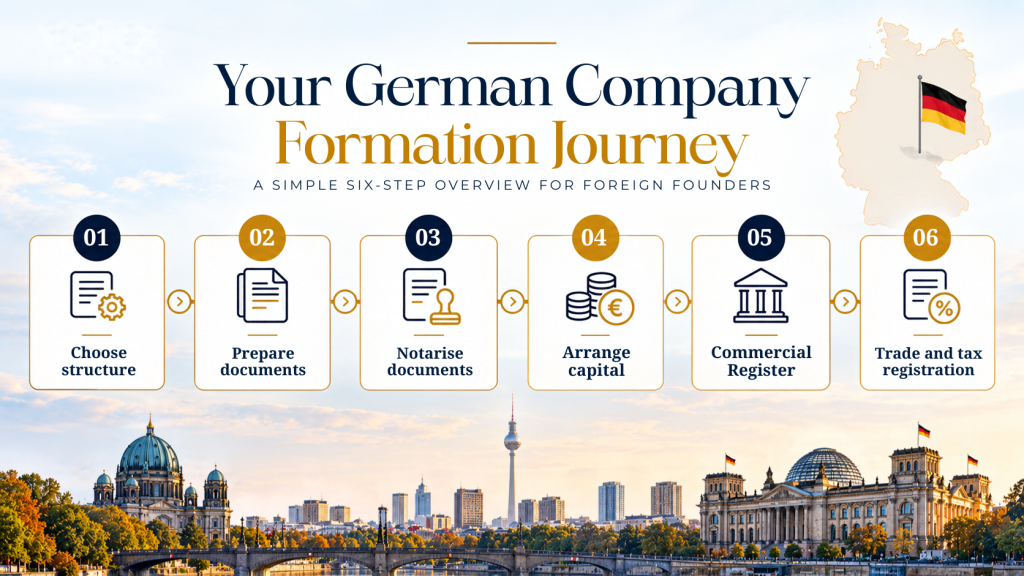
The basic path to start a business in Germany looks like this:
- Choose a legal structure.
- Draft the articles of association.
- Sign them before a notary.
- Open a formation bank account and deposit the share capital.
- Apply for entry in the commercial register.
- Register your trade and tax status.
Do You Need to Live in Germany to Register a Company?
It is not a question of developing a single strategy. In reality, there are three types of founders:
Remain abroad but with a German Managing Director: frequent practice when the company already has its own man in Germany, whom it trusts;
Remain abroad and be the sole Director: legally permitted for a GmbH, although it may complicate relations with banks and authorities.
Relocating to run the business: This generally requires a suitable residence permit.
However, there is not just one method of operation. In truth, there are three types of entrepreneurs:
Remain abroad but appoint a Managing Director who is German: this usually occurs in case a reliable individual already exists in Germany.
Remain abroad and become the sole Director: legal for GmbHs, but it may complicate matters with banks and authorities.
The EU Blue Card is designed for qualified employees, not founders, so it is often the wrong tool. EU and EEA citizens do not need a visa.
Note that owning a German business is not enough for automatic residency.
Your application is evaluated according to the business plan, the qualification of the person, and also whether the business will have any economic advantages for Germany.
It is possible to provide sufficient evidence with the help of an appropriate application.
Which Business Structure Should You Choose?
For most foreign founders, it comes down to the GmbH, the UG, or a branch of an existing foreign company.
Structure | Liability | Best for | Key point |
GmbH | Limited | SMEs, IT firms, trading businesses | Established company structure |
UG | Limited | Startups, small businesses | Lower starting capital |
Sole Proprietor / Freelancer | Unlimited | Independent professionals | Simple setup, personal liability |
Branch Office | Parent company liable | Foreign companies | Parent carries the risk |
Subsidiary (GmbH) | Generally limited | International expansion | Separate company owned by the parent |
GmbH, UG or Branch Office? Choose the Right Structure.
Not sure which German business structure fits your expansion plans? Let Vorx help you evaluate your options.
Vorx Consultancy Insight: For Indian companies expanding into Europe, we most often see the subsidiary GmbH. It keeps the German operation legally separate from the Indian parent and tends to be easier for German customers and banks to work with.
The right choice still depends on your business model, and it is worth discussing the tax implications with an adviser before you decide.
How Does Company Registration in Germany Work?
The registration of a business entity in Germany involves the following processes. Certain processes may be undertaken simultaneously, however, their sequence must be followed:
State the purpose of the business venture: This is contained in the articles of association of the company. The purpose should be stated clearly and specifically but not too limited.
Verify the company name: This process can be facilitated by the regional chamber of commerce (IHK).
Draft the articles of association (Gesellschaftsvertrag).
Sign before a notary: This step is mandatory for a GmbH or UG.
Open a formation account and pay in the share capital.
Submit to the commercial register: usually done by the notary.
Register your company at the Trade Office (Gewerbeanmeldung): that’s the business registration you usually hear about in Germany.
Register with the tax authority (Finanzamt): for a tax ID number and a VAT number (if applicable).
In actuality, it’s a multi-week process, not a multi-day one. The usual reasons for delay are lacking apostilles and translations, as well as bank onboarding for foreigners.
Planning to Register a Company in Germany?
From documentation to registration coordination, Vorx helps simplify your company formation journey.
How Do Notarisation and Remote Formation Work for Non-Residents?
The notary is often where non-resident founders lose the most time.
German law requires notarisation for a GmbH, and Germany has allowed certain company formations by video since 2022.
However, online formation generally relies on electronic identification that many non-EU passport holders cannot use. So Indian founders will often choose between two routes:
- Attending in person at a German notary.
- Signing through a power of attorney granted to someone in Germany, usually notarised in your home country.
If you have a power of attorney, then the documents which are signed outside of the country generally will require an apostille. India is a signatory to the Hague Apostille Convention, so the Indian documents are normally apostilled through the authorized body (the Ministry of External Affairs of India deals with apostillation of documents in India).
How Do You Open a Bank Account and Deposit Share Capital?
This is the classic chicken-and-egg problem. The share capital needs to be paid into a company account, but many banks prefer to open accounts only for companies that already exist, or for directors with a German address.
Founders usually solve this in one of two ways:
A formation account (Gründungskonto), opened before registration specifically to receive the capital.
A fintech or online business bank, which may be easier to open remotely.
Traditional banks can offer broader services but are often more cautious with non-resident founders. Expect detailed questions about your business model, the source of funds and your ownership structure.
Indian founders should have clear documentation of the parent company, the business activity and how the German entity will operate. Bank acceptance is never guaranteed, so it is sensible to approach more than one provider.
Don’t Let Banking Delay Your German Company.
Get guidance on formation documentation, banking requirements and the next steps for your German company.
What Is the German Business Register (Handelsregister)?
This is the officially maintained business register of Germany where details about all registered companies such as names of companies, address, purpose of business, managers, and the form of incorporation of the businesses are included.
There are two key reasons. First, a company is said to become a legal entity only after it is entered in the register. Secondly, it is checked by banks, customers, and suppliers frequently in Germany.
You can search entries through the official Handelsregister portal and the Unternehmensregister. Do not confuse it with two other registers:
- Trade Office registration: the licence-style registration of your business activity.
- Transparency Register: records the ultimate beneficial owners of the company.
What Documents Do You Need?
For individual founders and directors, expect to provide:
- A valid passport
- Proof of address
- Signed articles of association
- Any power of attorney, apostilled and translated where required
If a company rather than an individual is the shareholder, you will typically also need the parent’s certificate of incorporation, a board resolution authorising the German entity, and details of its directors and beneficial owners. These often need to be apostilled and translated as well.
Start the apostille and translation work early. It is usually the slowest part.
What Taxes and Compliance Should You Plan For?
Once registered, a German company must deal with several ongoing obligations:
Tax registration: You will receive your tax number from the tax authority when completing its application form. VAT ID becomes significant if you have business transactions within the EU.
Corporate tax and trade tax: Your tax burden varies depending on the city you conduct your business in.
Double tax treaties: The treaty between Germany and India becomes important with respect to dividends and other cross-border payments and issues of permanent establishment concerning Indian parent companies.
Accounting: You should prepare your annual accounts, get them published in the Bundesanzeiger and file entries in the Transparency Register.
Other registrations: IHK registration, employment insurance registration if you employ people, data protection regulation for IT firms and an EORI number if you import or export goods.
It would be wise to employ a German tax adviser (Steuerberater). For Indian founders, reviewing the outbound investment rules with a chartered accountant before you invest is also sensible.
How Does It Differ by Country?
The German side of the process is the same, but the home-country details differ:
India: Apostille through the MEA, plus outbound investment and FEMA considerations if an Indian company is the shareholder.
UAE: Companies from both free zones and the UAE mainland can become investors; however, the legalization of company documentation is required prior to doing business in Germany.
UK: Post-Brexit, the UK is a non-EU country, which is why UK founders fall into the non-EU route.
USA: US parents commonly use a German GmbH as an EU subsidiary. Tax structuring with advisers on both sides is important.
Singapore: Often used as an Asia-Pacific holding base for expansion into Europe.
Canada and Australia: Individual founders typically follow the same non-EU process as Indian founders.
Which Mistakes Cause Delays or Rejections?
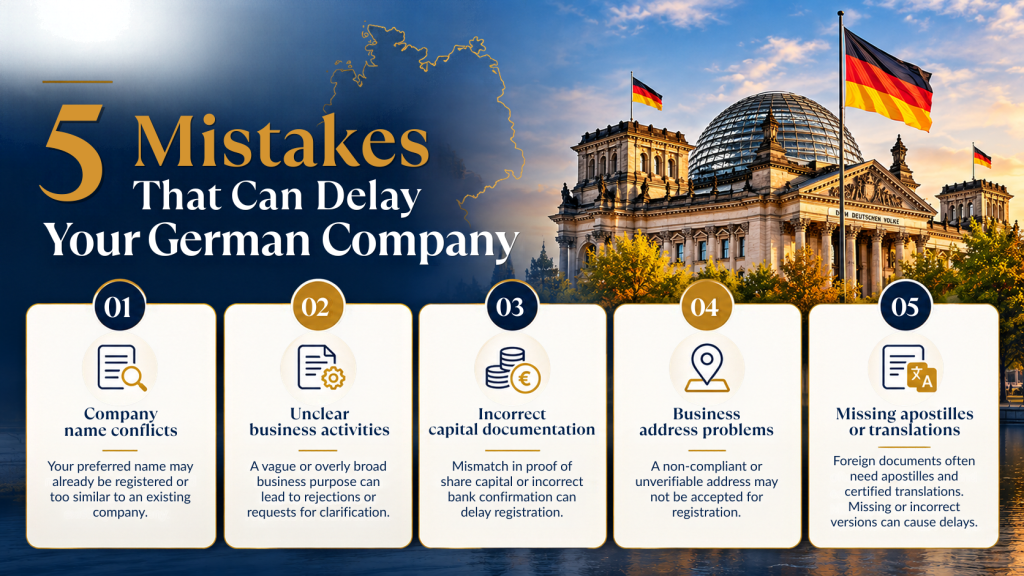
The most common problems are avoidable:
Name conflicts with existing or misleading company names.
Vague or unusual business purposes in the articles of association.
Capital proof issues, where the bank confirmation does not match what the court expects.
Address problems, including some virtual office addresses that banks or courts question.
Missing apostilles or translations.
Before submitting, have your notary or adviser check the name, address, documents and bank confirmation together, not one at a time.
Should You Use a Local Partner or Service Provider?
It is possible to handle this yourself, particularly if you have a German-speaking contact and a simple structure.
For non-resident founders, though, the coordination between notary, bank, court and tax office can become time-consuming.
At Vorx Consultancy, we help founders evaluate the right structure, prepare documents and coordinate the steps before filing.
Whoever you work with, look for a provider that explains the process openly, is clear about what it cannot guarantee, and works with German notaries and tax advisers.
Final Thoughts
The incorporation of a company in Germany is possible for foreigners who want to establish one by planning in advance the process of establishing a firm, that is by defining the legal structure of the business, collecting all necessary documentation, dealing with a notary, banking, registration at the register and tax registration.
If you are wondering whether the country is suitable for your further expansion, it would be helpful to discuss issues of business structure, residency and compliance before applying.
At Vorx Consultancy, we will be glad to assess your case and provide advice.
Ready to Expand Your Business to Germany?
Vorx Consultancy helps international founders navigate company structure selection, documentation, registration coordination and compliance planning.