
Choosing a business structure abroad is an early decision that an entrepreneur has to make when considering overseas business. This decision can shape the way the business is legally recognised, its liabilities and responsibilities, how its profits are taxed, what compliance it has to fulfil and how easily it can scale.
Two common structures that entrepreneurs consider are a sole proprietorship and a private limited company. They may seem similar as ways to operate a business, but they differ significantly in terms of legal recognition, liabilities and responsibilities, taxation, ownership and administration.
Understanding these differences is important before taking any steps towards starting a business abroad, as it will enable you to make the right choice for your specific business rather than the easiest one to set up.
What Is a Sole Proprietorship?
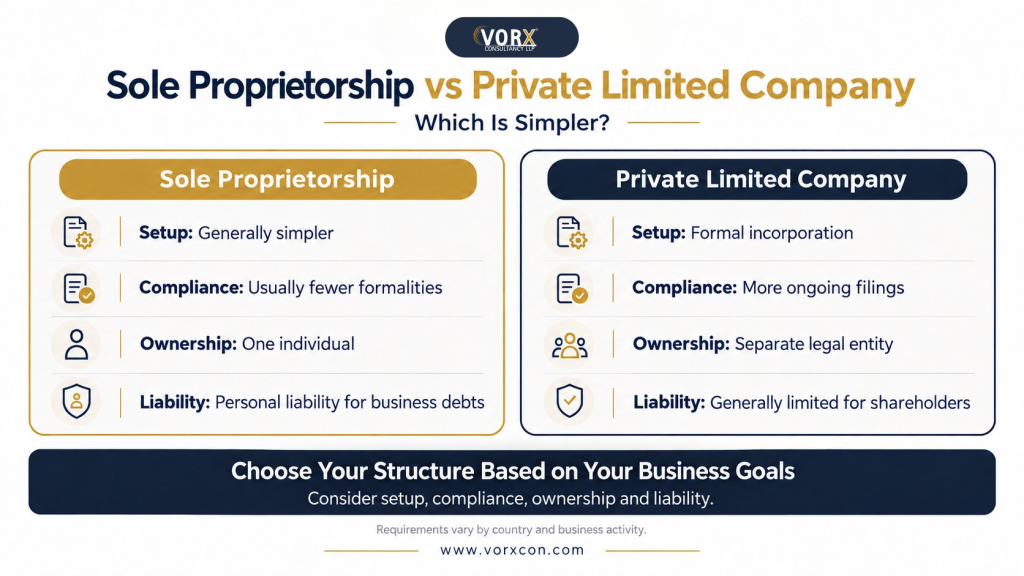
A sole proprietorship refers to a business structure that is owned and operated by a single individual. Said individual holds the primary control over the business, being responsible for its decisions, enjoying its profits and managing its operations. The appeal of such a business structure lies in its simplicity. In most cases, establishing a sole proprietorship requires less paperwork than creating a company. On the other hand, the owner and the business itself usually cannot be differentiated in terms of legal status.
This arrangement makes the owner of a sole proprietorship personally liable for its debts and obligations. The exact requirements and liabilities in terms of taxation, registration, licenses and foreign ownership will depend on the jurisdiction in which the business resides.
What Is a Private Limited Company?
A private limited company is a corporate structure that is usually created by its shareholders. It differs from a sole proprietorship in that it is a separate legal entity, capable of entering agreements and bearing liabilities in its own name.
A private limited company is typically characterized by its ownership structure that is differentiated from its management structure. In other words, while the company’s shareholders hold decision-making power, they delegate the responsibility of running the business to the board of directors.
This separation means that, in most cases, the personal assets of shareholders cannot be claimed to settle the debts of the company. In turn, a private limited company requires more organisational structure and paperwork to establish and maintain.
Ready to choose the right structure for your overseas business? Connect with Vorx Consultancy at www.vorxcon.com.
Recommended Reading:
Planning to establish yourself overseas? Understand how foreign residency can impact your Indian citizenship status.”
Sole Proprietorship vs Private Limited Company: Key Differences
The difference between a sole proprietorship and a private limited company becomes clearer when you look at how each structure affects the owner and the business in practical situations.
1. Legal Identity
Sole Proprietorship
A sole proprietorship generally does not create a separate legal entity. The business is closely connected to its owner, meaning the owner conducts the business in their own capacity.
For a small owner-operated business, this can keep the structure straightforward. However, there is less legal separation between the individual’s affairs and the business.
Private Limited Company
A private limited company generally exists as a separate legal entity from its shareholders. The company can enter contracts, own assets, open accounts and conduct business in its own name.
This separate identity creates a more formal structure and can be useful when the business is expected to operate independently of its founder.
2. Liability and Personal Risk
Sole Proprietorship
One of the biggest considerations with a sole proprietorship is personal liability. Since the owner and business are generally not legally separate, the owner may be personally responsible for business debts and obligations.
This can become particularly important when the business takes on significant contracts, loans or commercial risks.
Private Limited Company
A private limited company generally separates the company’s liabilities from those of its shareholders. Shareholders typically benefit from limited liability, subject to local law and specific circumstances.
This separation can provide greater protection for personal assets, although it does not remove every form of personal liabi
3. Taxation
Sole Proprietorship
The income of a sole proprietorship is generally connected to the owner’s personal tax position. The business may not be treated as a separate taxpayer in the same way as a company.
This can make the tax structure relatively straightforward in some jurisdictions, but the actual treatment depends on local tax rules.
Private Limited Company
A private limited company generally falls under corporate tax rules. When profits are distributed to shareholders, additional tax considerations may apply depending on the jurisdiction.
Therefore, entrepreneurs should look at the overall tax position, rather than comparing only corporate tax rates. Personal taxation, withholding taxes, dividend treatment and cross-border tax rules may also need to be considered.
4. Compliance and Ongoing Administration
Sole Proprietorship
A sole proprietorship generally involves fewer corporate formalities because there is no separate company governance structure to maintain.
However, the owner may still need to manage tax filings, licences, accounting records and other regulatory obligations. Simpler does not mean compliance-free.
Private Limited Company
A private limited company usually involves more structured compliance. Depending on the country, this may include annual returns, financial statements, statutory records, accounting requirements and corporate filings.
The additional administration can require more planning, but it creates a formal framework for managing the company.
5. Ownership and Decision-Making
Sole Proprietorship
The business is owned by one individual, who generally retains direct control over business decisions.
There is no need to divide ownership between shareholders, making decision-making relatively straightforward.
Private Limited Company
A private limited company generally has shareholders who hold ownership through shares, while directors are responsible for managing the company.
This creates a more structured decision-making process and allows ownership to be divided or changed as the business develops.
6. Investment and Business Funding
Sole Proprietorship
A sole proprietor generally relies on personal capital, business revenue, loans or other financing options.
Since there is no conventional shareholding structure, bringing in equity investors or business partners may require restructuring the business.
Private Limited Company
A private limited company has a share-based ownership structure, which can provide a clearer framework for introducing shareholders or structuring equity investment, subject to local regulations.
This can be relevant for businesses that expect to raise capital or expand with strategic partners.
7. Business Continuity
Sole Proprietorship
A sole proprietorship is closely tied to its owner. If the owner stops operating the business, continuity can become more complicated.
This can be less suitable for entrepreneurs who intend to build a business that will eventually be transferred or passed to another owner.
Private Limited Company
A private limited company generally has its own legal identity, allowing the company to continue even if shareholders or directors change, subject to applicable corporate rules.
This can make the structure relevant for businesses with long-term succession, ownership transfer or expansion plans.
Recommended Reading:
Once you choose your overseas business structure, selecting the right business bank account is another important step.”
Which Structure Is More Suitable for Your Business?
| Factor | Sole Proprietorship | Private Limited Company |
|---|---|---|
| Ownership | Single owner | One or more shareholders |
| Tax Treatment | Generally taxed through the owner | Company-level taxation may apply |
| Liability | Owner and business are generally not separate | Separate legal entity |
| Funding | Less suitable for external investment | Better suited for raising investment |
| International Expansion | Suitable for simpler operations | Often more suitable for structured expansion |
What Should You Check Before Choosing a Business Structure Abroad?
Before making a decision, consider the following:
Foreign Ownership Rules: Can a non-resident fully own the proposed structure, or are local shareholders or directors required?
Tax Treatment: How are business profits, salaries, dividends and cross-border transactions treated?
Liability Protection: What level of legal separation exists between personal and business liabilities?
Compliance Requirements: What tax filings, annual returns, accounting and corporate obligations will apply?
Banking and Operations: Can the business open a corporate bank account and operate in the way you intend?
It is also worth considering whether the structure supports your future plans. Changing a business structure later may involve additional registrations, asset transfers, contracts, banking changes and tax considerations.
Ready to choose the right structure for your overseas business? Connect with Vorx Consultancy at www.vorxcon.com.
How Vorx Consultancy Helps With International Business Setup?
Selecting a business structure abroad is only a part of the process of starting a business overseas. There are a number of additional considerations and regulations that one must be aware of and prepare for. These include, but are not limited to foreign ownership rules, company incorporation requirements, business banking and taxation compliance.
At Vorx Consultancy we assist entrepreneurs in international company formation and business setup by helping them navigate the options available to them in terms of business structures and the requirements that come with them. We provide expertise in company incorporation, business banking and compliance with tax and legal requirements for companies at various stages of development.
Planning to establish your business abroad? Connect with Vorx Consultancy
Book a Strategy Call: (Calendly Link)
Visit: www.vorxcon.com
Email: support@vorxcon.com
Final Thought
A sole proprietorship may be appropriate when starting a smaller scale enterprise, while a private limited company might be a better choice when considering a larger, more capital-intensive business. The former will probably require less paperwork to establish and run, while the latter will provide more opportunities for ownership and liability separation.
In either case, determining the appropriate business structure should be based on factors beyond ease of setup. Taxes, liabilities, legal requirements, management and ownership possibilities and future business plans are worth considering when comparing options available in the target jurisdiction.
