


You need to get into Europe, and perhaps you own an IT services firm from Bengaluru and work for German clients, or you are a seller of online products and you need an EU firm to increase the credibility of your products with the customers. The truth is, Hungary comes in the shortlist more often than not.
The quick response would be ‘yes’, because a foreign individual can have 100% ownership of a Hungarian company, and you do not require a Hungarian director.
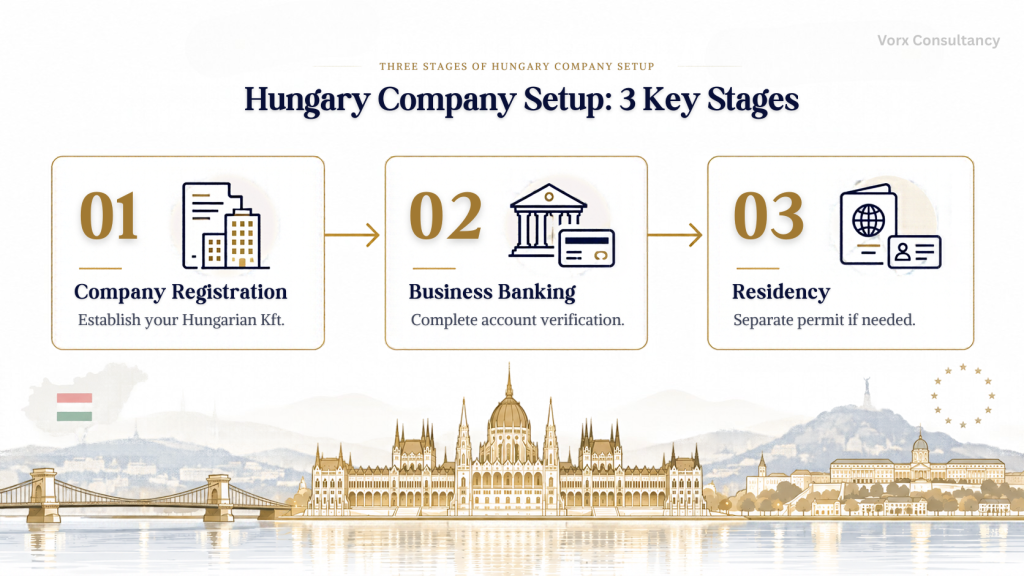
But there are three stages of company formation in Hungary, which many guides fail to distinguish among themselves.
They are as follows: forming the company itself, opening a Hungarian bank account and gaining residency in Hungary (if you wish).
Let’s look into these stages one by one, and that includes the registration changes that occurred since 2026.
Hungary Company Formation at a Glance (2026)
Factor | Details |
Company Type | Kft (Limited Liability) |
Foreign Ownership | 100% allowed |
Local Director | Not required |
Minimum Capital | HUF 3 million no need to deposit it before incorporation |
Corporate Tax | 9% |
Standard VAT | 27% |
Remote Registration | Possible with POA |
Banking & Residency | Separate processes |
Why Founders Choose Hungary for Their EU Base
The lowest corporate tax in the EU: Hungary taxes company profits at a flat 9%. The difference accumulates very fast for companies who use their profit to make investments.
True EU business address, not postbox in a tax haven: Hungary’s Kft is a fully fledged EU company, and therefore treated as such by European customers, markets and payment providers, which comes in handy when a German buyer’s purchasing department evaluates who he is dealing with.
Geographical center: Budapest is just a few hours drive from Vienna, Bratislava and Balkan countries. It means all of Central Europe is reachable via express delivery for trade and online businesses.
You maintain complete control yourself: No local partner, no nominee director. You can be sole owner and sole manager at the same time.
Expert Insight: Indian founders often compare Hungary only against Estonia’s e-Residency.
The real difference is substance. Estonia is great for a lean digital business run from India.
Hungary suits founders who want people, inventory or an office on the ground in the EU.
What Changed in 2026: The New Registration Rules
This is the part most guides haven’t caught up with. Hungary’s new Company Act, delayed several times, moved company registration to an automated procedure from January 2026.
In practice, three things change for you:
Your lawyer carries more weight: A Hungarian lawyer now certifies that your founding documents are lawful, a check a company court judge used to do.
Mistakes cost time: Practitioners report there’s no longer a stage where the court asks you to fix errors. An incomplete filing gets rejected and you start again.
Checks can come later: Authorities can inspect companies after registration, and problems can lead to fines.
The takeaway is simple: preparation now matters more than speed. Choose a lawyer who files Hungarian companies for foreigners regularly, and get your documents right the first time.
Which Business Structure Should You Choose?
Structure | Best for | Separate legal entity? | Your liability |
Kft (limited liability company) | Solo founders, SMEs, most foreign-owned businesses | Yes | Limited to your capital contribution |
Zrt (private company limited by shares) | Investor-backed or larger ventures that may issue shares | Yes | Limited |
Branch office | Foreign companies extending existing operations | No | Parent company is fully liable |
Commercial representative office | Market research and liaison only, no trading | No | Parent company is fully liable |
For most readers, the answer is a Kft. It’s flexible, a single person can own it, and it’s what Hungarian banks and authorities see every day.
Planning to Start a Company in Hungary?
Find the right business structure for your EU expansion with expert guidance from Vorx.
Example: Neha runs a 40-person software firm in Pune. She wanted to hire two developers in Budapest and invoice EU clients locally. A branch would have tied her Indian company’s balance sheet to every Hungarian contract. A Kft subsidiary kept the risk ring-fenced, so she chose that.
Requirements for Hungary Company Formation for Foreigners
What you will need is:
One or more shareholders of any nationality.
Managing Director of any nationality without having to reside in Hungary.
Seat of Registration: a Hungarian address whether that of your office or a registered seat agent.
Minimum share capital of HUF 3,000,000 in case of Kft. Share capital can either be in cash or in kind and you do not have to deposit it into a bank prior to the registration.
Hungarian lawyer: Mandatory to prepare and co-sign the founding documents.
Details of beneficial ownership: The person who owns and controls the company.
Documents Required for Company Registration in Hungary
For individual shareholders and directors: passport copy, proof of residential address and personal details (including mother’s maiden name, which Hungarian forms ask for). Directors also sign a specimen signature.
For a corporate shareholder: a recent certificate of incorporation or good-standing extract, its articles of association and a board resolution approving the Hungarian company.
Indian founders, take note: India is a Hague Convention member, so documents signed in India need notarisation and an apostille from the Ministry of External Affairs, followed by a certified Hungarian translation.
Expert Insight: Start the apostille process before anything else. It’s usually the slowest part of an Indian founder’s paperwork, and under the 2026 rules a missing apostille can mean a rejected filing rather than a quick fix.
Make Your Hungary Company Setup Simpler
Get professional support with company registration, documentation, and legal requirements.
How to Register a Company in Hungary: Step by Step
Choose structure and activities (remote): Choose Kft or some other structure, and state your business activities using Hungarian TEÁOR codes. Some types of activity require an additional license, for example, financial services and food processing.
Choose the company name (remote): The name should be unique and end with the chosen legal form, such as “Brightpath Kft.”
Get the registered seat (remote): You should sign the contract or agreement regarding the registered seat. Remember to include post handling service since official letters are delivered there.
Sign the deed of foundation /articles of association (remote): Your lawyer prepares the deed of foundation (one owner) or the articles of association (several owners), and you sign it in front of a notary public in person or through a power of attorney signed before the notary public.
File electronically (lawyer): Your lawyer submits everything to the company registry.
Receive your tax numbers (automatic): On registration, the National Tax and Customs Administration (NAV) issues your tax number, statistical number and, where applicable, an EU VAT number.
Register with the Chamber of Commerce within five business days (remote, via your provider).
Open a bank account (often needs a meeting): More on this below.
Register for local business tax and appoint an accountant (remote): Do this before your first invoice.
Incorporation can move quickly once documents are complete. Being ready to trade, with a bank account and invoicing set up, usually takes longer. Plan for both.

Can You Set Up a Hungarian Company Remotely?
Yes, mostly. All steps except steps 8 and 10 can be done from India, or anywhere else, through a power of attorney.
The bank account is the exception. Many Hungarian banks still want to meet the director in person or over a recorded video call. If you plan one short trip, plan it around the bank.
Opening a Corporate Bank Account as a Non-Resident
After all, this is when most non-Hungarian entrepreneurs find themselves stuck. Hungarian banks adhere to strict EU laws against money laundering, and a newly created company under the ownership of someone from abroad, without any staff or clients in the country, is automatically considered a risk factor.
Two main options to consider:
Regular Hungarian banks, like OTP, Raiffeisen, and MBH: Good for credibility and local transactions, but prepare for a lot of questions and in-person interviews.
EU-based payment institutions like Wise Business or Revolut Business: Quick and easy to create an account with, good for when you’re waiting to open a traditional account.
Reasons for your application to get declined might be no business connection to Hungary, a corporation director, unknown sources of funds, or a high-risk industry such as cryptocurrency.
What helps: a short business plan, signed or draft contracts with EU clients, proof of where your capital came from, and a real registered office.
Expert Insight: Treat the bank meeting like a client pitch. Founders who arrive with a one-page summary of who they’ll sell to, and in which currencies, get approved far more smoothly than those who simply bring their passport.
Need Help With Hungary Business Banking?
Vorx can guide you through banking requirements, documentation, and account application preparation.

Residence Permits: Owning a Company Isn't Living Here
This surprises many non-EU founders. Being offered an EU company from a Hungarian firm does not entitle you to stay in Hungary. Should you wish to move, a separate visa is required.
Self-employment residence permit for guests: most common choice for those working for themselves in Hungary.
White Card: designed for remote workers employed or running companies outside Hungary.
Guest Investor permit: a separate investment-based route, worth a look if you plan to invest in Hungarian real estate funds.
Hungary's Tax System in Plain Terms
Corporate income tax: 9% on profits.
KIVA (small business tax): an optional regime taxed on a different base that includes payroll. It can suit IT and service companies with large teams; ask your accountant to compare both.
Local business tax (HIPA): charged by the municipality, up to 2% of adjusted revenue. Founders often forget this one.
VAT: 27% standard rate: If you sell to consumers in other EU countries via the internet, then the EU One-Stop-Shop (OSS) enables reporting of VAT in all EU countries using one tax return.
Real-time invoicing: All invoices have to be reported to NAV via its Online Számla system, which requires proper invoicing software from the start.
Dividends to Indian owners: India and Hungary have a Double Taxation Avoidance Agreement. Get advice on which rate applies to you before your first payout.
Your First 90 Days After Registration
- Register with the Chamber of Commerce (within five business days)
- Register for local business tax with your municipality
- Appoint a Hungarian accountant
- Set up Online Számla-compliant invoicing software
- Open your bank account and pay in share capital if contributing cash
- Register as an employer before your first hire
Another thing: If you have to change your address or activities then it will require changes in your registration documents through your lawyer. Choose them carefully in the beginning.
Common Mistakes Foreign Founders Make
- Taking a White Card while planning to own a Hungarian company.
- A bank account to be opened the same week as the company’s incorporation.
- Documents without apostille or certified translation.
- Ignoring local business tax and Online Számla until the first invoice is due.
- Picking an online location which does not forward official correspondence.
Conclusion:
Hungarian company registration becomes an easy process if you are able to distinguish the three components that move within it: the company itself, the bank account, and the residence route.
Get the documents right first time, prepare properly for the bank, and pick your permit before you incorporate.
Do that, and you’ll have a low-tax, fully owned EU company working for you. If you’d like help with any step, book a consultation with our team.
Ready to Establish Your Business in Hungary?
From company formation to banking preparation and ongoing compliance, Vorx helps you navigate your international business setup.
