
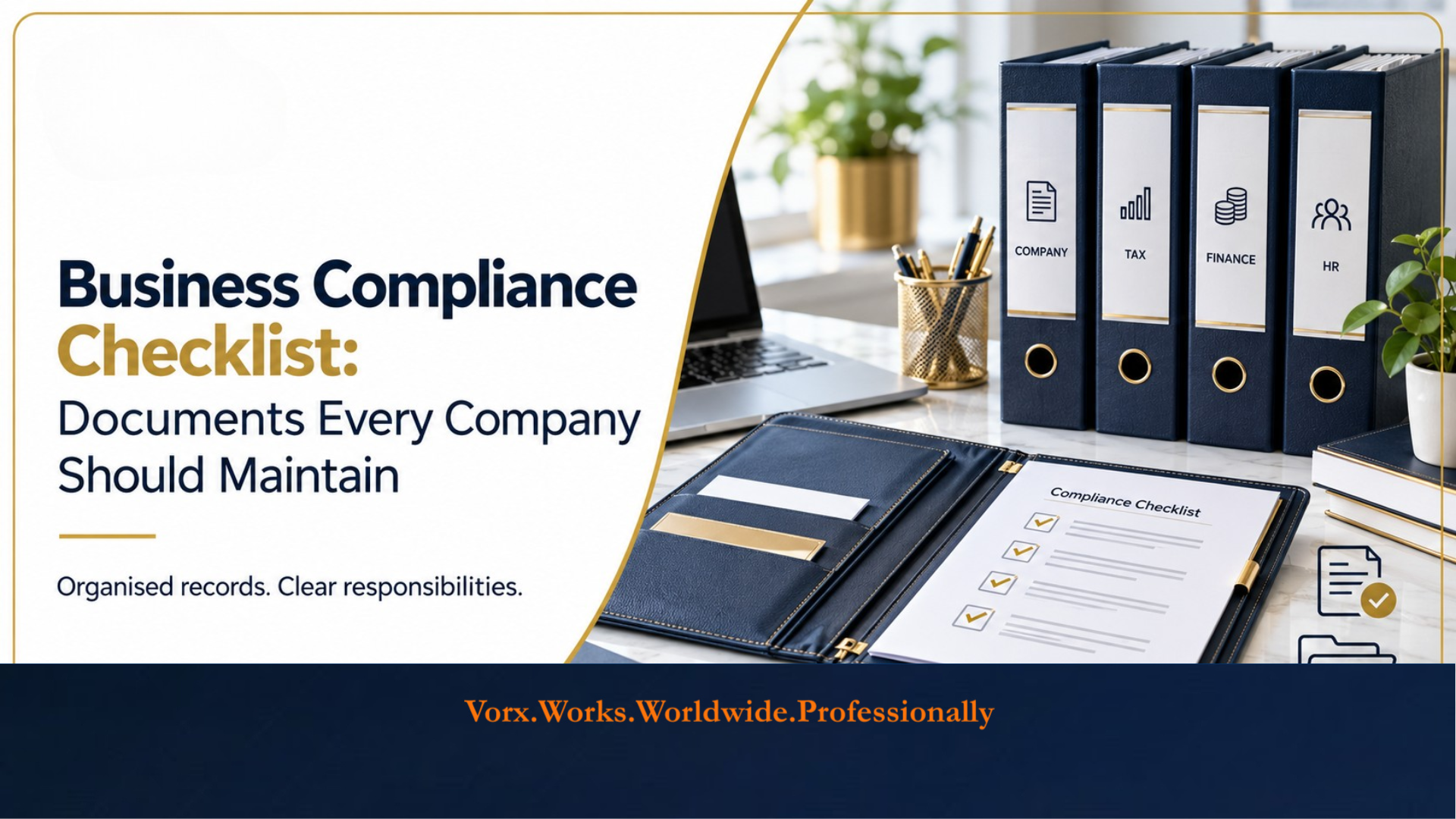
Missing documents can cause problems during a bank review, tax inquiry, licence renewal or investor meeting. In cases where a business has fulfilled its obligations, but the records are not complete, it can be difficult to prove this.
A business compliance checklist helps organise the evidence to back up the operations of a business. Rules differ in different countries, industries and company structures, so adjust the following categories to a particular organisation.
Company, Ownership and Statutory Filing Records
Keep your certificate of incorporation, constitutional documents and evidence of your registered address. It is important to show the date of incorporation, the constitution of the company’s governance and the registered address of the company.
Keep updated records of your shareholders in case of a shareholder change or director appointment, and of beneficial ownership disclosure if applicable. Store your annual returns and other statutory filings together with their submission acknowledgements.
Why are these records important: To show the existence of the company, its ownership structure and filing submissions. In the event of a change of ownership, make sure that the internal records, the required disclosure in the appropriate registry and/or the bank information are up to date.
Identify gaps before your next filing or bank review. Book a consultation at www.vorxcon.com.
Business Licences, Permits and Industry Requirements
Retain your relevant business licences, trade licences, professional approvals and premises permits. You may also be required to meet health, safety, environmental and/or industry requirements depending on the nature of your activities.
For each licence, keep the renewal receipts and the approval conditions together and note the activities which it allows, its expiry date and who is responsible for renewal.
Why are these records important: The importance of these records lies in the fact that they allow you to prove that your operations are approved by the relevant authorities. When you are introducing a new service or when there is a change of location, you must ensure that your new activities are included in the approvals; merely having incorporated is generally not enough.
Tax Registrations, Returns and Payment Records
Arrange the corporate tax, GST/VAT and employer tax registrations that apply to your situation and retain the returns you have filed together with the calculations. Save the payment receipts, records of refunds and all correspondence with the tax authorities. In cases where this is relevant, include the withholding certificates, tax residency certificates and the supporting documents needed for treaty claims. Ensure that the figures reported match up with your invoices and other transaction records.
Why are these records important: The importance of these records lies in the fact that tax compliance records show how the liabilities were calculated and settled. While a return indicates what was reported, the supporting documents can be used to verify these figures when a tax review takes place.
Recommended Reading:
For a clearer distinction between tax obligations and company-level responsibilities, read our guide to tax compliance vs corporate compliance.
Accounting, Financial and Banking Records
You should retain your sales invoices, supplier bills, expense receipts, ledgers, bank statements and reconciliation records. If appropriate, include the financial statements, the asset and inventory registers, the loan agreements and the audit reports. In the case of international payments you must keep the remittance evidence together with the relevant foreign exchange records. Ensure that the shareholder capital contributions are clearly separated from the loans.
Why are these records important: The importance of these records lies in the fact that they explain the source of the funds, the reason why the company is making the expenditure, and how it accounts for the transaction; a bank statement confirms a payment, whereas the relevant invoice or agreement gives an explanation of the transaction.
Identify gaps before your next filing or bank review. Book a consultation at www.vorxcon.com.
Employee and Payroll Documents
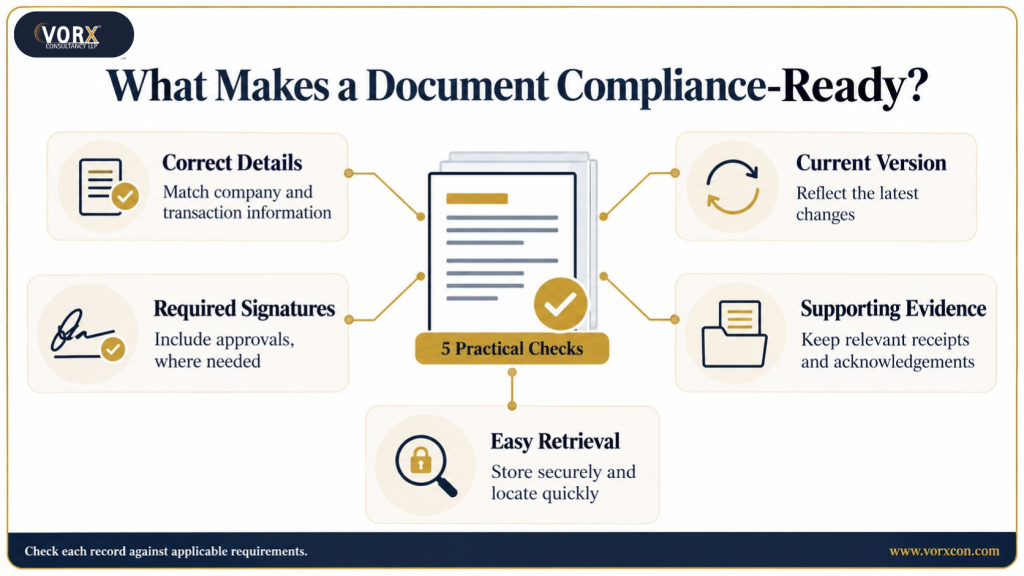
Maintain your signed employment contracts, identification and work authorisation if applicable. Keep attendance, leave and payroll records, together with your payslips and proof of salary payments. Document salary increases, bonuses, deductions, reimbursements and final payments. Keep applicable pension, social security and payroll tax records and restrict access to these, if applicable.
Why are these records important: To support employment terms and salary calculations. The contracted pay, payroll figures and bank payments should be reconciled, with documented explanation for variations.
Contracts and Corporate Decision Records
Keep your executed customer and supplier agreements, leases, insurance policies and intellectual property contracts where applicable. Attach the amendments so that the latest obligations and renewal terms are clear. Keep your board minutes, shareholder resolutions and delegated signing authorities, if applicable. Document approvals of borrowing, dividends, major purchases and ownership changes.
Why are these records important: Contracts describe the commercial obligations, while the corporate decision records show who authorises significant actions. Together, they help to resolve disputes over payment terms, responsibilities and signing authority.
Identify gaps before your next filing or bank review. Book a consultation at www.vorxcon.com.
Data Protection and Privacy Records, Where Applicable
Evaluate the privacy requirements that apply to the customer, employee, and website user information which you hold. The documents that are relevant here could be the privacy notices, the processing inventories, the processor agreements, and any evidence of consent where consent is obtained. Ensure that you keep records of any breaches and have documented retention and deletion procedures in place. Also check how the information is transferred between the online forms, your CRM system and the other processors.
Why are these records important: The importance of these records lies in the fact that they allow you to explain the personal information you collect, the purpose for which it is collected, who is authorised to have access to it and how it is protected; furthermore, the collection of leads also brings with it the responsibility of managing that information.
Recommended Reading:
To prioritise gaps identified during your document review, explore how a compliance risk assessment can help evaluate areas needing attention.
When Should You Review Your Compliance Documents?
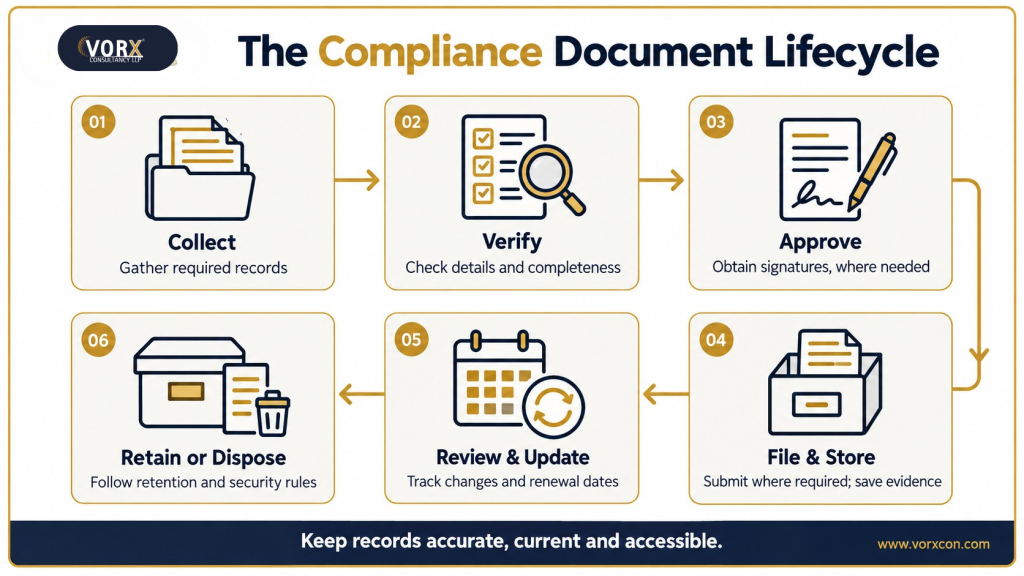
Compliance documents need regular attention because business details, transactions and obligations change over time. Scheduled reviews help identify missing records, outdated information and approaching renewals.
Review timing | What to check |
Monthly | Invoices, bank reconciliations, payroll and payment evidence |
Quarterly | Missing records, upcoming filings and licence renewals |
Before annual filings | Financial statements, tax calculations and statutory records |
After business changes | Ownership, directors, staff, address and activity-related documents |
Before bank or investor reviews | Company documents, ownership details and source-of-funds evidence |
When regulations change | Affected registrations, policies and reporting requirements |
Annually | Retention periods, access permissions and secure backups |
Identify gaps before your next filing or bank review. Book a consultation at www.vorxcon.com.
How Vorx Helps With Business Compliance
Vorx offers assistance with the annual filings in India and abroad, tax residency, banking and cross-border compliances and the reporting of foreign assets and entities where applicable. For businesses that operate in multiple jurisdictions, this service is streamlined since these requirements can be different in each region.
A compliance review can detect the missing documents, clarify the upcoming requirements and appoint the responsible parties for these tasks. This process makes the management of an existing business easier, since it provides documentary evidence for a number of procedures. For instance, an organised set of documents clarifies the terms of a supplier contract and explains the rationale behind any financial liabilities identified by an auditor.
Are Your Company’s Compliance Documents Up to Date? Identify missing records and prepare for upcoming filings, renewals and banking reviews with Vorx.
Book a Strategy Call: (Calendly Link)
Visit: www.vorxcon.com
Email: support@vorxcon.com
Final Thought
Business compliance records is a continuing practice, since a certificate, contract or return can only be as effective as the documentary evidence that supports it. Having the records ready also aids the collaboration between a business owner, accountant, employees and advisers.
The compliance review starts from the verification of the relevant documents for ownership, permits, transactions and filings. After identifying the gaps and assigning responsibilities, create a schedule to maintain these records. This way, the documents will be organised and easy to locate in case of an audit or a shareholder inquiry.