
Setting up a business is often associated with the registration of an entity or choosing of its name. For some business models, depending on their structure and location, additional legal aspects may appear. This is the point at which it is worth learning the subtleties of the different types of licence required.
Indeed, although they are often used interchangeably, for businesses in specific locations these two notions can entail significantly different obligations. Knowing what type you are dealing with will contribute to a hassle-free experience when it comes to getting approval to start operating.
What Is a Business Licence?
A business licence is a permit issued to a company to allow it to engage in a certain range of activities that require authorisation under law. This includes all aspects of legal, organisational and industry-specific requirements that the owner should fulfil before initiating operations. Thereby, depending on the type of activity and the regulations of local governmental authorities, an enterprise may be required to obtain a particular type of licence.
Although it plays a critical role in authorising a company’s operations, one should distinguish a business licence from a company’s registration. Indeed, the latter is needed to legalise the existence of an entity where this is required by law. Depending on the type of activity and its accompanying threats to public safety and order, one may need to provide several types of documentation and obtain a variety of permits in order to operate.
For guidance on your international business plans, contact Vorx Consultancy.
What Is a Trade Licence?
A trade licence is a permit that allows an entity to do specific types of commerce within the framework of authorisations established by law. In other words, the documents that trade licence refers to should be provided for any organisation to operate on the basis of the relevant legislation. These authorisations are usually issued for similar types of business activities, based on the characteristics of the goods and services that companies deal with, and their premises.
In addition to meeting the standard set of requirements for running a business, an organisation that has selected retail trade as its primary activity may need to obtain a number of additional permits. For example, one may need to provide documentation both for the right to engage in commercial activity in general and for the right to sell specific goods. At the same time, the nuances of this concept often vary depending on the jurisdiction. Therefore, the term itself covers a variety of activities that an enterprise must undertake in order to operate.
Business Licence vs Trade Licence: Key Differences
The main difference lies in the scope of authorisation and how the relevant laws define each term.
Basis | Business Licence | Trade Licence |
Purpose | Authorises specified business operations | Authorises a particular trade or commercial activity where applicable |
Scope | May cover general or regulated business activities | Often relates to a specific trade or activity |
Requirements | Depend on the business model and regulations | Depend on the trade and applicable licensing rules |
Applicability | Varies by jurisdiction and industry | Varies by jurisdiction and type of trade |
These terms can overlap, and some jurisdictions may use one term instead of the other. Neither licence automatically replaces additional approvals required for regulated activities. Businesses should therefore focus on the permissions required by law rather than relying only on the licence name.
For guidance on your international business plans, contact Vorx Consultancy.
Business Licence vs Trade Licence: Real-World Examples
Consider how licensing needs may differ across common business models:
- Consultancy firm: May need business registration and relevant professional or regulatory approvals if its services fall within a regulated sector.
- Retail business: May require authorisation to conduct commercial activities, along with additional permissions for specific products or premises.
- Restaurant: May need a business or trade licence, food safety approvals and other premises-related permissions.
- International trading company: May require commercial authorisation, customs-related registration or product-specific approvals, depending on the goods and markets involved.
These examples are illustrative. The actual requirements depend on local law, the activities performed and the nature of the products or services offered.
Recommended Reading:
Before applying for a business or trade licence, review this compliance checklist for registering a company abroad to understand licensing, documentation and ongoing regulatory requirements.
Does Your Business Need Both Licences?
An organisation may not need both documents, since a single licence often provides coverage for a range of activities. It is necessary to clarify which authorities apply to which activity and whether one document suffices to cover all operations.
At the same time, there are also limitations related to the industry, the products that a company sells or the services it provides, and specific local requirements that must be complied with. Consequently, before taking any steps, it is vital to formalise a list of all permits and approvals required for a particular type of business in a specific location.
For guidance on your international business plans, contact Vorx Consultancy.
Business Licence vs Trade Licence: How Requirements Differ Across Countries?
Business licensing requirements vary from one country to another because each jurisdiction has its own rules for company registration, commercial activities and regulatory approvals. Some countries use a trade licence as the main authorisation for conducting business, while others require businesses to obtain specific licences or permits based on their activities.
Licensing factor | How Requirements May Differ |
Licence terminology | The same authorisation may be called a business licence, trade licence, operating permit or commercial licence. |
Issuing authority | Applications may be handled by national regulators, local authorities, municipalities or industry-specific departments. |
Business activity | Retail, consultancy, manufacturing and financial services may have different licensing requirements. |
Additional approvals | Businesses dealing with food, healthcare, imports or regulated products may need separate permits. |
Renewal and compliance | Validity periods, renewal procedures, reporting obligations and fees depend on local regulations. |
Recommended Reading:
Before applying for business licences, it is important to understand the legal documents that establish a company. Read our guide on what a Certificate of Incorporation is to learn about its purpose and role in business registration.
How to Identify and Apply for the Right Licence?
Choosing the right licence entails the understanding of your business activities and the identification of the applicable regulations. Prior to submitting an application, there are several key steps to take into account:
- Define your business activity: Clarify the products or services you intend to offer.
- Check local regulations: Identify the relevant licensing authority and its requirements.
- Confirm the required permissions: Determine whether you need company registration, a business licence, a trade licence or additional permits.
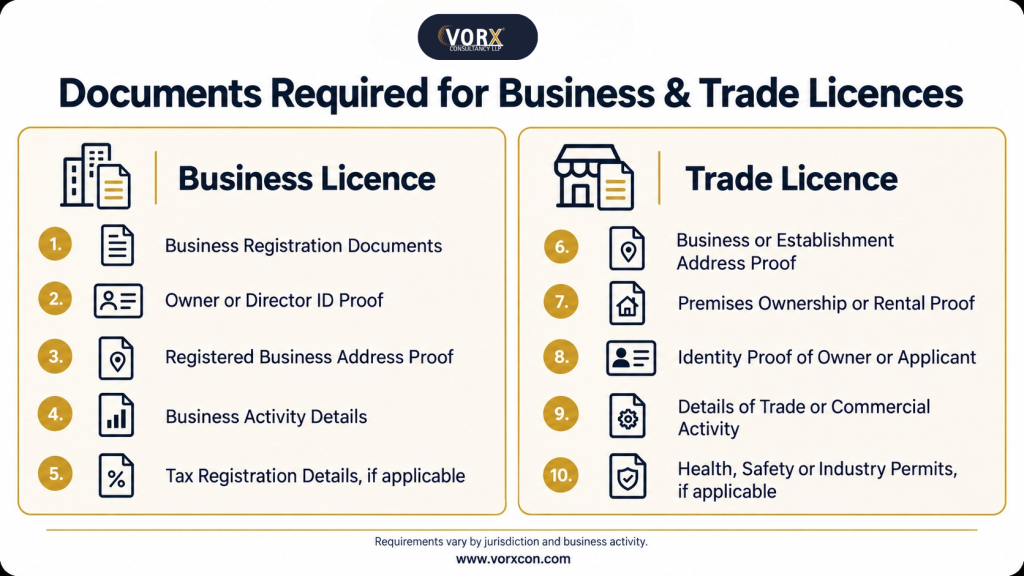
- Prepare the documents: Depending on local rules, you may need to provide identification, incorporation records, premises details and supporting approvals.
- Review fees and renewals: Check the application costs, processing requirements, licence validity and renewal deadlines.
By taking these steps prior to launching your operations, you can help prevent avoidable difficulties and compliance issues.
For guidance on your international business plans, contact Vorx Consultancy.
Common Licensing Mistakes to Avoid
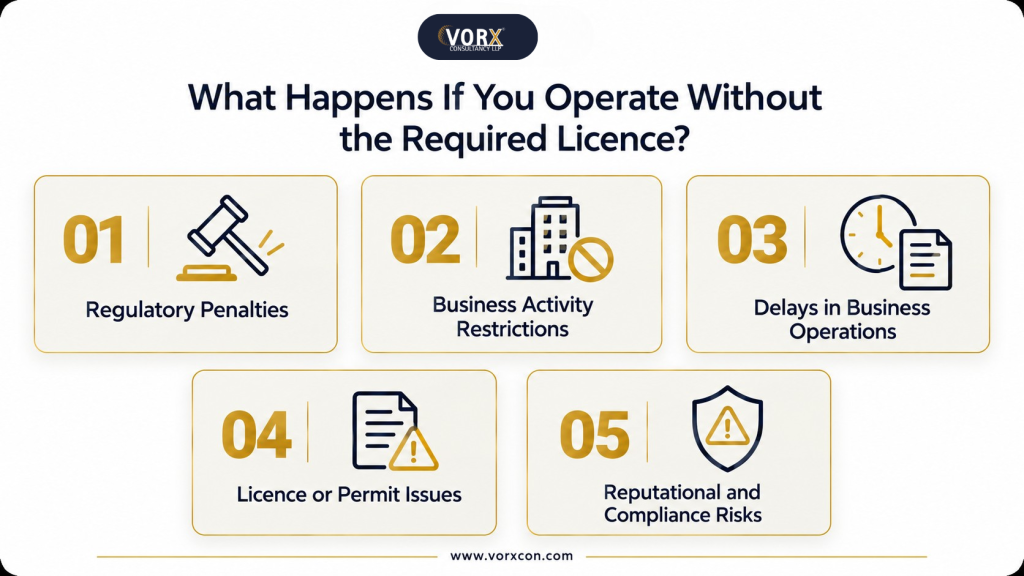
Licensing mistakes can delay a business launch and create unnecessary compliance costs. Many of these problems arise when business owners assume that one registration covers every legal requirement. Some common mistakes include:
- Confusing registration with licensing: Company registration does not automatically authorise every business activity.
- Assuming both licences are always necessary: The requirement depends on the jurisdiction and the applicable licensing framework.
- Overlooking additional approvals: Certain industries, products and premises may require separate permissions.
- Ignoring renewal deadlines: Expired licences or failure to meet licence conditions can affect business operations.
How Vorx Consultancy Helps You Navigate Business Licensing Requirements?
Setting up a business means that the entrepreneur needs a wide range of documents both for the setup of a business and for its ongoing operations. As an international consultancy, Vorx Consultancy advises entrepreneurs on company setup and helps comprehend the various requirements for taxes and duties and compliance obligations.
Vorx Consultancy assists entrepreneurs in every step of setting up a venture both locally and abroad. By contacting the experts at Vorx Consultancy , one can get advice on the most optimal way of company registration in accordance with the selected market. The specialists also provide consultations on the process of starting a business in a foreign country, considering the specific requirements of local and international laws.
Need Help Understanding Business Licensing Requirements? Connect with Vorx Consultancy for Expert Guidance.
Book a Strategy Call: (Calendly Link)
Visit: www.vorxcon.com
Email: support@vorxcon.com
Final Thought
Being aware of the distinction between a business licence and a trade licence can help you differentiate between the appropriate authorisation for your activities and prevent compliance issues. As licensing criteria may vary from country to country, industry and local jurisdictions, it is vital to identify the applicable rules before starting operations. By identifying the required permissions and ensuring your documents are well-maintained, you can build your foundation and support the development of your business.
