

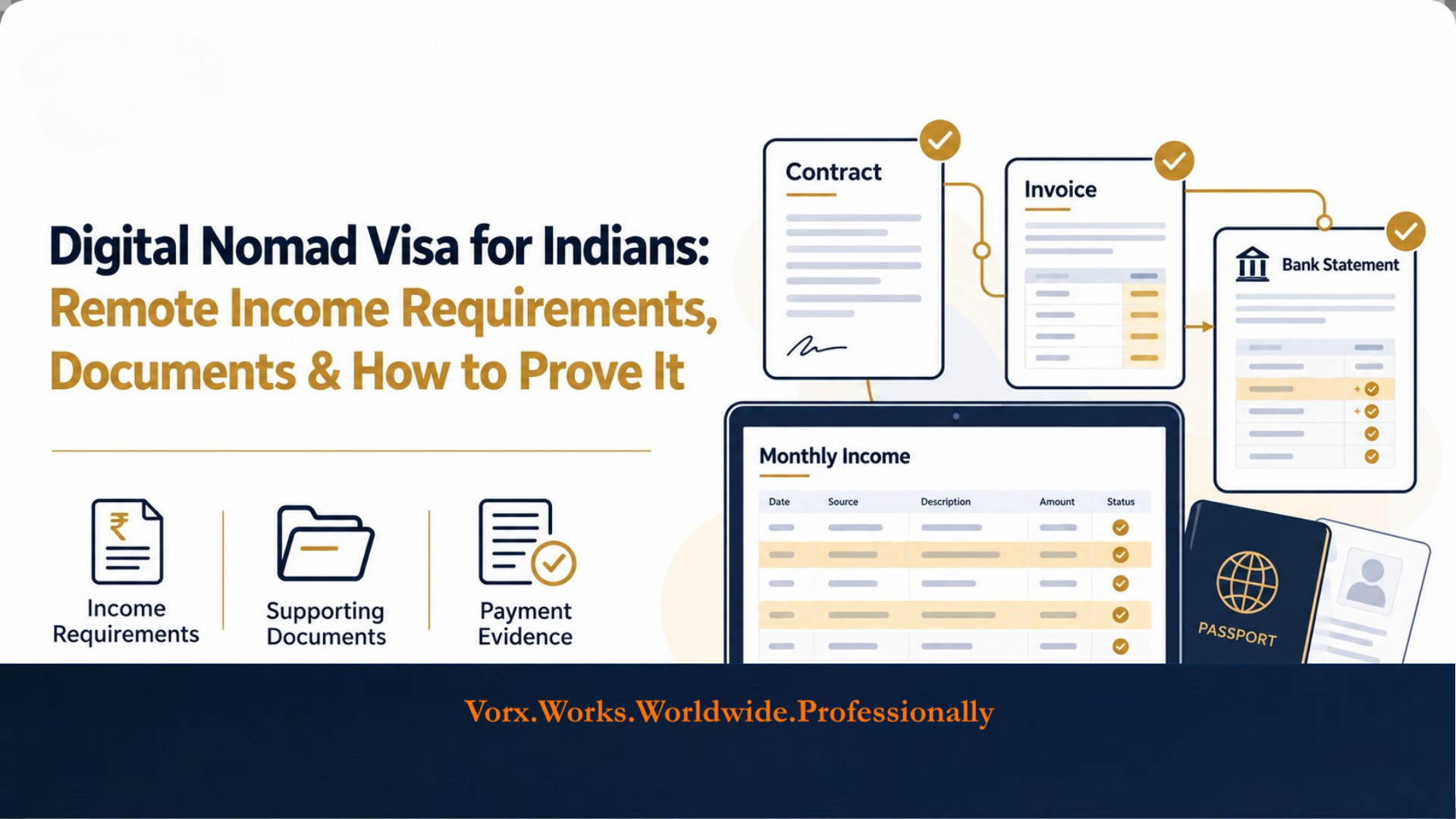
Working remotely from a different region is becoming popular for Indian professionals, freelancers, consultants, and entrepreneurs. A digital nomad visa typically allows qualifying foreigners to reside in another nation while working remotely for an overseas company or clients, depending on the specific entry requirements of the given country. However, simply having a remote job or an offshore employer paying in Indian Rupees (INR) does not always constitute approval for such a long-term visa application. Some sort of connection between the worker and the nation where they physically reside during their employment should be evident.
Understanding the intricacies of the digital nomad visa requirements and preparing one’s income proof accordingly can improve an Indian applicant’s chances of success on their first try and save them from extra hassles of resubmission.
Ready to take your business beyond borders? Explore company formation, banking support and compliance services with Vorx Consultancy
What Is Remote Income?
Remote income is money earned through work that can be performed outside a traditional office. For digital nomad visa applicants, the eligibility of that income depends on the destination country’s immigration rules. Common sources include:
- Remote employment: A regular salary from a company that permits you to work remotely.
- Freelance income: Payments from international clients for services such as software development, writing, design, or digital marketing.
- Consulting income: Professional fees earned through ongoing or project-based consulting agreements.
- Business income: Earnings from a business operated remotely, provided the relevant visa permits that activity.
For Indian applicants, it is important to distinguish between money earned from eligible remote work and passive income from investments, rent, or savings. These sources may be treated differently under individual visa programmes.
Why Must You Prove Remote Income?
Countries offering digital nomad visas generally want evidence that applicants can support themselves without relying on unauthorised local employment or public assistance. Income proof may help immigration authorities establish:
- Whether you meet the programme’s minimum income requirement.
- Whether your remote employment or business activity is genuine.
- Whether your earnings are sufficiently regular and sustainable.
- Whether your declared income matches your supporting financial records.
Ready to take your business beyond borders? Explore company formation, banking support and compliance services with Vorx Consultancy
Recommended Reading:
Before preparing income proof, understand the eligibility criteria, application process, and key requirements for a digital nomad visa for Indians
Which Documents Prove Your Remote Income?
Prepare evidence around your actual working arrangement:
Your profile | Work evidence | Financial evidence |
Remote employee | Employment contract and remote-work confirmation | Payslips and corresponding salary credits |
Freelancer | Client agreements showing services and payment terms | Invoices, payment receipts and bank credits |
Business owner | Ownership records and evidence of active business activity | Records explaining income received personally |
An Indian income tax return or Form 16 may support the explanation of past earnings where relevant. However, neither necessarily establishes your current monthly income or permission to continue working abroad.
Recommended Reading:
If you work with international clients or manage a location-independent business, explore the different remote work visa options for freelancers and digital nomads to understand which pathway may suit your work arrangement.
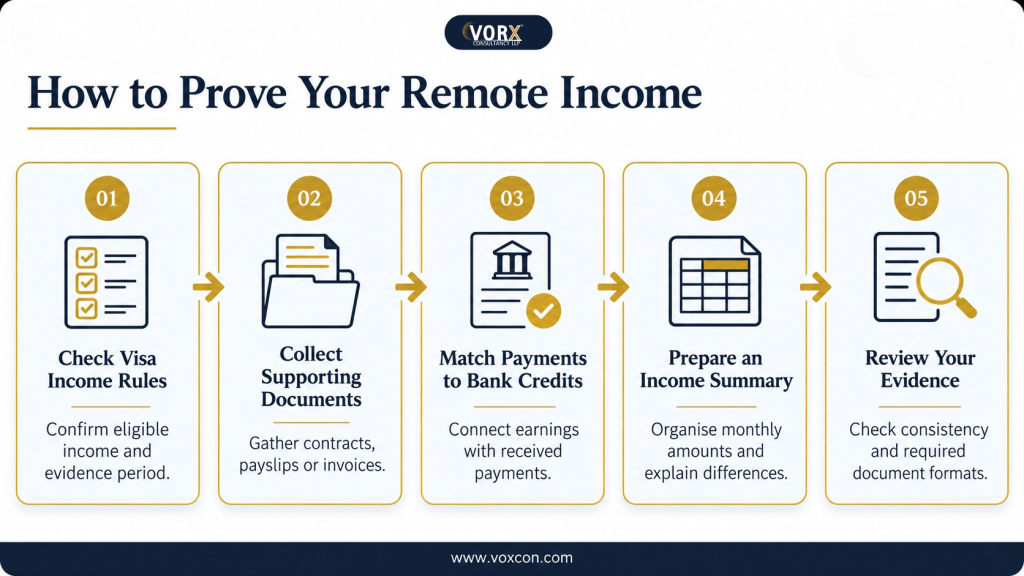
How to Connect Contracts, Invoices and Bank Credits
Ensure that there is a paper trail from the agreed work and payment terms to the actual income received.
In case of a freelancer, a contract between the client and the applicant outlines the scope of work and payment terms. The invoice represents the total sum owed to the freelancer, while the receipt and the bank statement indicate the actual income received.
For Example, an Indian freelance designer offers her services to a UK-based company for £1500. The bank statement, however, shows a lesser amount in INR due to currency differences and transfer fees.
To clarify the discrepancy, supporting documents, such as the client agreement, invoice, receipt from the payment processor, and the bank credit statement, can be submitted. In this case, the payment processor receipt and the bank documents illustrate the commercial intent between the parties and justify the difference between the invoiced amount and the actual income received.
A useful payment tracker includes:
- Client or employer name.
- Invoice or payslip reference.
- Payment date and original currency.
- Amount credited and any deductions.
Ready to take your business beyond borders? Explore company formation, banking support and compliance services with Vorx Consultancy
How to Prove Irregular or Multiple Income Streams
Freelancers, consultants, and entrepreneurs may earn different amounts each month. This does not automatically mean their income evidence is weak, but unexplained fluctuations can make it harder to assess their financial position. To present irregular or multiple income streams clearly:
- Provide contracts and payment records for each significant client.
- Prepare a monthly income summary covering the required period.
- Explain gaps between projects, seasonal changes, or delayed payments.
- Separate client payments from personal transfers and reimbursements.
- Include tax returns or business financial statements where relevant.
If you operate a business, remember that total turnover is not necessarily the same as personal income. Clearly distinguish business revenue, operating expenses, and personal earnings whenever the application requires this information.
What Makes Remote Income Evidence Strong?
Applicants can have varying income streams for different clients. This is not an indicator of weak or insufficient income evidence; instead, irregularities between income brackets may be a complicating factor in some cases.Prior to the visa application, it is necessary to establish that:
- Present the income statements, which represent the total monthly income for the relevant period.
- Report the irregularities in the income brackets and justify the variations in payments.
- Differentiate the amounts transferred to the applicant in case of multiple income streams (client to contractor, reimbursement, etc.).
- Submit the tax documents, which may further explain the income differences.
- If the applicant reports to be in the business ownership structure, ensure that the total revenue is not mistaken for personal income. Explain the revenues, costs, and expenses in detail if applicable.
- List all the relevant agreements with clients and track the payments according to the source.
Ready to take your business beyond borders? Explore company formation, banking support and compliance services with Vorx Consultancy
Common Income-Proof Mistakes to Avoid
Indian applicants should not attempt to submit single bank statements. with no explanation or supporting documents, rely on unsigned agreements, or provide invoicing documents without evidence of payment. Business owners who base their income on their turnover and not direct wages should also seek advice on the difference between the two.
Among the typical errors, it is possible to highlight failure to account for currency differences and to provide the necessary translation of income-related documents for the target country’s visa office, and the submission of income statements in which discrepancies can be found. Apart from these instructions provided by the responsible authority, Indian remote workers and entrepreneurs should double-check the document list against the most recent guidelines issued by the visa office in their target country.
How Vorx Helps Prepare Your Income Evidence
Vorx Consultancy can advise candidates and business owners in regard to various residency and business immigration matters. We can examine the particularities of your target country’s documentary needs, help you organize your income-related entries, and identify any inconsistencies or misunderstandings that could arise during the visa interview.
Our professionals can assist Indian nationals, who work remotely for foreign employers, are employed as local independent contractors, consultants, or entrepreneurs. Preparing the correct income-related documents from the beginning can make one’s overseas relocation plans smoother and more organized.
Planning to work remotely from another country? Contact Vorx Consultancy to discuss your international residency options.
Book a Strategy Call: (Calendly Link)
Visit: www.vorxcon.com
Email: support@vorxcon.com
Final Thought
A digital nomad visa applicant should not only be prepared to show their sources of income but also prove that their work and income meet the minimum requirements and sufficiently tie them to the location where they are staying. Thus, an Indian remote worker can improve their visa chances by being prepared to explain one’s income, expenses, and employment contracts and having relevant supporting documents at hand.
