


You’ve decided Hungary makes sense for your European expansion. Now comes the legal question: should you set up a Hungarian limited liability company (Kft.), or register a branch office of your existing company?
In the case of Hungary Kft vs branch office, both have a provision for trading, hiring employees, and paying the 9% corporate income tax of Hungary.
The actual distinction lies in the risks that each poses, the taxation of your profit at home, and how much paperwork you need to do.
This article will provide a side-by-side comparison of the two, discuss a third alternative that might suit companies just looking to explore the market, and detail what founders from India need to consider.
Quick Answer: Kft vs Branch Office at a Glance
Key Factor | Kft. (Subsidiary) | Branch Office |
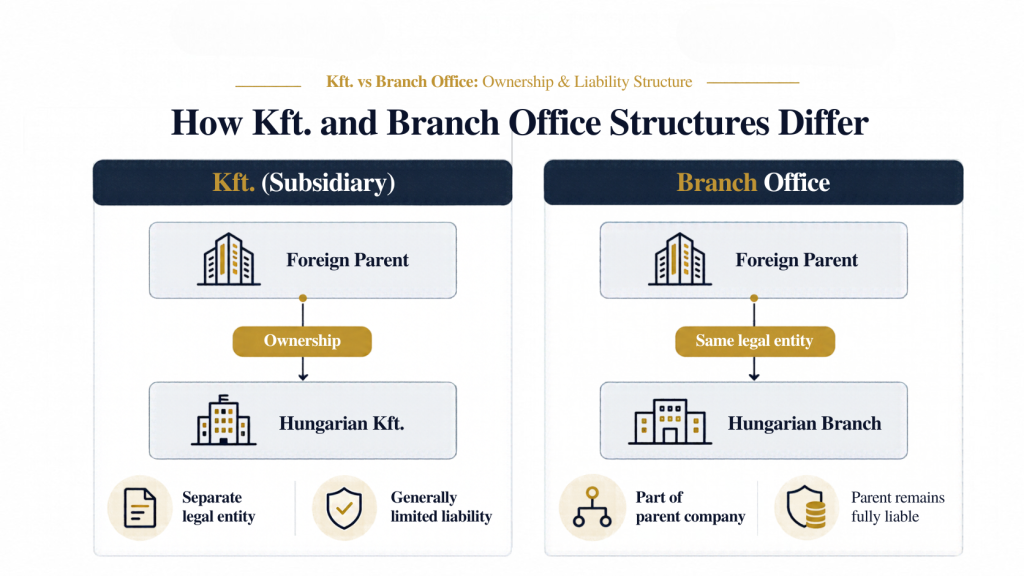
Legal Status | Separate legal entity | Part of foreign parent |
Liability | Generally limited | Parent fully liable |
Minimum Capital | HUF 3 million | No minimum |
Management | Managing director(s) | Local representative |
Corporate Tax | 9% CIT + up to 2% local tax | 9% CIT + up to 2% local tax |
Profit Transfer | Dividends; generally 0% WHT to corporate shareholders | No separate remittance tax |
Accounting | Annual financial statements | Branch accounts and reporting |
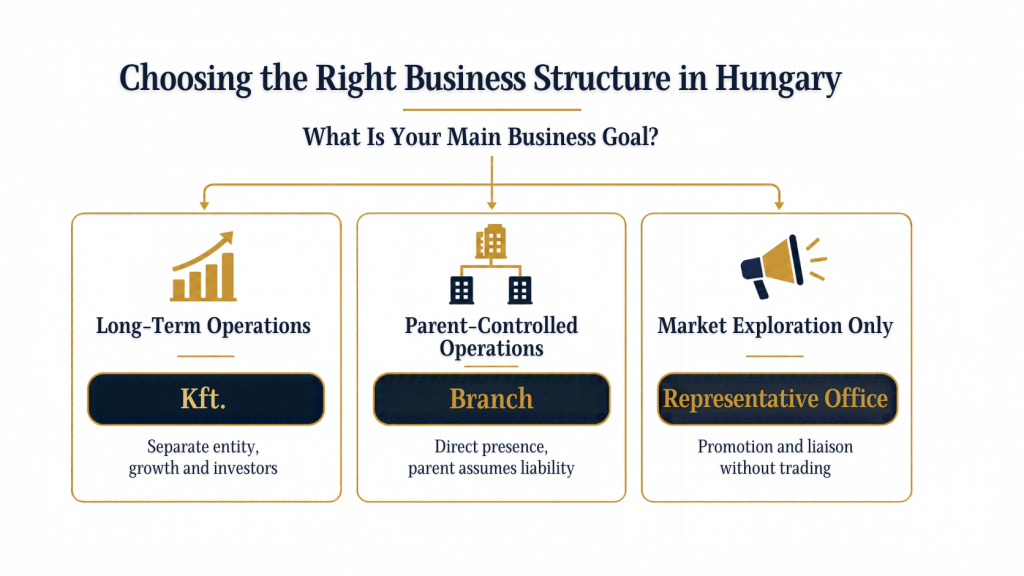
Best For | Long-term business expansion | Parent-controlled operations |
In short: if you plan to stay, grow and limit your parent company’s exposure, a Kft. is usually the stronger choice. A branch can make sense for focused, lower-risk activity where you want everything on one balance sheet.
Not Sure Which Hungary Business Structure Fits Your Plans?
Vorx Consultancy helps foreign companies evaluate Kft. and branch-office options based on business goals, liability and compliance requirements.
What Is a Hungarian Kft.?
The “Kft.” or “Korlátolt felelősséggű társaság” is the Hungarian limited liability company form and one that many foreign businesses prefer to use.
Such companies have their legal status and operate under Act V of 2013 of the Hungarian Civil Code.
This type of company also has its own legal personality and can enter contracts, own assets and be indebted in its name.
There is no limit to foreign ownership in Hungary so a foreigner can own a Kft. 100%. An exception applies in case of strategic business fields.
Subsidiary or standalone company?
It’s the same legal form either way. If your foreign company owns the quotas, the Kft. is a subsidiary.
If you own it personally, it’s a standalone company. The distinction matters mainly for tax and exchange-control rules in your home country, covered below.
Hungary Kft registration requirements
Share capital: The minimum is HUF 3,000,000. Cash contributions don’t have to be paid at incorporation.
The legal deadline runs until three months after the approval of the accounts for the second full financial year. Capital can also be denominated in EUR or USD, in which case the books are kept in that currency.
Managing director: At least one managing director, who can be an individual or a company and doesn’t need to be Hungarian.
If directors live abroad, some decisions should still be taken in Hungary to avoid questions about where the company is actually managed for tax purposes.
Registered seat: Every Kft. needs a registered office in Hungary. Many foreign founders use a registered-seat service provider.
Filing: Documents are filed electronically with the court of registration through a Hungarian lawyer. The tax authority runs a preliminary tax check first.
Timeline: A Kft. is usually registered within a week of its tax number being issued. If you use the standard-form articles of association, the court registers it on the next working day.
After registration: Register with the local chamber of commerce within 15 days and open a Hungarian bank account.
The bank runs KYC checks and reports the ultimate beneficial owner to the national UBO register.
Audit: Required if expected average annual turnover over the next two years exceeds HUF 600 million, or average headcount exceeds 50.
Pros and cons of a Kft.
Advantages: The risk of your parent firm will be limited to its invested amount. You deal with the customers, landowners, and banks as a local company.
It is possible to form joint ventures, quota selling, and restructuring in the future. Hungary does not have withholding taxes on dividends for foreign companies.
Disadvantages: More administrative burden than a branch – separate legal accounts, corporate governance, and transfer-pricing documentation for dealings with your parent company in most cases.
What Is a Branch Office (Fióktelep) in Hungary?
Branches in the jurisdiction of Hungary are formed on the basis of the provisions of the Branch Office Act (Act CXXXII of 1997). They constitute an unincorporated establishment of a foreign firm that acts independently and that is registered in the Hungarian register of firms.
It can conclude contracts, own property and sue, yet only in the interests of the foreign head office. It is not a separate legal person.
What a branch can do
A branch can carry out the same commercial activities as a Hungarian company: selling, providing services, employing staff and invoicing customers. Licensed activities still need the relevant permits, just as they would for a Kft.
Hungary branch office registration and tax
Registration: Mandatory entry in the company register, with no minimum capital. The assets your parent provides to run the branch must still be shown in the accounts and register.
Representative resident: Although a “branch manager” is not required, you will have to designate a resident representative who either works for the branch or has signed a service contract, and who resides in Hungary.
Corporate income tax: The branch pays 9% corporate income tax on income derived from the branch operations in Hungary, just like a Kft. There is no corporate tax in Hungary when profits are remitted back to the parent company.
Other taxes: Local business tax (0–2% depending on the municipality), 27% standard VAT where applicable, and payroll taxes if you employ people locally.
Paperwork: Lower running costs than a Kft. in most cases, though the parent’s own accounts may need to be filed in Hungary.
Example: when a branch fits
Example: A medium-sized engineering services firm located in Pune gets a nine-month contract for commissioning the machinery at a factory in Hungary.
They need to bill themselves locally and pay a small local team, but do not have any further plans.
A branch lets it do this without setting up and later winding down a separate company. The trade-off: if a dispute arises with the client, the claim is against the Indian company itself.
The Third Option: Commercial Representative Office
If you only want a presence in Hungary, without generating any income locally, a commercial representative office (Kereskedelmi kepviselet) provides a lighter structure.
It may operate only in the name of the parent company and negotiate, arrange, conclude agreements, provide information to business partners and communicate with business associates on its behalf. However, it may neither engage in any business operations nor earn any income for itself.
Similar to the branch, it does not have an independent corporate personality, the liability rests with the parent company, and it must be registered as a company.
Because it shouldn’t generate trading income, its corporate tax exposure is usually limited. Even so, it still has registration and payroll obligations, and if its people routinely negotiate and close deals, a tax authority may treat it as a taxable presence of the parent.
Example: An Indian textile exporter places one sales manager in Budapest to meet buyers and support orders that are invoiced from India. A representative office suits this, until the company wants to hold stock or invoice locally.
Hungary Kft vs Branch Office: 5 Factors That Decide It
1. Liability and risk
This is the biggest difference. A Kft. creditors generally look to the Kft.’s assets. A branch’s creditors can pursue the entire foreign company.
If your Hungarian work involves product liability, large contracts, employees or leases, that exposure matters.
2. Tax in Hungary: almost identical
Both pay 9% corporate income tax, local business tax and VAT, and both can carry losses forward, subject to limits.
On the Hungarian side alone, tax rarely decides the question. If you want to benchmark Hungary against other countries, see our global corporate tax rates guide.
3. Tax and FEMA at home: the factor most guides skip
For an Indian parent, this often decides it.
Branch: A branch is part of the Indian company, so its profits are generally included in the Indian company’s taxable income.
India taxes them at Indian rates and gives credit for Hungarian tax under the India–Hungary tax treaty.
In practice, the low 9% Hungarian rate gets topped up to your Indian rate. On the flip side, early-stage branch losses may reduce the Indian company’s taxable profit.
Kft.: Profits are taxed at 9% in Hungary and are generally taxed in India only when distributed as dividends.
That gives you more control over timing. One caution: if the Kft. is effectively run from India, it risks being treated as Indian tax resident under the place-of-effective-management rules.
FEMA: Investing in a Kft. is an overseas direct investment under India’s exchange-control rules, routed through your authorised dealer bank with ongoing reporting.
Funding a foreign branch follows a different set of FEMA rules. Confirm the route with your bank and adviser before you send money.
This is where a structure that looks cheaper in Hungary can cost more overall. If you’d like this modelled for your numbers, our FEMA and overseas investment and international tax structuring teams can help.
Expanding from India to Hungary? Plan Your Structure Carefully.
From overseas investment compliance to cross-border tax planning, Vorx Consultancy helps you evaluate the requirements before setting up your Hungarian business.
4. Banking and local presence
Both structures need a Hungarian bank account, and banks will run full KYC on the parent and its owners.
The branch’s resident-representative requirement is often the practical hurdle: if you don’t yet have anyone living in Hungary, a Kft. with a foreign director may be easier to start. Vorx offers business bank account support for cross-border structures.
5. Flexibility and exit
A Kft. can take on local partners, raise capital or be sold.The branch cannot be sold as an independent business unit, while the change from branch to Kft. will most likely require setting up the new entity with the related labor and property transfers and resulting tax implications. In case of projected growth, beginning with the Kft. will save the effort.

Which Structure Should You Choose?
Choose a Kft. if you:
- Plan a long-term presence with local staff, premises or stock
- Want to protect the parent company from Hungarian liabilities
- May bring in local partners or investors
- Prefer to keep profits in Hungary and decide when to repatriate them
Choose a branch office if you:
- Have a defined project or are testing demand with limited risk
- Want results consolidated in the parent’s accounts (for example, to use early losses)
- Can appoint a representative who lives in Hungary
Choose a representative office if you:
- Only need marketing, liaison or buyer support
- Will continue to invoice from your home country
Example: An Indian SaaS firm wants to set up a five-member sales and support team in Budapest catering to EU clients with yearly contracts. All factors point towards a Kft.
Common Mistakes to Avoid
Choosing a branch for simplicity without a resident representative. Registration stalls without one.
Assuming 9% is your final tax rate. For an Indian branch, it usually isn’t.
Running a Kft. entirely from India. It invites tax-residence questions in both countries.
Letting a representative office trade. Issuing invoices or delivering services locally goes beyond its permitted scope.
Missing post-registration steps such as chamber-of-commerce registration and local business tax registration.
Conclusion
Hungary’s decision to incorporate as Kft. vs. Branch Office is dependent on answers to three main questions:
The level of financial risks your parent firm will be willing to bear; Duration of operations; How the profits will be taxed by your country.
As far as establishing a more or less permanent presence in Hungary goes, then Kft. is definitely a more secure choice.
The choice of Branch is better for short-term or limited operations, while Representative Office would be better for just the market presence.
Before registering the enterprise, think about what you expect to do, what results you should gain, your domestic tax system and FEMA situation.
Vorx Consultancy assists Indian and foreign businesses in their European expansion, including entity formation and registration, FEMA compliance, bank account opening and accounting. Book a consultation to discuss which structure fits your plans.
Ready to Establish Your Business in Hungary?
Whether you’re considering a Kft. or branch office, Vorx Consultancy supports business registration, cross-border compliance, banking assistance and ongoing accounting requirements.
