


Should Oman be on your list of business destinations, this article comes with positive news. As of January 2020, 100 percent ownership of companies is allowed, with no specific threshold for most operations. All applications for registration will now go online via the Oman Government Invest Easy website.
But “you can own 100%” isn’t the same as “setup is simple.” The decisions that cost founders time and money come earlier: which structure to use, whether your activity is open to foreign owners, how you’ll hire under Omanisation rules, and whether a bank will open your account.
This guide to Oman company formation for foreigners takes those decisions in the order you’ll face them, with extra notes for founders setting up from India.
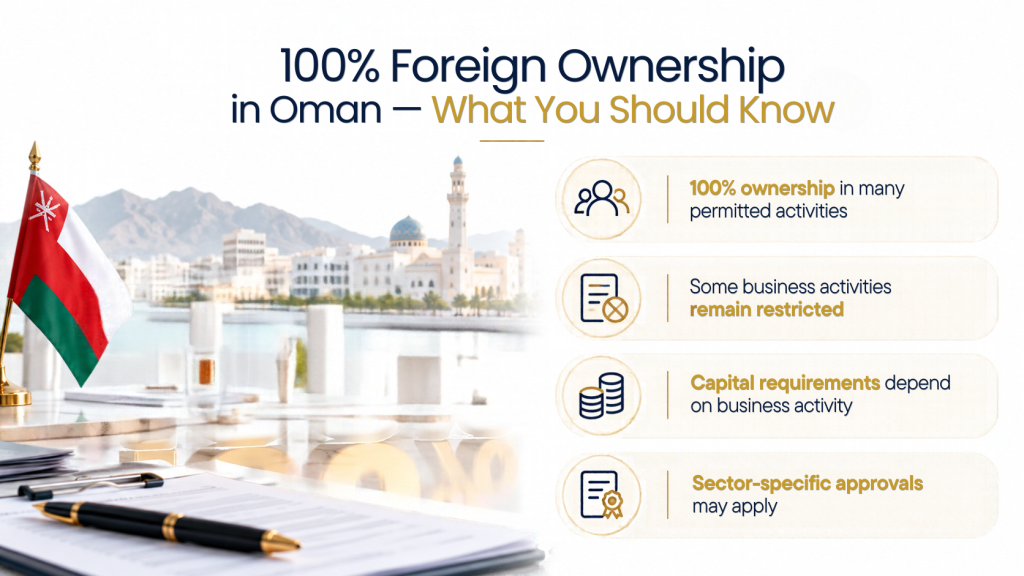
Can foreigners own 100% of a company in Oman?
Yes, in most activities.The Foreign Capital Investment Law (Royal Decree 50/2019), which came into effect on 7 January 2020, eliminated the requirement for an Omani partner. Furthermore, it got rid of the earlier OMR 150,000 minimum capital requirement for foreign companies.
Three conditions still matter:
- Restricted activities: There is a published list of activities that remains restricted to Omanis only. Make sure you check your activity code before purchasing anything else.
- Capital still has to make sense: “No minimum” doesn’t mean a token amount will do. Banks, landlords and visa officers look at whether your capital fits your business plan.
- Your role as owner: According to the official advice, the role of the foreign investor should be supervision of the business instead of professional practice within it.
If you plan to work as a licensed professional yourself, sector licensing rules apply separately.
Mainland vs free zone vs branch: choosing your structure
This is the decision that shapes everything that follows, so it’s worth getting right before you file.
Mainland LLC or single-person company
Foreign firms form either a Limited Liability Company (LLC) or Single-Person Company (SPC) in the Ministry of Commerce, Industry and Investment Promotion (MOCIIP).
A mainland firm may deal business in any part of the Sultanate of Oman. Bids can be made in local projects while contracting with Omani clients directly.
SPC is a single ownership with limited liability whereas LLC consists of two or more shareholders.
Free zones and the Duqm Special Economic Zone
The special economic zones in Oman are Sohar, Salalah, and Al Mazunah free zones, Special Economic Zone at Duqm, and Knowledge Oasis Muscat for technology companies.
These are controlled by the Public Authority for Special Economic Zones and Free Zones (OPAZ). These are good for businesses which physically operate near ports or industrial areas, i.e., manufacturing, logistics, warehousing, and re-exporting.
Be careful with the tax headline. Many sites promise a flat 30-year tax holiday. With Royal Decree 38/2025, which came into effect in April 2025, corporate taxation exemption period is 10 years, extendable twice up to 30 years, for projects considered important. Take 30 years as a maximum limit only.
Goods moving through the zones get customs exemptions. Once you sell into mainland Oman, normal customs rules generally apply.
Branch of a foreign company
A branch isn’t a separate legal entity, so the parent company carries full liability. It’s usually used to deliver a specific contract, often for a government client, and approval is case by case.
Route | Best for | Market access | Tax position | Watch out for |
Mainland LLC / SPC | Services, trading, selling to Omani customers | All of Oman | 15% corporate tax | Restricted activities, Omanisation quotas |
Free zone / Duqm SEZ | Manufacturing, logistics, re-export | Zone and overseas; mainland sales follow customs rules | Exemption of 10 years, renewable to max 30 for qualifying activities | Physical premises in the zone; incentives are conditional |
Branch | Delivering a defined contract | Within the approved scope | 15% on Oman profits | Parent fully liable; case-by-case approval |
Not Sure Which Oman Company Structure Fits Your Business?
Choosing between a mainland LLC, free zone company, or branch depends on your business activity and expansion goals. Vorx Consultancy can help you evaluate the right structure before registration.
Here’s how that plays out. These are hypothetical examples, not client cases:
A Pune engineering consultancy wins its first Omani client and needs to invoice locally and hire two people. A mainland SPC owned by the Indian company is likely the cleanest fit. A free zone would add premises cost with no real benefit.
Surat textile exporter seeks a distribution center in the Gulf region. Mainland trading company LLC allows it to operate in Oman. In case the plan involves re-exporting into East Africa via Salalah, the use of a free zone warehouse may be considered.
A mid-sized Indian chemicals maker planning a plant near a port would look at Sohar or Duqm, where land, customs and tax incentives matter more than access to Muscat’s retail market.
Not sure which route fits your activity? Vorx’s company formation services start with an activity and structure check before anything is filed.
Oman company registration process, step by step
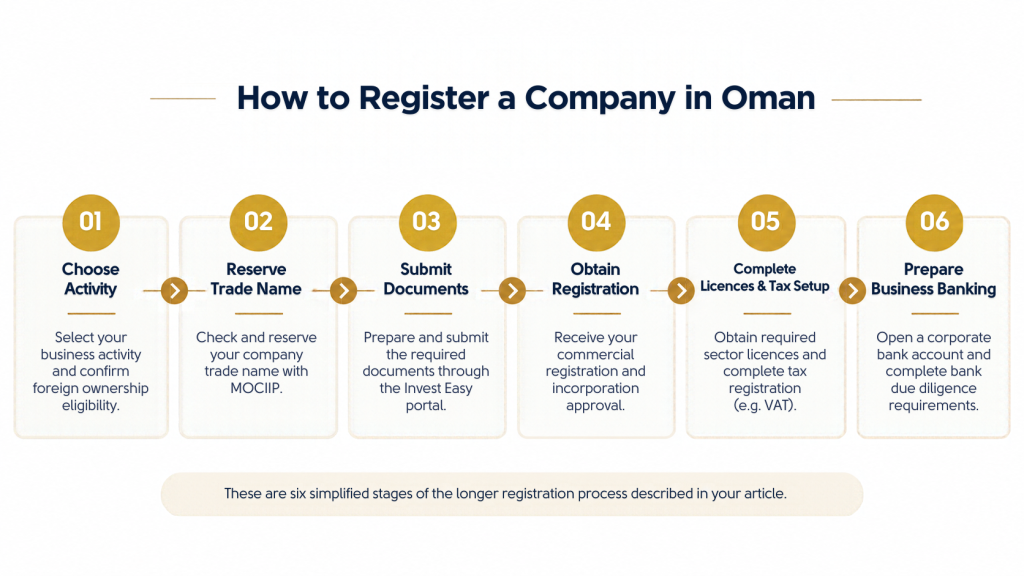
For a mainland company, most of the work runs through Invest Easy, MOCIIP’s single-window portal, which connects more than 17 government entities.
- Confirm your activity and any sector approvals (health, education and tourism often need them).
- Reserve a trade name on Invest Easy.
- Submit shareholder and manager details with the articles of association. Foreign investors may need a security clearance at this stage.
- Receive your Commercial Registration (CR), issued electronically once fees are paid and the file is approved.
- Register with the Oman Chamber of Commerce and Industry (OCCI). Membership must be renewed; a lapse can block other government services.
- Get a municipal licence for your premises, which means you need a lease.
- Register with the Oman Tax Authority. Every entity must register, even before it makes a profit.
- Set up labour, visa and social insurance registrations for any staff.
- Open a corporate bank account.
The CR itself can arrive within days once your documents are complete. Being fully operational, with a lease, visas and a bank account, usually takes several weeks to a few months.
Free zone companies apply to the relevant zone authority instead, and the process includes a land or premises agreement with the zone.
Documents required for Oman company registration
The individual shareholders usually offer passports, addresses, and photographs. Residents add their Omani residence card.
Corporate shareholders typically provide:
- Certificate of incorporation and constitutional documents
- A board resolution approving the Omani company and appointing its manager
- A power of attorney for the person filing
- An ownership chart showing the ultimate beneficial owners
India and Oman are signatories to the Apostille Convention, hence apostille is obtained for Indian documents from the Ministry of External Affairs instead of the embassy. Consult the authorities receiving the document if there are any additional requirements needed.
Arabic translation is frequently required, while proper names need to be precisely aligned with passports; otherwise, slight spelling differences result in rework.
What does company formation in Oman cost?
There’s no single price, and “from” figures in adverts usually cover only a basic licence and one visa. Budget for these components instead:
- Government registration fees. MOCIIP says it has cut CR fees, setting them at OMR 100 for companies employing no more than five foreign workers. Foreign investors who employ at least one Omani pay the same CR fees as Omani investors.
- OCCI membership and municipal fees, which depend on company grade and location.
- Premises. A lease is needed for the municipal licence and is often the largest recurring cost.
- Visas, medicals and ID cards for each expatriate.
- Apostille, translation and drafting of documents.
- Professional fees if you use a consultant.
Oman corporate tax, VAT and Omanisation
- Corporate income tax is 15% of taxable profits, including for branches. A 3% rate exists for small businesses, but its conditions mean most foreign-owned companies shouldn’t plan around it. Annual returns are required even when no tax is due.
- Withholding tax applies to certain payments to non-residents, such as royalties and some service fees. Factor this in if your Indian parent will charge the Omani company fees.
- VAT is 5%. Registration is compulsory once taxable supplies exceed OMR 38,500 a year, while voluntary registration is allowed from OMR 19,250. Filing is done on a quarterly basis, while e-invoicing is being introduced.
- The personal income tax becomes applicable from 1 January 2028 at a rate of 5% for individuals who earn more than OMR 42,000 a year. It is important to note that residents will be taxed on their global income.
- Omanisation provides a sector-wise quota for hiring Omanis, while some positions are reserved as well. It restricts the number of expatriate visas you can obtain.
If you’re comparing Oman with the UAE or Saudi Arabia, you can compare corporate tax rates across countries side by side.
Opening a business bank account in Oman
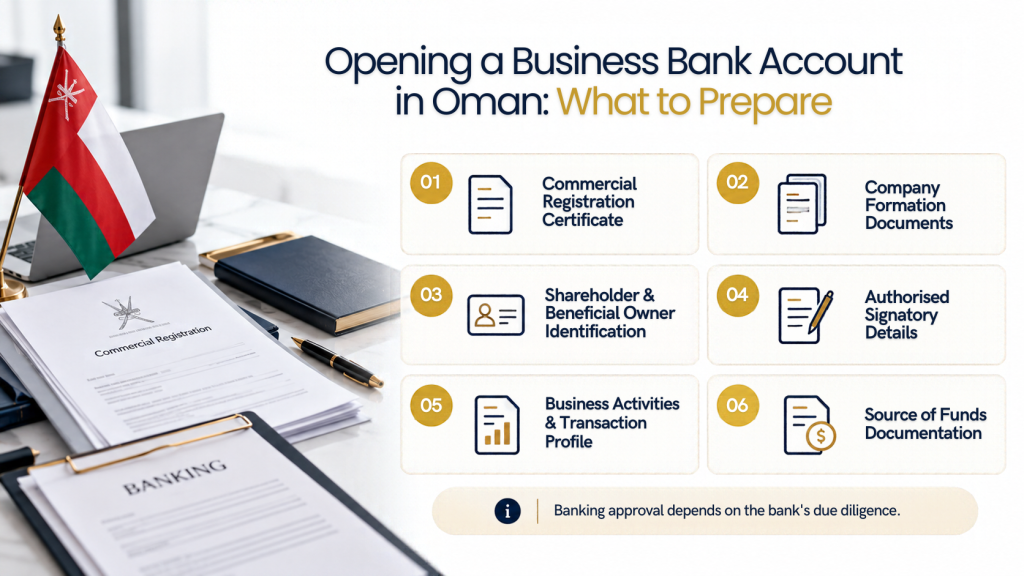
Omani banks will open corporate accounts upon receipt of the CR. You should expect to furnish the CR, articles, beneficial owner identification papers, signing papers, and transaction profile, ideally supported by signed contracts or invoices.
The presence of a signatory who resides in Oman and is available for attendance simplifies the process. It would be hard to obtain account opening from companies whose staff members are outside Oman.
There is a different risk appetite at each bank.Vorx offers business bank account assistance to help prepare a clean KYC pack.
Planning Your Oman Company Setup?
Company registration is only one part of the process. Vorx Consultancy helps foreign entrepreneurs navigate documentation, business banking requirements, and compliance.
Residency options for foreign owners
The standard approach is through a work visa issued by your employer, with labour approvals and Omanization restrictions applying.
For bigger investors, Oman launched its Golden Residency program in August 2025, with terms of residency available for 5 and 10 years, including their families.
The official threshold varies by source, ranging from OMR 200,000 to OMR 500,000, so be sure to check the latest numbers with Invest Oman.
What Indian founders should sort out before starting
ODI and FEMA: Indian investments made in an overseas business will be governed by the Overseas Investment Rules and Regulations 2022 of India.
Filings go through your authorised dealer bank, and ongoing reporting applies. Doing this late is one of the most common India-side problems. Vorx’s FEMA and ODI compliance team can run this alongside the Oman setup.
Where the company is managed: If key decisions are really taken in India by India-resident directors, Indian tax authorities could treat the Omani company as a tax resident in India. Real management in Oman matters.
India–Oman CEPA: The trade agreement came into force on 1 June 2026. It gives duty-free access for 99.38% of India’s exports to Oman by value and adds services and professional mobility commitments. It’s a strong reason for trading and services firms to look at Oman now.
Paperwork timing: Apostille and translation may even be longer than the filing process in Oman, so begin early.
Common mistakes to avoid
- Filing for an activity on the restricted list
- Choosing a free zone for the tax headline when your customers are on the mainland
- Setting token capital that banks and visa officers won’t accept
- Letting OCCI membership lapse
- Signing a lease before checking Omanisation limits on your hires
- Registering late for VAT
- Skipping ODI filings in India
Ready to Start Your Business in Oman?
From selecting the right company structure to registration, banking, and cross-border compliance, Vorx Consultancy helps Indian and international entrepreneurs plan their Oman business expansion.
Conclusion:
In contrast to the past, Oman now welcomes foreign ownership, which presents a new motive for Indian businessmen because of the CEPA.
Those cases that work best have already settled structure, operations, and staffing prior to any filings and are processed simultaneously with Indian approvals.
For a second look at your proposal, Vorx can audit your operations, suggest a structure for it, coordinate registration and banking, and take care of the FEMA side in India. Book a consultation to get started.
