


If you own a company in Oman, or plan to, here is the short answer: most foreign-owned companies pay corporate tax at 15% on their net profit.
The lower 3% rate you’ve probably read about exists, but it’s built for small Omani-owned businesses. Free zone companies can pay nothing for years, but only if their activity and licence qualify.
This guide covers what actually matters to a foreign owner in 2026. You’ll learn which rate applies, how profit is calculated, what’s due and when, and what happens when you send profits back to India.
Oman corporate tax 2026 at a glance
Tax / Requirement | 2026 Rules |
Corporate Tax | 15% of taxable profit |
SME Tax Rate | 3% for eligible businesses |
Petroleum Tax | 55% (special sector) |
Withholding Tax | 10% on certain foreign payments* |
VAT | 5% |
Annual Tax Return | Within 4 months (3 months for qualifying SMEs) |
Tax Losses | Carry forward up to 5 years |
Local Income Tax | None |
Want to see how Oman stacks up against the UAE, Saudi Arabia or Singapore? Check our global corporate tax rates table or compare jurisdictions side by side with the free country comparison tool.
Which corporate tax rate applies to your company?
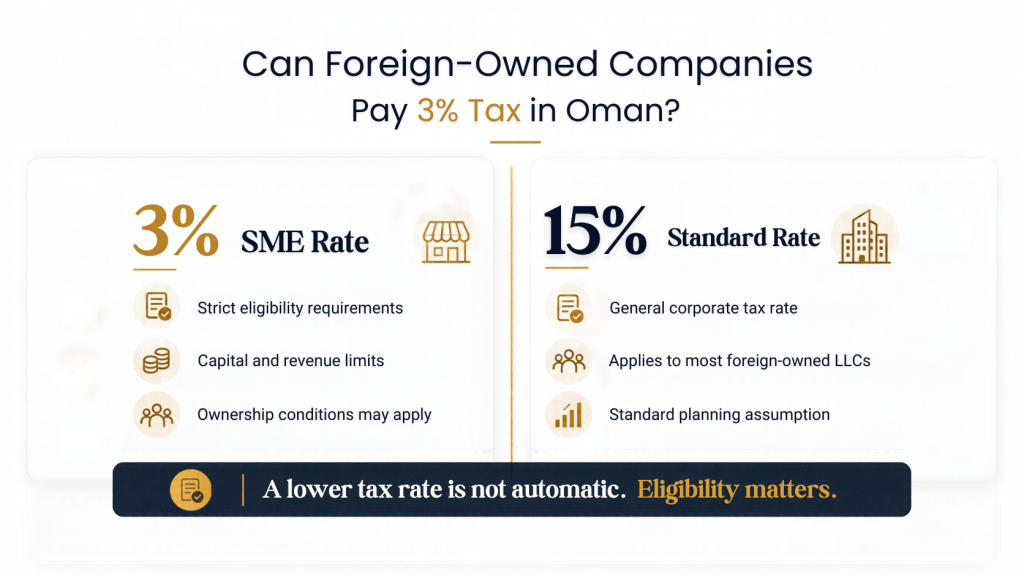
The 15% standard rate
Oman’s Income Tax Law taxes companies formed in Oman on their worldwide income. Branches and other permanent establishments of foreign companies pay tax on their Oman-source income.
The rate is a flat 15%. There’s no tax-free threshold and no sliding scale. A foreign-owned LLC earning OMR 10,000 in profit pays the same rate as one earning OMR 10 million.
The 3% SME rate, and why most foreign owners won’t get it
The 3% rate applies to Omani proprietorships and LLCs that meet all of these conditions:
- Registered capital of OMR 60,000 or less at the start of the tax year
- Gross income of OMR 150,000 or less in the tax year
- An average of 25 employees or fewer
- No activity in excluded sectors such as banking, insurance, air or sea transport, or natural resource extraction
These thresholds were raised recently. Many websites still quote the older limits of OMR 50,000, OMR 100,000 and 15 employees, so check which version you’re reading.
Here’s the part competitors skip. The SME regime is aimed at Omani-owned small businesses. Earlier executive regulations added conditions such as an Omani owner actively running the business and minimum Omani employment.
If your LLC is wholly or mostly foreign-owned, plan your budget around 15%. Treat 3% as a bonus to confirm with an advisor, not as an assumption.
Also note the cliff edge. Cross any single threshold, even by one rial, and the full 15% applies for that year.
Free zone and Special Economic Zone companies
The recently introduced Law of Special Economic Zones and Free Zones (Royal Decree 38/2025) permits exemption from income tax for businesses operating in these zones. The baseline is ten years, renewable for certain activities. Some zone packages can extend to 25 or 30 years if conditions are met.
The exemption is not universal. Banks, insurers, telecom operators and certain transport companies are excluded. Most zones also restrict trading directly into the Omani mainland market.
A free zone makes sense for manufacturing, logistics and export-led businesses. If your customers are mainly inside Oman, a mainland LLC is often the more practical choice, despite the 15% rate.
Petroleum and Pillar Two: who needs to care
The 55% petroleum tax only applies to companies engaged in oil and gas exploration and production in accordance with government contracts.
Pillar Two, the 15% global minimum tax, came into effect through Royal Decree 70/2024 on 1 January 2025. The provision is applicable to multinational groups having consolidated revenue of more than €750 million.
As of mid-2026, executive regulations were pending.. If your group is below that size, you can set Pillar Two aside.
Not Sure Which Oman Tax Rate Applies to Your Business?
Vorx Consultancy helps you understand your tax obligations before you set up.
How your taxable profit is calculated
Tax is charged on accounting profit adjusted under the tax rules, not on revenue. Your audited IFRS accounts are the starting point.
OTA accepts any costs you incur to make money that you have to pay tax on. Disputes are likely in the following areas:
- Charges between related parties: Management fees, royalty payments, and charges to the parent company are carefully examined. Ensure that there is proof of arm’s length pricing.
- Partner and director remuneration: Deductions for payments to partners are capped by formula. Don’t assume founder salaries are fully deductible.
- Head office costs: Allocations from an overseas parent need support and must relate to the Omani business.
There’s an important change coming. According to the decision of the OTA on No. 180/2026, from the tax year beginning on 1 January 2027 onwards, expenses will be deductible if they are incurred in the course of business activity, authorized for deduction, and do not originate from the violation of any obligation.
Fines and penalties are the obvious victims. It is yet to be seen what will fall under the definition.
If you suffer losses, they can be carried forward for a period of five years.There’s no carry-back.
Example (hypothetical):The founder of the company operates a 100% owned trading LLC in Muscat. The revenue for the year 2026 is OMR 400,000 with allowable expenses being OMR 300,000. Profit after tax will be OMR 100,000 while corporate tax stands at OMR 15,000.
In case the OMR 8,000 of allowable expenses had been charged as management fees without any formal agreement from the Indian parent company, OTA would have rejected it, increasing the liability to OMR 16,200.
Withholding tax on payments abroad
In cases where your Omani company is paying a foreign company that does not have any permanent establishment in Oman, you may be required to deduct 10% from the gross payment. This covers:
- Royalties, including some software and licence fees
- Payments for research and development
- Management fees and payment for services
Dividends and interest are the welcome exception. A Royal Directive in January 2023 suspended withholding tax on dividends and interest paid to non-resident investors.
A double tax treaty can reduce the 10% rate on royalties and services. Oman has a treaty with India, but claiming treaty relief normally needs a tax residency certificate and proper paperwork. Without it, expect the full 10%.
Withheld tax must be paid to the OTA within the month after the payment. Late remittance attracts extra tax of 1% per month.
Getting profits back to India
This is where most guides stop, and where Indian founders often get caught out.
Dividends: Your Oman LLC pays no withholding tax on dividends. But the dividend is still income for you or your Indian holding company, and it’s taxed in India under normal rules. Since Oman withheld nothing, there’s usually little foreign tax to credit against the Indian bill.
Fees and royalties: If your Indian company charges the Oman entity for services or IP, the 10% Omani withholding may apply.
You can generally claim credit for that tax in India under the treaty, if the documentation is in order.
Place of effective management (POEM): Indian tax law can treat a foreign company as an Indian tax resident if its key management decisions are effectively made in India.
An Oman LLC whose decisions are all taken by a founder sitting in Bengaluru is exposed. If that happens, India can tax the company’s global profits.
Indian residents investing abroad must also comply with RBI’s overseas investment rules. Get this right at setup, not when the first dividend is due.
Example (hypothetical): A Delhi founder sets up an Oman LLC, holds every board meeting on video from Delhi, and signs all contracts there.
On paper the company is Omani. In substance, decisions happen in India. Appointing a local manager with real authority and holding board meetings in Oman reduces this risk.
Unsure whether to hold your Oman company personally or through an Indian entity? That choice changes how dividends are taxed. It’s worth a structuring review before the first profit distribution.
Planning to Transfer Business Profits from Oman to India?
Get expert guidance from Vorx Consultancy on cross-border taxation and ownership structures.
Registration, filing and penalties
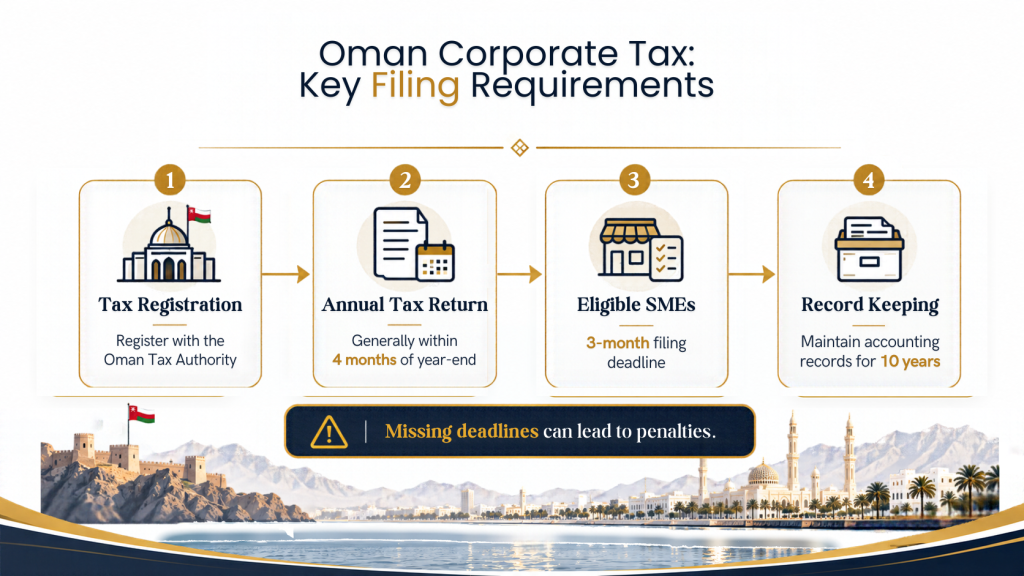
Registration: All companies that conduct their business in Oman must register with the OTA and obtain a tax card, irrespective of whether they earn profits or not.
Tax year: The tax year is the calendar year. A different year-end needs prior OTA approval, and your first tax year can run up to 18 months.
Annual return: File one return of income within four months of the year-end. For a December year-end, that’s 30 April. Attach audited accounts signed by an Oman-registered auditor. Pay the tax with the return.
SMEs: Taxpayers on the 3% rate file within three months and attach a simplified income statement. Audited accounts are not required.
Penalties: Late filing costs between OMR 100 and OMR 2,000. Late payment attracts extra tax of 1% per month. Understating income can trigger a fine of 1% to 25% of the tax shortfall. If you don’t file at all, the OTA can assess your profit by estimate.
Records:Keep accounting records for a period of ten years. OTA frequently asks for detailed invoices and contracts, even when they have your audited accounts.
Common mistakes foreign owners make
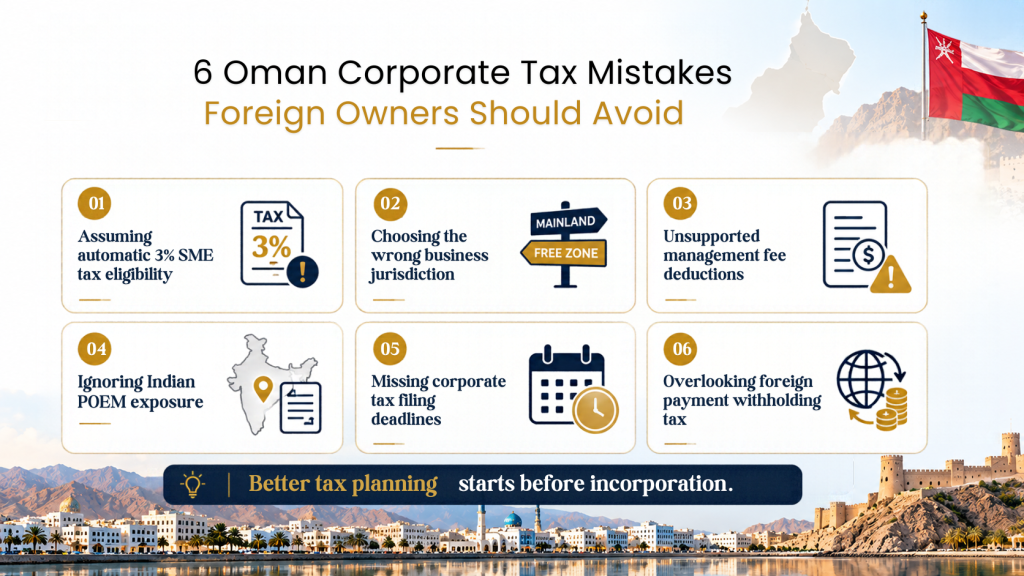
- Budgeting at 3% without confirming eligibility
- Choosing a free zone, then trying to sell mainly to mainland customers
- Charging management fees to the Oman entity without agreements or transfer-pricing support
- Running the company entirely from India and creating POEM risk
- Missing the 30 April deadline because the audit started too late
- Forgetting to withhold 10% on payments to foreign service providers
What's changing in 2027 and 2028
Two changes deserve a place in your planning. First, the more stringent deductible expenses criterion per Decision 180/2026 is applicable beginning from the tax year 2027.
Second, Oman’s Personal Income Tax Law (Royal Decree 56/2025) will be effective as of 1 January 2028. This law levies 5% personal income tax on individuals earning more than OMR 42,000 a year.
If you relocate to Oman and draw a large salary or dividend, this could affect how you pay yourself.
Make Your Oman Business Tax-Ready with Vorx Consultancy.
From company formation to corporate tax compliance, get professional guidance for your business.
Plan your Oman tax position before you need it
Oman corporate tax for foreign-owned businesses in 2026 comes down to one number: 15% tax rate on profit, once per year.
The actual rate will depend on the strategy behind it. Your business structure, your location, your pricing for the Oman-based company, and transfer of profit back to India affect the bottom line.
The best way to make sure you got everything right is during incorporation, or before the first financial year.
Vorx Consultancy helps Indian and international founders set up in Oman, structure ownership, and stay compliant on both sides. Book a consultation to review your Oman setup and tax position.
This article is provided for informational purposes only and does not constitute tax advice as of October 2026. Please consult your advisor about your situation.