


You’ve registered your Oman company, or you’re close. Now you need a business bank account in Oman so you can receive payments, pay suppliers and run payroll. This is the part which usually takes the most time for most foreigners.
The short answer is “yes,” a foreign corporation can open an account in the country of Oman. But Omani banks don’t approve accounts just because the paperwork is complete.
They want to understand who owns the business, where the money comes from, and whether the company has real activity in Oman.
This guide walks you through the process in the order you’ll actually face it, with the documents, KYC checks and common mistakes that slow foreign founders down.
Can a Foreign-Owned Company Open a Business Bank Account in Oman?
Yes. Under the Oman Foreign Capital Investment Law (RD No. 50/2019), which became effective on 2 January 2020, foreign investors can fully own (i.e., 100%) an Omani company without having to have a local partner.
Only a few types of activities are restricted from foreign ownership. So make sure to verify your activity.
Two points matter for banking:
- The account belongs to the Omani entity: You open it for your registered Oman LLC, branch or free zone company, not for your Indian or other overseas company.
- Banks decide: Owning 100% of the company gives you the right to operate. It doesn’t give you a right to a bank account. Each bank applies its own risk policy on top of Central Bank of Oman (CBO) rules.
Read this guide: Oman Company Formation for Foreigners: A Complete 2026 Guide
Before the Bank: Get Your Setup in the Right Order
Many delays happen because founders approach a bank too early. A typical sequence for a mainland company looks like this:
Check your activity and reserve a name on Invest Easy, the Ministry of Commerce, Industry and Investment Promotion (MOCIIP) online portal.
Obtain your Commercial Registration (CR). This is the company’s core legal document, and every bank will ask for it.
Register with the Oman Chamber of Commerce and Industries (OCCI). The OCCI certificate is always required by banks.
Obtain a lease for your office and get municipal approvals where required by your business activity.
Open the bank account.
Register with the Oman Tax Authority and keep your tax registration current.
Free zone and special economic zone companies follow their zone authority’s process, but the banking logic is the same: banks want a licensed entity with a clear address before they onboard you.
Note: Some company structures may need a capital account opened during incorporation, which is later converted into a regular current account. Confirm with your bank and formation adviser whether this applies to you.
Read this guide: Oman Corporate Tax 2026: What Foreign-Owned Companies Actually Pay
Oman Corporate Bank Account Requirements: The Document Pack
Exact lists vary by bank, but most Oman corporate bank account requirements fall into four groups.
Document | Why the bank wants it |
Commercial Registration (CR) certificate | Proves the company legally exists |
Memorandum/Articles of Association | Shows ownership and who can act for the company |
OCCI membership certificate | Confirms chamber registration |
Office lease agreement | Shows a real business address in Oman |
Municipality licence (if applicable) | Confirms the premises can be used for the activity |
Board or shareholder resolution | Authorises the account and names signatories |
Parent company documents (if a company is the shareholder) | Certificate of incorporation, constitution and register of shareholders, usually attested |
Shareholder, UBO and signatory documents
- Copies of passports of all shareholders, directors, signatories, and ultimate beneficial owners (UBOs).
- Oman resident card for any signatory who lives in Oman
- Proof of residential address
- CVs or professional profiles for key individuals, which some banks request
- A bank reference letter from the owner’s home-country bank, which some banks request
Bank forms and declarations
You should be prepared to sign the bank’s form for opening an account, as well as declarations on beneficial ownership, being a Politically Exposed Person (PEP), CRS tax residence, and, if applicable, FATCA.
Bank Muscat’s business account form, for example, includes PEP and “close associate” questions and asks for VAT details where applicable.
Business substance documents
This is where foreign-owned companies often fall short. Banks want evidence that the business is real:
- A short business plan with expected monthly transaction volumes
- Signed contracts, purchase orders or letters of intent from customers or suppliers
- Financial statements of the parent company
- An ownership chart showing every layer up to the individual owners
Need Help Preparing Your Oman Banking Documents?
Vorx Consultancy can assist with corporate banking documentation and KYC requirements.
Step-by-Step: How to Open a Business Bank Account in Oman
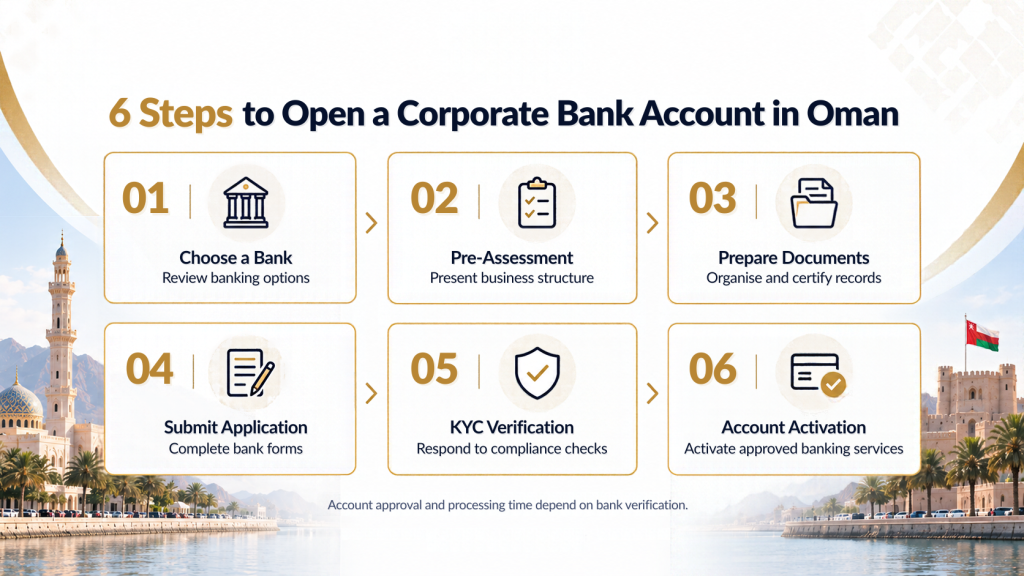
Narrow down the list of banks: In Oman, some banks are available like Bank Muscat, Bank Dhofar and National Bank of Oman. They also have some international and Islamic banks, such as HSBC and Standard Chartered Bank.
Have a pre-assessment: Show your structure and business model to the relationship manager before you submit anything.
Certify documents: Documents from abroad must usually be certified or apostilled, with Arabic translation if requested by the bank.
Submit your application and declarations.
Answer compliance questions: You can expect further queries about source of funds, customers, and ownership.
Activate the account: Upon approval, you get your account credentials, online banking and card access.
How long does it take? There’s no official timeline. A clean, well-documented application can move in a few weeks.
Advisers commonly report one to three months for foreign-owned companies, and longer when ownership is complex.
Do You Need to Visit Oman or Hold Residency?
This is the question that most non-native founders ask first, and the honest answer to this is: it depends on the bank and you.
- Resident signatory: It usually helps to have a resident signatory with an Oman residence card as it is easier for the bank to authenticate him/her locally.
- Non-resident signatory: Banks may have non-resident signatories; however, there may be requirements such as face-to-face meetings, video authentication or documentation. These requirements vary from one bank to another.
Whether you want to run the business from India or another place, you should consider early on whether you will have an Oman investor or residence permit for yourself.
What Omani Banks Look at During KYC
The Omani banks comply with the provisions of the Anti-Money Laundering and Combating Terrorism Financing Law (Royal Decree No. 30/2016) and CBO directives.
This law mandates banks to know their clients and ascertain their beneficial owners and also perform enhanced due diligence for high-risk clients.
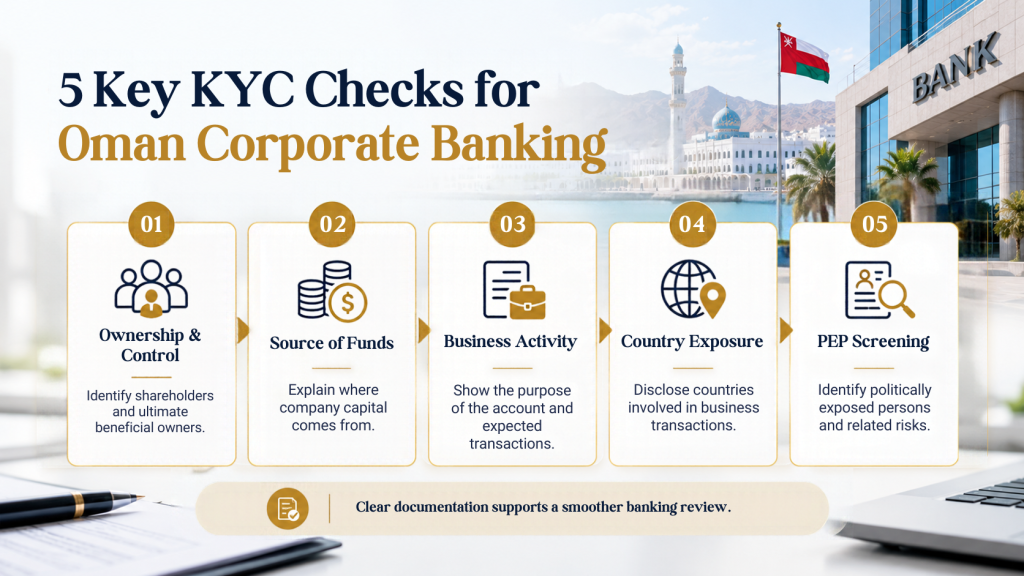
Compliance officers concentrate on answering the following five questions:
- Who really owns and controls the company? This needs to be tracked down to individual level.
- Where did the money come from? Capital, early-stage funding needs a documented source.
- What is the purpose of the account? The amounts, currencies and parties involved should reflect your business plan.
- What countries are involved? High-risk jurisdictions will attract further investigation.
- Is anyone a PEP? PEP status doesn’t block an account, but it adds checks.
If you want to prepare your file to this standard, our AML and KYC compliance support can help.
Common Reasons Applications Stall or Get Rejected
Problem | What to do instead |
Unclear source of funds | Provide bank statements, financials or sale agreements showing where capital came from |
Multi-layer ownership with no chart | Submit a signed ownership chart with documents for every entity |
No local presence or activity | Show a lease, Oman contracts or a credible launch plan |
Vague business description | Name products, customers, suppliers and expected monthly volumes |
Unattested overseas documents | Attest or apostille documents before submission |
Expired CR, lease or passports | Check validity dates before applying |
High-risk country exposure | Explain the trade link openly and document it |
Read This Guide: Oman Company Compliance Requirements: A 2026 Guide for Foreign Business Owners.
Facing Delays with Your Oman Bank Account?
Get professional guidance from Vorx Consultancy on banking documentation and compliance requirements.
Notes for Indian Founders
Indian entrepreneurs face a few extra steps on both sides.
FEMA compliance comes first: If an Indian company or resident individual funds the Oman entity, the investment generally has to follow India’s overseas investment rules, routed through an authorised dealer bank.
Omani banks may ask how the capital reached Oman, so keep that paperwork ready. Our FEMA and overseas investment advice covers this.
Attest your Indian documents early: Company documents, board resolutions and sometimes personal documents need attestation or apostille. This will take weeks, so plan ahead of the banking stage.
Make clear your organization: If your Indian business has investors or holding companies, write a one-page structure note.
Example (hypothetical): The exporter from Jaipur sets up a wholly-owned LLC in Muscat for marketing to GCC buyers.
The founder plans to manage it from India. Before approaching banks, she completes the ODI filing in India, signs a small office lease in Muscat, collects two letters of intent from Omani buyers and appoints a resident operations manager as a second signatory.
The bank’s questions then focus on volumes and currencies, not on whether the business is real.
After the Account Opens
Arrange your online banking facilities and establish user permissions for each signer.
Register yourself with the Oman Tax Authority: The corporate income tax comes with a uniform rate of 15% and is mandatory based on legal presence rather than profits made.
VAT: The VAT rate of Oman is 5%. It becomes mandatory to register with Oman once annual taxable supplies go beyond 38,500 OMR. Our VAT registration support can help.
Update your KYC record: The banks update customer records at intervals. Keeping your CR, lease, and passports up to date will prevent your account from being restricted.
Conclusion:
Setting up a business bank account in Oman as a foreign entrepreneur is quite possible, but it takes preparation.
Go about the registration process in the right sequence, prepare your ownership and source-of-funds documentation, and solve the signatory problem.
If you’re planning an Oman entity or your bank application has stalled, Vorx can help with structuring, documentation and corporate bank account opening support.
Planning to Open a Business Bank Account in Oman?
Vorx Consultancy supports foreign entrepreneurs with company formation, banking documentation and compliance guidance.
