


Oman vs UAE Company Formation: When you consider Oman and UAE company formation, you must be aware that almost all comparisons revolve around skylines, GDP, and standard of living. This is very helpful information; however, it will not help you decide which company to form.
This is the quick answer to the question. The United Arab Emirates generally attracts entrepreneurs who require low tax on small profits and also international customers.
Oman usually works well for traders, logistics, and manufacturers seeking access to the GCC market, a more open market environment, and, for Indian exporters, new tariff advantages. It really depends on your business model rather than the reputation of either country.
This guide will compare Company Registration Oman versus UAE on the four factors that influence your business on a daily basis: Taxation, Ownership, Banking & Compliance.
It then maps them to common business types. We have deliberately left out setup and running costs, because they vary widely by emirate, free zone and activity, and change often.
Oman vs UAE company setup at a glance
Factor | UAE | Oman |
Corporate Tax | 0% up to AED 375K; 9% above. Qualifying free-zone income: 0% | 15%; eligible small firms: 3% |
VAT | 5% | 5% |
Personal Income Tax | No tax | 5% above OMR 42K from 2028 |
Foreign Ownership | 100% for most activities | 100% for most activities |
Local Hiring | Rules apply by size and sector | Generally 1 Omani after year 1 |
E-Invoicing | Phased from 2027 | Phased from 2027 |
India Trade Agreement | CEPA since 2022 | CEPA since June 2026 |
Note: Tax benefits and foreign ownership depend on eligibility and business activity.
Want to add a third country to the shortlist? You can compare jurisdictions side by side with our free tool.
Not Sure Whether Oman or UAE Fits Your Business?
Compare jurisdictions before making your company formation decision.
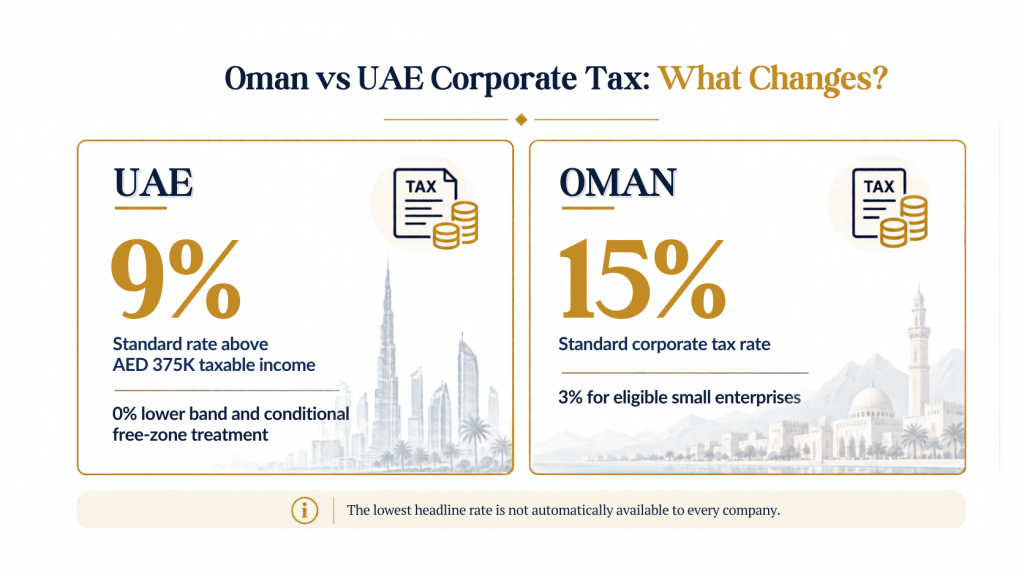
Oman vs UAE corporate tax
On headline rates, the UAE looks cheaper. The real picture depends on your structure and profit level.
UAE: low rate, but the 0% routes have conditions
Taxation of UAE corporations will take effect from fiscal years commencing on or after 1 June 2023. The tax rates are such that for income not exceeding AED 375,000, it will be taxed at 0%.
Zero percent tax rate is possible only for free zone companies that qualify as a Qualifying Free Zone Person (QFZP).
This implies having substance in the free zone, generating qualifying income, pricing transactions with related parties on an arm’s length basis and meeting the de minimis requirement, i.e., non-qualifying income should not exceed 5% of total income or AED 5 million. Breach it, and the company loses QFZP status for five years.
Small Business Relief allows companies with revenues below AED 3 million the option to treat their company as having zero taxable income.
The measure applies to tax periods that end on or before 31 December 2026.Unless the Cabinet extends it, plan your 2027 numbers without it.
If you are considering a free zone, our free zone finder helps match your activity to a suitable zone.
Oman: higher standard rate, with a small-business window
The corporate tax rate in Oman is 15%, and all resident companies are taxed on their global income.
A lower tax rate of 3% is available for small firms which meet certain conditions relating to their capital, turnover, and number of workers (not exceeding 15). Certain types of business are not eligible for the tax incentive, so it is essential to make sure you qualify.
It will be the greatest individual change from 2028 onwards. According to Oman’s Personal Income Tax Law [Royal Decree 56/2025], income tax is imposed at 5% on individuals with income greater than OMR 42,000 per year.
While most individuals earn less than this amount, an entrepreneur who moves and earns a high salary or other income must follow it. The UAE does not have a personal income tax.
Read this guide: Oman Corporate Tax guide in 2026.
VAT is the one area where both match
Both countries charge VAT at 5%, with mandatory registration once taxable supplies cross a set threshold. Neither gives you a VAT advantage.
Foreign ownership: can you own 100%?
Yes, in most activities, in both countries. The details differ.
In the UAE, the amendments to the Commercial Companies Law have abolished the requirement of 51 percent ownership by nationals for mainland firms as of 1 June 2021.
“Strategic impact activities” including banking, insurance, defence and security require approval and local presence.
Each emirate publishes which activities qualify for full foreign ownership. Free zones have always allowed 100% ownership.
In Oman, the Foreign Capital Investment Law (Royal Decree 50/2019) came into force in January 2020. It removed the old 70% foreign ownership cap and the minimum capital requirement for foreign investors.
A negative list reserves certain activities for Omanis. That list increased to 123 activities in 2024, but it comprises mainly small, domestic activities like handicrafts, not sectors usually targeted by foreign investors.
Practical tip: check your exact activity code against the relevant list before you choose a name or sign a lease.
Local hiring rules that affect small founders
This is the factor most comparisons skip, and it can decide the matter for a solo founder.
Oman: a foreign-investor company must employ at least one Omani national, registered with social insurance, after one year of commercial activity.
Since April 2024, companies that miss this face restrictions on the Oman Business Platform. The directive issued in 2025 by the Ministry of Labour applies the regulation to all commercial registrations that complete one year of operation, imposing penalties in the form of licence suspension for non-compliance.
An actionable employment plan can meet this requirement, with special provisions made for entrepreneurs and permanent owners.
UAE: Emiratisation goals apply to firms that employ 50 or more people, where firms must increase the number of Emirati workers employed in skilled jobs by 2% annually.
Firms employing 20 to 49 workers in any of the fourteen listed sectors must also hire Emiratis. A three-person startup faces no quota.
If you plan to run a lean company with no staff, factor Oman’s hiring rule into your plan from day one.
Oman vs UAE business banking
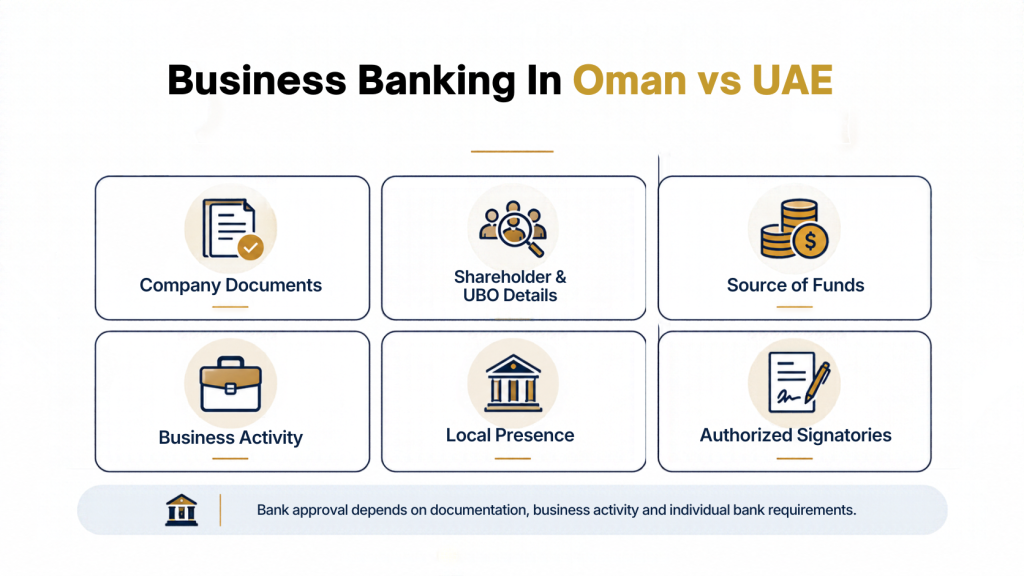
However, banking regulations are established not through laws but through the risk policy of the bank itself. The following is an example of standard practice.
Banks conduct full checks for the shareholders and beneficial owners in both jurisdictions. They normally require a good business model, agreements or invoices, sources of funds, and local presence. A resident signatory with a residence visa often helps.
The UAE has a deeper banking market, with many local and international banks plus digital business account providers.
That gives you more options if one bank declines, but scrutiny is high for businesses with no visible substance, especially some free zone setups.
Oman’s banking market is smaller and more relationship-driven. Expect banks to prefer a resident investor or signatory and a physical presence, with fewer fintech alternatives.
In our experience, delays in either country usually come from an incomplete file: a vague business plan, missing shareholder bank statements or unexplained links to high-risk jurisdictions.
Preparing these upfront makes a real difference. Vorx can help with business bank account opening support once your company is in place.
Planning Your Corporate Bank Account?
Get guidance on banking documentation and application requirements.
Oman vs UAE annual compliance
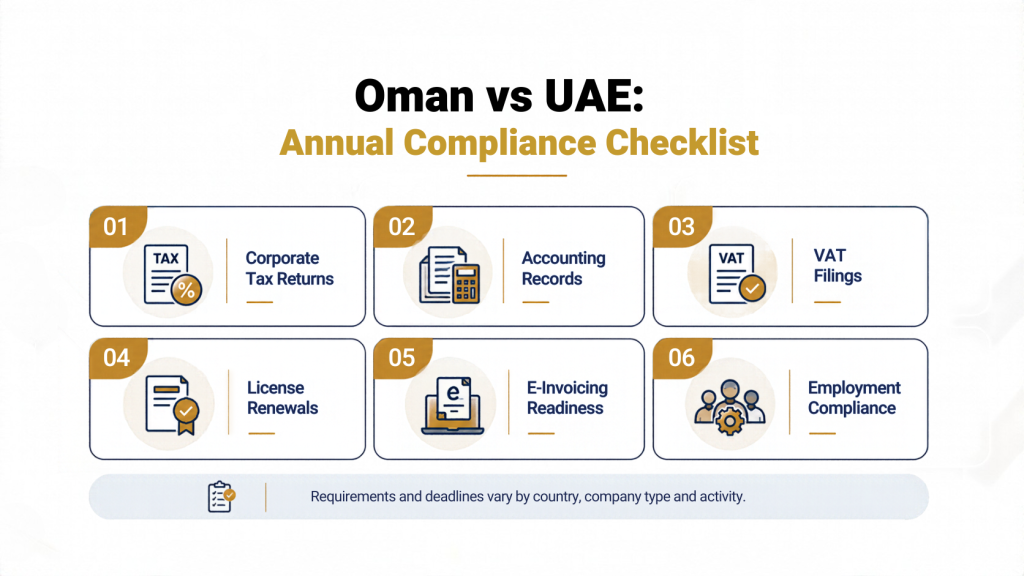
Both countries have tightened compliance in recent years. Here is what you will deal with every year.
Corporate tax returns: in UAE, register with the Federal Tax Authority and file within nine months from the end of the tax period, regardless of whether you pay 0%.
In Oman, all firms must register with the Oman Tax Authority and file an annual tax return, regardless of whether or not they make a profit.
Accounting records: both expect proper books. In the UAE, QFZPs and companies with revenue above AED 50 million need audited financial statements.
VAT returns: periodic filing in both once registered.
Transfer pricing: Related party transactions should be arm’s length in UAE, and documentation is important for group structures.
E-invoicing: The United Arab Emirates’ new VAT system will be made mandatory starting 1 January 2027 for all companies earning AED 50 million or more, while the rest will follow on 1 July 2027.
The Fawtara program of Oman started with a pilot in August 2026; Tax Authority Decision 189/2026 mandates implementation phases starting from 2027, which depends on whether the supplies for the year exceeded OMR 5 million.
Licence renewals and local hiring reporting: annual in both.
E-invoicing deadlines in 2027 will be the task that needs to be planned at the moment for the company run by the founder outside Poland, as he will need software and a certified provider.
Read this guide: Oman Company Compliance Requirements in 2026 guide.
Which is better, Oman or UAE, for your business?
This is where the comparison becomes a decision.
Business Type | Best Fit | Why? |
Consulting, IT & Digital Services | UAE | Lower tax on modest profits, more banking options |
Trading & Import-Export | Both | Oman: port access; UAE: established trade networks |
Manufacturing & Logistics | Oman | Strategic ports and industrial opportunities |
Holding Company | UAE | Established banking and tax advantages |
Solo Entrepreneurs | UAE | No personal income tax or small-team hiring quota |
Note: The best choice depends on your business activity, tax eligibility, costs and operational needs.
Read this guide: Oman Company Formation for Foreigners
Hypothetical example: a Surat textile exporter sells into Oman and Saudi Arabia. Under the India–Oman CEPA, Oman has removed duties on all 945 textile and apparel tariff lines.
An Omani trading subsidiary could import duty-free and distribute regionally. The founder would need to plan for the one-Omani hiring rule and a local banking relationship.
A second example: a Bengaluru SaaS founder billing US and European clients would usually look at a UAE free zone.
The key question is whether the income counts as qualifying income, and whether the company is really managed from the UAE (see below).
Some businesses use both: a UAE company for services and banking, and an Omani entity for trading into Oman.
That works only if each company has genuine substance. If you are unsure which fits, a structuring consultation before registration is far easier than restructuring later.
What Indian founders should check first
Rules for Overseas Direct Investment: Indian investors investing in a foreign company have to comply with India’s Overseas Investment Rules and Regulations (2022).
Getting this right also helps with source-of-funds questions from GCC banks. Vorx offers FEMA and overseas investment advice.
Place of Effective Management (POEM): If critical management and business decisions are made in India, then Indian tax laws allow for the foreign company to be considered a tax resident of India.This is the biggest risk for founders who run a UAE or Omani company from India.
Treaties: Taxation agreements are present in both these countries with India. It is essential that before earning from either of the countries, you should be clear about the tax implications.
Trade agreements: the India-UAE CEPA has been in effect since 2022, while the India-Oman CEPA has been in effect since 1 June 2026. For goods businesses, compare tariff treatment for your specific products.
Conclusion:
For most service, digital and holding businesses, the UAE is the stronger default thanks to lower tax on modest profits, no personal income tax and a deeper banking market.
There is a need to seriously consider Oman as an area of business for trade, logistics, and manufacturing companies, particularly Indian exporters using the recently signed CEPA. Neither is inherently better.
The next logical step would be to assess how well your business model withstands the following four criteria: taxation, ownership, hiring locally and banking.
If you would like a second opinion, Vorx Consultancy helps founders compare structures, set up in the UAE or Oman, and plan banking and compliance before they commit. Book a consultation to discuss your plans.
Planning to Start a Company in Oman or UAE?
Vorx helps entrepreneurs explore company formation, banking and compliance requirements.
