


If you were researching the formation of companies in Ghana by foreigners prior to July 2026, most of that information is now outdated.
Ghana repealed its former investment statute on 15 July 2026 and enacted the new Ghana Investment Promotion Authority Act, 2026 (Act 1173).
The headline change is big. Most foreign-owned businesses no longer need to bring in a fixed minimum capital. Trading companies are the main exception.
This guide elaborates on the changes that were made, ownership rights, the registration process, government charges for 2026 verified, the taxes that come after, and an additional checklist for Indian startups.
Planning to Register a Company in Ghana?
Understand your eligibility, foreign ownership rules, and registration requirements before getting started.
Explore Ghana Company Formation
What Changed in 2026: GIPC Act vs GIPA Act
The Ghana Investment Promotion Centre (GIPC) has been changed to the Ghana Investment Promotion Authority (GIPA).
However, the institution retains its mandate of being the investor registration agency and also acquires more monitoring and punishment powers.
Rule | Old GIPC Act (Act 865) | New GIPA Act (Act 1173) |
100% foreign-owned, non-trading | US$500,000 minimum | No general minimum |
Joint venture with a Ghanaian | US$200,000 minimum | No general minimum |
Trading (buying and reselling goods) | US$1,000,000, cash or goods | US$500,000 cash only, plus 75% skilled Ghanaian staff |
Investor registration renewal | About every two years | Every year |
Automatic expatriate quota | Up to 4 people | 2 to 12 people, valid 5 years |
The new Act continues to retain two old exemptions, including Ghanaian citizens who were deprived of citizenship by virtue of the other nations not recognizing dual citizenship and portfolio investments in shares on the stock exchange in Ghana.
There are a few sources which have noted that the foreigner-married-to-Ghanaian exception was not extended, so be sure not to count on it.
Since your Ghana budget or business plan was based on the former thresholds, it would be wise to review it before doing any submission.
Can a Foreigner Own 100% of a Company in Ghana?
Yes, in most sectors. The new Act expressly allows wholly foreign-owned enterprises and joint ventures, subject to sector laws.
Activities reserved for Ghanaians
The section 32 of the Act restricts six operations to foreigners or a company that is not totally owned by Ghanaians:
- Selling of goods or services in a market, petty trade, hawking, or operating a market stall
- Beauty salons and barbering shops
- Taxi or car-hire services with fewer than 25 vehicles
- Producing exercise books and basic stationery
- Retailing finished pharmaceutical products
- Producing, supplying and retailing sachet water
Breaching this list carries an administrative penalty of 5,000 to 10,000 penalty units, plus monthly penalties while it continues.
Sectors with their own capital rules
“No general minimum” does not mean “no minimum anywhere”. Banking, insurance, payment services, telecoms and mining are licensed by their own regulators, which set separate capital and ownership conditions. Check the sector regulator before you fix your stated capital.
Ghana Company Registration Requirements
Under the Companies Act, 2019 (Act 992), plan for these before you start:
At least two directors, one of whom must be resident in Ghana. Foreign nationals can be directors.
A qualified company secretary: The Act sets professional qualifications, such as membership of a recognised secretaries’ or accountants’ body, or being a Ghanaian lawyer.
An auditor’s written consent to act for the company.
A registered office address in Ghana.
Identification of Shareholders and Directors using passports as well as TIN of directors and company secretary.
Information about beneficial ownership indicating the actual persons who own the business.
The resident-director rule is where many foreign founders get stuck. You need someone trustworthy on the ground, which is a governance decision, not just a form-filling step.
GIPA Registration Requirements 2026
Every enterprise with foreign ownership must register with GIPA. Not attending is illegal and makes one ineligible for all incentives, warranties, and work permit assistance stipulated in the Act.
Key rules:
Statutory time frame: If your application is in order, GIPA should register you in five days.
Trading firms: minimum investment of US$500,000 in cash equity, and at least 75% of the workforce should be skillful Ghanaians. Import of goods will no longer contribute to the figure.
Annual renewal: non-renewal incurs a penalty of 7,000 penalty units and monthly charges. Based on the reported rate of GHS 12 per penalty unit by Ghanaian advisors, it will cost roughly GHS 84,000.
Anti-fronting: even if the company looks to be a Ghanaian company, then this still falls under the requirement for foreign capital if any beneficial owner or director is not a Ghanaian.
Branches & Technology Licences: To open another branch, one should first obtain GIPA’s permission; technology transfer arrangements (licences, franchises, management fees) need to be approved for payments to be deducted for tax purposes.
Checklist for Indian Founders
Ghana filings are only half the job. Indian residents also need to comply with Indian rules:
Overseas Direct Investment (ODI): An investment in a company of Ghana is governed by India’s Foreign Exchange Management (Overseas Investment) Rules & Regulations, 2022 and is reported through your authorized dealer bank.
Persons: remittances for foreign investments come under the US$250,000 cap of the Liberalised Remittance Scheme per financial year.
Double taxation: we could not confirm a comprehensive India–Ghana tax treaty in force. Plan around unilateral foreign tax credit relief under Indian law and get advice before choosing between dividends, fees or royalties.
Transfer pricing: The price charged for the transfer of goods between the Indian company and the Ghanaian company should be an arm’s length price. If there is any technology or management agreement, then it will require GIPA filing too.
Expanding Your Business from India to Ghana?
Plan your Ghana company registration alongside Indian overseas investment and compliance requirements.
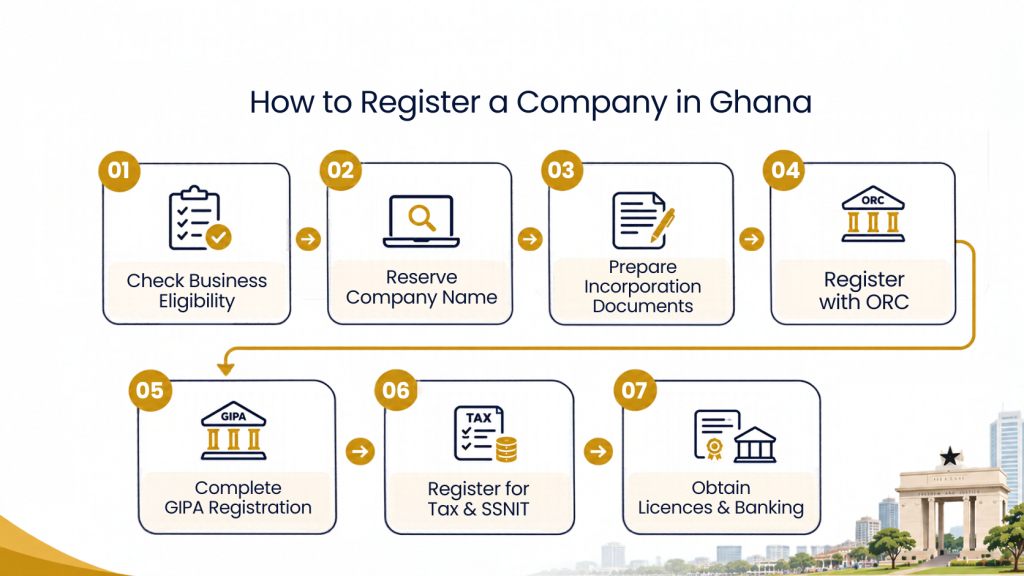
Step-by-Step Company Registration in Ghana
Verify that the activity is allowed: It should not be reserved and whether there is a sector license required.
Name of the Company Reserve the company name using the ORC website portal.
File incorporation documents such as the company constitution, Form 3, officer consents, and beneficial ownership profile.
File with the ORC and pay fees: On approval you receive the Certificate of Incorporation and certified documents.
Register with GIPA after incorporation and before you start operating.
Register with the Ghana Revenue Authority (GRA) for tax and, where required, VAT.
Register with SSNIT before hiring staff.
Obtain sector licences and open a bank account. Bring your capital in through a Ghanaian bank and keep the transfer records.
Subsidiary or Branch? Choosing the Right Structure
Most foreign investors choose between a new Ghanaian company and a registered branch of their existing company, called an external company.
Factor | Private company limited by shares (subsidiary) | External company (branch) |
Legal status | Separate Ghanaian company | Extension of the foreign parent |
Parent’s liability | Limited to its investment | Parent exposed to branch liabilities |
ORC registration fee (2026) | GHS 585, plus 1% duty on stated capital | US$1,400 (cedi equivalent) |
Tax on profits | 25% corporate tax | 25% corporate tax |
Tax when profits go home | 8% withholding tax on dividends | 8% tax on repatriated branch profits |
Local credibility | Usually stronger with banks and customers | Can work for project or contract-based work |
For most SMEs and startups, a subsidiary is the cleaner choice. It ring-fences risk and is simpler to explain to Ghanaian banks, landlords and customers.
Not Sure Whether to Choose a Subsidiary or Branch?
Vorx Consultancy can help you evaluate your business structure, registration requirements, and compliance considerations.
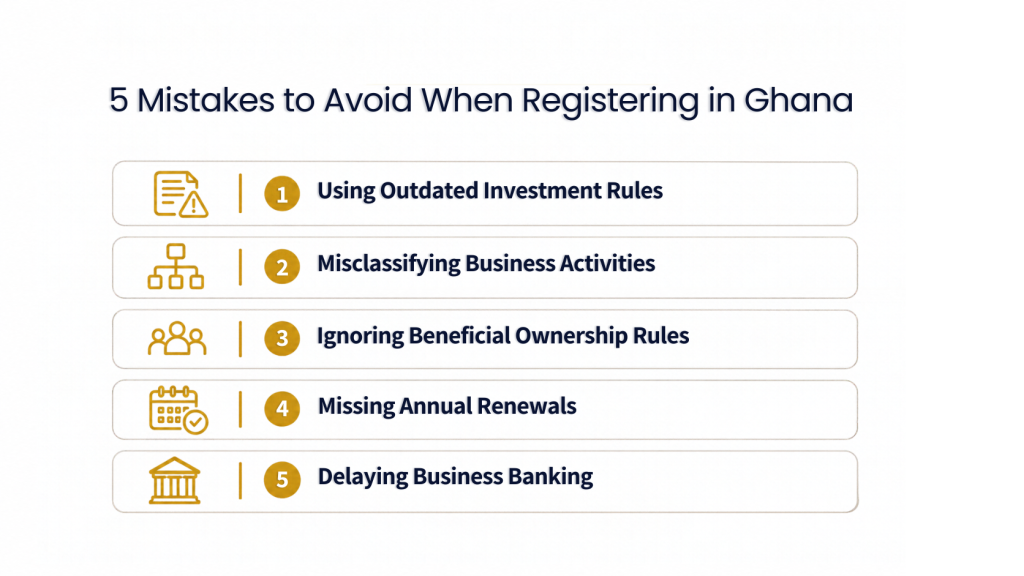
Common Mistakes to Avoid
Planning on pre-July 2026 rules. Old capital figures and the goods-in-kind route for trading are no longer valid.
Misclassifying the business. If you buy and resell goods, you are trading, even if you also provide services.
Using a Ghanaian nominee to avoid the rules. The new beneficial-ownership test targets exactly this.
Forgetting annual renewals. GIPA renewal, ORC annual returns and tax filings each have their own dates.
Leaving banking until last. Account opening for foreign-owned companies involves detailed checks; start early.
Conclusion
It has become easier than ever before to access Ghana with business interests in services, technology, and manufacturing compared to the past decade. The downside is that there is stricter compliance in terms of GIPA renewals and penalties.
What should be done next includes ascertaining three important factors: if you are trading, the suitable structure for it and your resident director and secretary.
In case you require assistance with your mapping of entry into Ghana, Vorx Consultancy can assist in arranging for company formation, GIPA registration, banking and the ODI procedures in India in relation to the same. Schedule an appointment to discuss your plans under the 2026 laws.
Ready to Establish Your Business in Ghana?
From company formation and GIPA registration to banking preparation and compliance, Vorx Consultancy can help you plan your next steps.
