


Registering a company in Ghana is the easy part. Keeping it in good standing every year is where most foreign-owned businesses slip.
The rules for Ghana companies arise from four bodies, namely the Office of the Registrar of Companies (ORC), Ghana Investment Promotion Authority (GIPA), Ghana Revenue Authority (GRA) and Social Security and National Insurance Trust (SSNIT). Each runs its own calendar, portal and penalty regime.
And 2026 changed the rules in three important ways:
A new investment law: Ghana Investment Promotion Authority Act, 2026 (Act 1173) repealed the old GIPC Act. It received assent on 15th July 2026 and provided for annual renewal of registration of foreign involved companies.
A new VAT law:The VAT Act, 2025 (Act 1151) became law on 1 January 2026, which affected registration thresholds and the abolition of the flat rate scheme.
Real enforcement: The ORC started imposing fines on companies which had failed to submit their beneficial ownership data since 12 January 2026. The ORC imposed fixed penalties for late annual submissions.
This guide explains an overview of what a foreign company registered in Ghana is supposed to submit and the consequences of failure to do so.
It is written for founders, directors and finance departments that are managing a Ghana-based company from outside Ghana, particularly Indian firms with subsidiaries in Ghana.
Quick answer: An average private firm which is owned by foreigners in Ghana will have to submit annual returns with audited accounts to the ORC, update their beneficial ownership information, register annually with GIPA, file corporate tax returns within four months from the end of the year, pay provisional tax on a quarterly basis, and file monthly VAT returns if registered.
Ghana Company Compliance at a Glance: Four Regulators
Before going into detail, it helps to see who expects what.
Regulator | What they expect | How often |
ORC (Registrar of Companies) | Annual returns with financial statements, beneficial ownership details, changes to directors, shares and address | Yearly, plus whenever details change |
GIPA (formerly GIPC) | Registration renewal for companies with foreign participation; expatriate quota and technology transfer approvals | Yearly under Act 1173 |
GRA (Revenue Authority) | Corporate income tax, Growth and Sustainability Levy, VAT, PAYE, withholding tax, transfer pricing returns | Monthly, quarterly and yearly |
SSNIT | Social security contributions and monthly contribution reports | Monthly |
Regulated sectors such as banking, insurance and energy add their own licences on top; this guide covers what almost every company shares.
Read this guide: Ghana Company Formation for Foreigners in 2026 guide.
Ghana Company Filing Deadlines: A Sample Annual Calendar
The dates below assume a 31 December financial year-end, which most Ghanaian companies use. If your year-end is different, the annual tax deadlines move with it.
When | Obligation | Regulator |
By the 14th of every month | SSNIT Tier 1 contributions and contribution report for the previous month | SSNIT |
By the 15th of every month | PAYE deducted from salaries in the previous month | GRA |
By the last working day of every month | VAT return and payment for the previous month (if VAT-registered) | GRA |
End of each quarter | Provisional corporate tax and Growth and Sustainability Levy instalments | GRA |
30 April | Corporate income tax return for the previous year, employer’s annual return, transfer pricing return (if applicable) | GRA |
Window announced by the ORC each year | Annual returns with financial statements | ORC |
On your GIPA renewal date | Annual GIPA registration renewal | GIPA |
Within the prescribed time after any change | Updates to directors, secretary, shareholders, beneficial owners or address | ORC |
Regulators sometimes extend deadlines (in 2026 the ORC moved annual returns from 30 April to 30 June), but extensions are announced, never guaranteed. Diarise the original date.
Managing Ghana Company Compliance from Overseas?
Keeping track of multiple filing deadlines can be challenging. Vorx Consultancy helps foreign business owners navigate corporate compliance requirements and stay organised.
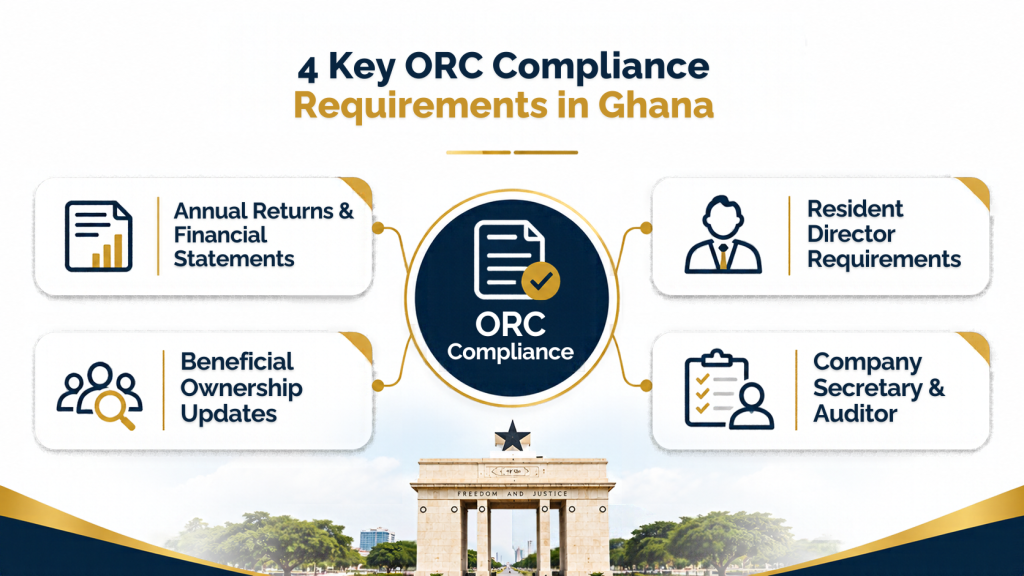
ORC Requirements: Annual Returns, Beneficial Ownership and Company Records
The Companies Act, 2019 (Act 992) is the foundation of Ghana corporate compliance requirements. The ORC administers it.
Annual returns with financial statements
Every company must file an annual return once a year. The ORC’s 2026 notices made clear that the return must be filed together with financial statements; a return without them is treated as non-compliant.
This applies to companies with share capital, companies with guarantee, unlimited companies and external companies (which are branches of foreign companies).
Beneficial ownership disclosure
It is important that businesses reveal the people behind the business who have control over or influence on the business. For foreign organizations, this means identifying the ultimate owners through the holding company structure.
The ORC began enforcing a GH¢500 penalty on non-filers from 12 January 2026. Individuals who fail to provide the information, or give false details, face larger fines or imprisonment. The ORC has also banned bearer shares.
Beneficial ownership is not a one-time filing. Any change in ownership or control needs to be updated.
Directors, company secretary and auditor
Three governance rules catch foreign owners off guard:
- Resident director: A company needs at least two directors, and at least one must be ordinarily resident in Ghana (section 171 of Act 992).
- Qualified company secretary: Act 992 requires a company secretary who meets the qualifications in the Act. Operating for more than six months without one is an offence.
- External auditor: The law requires that organizations appoint an external auditor. However, there is a very small exception to this rule, but the exception does not cover small organizations that are part of larger groups.
GIPA Registration Renewal Ghana: What Changed in 2026
This is the biggest compliance change for foreign-owned businesses this year.
The Ghana Investment Promotion Authority Act, 2026 (Act 1173) superseded the GIPC Act, 2013 (Act 865) to transform GIPC into GIPA. It was granted by the President on 15 July 2026.
Annual renewal replaces two-year renewal
Under the old law, GIPC certificates were renewed every two years. According to Act 1173, registration has to be renewed on an annual basis. Enterprises that were registered according to the former Act remain registered, but they have been brought into the annual cycle.
Practical step: confirm with GIPA when your first renewal under the new Act falls due. Do not assume your old two-year date still applies.
Minimum capital rules relaxed, except for trading
Act 1173 removed the general minimum foreign capital requirements for joint ventures and wholly foreign-owned companies. Under the old law these were US200,000andUS500,000.
Trading companies are the exception. Reported figures put the requirement at US$500,000 in cash equity, plus at least 75% of employees being skilled Ghanaians. Six categories of activity remain reserved for Ghanaians.
Expatriate quotas and technology transfer agreements
The quota for expatriates is now based on the level of investment capital from 2 to 12 expatriates per capital level from US50,000toaboveUS10 million. Quotas and permits previously issued still remain valid until their expiration date.
Should your Ghana firm pay an overseas subsidiary company for technology, know-how, computer software licenses or managerial services, ensure that the deal is filed with GIPA.
According to Act 1173, banks are supposed to check the registration of the payment in question, and fees paid under unregistered contracts are not tax-deductible.
Is Your Ghana Company Ready for the 2026 Compliance Changes?
From GIPA registration renewals to corporate obligations, Vorx Consultancy helps international businesses understand and manage their compliance requirements.
Ghana Company Tax Compliance: Corporate Tax, GSL and VAT
Corporate income tax and quarterly payments
Corporate tax is charged at a flat rate of 25% and different rates apply to certain sectors like mining.
Businesses make provisional tax payments through four quarterly instalments. The final return needs to be paid within four months after the financial year-end date, which is 30 April.The GRA can grant an extension of up to two months on application.
The return is filed with audited financial statements, which is why your audit timetable drives your tax timetable.
Growth and Sustainability Levy (GSL)
On top of corporate tax, most companies pay the GSL:
- 2.5% of profit before tax for most companies (Category C)
- 5% of profit before tax for listed sectors such as banks, insurers and telecoms (Category A)
- 1% of gross production for mining and upstream oil and gas
The levy applies through 2028, is not deductible for corporate tax, and applies even to companies enjoying a tax holiday. Many foreign investors miss it when modelling Ghana returns.
Read this guide: Ghana Company Tax Guide in 2026.
Ghana VAT filing requirements under the new VAT Act
The VAT Act, 2025 (Act 1151) took effect on 1 January 2026. The key points for foreign-owned businesses:
- Goods suppliers must register once taxable supplies reach GH¢750,000 a year (up from GH¢200,000).
- Service suppliers must register regardless of turnover, unless the GRA permits otherwise. This matters for consultancies, IT firms and other service businesses.
- The flat rate scheme and the COVID-19 levy were abolished. The combined effective rate is now about 20% (15% VAT plus 2.5% NHIL and 2.5% GETFund).
- Returns are filed monthly, by the last working day of the following month.
Transfer pricing and branch profits
If your Ghana company trades with related parties abroad (buying goods from the parent, paying management fees or royalties), transfer pricing documentation and a transfer pricing return are part of the annual cycle.
Branches of foreign companies also face an 8% branch profit remittance tax on profits treated as repatriated.
Payroll Compliance: PAYE and SSNIT
After you employ someone in Ghana, paying them is a recurring monthly affair:
PAYE: Deduct the income tax on salaries and remit it to the GRA by the 15th of the following month.
SSNIT: contributions account for 18.5% of the basic salary, where 13% is paid by the employer while 5.5% is paid by the employee.
Out of these contributions, 13.5% is contributed to SSNIT (Tier 1) by the 14th of the next month, while 5% goes to a private Tier 2 scheme.
Annual employer return: Summary of earnings and PAYE for the employees, to be prepared by 30 April.
Late SSNIT payments attract a penalty of 3% per month, which compounds quickly. Non-payment of contributions is also a criminal offence.
Extra Obligations for Indian Parent Companies
If your Ghana company is owned by an Indian company or resident individual, Ghana compliance is only half the picture.
Annual Performance Report (APR): According to the FEMA Overseas Investments regulations, the Indian investor should prepare an APR for every overseas company via their authorized dealer bank by 31st December each year.
In the case of a subsidiary in Ghana, whose financial year ends in December, the APR for that particular year will be filed by 31st December of the next year.
Audited accounts: If the Indian investor controls the foreign company, then the APR should be based on audited accounts. A timely Ghana audit therefore serves both countries.
Tax treaty position: It is not advisable to rely on the relief provided by any treaty in respect of dividends, interest, royalties or service charges between Ghana and India. This should be verified prior to making intercompany transactions.
Coordinated planning between the Ghana and India accounting schedules prevents a usual chain reaction of: Delayed closure of Ghana accounts, which results in delayed India APR.
Ghana Company Non-Compliance Penalties
Penalties in Ghana are rarely dramatic on day one. The damage comes from accumulation and from what a bad compliance record blocks.
Failure | Possible consequence |
Late annual returns (ORC) | Fixed penalties announced in 2026: GH¢1,000 for 1–4 years in default and GH¢2,000 for 5 years or more, plus filing fees. The Act also provides for daily penalties, and persistent default can lead to the company being struck off |
No beneficial ownership filing | GH¢500 company penalty from January 2026; fines or up to two years’ imprisonment for individuals giving false or no information |
Lapsed GIPA registration | Loss of investment benefits and incentives, problems with expatriate quotas and work permits, and penalties under the new Act |
Late tax returns or payments | Penalties and interest under Ghana’s revenue administration law |
Late SSNIT contributions | 3% per month, compounding, plus possible prosecution |
Higher operational costs: when applying to be reviewed by a bank, get funding or renew a visa, you have to provide evidence of good standing, which is hindered by any inconsistencies in your ORC or GRA record.
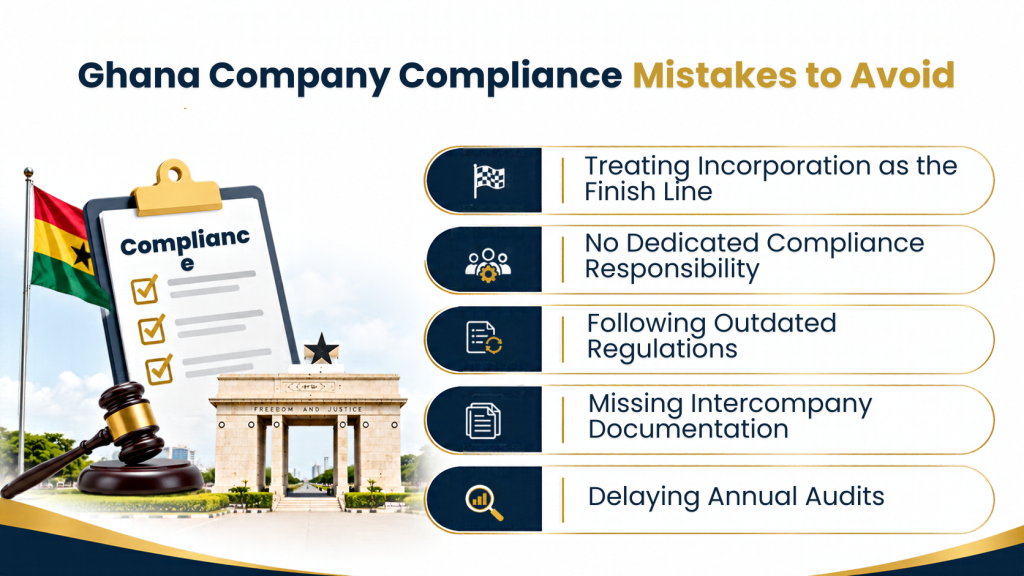
Common Mistakes Foreign Owners Make
These are the patterns that lead to turning a doable calendar into a backlog:
Treating incorporation as the finish line: Registration generates responsibilities; it does not relieve them.
No single owner for Ghana compliance: Where filing is split among the local accountants, nominee directors, and head office, timing will fall through the cracks.
Running on old assumptions: The two-year GIPC cycle, the old VAT threshold and the flat rate scheme no longer apply in 2026.
Paying the parent without paperwork: Unregistered technology transfer agreements and undocumented management fees create tax and remittance problems.
Starting the audit too late: The audit feeds the tax return, the ORC annual return and, for Indian parents, the RBI APR.
Keep Your Ghana Business Compliant Beyond Incorporation.
Avoid unnecessary compliance risks with professional guidance on company administration, regulatory filings and ongoing business obligations.
Final Thoughts: Build One Calendar, Not Four
The essence of compliance in a Ghanaian firm boils down to three annual cycles at ORC and GIPA, while those of GRA and SSNIT follow a monthly, quarterly and annual cycle.
What makes it hard for foreign owners is distance, four separate systems and a year of major legal change.
The next logical step would be to create a timeline for all year-end, registration, salary payment, and intercompany payments for your firm. If you have a parent company based in India or somewhere else, then their reporting timeline should be added as well.
The Vorx Consultancy can assist foreign businesspeople to establish, organize, and run their businesses in foreign countries, such as the entities in Ghana.
If you are planning a Ghana entity or want an existing one reviewed against the 2026 rules, book a consultation with our team for a clear, country-specific compliance plan.
