


The Bulgarian corporate tax rate for 2026 will be 10%. It is true, but only the Hungarian rate of 9% is lower in the EU.
However, when deciding on the establishment of a company in Bulgaria, what you really need to know is what remains after the profit gets to your pocket.
These depend on four other things: dividend tax, VAT, withholding tax for foreign payments, and the tax laws of your home country..
Each is explained here with 2026 figures and two illustrations. Your actual exposure will be revealed before incorporation and not after.
Here is a little point to make: Bulgaria joined the Euro on 1 January 2026. All thresholds stated below are in Euros, and returns in 2026 will be paid in Euros as well.
Read this guide: Bulgaria Company Formation for Foreigners guide in 2026.
Bulgaria tax rates 2026 at a glance
Tax | 2026 rate | Applies to |
Corporate income tax | 10% flat | Taxable profit of Bulgarian companies |
Dividend tax (withheld) | 5% | Dividends to individuals and non-EU/EEA companies |
Dividends to EU/EEA companies | 0% | Qualifying corporate shareholders |
Withholding tax on interest, royalties, technical and consulting fees | 10% | Payments to non-residents, before treaty relief |
VAT | 20% standard, 9% reduced | VAT-registered businesses |
VAT registration threshold | EUR 51,130 per calendar year | Bulgarian-established businesses |
Tax on certain expenses | 10% | Entertainment costs, some staff benefits in kind |
Global minimum tax | 15% | Groups with EUR 750m+ consolidated revenue |
The draft 2026 budget proposed doubling dividend tax to 10%. It wasn’t adopted. The 5% rate applies for the whole of 2026.
How the 10% corporate tax is calculated
This is not an income tax. It is a profit tax based on the adjusted accounting profit under the tax laws. The accountant will take the profit from your books, add back disallowed costs, and deduct reliefs like past losses.
Two things catch first-time owners:
Expenses need paperwork: An expense that is not properly invoiced or justified in terms of its business use is added back to the bottom line.
Related-party deals must be priced at market rates: When you pay your Indian or UAE company for services from your Bulgarian company, it needs to be done at the same price that unrelated companies would charge.
Transfer Pricing Ordinance is applicable from 1st January 2026 onwards. Therefore, maintain your documentation. Currently, tax loss carryforward is allowed for five years. This will probably change next year.
The separate 10% tax on some expenses
Bulgaria has an additional one-time charge of 10 percent of expenses, particularly entertainment and representation expenses, plus certain other fringe benefits offered to employees.
It’s paid on top of corporate tax. Although the figures involved are small, it tends to shock the owners who thought every business lunch would just reduce profits.
Dividend tax: where 10% becomes 14.5%
The majority of small business owners withdraw their money in the form of dividends. Whenever a company pays its dividends, 5% is withheld and forwarded to the National Revenue Agency.
Who receives the dividend changes the rate:
- You, as an individual (resident or not): 5%.
- A company in the EU or EEA: generally 0%, if the Parent-Subsidiary Directive conditions are met, including a minimum shareholding.
- A company outside the EU/EEA, such as a UAE or Indian holding company: 5%, unless a tax treaty gives less.
The treaty will only help if the treaty rate is lower than 5%. This is generally not the case, so your 5% domestic rate will apply.
Example 1: an owner who lives in Bulgaria
Hypothetical: Maya is the owner of a consulting firm based in Sofia and a tax resident of Bulgaria. The firm earns EUR 100,000 net income and Maya distributes it all.
Step | Amount (EUR) |
Taxable profit | 100,000 |
Corporate tax at 10% | -10,000 |
Profit available to distribute | 90,000 |
Dividend tax at 5% | -4,500 |
Net to Maya | 85,500 |
The total tax bill is EUR 14,500, which equates to an effective tax rate of 14.5%. As far as an EU member state goes, this is a very low figure indeed.
Example 2: an Indian founder who lives in India
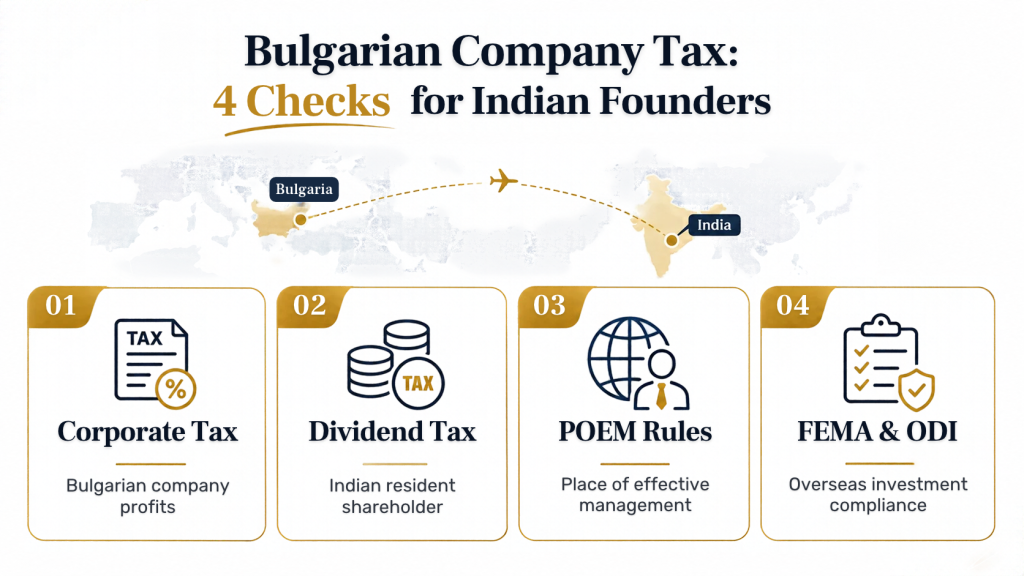
Hypothetical. Rahul is a resident of Bengaluru and earns profits worth EUR 100,000 from his Bulgarian SaaS firm. However, Bulgaria continues to charge 10% plus 5%.
However, being a resident of India, he will be subject to Indian taxation on the dividends received based on his slab rates, taking into account the 5% taxed in Bulgaria (Form 67).
Therefore, his actual rate is much closer to his Indian rate than to 14.5%. Moreover, if the important decisions of the business are made in India, the company could be considered Indian tax resident under the POEM regulations. The investment would also need to adhere to FEMA regulations on overseas investments.
This is the gap most “10% tax” articles leave out. Where you live often decides your real rate. If you’re unsure how this applies to you, our international tax and compliance team can review your structure before you commit.
Is Your Bulgarian Company Structure Tax-Efficient?
A 10% corporate tax rate doesn’t always mean lower overall taxes. Vorx Consultancy can help you assess cross-border tax exposure, dividend taxation and compliance requirements.
VAT: usually your first compliance trigger
Tax on companies is paid yearly. VAT can affect you weeks after becoming a trader.
The normal rate is 20%, with a 9% reduced rate for certain items. For transactions from 2026, a business established in Bulgaria will need to register when the taxable turnover exceeds EUR 51,130.
There were also stricter rules: You have only 7 days to apply, and you become registered from the day after you step across the border.
What this means for service businesses:
- Selling services to EU businesses? You may need VAT registration regardless of turnover under Article 97a of the VAT Act. Many IT and consulting firms trigger this early.
- Foreign companies without a Bulgarian establishment have no threshold. They register before their first taxable sale in Bulgaria.
- Monthly filing. Once registered, you file a VAT return every month, by the 14th of the following month.
- EU small business scheme. New from 2026, it can exempt small businesses whose total EU turnover stays under EUR 100,000.
Need Help With Bulgaria VAT Registration?
VAT registration deadlines and cross-border transactions can create compliance obligations earlier than expected. Vorx Consultancy can assist with VAT registration and ongoing compliance coordination.
Withholding tax on payments abroad
In case your Bulgarian company pays anyone outside of Bulgaria, there may be withholding tax involved. The withholding tax is generally at 10% for interest, royalty, and technical or consulting fees paid to non-residents, while dividends are taxed at 5%.
The rate can drop in two ways:
- EU directives: Interest and royalties that are paid to related EU companies may be exempted, usually where there is a 25%+ shareholding connection.
- Tax treaties: The number of treaties signed by Bulgaria is about 70. In general, relief requires evidence of tax residency of the recipient.
For instance, if your Bulgarian company pays a license fee for software to an Indian company, you would have to establish whether this is a royalty and what the relevant treaty rate is. Otherwise, the Bulgarian company will be liable for the unpaid tax.
Advance payments, the annual return and key dates
Larger companies don’t pay corporate tax once a year. They pay in advance, based on expected profit.
Prior-year net revenue | Advance payments |
Up to about EUR 153,000 | None |
About EUR 153,000 to 1.53 million | Quarterly |
Above about EUR 1.53 million | Monthly, by the 15th |
A newly registered company makes no advance payments in its first year. Underestimate badly later on, and interest is charged on the shortfall.
Key dates for a calendar-year company:
Deadline | What’s due |
14th of each month | VAT return, if registered |
15 April | Advance payment declaration, if required |
30 June | Annual corporate tax return (Form 1010) and final tax payment |
30 September | Annual financial statements published in the Commercial Register |
So the return for the 2026 tax year is due by 30 June 2027, in euro.
Minimum tax and SAF-T: who needs to worry
Since 2024, Bulgaria has been operating on the global minimum tax of 15%. This applies to only those groups whose consolidated income is EUR 750 million and above. For a new business or an SME, the 10% rate remains.
Your accounting records, maintained in a standard electronic file called SAF-T, have also been made mandatory by law.
It will be phased in, beginning with large businesses. Small businesses need to find out from their accountant at which stage it would apply and what software would generate it.
What may change in 2027
The Ministry of Finance published draft tax bills on 23 September 2026. As at mid-November 2026 they are still in parliament but not enacted into law yet. Key issues for founders:
- The VAT registration threshold would rise from EUR 51,130 to EUR 75,000.
- Tax losses could be carried forward for 10 years instead of 5, but only against up to 70% of each year’s profit.
- A one-off 33% tax on excess profits would apply to certain sectors such as banks, insurers and telecoms. It isn’t aimed at typical SMEs.
- None of the drafts changes the 10% corporate tax or the 5% dividend tax.
We’ll update this guide when the final law is passed.
Common mistakes we see
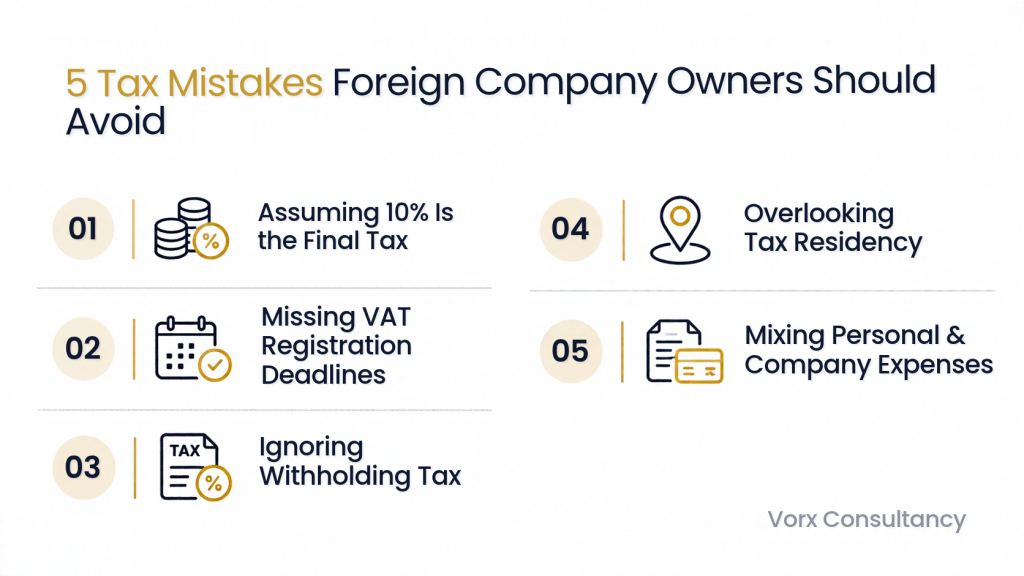
- Treating 10% as the final tax without checking home-country tax on dividends.
- Missing the 7-day VAT window after crossing EUR 51,130.
- Paying foreign contractors without checking withholding tax.
- Running the company entirely from abroad with only a Bulgarian address. This weakens your tax position and often causes trouble with banks. See our guide to business banking for foreign-owned companies.
- Mixing personal and company spending, which gets added back to profit.
Is a Bulgarian company right for you?
Bulgaria does not make much sense from an investor perspective if the intention is to only save on taxes without operating the enterprise from that country, especially when one remains a tax resident of India or UK. Otherwise, Bulgaria makes great sense.
Before you incorporate, run your own numbers: expected profit, how you’ll pay yourself, where you live and who your customers are.
If you want another set of eyes to look at it, Vorx can help you with your tax exposure, Company formation in Bulgaria, and VAT and annual filings.
Planning to Start or Operate a Company in Bulgaria?
Understanding your total tax exposure is essential before making business decisions. Vorx Consultancy supports international entrepreneurs with Bulgaria company formation, tax registration and ongoing compliance.
Book a Consultation With Vorx Consultancy
