

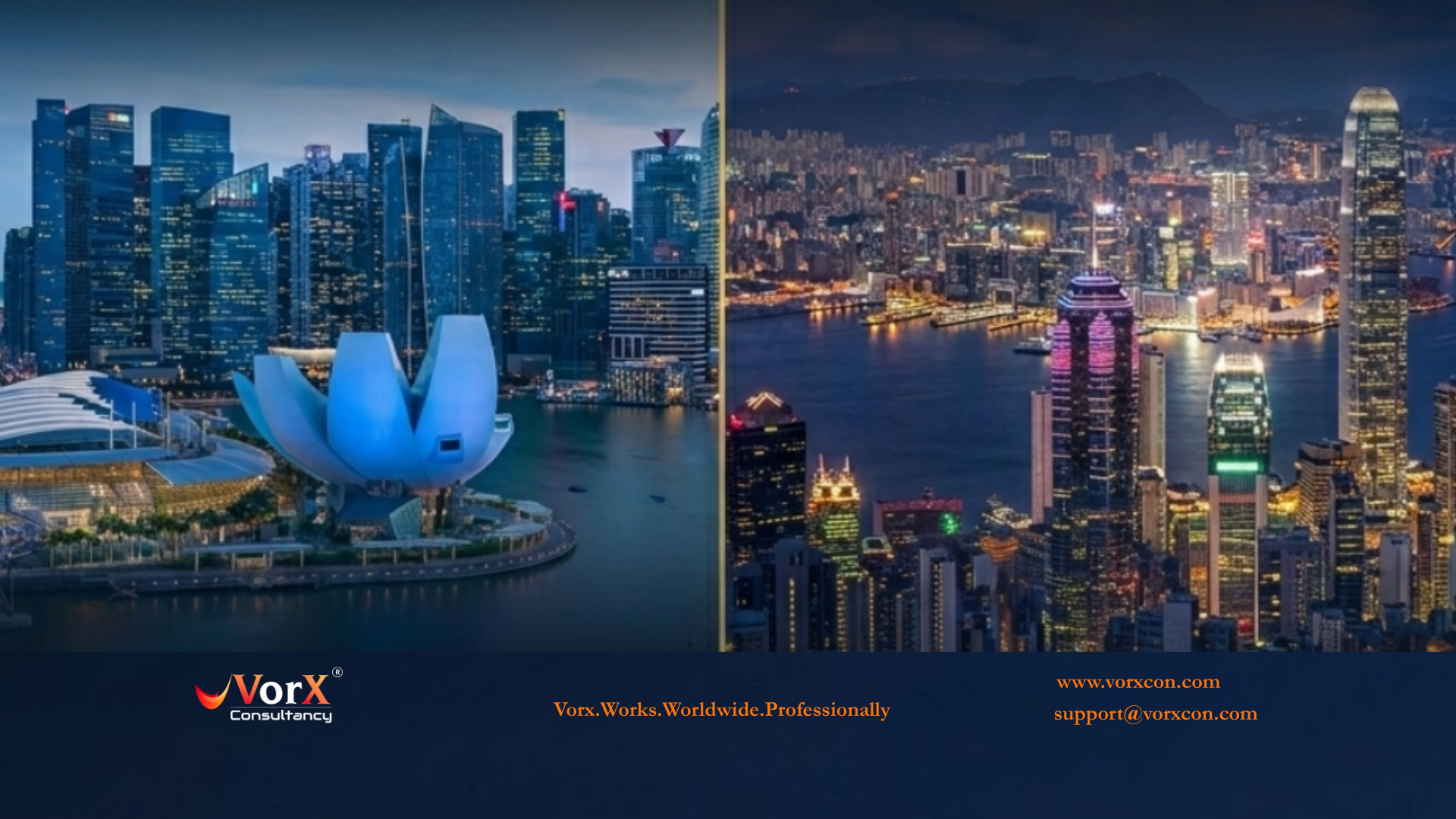
A Strategic Decision Framework for Founders
Choosing between Singapore and Hong Kong in 2026 is not a branding exercise. It is not about which jurisdiction “sounds stronger” in investor conversations. It is a structural decision that will shape your tax experience, banking access, compliance workload, Immigration pathway, & long-term capital strategy.
Singapore and Hong Kong are elite global financial hubs. Each jurisdiction permits 100% foreign ownership and operates within an internationally recognized legal system. Founders also benefit from efficient and streamlined incorporation procedures in both locations.
Yet they operate on fundamentally different regulatory philosophies.
Singapore represents structured governance, policy predictability, & Institutional Alignment with global capital markets. Hong Kong represents territorial taxation Efficiency, commercial pragmatism, & deep integration with Mainland China.
The correct choice is rarely about headline tax rates. It is about alignment between your revenue geography, management substance, capital sources, and expansion strategy.
Regulatory Philosophy: Structured Governance vs Territorial Interpretation
Singapore’s corporate Ecosystem is built on clarity & codification. Regulatory updates are incremental, documented, and Publicly communicated. Compliance Expectations are clearly defined, and enforcement tends to be consistent. For founders building long-term, venture-scalable structures, this Predictability Reduces uncertainty.
Hong Kong, by contrast, operates on a territorial taxation model. The jurisdiction taxes profits sourced within Hong Kong while exempting genuinely offshore income. However, the burden of proof lies with the company. Profit source is not assumed — it is assessed. This creates flexibility, but also requires disciplined documentation and defensible operational structuring.
In practical terms, Singapore regulates through formal compliance architecture. Hong Kong regulates through interpretation of economic activity.
If your company generates cross-border digital revenue, licenses intellectual property, or plans institutional fundraising, Singapore’s structured approach may provide clearer long-term positioning. If your business is closely connected to Mainland China trade flows and can clearly separate offshore income, Hong Kong’s territorial model can offer efficiency — provided it is defensible.
Flexibility without documentation becomes exposure.
Tax Architecture: Beyond Headline Rates
Singapore applies a 17% corporate tax rate, but startups often reduce their effective tax burden during early-stage operations by leveraging structured exemptions and incentive schemes. The authorities may exempt foreign-sourced income under specific conditions, and they administer the system through strict documentation requirements rather than aggressive interpretation.
Hong Kong’s corporate profits tax is 16.5%, operating under a two-tier system that lowers tax on the first band of assessable profits. There is no VAT or GST regime. The jurisdiction’s defining feature is territorial taxation — only Hong Kong-sourced profits are taxed.
The key difference lies not in percentage points but in structural logic. Singapore provides incentive-driven reductions within a globally aligned framework. Hong Kong provides potential tax neutrality for offshore income, subject to source analysis and review.
For founders, the strategic question is not “Which tax rate is lower?” but rather, “Where does my profit-generating activity legally occur, and can I substantiate it?”
Tax efficiency must be sustainable under audit conditions.
Banking Environment: Institutional Depth vs Commercial Flexibility
No incorporation strategy is complete without banking feasibility. Both jurisdictions have tightened onboarding standards in recent years due to Global anti-money laundering compliance requirements.
Singapore’s banking Ecosystem is highly respected internationally. Institutions tend to conduct thorough due diligence, often requiring in-person Verification & Detailed business plans. Approval can take time, But once secured, banking relationships are stable and globally credible. For Venture-backed startups or technology-driven companies, this credibility carries weight.
Hong Kong banks also maintain strong global reputations, Particularly for trade finance & China-linked transactions. However, Scrutiny has intensified, Especially where companies claim offshore income. Banking narratives must Align precisely with transaction flows, operational substance, & documentation.
In both jurisdictions, the real bottleneck is rarely company incorporation. It is bank account activation.
Incorporating without validating banking strategy can result in dormant entities with no operational capability.
Immigration and Founder Relocation
Incorporation does not automatically grant residency rights. Immigration frameworks in both jurisdictions operate independently from corporate registration.
Singapore integrates corporate substance and immigration more closely. Employment passes are structured and documentation-driven, and the requirement for a resident director embeds local governance into the company framework. Founders intending to relocate often find Singapore’s system predictable, though compliance-heavy.
Hong Kong offers entrepreneur visa pathways focused on economic contribution and business viability. There is no mandatory local director requirement, which provides structural flexibility. However, visa approval depends on demonstrating meaningful local economic engagement.
Relocation planning should precede incorporation decisions. Sequencing matters. Establishing a company without considering immigration alignment can create unnecessary restructuring later.
Governance and Compliance Obligations
Both jurisdictions operate within high-standard compliance environments. Neither is a low-substance offshore shelter.
Singapore requires at least one resident director and annual compliance filings. Small companies may qualify for audit exemptions, reducing early-stage compliance costs. The governance model emphasizes procedural clarity.
Hong Kong requires a company secretary, annual returns, and annual audits for most entities. While there is no resident director requirement, audit obligations are more broadly applied.
From a cost perspective, founders should evaluate a three-year compliance horizon rather than focusing on first-year setup expenses. Long-term sustainability matters more than incorporation speed.
Market Positioning and Expansion Strategy
Singapore positions itself as the gateway to Southeast Asia. It offers strong intellectual property protection, reliable judicial systems, and deep integration with ASEAN markets. It is frequently chosen as a regional headquarters by multinational corporations and is well aligned with venture capital ecosystems.
Hong Kong serves as a commercial bridge to Mainland China. Its relevance lies in capital markets connectivity, trade infrastructure, and proximity to the Greater Bay Area. For businesses sourcing, distributing, or settling transactions linked to China, this positioning is strategically valuable.
The choice therefore depends on expansion trajectory. ASEAN growth strategies often align structurally with Singapore. China-facing operations may align more naturally with Hong Kong.
Geopolitical and Perception Considerations
Singapore is widely viewed as politically stable, regulatory-consistent, and globally neutral. Investor perception tends to be uniformly positive across Western and Asian markets.
Hong Kong maintains its role as an international financial center under the “One Country, Two Systems” framework, while being closely integrated with Mainland China. For certain investors, geopolitical narratives may influence perception, even where corporate law remains robust.
Perception does not replace legal analysis — but it can influence fundraising conversations and investor comfort levels.
Applied Founder Scenarios
To illustrate alignment, consider three simplified structural profiles:
- A venture-backed SaaS company targeting ASEAN markets and institutional investors may benefit from Singapore’s IP protection, venture ecosystem, and regulatory predictability.
- A trading entity deeply integrated with Mainland China supply chains may find Hong Kong’s territorial taxation and geographic positioning commercially efficient.
- An international holding company managing global subsidiaries must assess management control location, treaty networks, capital origin, and board substance before selecting either jurisdiction.
In each case, the decision is architectural, not cosmetic.
Conclusion: Architecture Over Headlines
Singapore & Hong Kong are both high-caliber jurisdictions. Neither is universally superior. Each rewards disciplined structuring & penalizes superficial planning.
Singapore offers Regulatory clarity, incentive-driven tax architecture, & strong institutional positioning within Southeast Asia. Hong Kong offers territorial taxation logic, China integration, and governance flexibility..
The decisive factor is not which jurisdiction is “better.” It is which jurisdiction aligns with your company’s operational substance, capital structure, and long-term expansion path.
Incorporation is easy.
Sustainable structuring is not.
Founders who build with alignment scale efficiently.
Founders who build for optics restructure later.
Choose architecture.
Strategic Advisory Note
If you are evaluating Singapore or Hong Kong for 2026 incorporation, the most important step is not filing documents — it is conducting a structural assessment.
At Vorx Consultancy, we help founders evaluate:
- Tax defensibility and revenue geography alignment
- Banking feasibility before incorporation
- Immigration structuring (if relocation is planned)
- Long-term compliance modeling
- Exit and capital strategy positioning
Before choosing a jurisdiction, choose clarity.
Book a strategic consultation today:
www.vorxcon.com
support@vorxcon.com
