

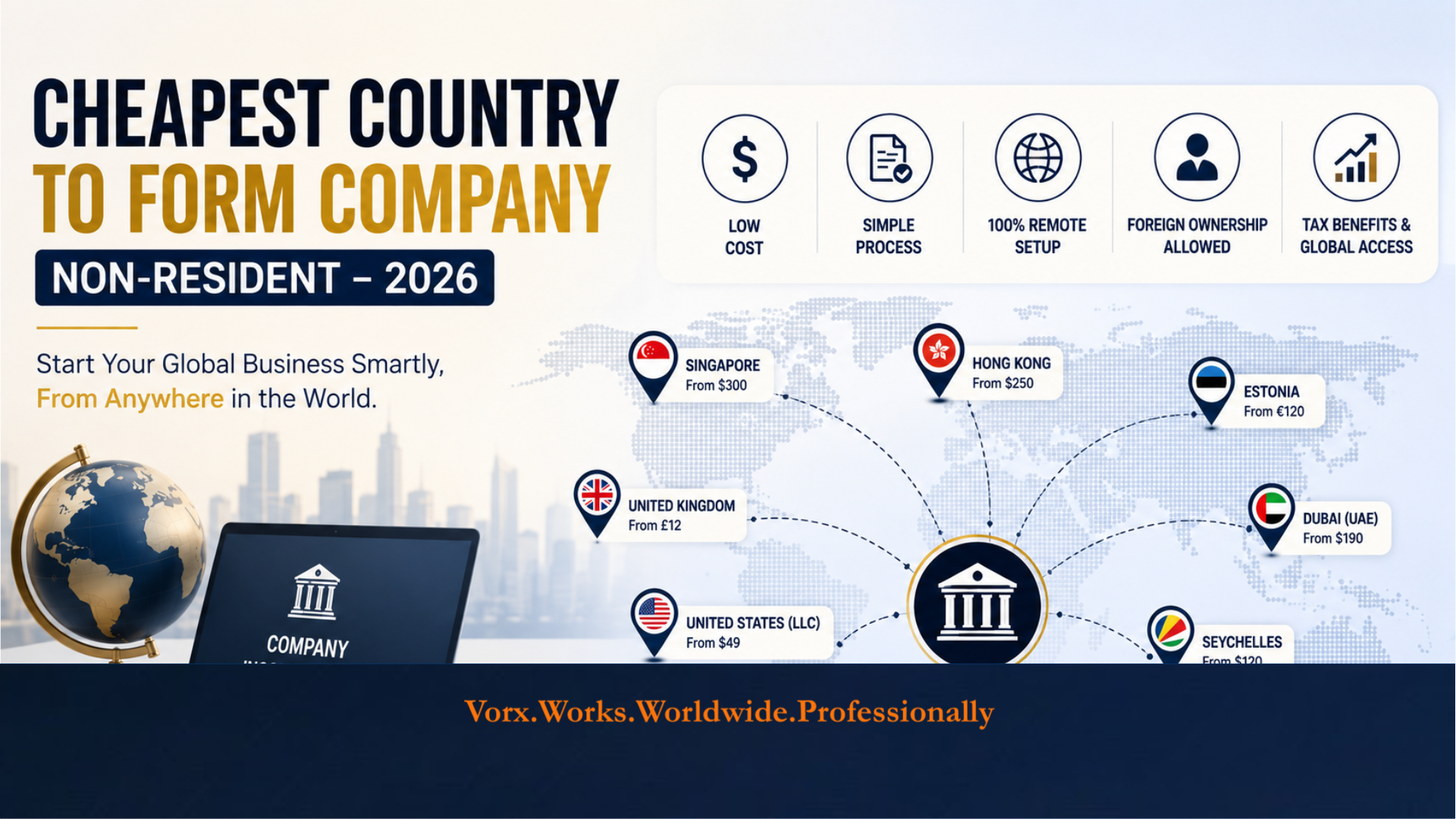
So, you’ve got a killer idea, a laptop, and a burning desire to stop paying 40% of your income to a government that barely provides decent potholes in return. You want to incorporate. But here’s the rub: you don’t want to spend five figures just to get a piece of paper that says you exist.
Finding the “cheapest” country to register a business is a bit like looking for the cheapest car. Do you want the one that’s cheap to buy but explodes on the highway, or the one that’s a bit more upfront but runs forever? In 2026, the landscape has shifted. Compliance is tighter, but digital access is better than ever.
Let’s get real about where your money goes the furthest.
Part 1: The Heavyweight Champion — The United States (Specifically New Mexico and Wyoming)
It’s a bit of a cliché, but for a good reason. The U.S. remains the gold standard for non-resident entrepreneurs. If you are looking for pure, unadulterated low-cost entry, New Mexico is your best friend.
New Mexico doesn’t require an annual report for LLCs. You pay your filing fee once, and as long as you have a registered agent, you’re basically set. Wyoming is the “premium” version of this—slightly higher fees but a reputation for privacy that’s harder to crack than an encrypted vault.
Part 2: The European Underdog — Georgia (The Country, Not the State)
Georgia is the best-kept secret in the nomad community. It isn’t just about the wine and the mountains; it’s about the 0% tax on retained earnings. In 2026, Georgia has further streamlined its “Individual Entrepreneur” status, which allows for a 1% tax rate on turnover up to roughly $180,000 USD.
Setting up here is incredibly cheap if you fly in, but even remotely, it’s a bargain compared to the rest of Europe.
Part 3: The Efficiency King — The United Kingdom
Instead of focusing on costs, it’s more useful to compare the operational advantages of each jurisdiction.
The United States offers strong global credibility and easy access to payment platforms, the United Kingdom provides one of the fastest company registration systems in the world, Georgia is known for its entrepreneur-friendly tax regime, and Estonia leads in digital infrastructure for remote founders.
Recommended Reading:
Once you have shortlisted a jurisdiction, our guide to registering a company abroad in 2026 can help you understand the key formation steps.
Part 4: The Digital Native — Estonia
Estonia’s e-Residency program is no longer the “cheapest” in terms of raw dollars. The fees have crept up over the years. However, if you factor in the “cost of my own sanity,” Estonia wins. Everything is digital. You will never, ever have to mail a physical piece of paper or visit an embassy.
For a remote founder, the ability to manage a European company from a beach in Thailand without hiring an army of accountants is where the real savings happen.
Part 5: The Hidden Pitfalls of “Cheap”
I’ve seen it a thousand times. A founder picks the Marshall Islands or some obscure Caribbean jurisdiction because the sales page promised “Zero Taxes and Total Anonymity.”
Then they try to open a bank account.
Every Tier-1 bank laughs them out of the room. They end up stuck with high-fee EMI accounts that freeze their funds every three weeks. In 2026, “cheap” registration that results in “expensive” banking is a bad deal. Always work backward from the bank account.
Recommended Reading:
Cost should not be the only factor when choosing a jurisdiction. Explore our guide to the best countries for company formation in 2026 to compare broader business considerations.
Part 6: Making the Final Call
If you want the absolute bottom-dollar price for a legitimate entity with banking access, the United States (New Mexico) or the United Kingdom are your winners.
If you want a path to residency and a unique tax setup, Georgia is the move.
If you want the most seamless digital experience and don’t mind paying a bit extra for the infrastructure, Estonia is the way to go.
Setting up a company is easy. Setting up the right company that won’t get you audited or blacklisted is the hard part. At Vorx, we specialize in helping global founders navigate these waters without the corporate fluff. Ready to go global?
Book a Strategy Call: (Calendly Link)
Visit: www.vorxcon.com
Email: support@vorxcon.com
The Bottom Line
In 2026, the cheapest country to form a company as a non-resident is the one that allows you to operate without friction. Don’t step over a dollar to pick up a dime. Focus on a jurisdiction that banks trust, that your customers respect, and that keeps your overhead low enough to actually grow. Good luck out there.
