


Europe is turning out to be a highly favored destination for professionals, especially since in 2026, there will be a high need for skilled professionals in the areas of technology, engineering, medicine, finance, and research.
High-ranking European countries like Germany, Netherlands, Poland, Spain, and Italy have opened up their borders to professionals who can fill up this need in the market.
In particular, the EU Blue Card is becoming an appealing option for skilled professionals in India and other developing countries to move to Europe.
Unlike other traditional immigration options, the ‘Blue Card Europe’ is specifically designed for high-skilled professionals with the necessary education, experience, and expertise.
This route allows individuals who have expertise in IT, Engineering, Medicine, Health Care, Research, and Business to get jobs and reside in Europe.
This article gives you an all-inclusive information regarding the EU Blue Card 2026 immigration policy, requirements, visa application process, and other details.
What is the EU Blue Card?
EU Blue Card is nothing but an employment and residence permit for highly skilled individuals that wish to move to Europe. This immigration policy has been created to attract qualified professionals and compete in the global labor market.
This immigration pathway facilitates skilled professionals to get legal employment in one of the EU member states.
The EU Blue Card is different from the traditional EU Blue Card Visa since the former targets highly skilled workers.
Highly skilled professionals should have certain qualifications, experience in working in the industry and a certain salary level. Majority of the European nations have opted for the EU Blue Card program like Germany, Netherlands, Poland, Spain, Italy, Malta, etc.
Why Choose the EU Blue Card in 2026?
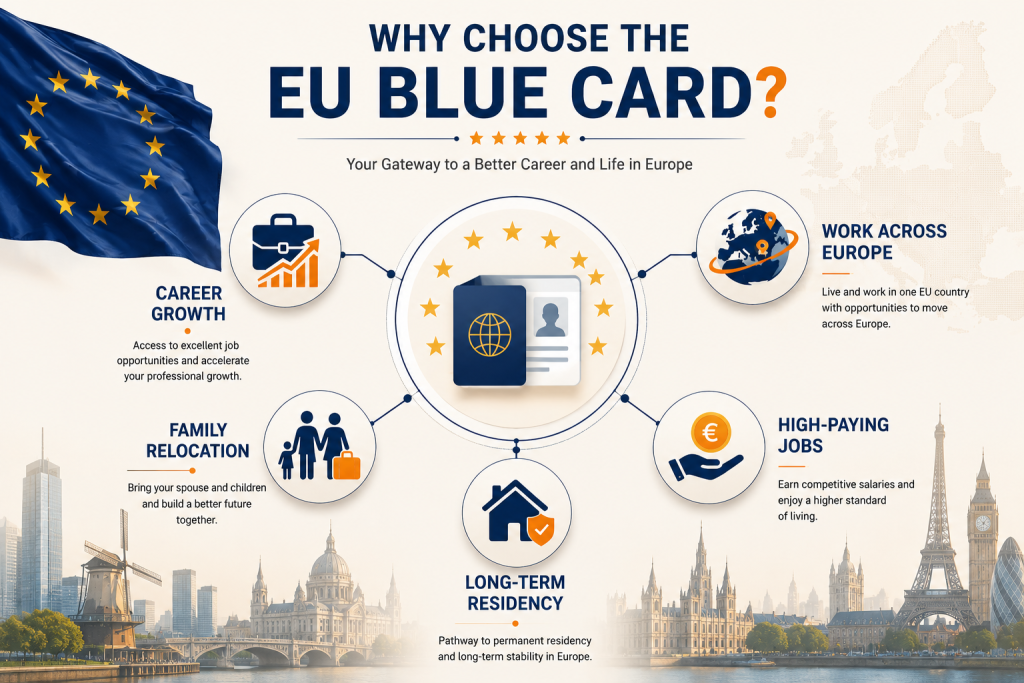
The popularity of the EU Blue Card is rising due to many advantages for international professionals.
1. Access to European Job Markets
Blue Card holders can access some of the world’s strongest economies and work with leading international companies across Europe.
2. Better Career Opportunities
Europe has a strong demand for professionals in areas such as:
- Artificial intelligence
- Software development
- Cybersecurity
- Engineering
- Healthcare
- Renewable energy
- Finance
3. Family Relocation Benefits
Many EU Blue Card holders can bring their spouses and children with them, giving families the opportunity to build their future in Europe.
4. Pathway to Long-Term Residency
Depending on the country and individual circumstances, Blue Card holders may become eligible for permanent residence after fulfilling the necessary requirements.
5. International Mobility
The EU Blue Card offers greater flexibility compared to many traditional work permits, especially for professionals planning to build a long-term career in Europe.
Vorx Consultancy Pro Tip:
The choice of the right country in Europe before applying may greatly affect your career development, tax system, and settlement opportunities.
EU Blue Card Requirements 2026: Eligibility Conditions
In order to be eligible for the EU Blue Card 2026, applicants should usually satisfy certain eligibility criteria.
Education Requirements
Applicants usually require:
- A recognised university degree
- Professional qualifications related to their job role
- Recognition of foreign qualifications where required
Some countries may also consider professional experience for specific shortage occupations.
Job Offer Requirements
A valid employment contract or job offer from an EU employer is one of the main requirements.
The position should:
- Match your qualifications
- Be considered a skilled professional role
- Meet country-specific employment standards
Salary Requirements
Applicants must meet minimum salary thresholds set by individual countries.
Salary requirements can vary depending on:
- Country
- Profession
- Shortage occupation category
For instance, there might be favorable conditions in sectors that require workers who are highly skilled.
Who Can Apply for an EU Blue Card? Eligible Professions
The EU Blue Card is mostly designed for professionals in high-demand occupations.
Technology Professionals
Technology experts are among the most in-demand applicants, including:
- Software developers
- AI specialists
- Data scientists
- Cybersecurity professionals
- Cloud technology experts
Engineering Professionals
European industries require skilled engineers in areas such as:
- Mechanical engineering
- Electrical engineering
- Industrial technology
- Automotive sectors
Healthcare Professionals
Doctors, medical specialists, and healthcare workers are highly valued due to Europe’s growing healthcare demand.
Finance and Business Professionals
Professionals in:
- Financial analysis
- Management consulting
- Business operations
may also find opportunities through skilled immigration programs.
Researchers and Scientists
European universities and research institutions continue to attract international researchers and specialists.
Best European Countries for EU Blue Card Opportunities
Germany EU Blue Card
Germany remains one of the strongest destinations for skilled professionals.
The country offers opportunities in:
- Technology
- Engineering
- Manufacturing
- Healthcare
Its strong economy and demand for skilled workers make Germany one of the most popular choices for EU Blue Card applicants.
Netherlands EU Blue Card
The Netherlands is known for innovation, international companies, and technology-driven industries.
Professionals in IT, finance, research, and engineering often find attractive opportunities here.
Poland EU Blue Card
Poland has developed into a growing technology and business hub.
The country attracts professionals due to its expanding IT sector and international companies.
Spain and Italy EU Blue Card Opportunities
Spain and Italy offer opportunities for skilled professionals, along with attractive lifestyle benefits.
These countries are rapidly gaining popularity among international workers who are exploring options to live in Europe.
Steps for Applying for the EU Blue Card
The typical procedure for applying for the EU Blue Card involves the following stages:
Eligibility Screening:
Step 1: Assess Eligibility
Determine whether you meet the criteria based on qualifications and experience.
Step 2: Secure Employment
Find suitable employment from a qualified European employer.
Step 3: Prepare Documentation
Gather all necessary documentation, including proof of qualifications and employment.
Step 4: Apply
File your application at the respective embassy or immigration department.
Step 5: Get Approved
Upon approval, your residence permit is issued.
Step 6: Move to Europe
Upon approval, you may go and start working in Europe.
Documents Required for EU Blue Card Application
Common documents include:
- Valid passport
- Employment contract
- University degree certificates
- Qualification recognition documents
- Professional CV
- Health insurance proof
- Accommodation details
- Country-specific supporting documents
Requirements may differ depending on the destination country.
EU Blue Card vs Other European Immigration Options
EU Blue Card vs Work Visa
A traditional work visa may apply to broader categories of workers, while the EU Blue Card focuses on highly qualified professionals.
EU Blue Card vs Self Employment Visa
The Blue Card is mainly for employees. Entrepreneurs and business owners may require self-employment or company formation routes.
EU Blue Card vs Digital Nomad Visa
Digital nomad visas are for remote workers, whereas the Blue Card requires employment with an EU-based company.
EU Blue Card vs Startup Visa
Startup visas are suitable for entrepreneurs launching new and unique businesses, whereas the Blue Card is designed for skilled employees.
Common Mistakes Applicants Should Avoid
Most applicants who fail or experience delays in the EU Blue Card application process make these mistakes:
- Choosing the wrong immigration path
- Failing to meet qualification recognition requirements
- Poor documentation
- Failure to understand the requirements and processes in detail
- Failure to structure their immigration and settlement plan strategically
Avoiding such mistakes can significantly increase the chances of a successful application.
Can EU Blue Card Holders Get Permanent Residency?
Yes, an EU Blue Card holder can apply for permanent residency in Europe under certain conditions.
Conditions may include:
- Minimum residence period
- Language requirements
- Stable employment
- Compliance with immigration laws in the locality
This will depend upon the country that you are living in.
Conclusion: Is EU Blue Card 2026 for You?
The EU Blue Card is considered to be one of the finest immigration options for skilled immigrants in 2026.
Considering the employment options and the possibility of permanent residence, it is indeed worth considering.
However, the country selection, application process, and document submission should be handled by experienced immigration experts.
At Vorx Consultancy, we assist skilled migrants and entrepreneurs in accessing diverse immigration opportunities, company formation, and residency options. We offer expert consultation on immigration matters to help our clients achieve their personal and professional goals in Europe.
If you are considering skilled immigration to one of the EU member states, contact Vorx Consultancy to help you take the first step towards your new life in Europe.
