

For decades, the United Arab Emirates has been associated with entrepreneurs, international corporations, startups, and investors due to its attractive location. The presence of high-quality infrastructure, favorable conditions for doing business, and a stable economy has long attracted visionary minds. While these benefits continue to serve as strong motivators for relocation and expansion, businesses must prepare for additional responsibilities, including federal taxes. Many multinational entities perceive the UAE as a jurisdiction that imposes no taxes at all. In reality, the Emirates have implemented corporate tax regulations that require businesses to meet specific requirements, maintain proper accounting and financial records, and adhere to all UAE tax guidelines.
It is important to recognize that these obligations impact businesses’ long-term growth and stability, especially from an international business perspective. Even if multinational corporations intend to relocate their regional office or establish their first branch on the Arabian Peninsula, taxation must be integrated into the strategic planning process.
In this guide, we’ll explain how UAE Corporate Tax works, who it applies to, the key compliance requirements, and the practical steps international businesses can take to expand into the UAE with confidence.
What Is UAE Corporate Tax?
Corporate tax is a direct tax imposed on the net profit of qualifying entities operating within the UAE. It supports the government’s efforts to transform the country into a reliable business hub while preserving its status as one of the most attractive destinations for foreign direct investment (FDI).
The introduction of new taxes may seem counterproductive from the business point of view but corporate tax is meant to promote economic growth while bringing the UAE in line with global tax standards. Businesses should consider this development a positive step forward since it ensures that multinational organizations are committed to long-term partnerships and transparency. This is particularly important for international businesses that seek to strengthen their reputation by operating in one of the world’s largest economies.
In reality, corporate taxes provide a solid foundation for sustainable growth and compliance with global accounting standards.
Vorx Pro Tip: Build your business structure around long-term compliance, not short-term tax savings. Good planning today prevents expensive restructuring tomorrow.
Who Needs to Pay UAE Corporate Tax?
One of the most common myths about the UAE is that all local businesses are exempt from corporate taxation. Although numerous companies benefit from preferential terms and conditions, multinational entities that wish to relocate their regional office or establish a legal presence in the UAE should conduct comprehensive research.
First, businesses need to understand if the chosen corporate structure is subject to taxation. Second, they should analyze factors that may impact the tax rate, including residency status, business activities performed in the UAE, and income generated by the company. Multinational corporations should also consider whether their organizational structure qualifies for certain benefits, exemptions, and incentives available in the UAE.
Currently, all businesses including local entities, multinational corporations, branch offices, and Free Zone companies can benefit from favorable corporate tax regulations. Nevertheless, businesses that plan to operate from a Free Zone should recognize that preferential terms are only available for qualifying activities. In other words, relocating to a Free Zone is not enough; entrepreneurs must also review the benefits and requirements applicable to their industry and company structure.
Choosing a Free Zone solely because someone advertised “0% tax” without understanding the qualifying conditions can become an expensive strategic mistake.
Why Was Corporate Tax Introduced in the UAE?
The introduction of corporate tax demonstrates the UAE’s desire to position itself as an attractive yet reliable jurisdiction for multinational corporations and entrepreneurs. In recent years, global organizations have imposed strict requirements on jurisdictions that want to join international rankings, including the adoption of transparent tax policies.
In many ways, the UAE corporate tax is a response to international organizations’ expectations, as it demonstrates that the Emirates are committed to promoting economic growth while ensuring that multinational corporations contribute to the local economy. This move does not undermine the UAE’s appeal to entrepreneurs but rather enhances their trust and confidence.
A transparent tax framework often improves business credibility rather than reducing competitiveness.
What Are the Main UAE Tax Compliance Requirements?
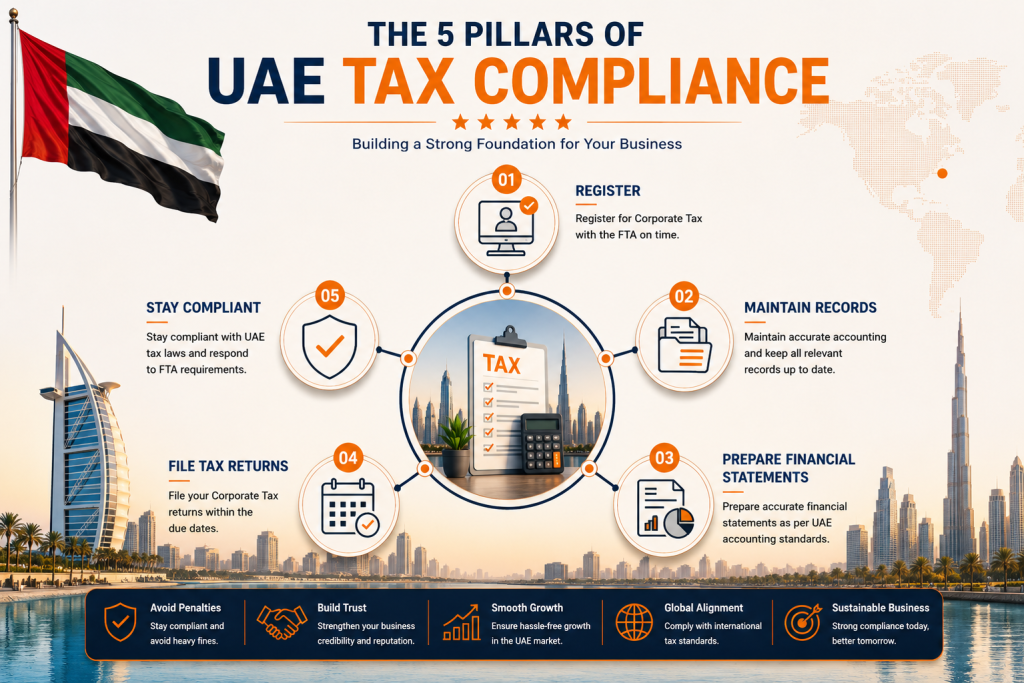
Corporate tax compliance involves much more than filing an annual return. Businesses are expected to maintain accurate accounting records, prepare financial statements, register with the Federal Tax Authority (FTA) where applicable, file corporate tax returns within prescribed deadlines, and retain supporting documentation. Businesses can review the Federal Tax Authority’s Corporate Tax Registration requirements to understand the applicable registration process, documentation, and compliance obligations.
Strong UAE tax compliance generally includes:
- Proper bookkeeping and accounting
- Timely tax registration
- Financial statement preparation
- Corporate tax return filing
- Record retention
- Transfer pricing documentation where required
In general, businesses should focus on developing a robust UAE tax compliance strategy that involves proper bookkeeping, timely registration, preparation of financial statements, tax return filing, record retention, and transfer pricing documentation, if applicable. In addition, organizations must recognize that tax compliance is an ongoing process and an active contribution to the local economy.
businesses should always adhere to all applicable regulations and avoid practices that may result in additional liabilities and reputational damage, even if they do not intend to evade taxes.
How Are Mainland and Free Zone Companies Taxed Differently?
One of the most critical decisions that multinational corporations and local businesses make is related to the choice of jurisdiction. In general, Mainland companies offer more opportunities for businesses that want to operate nationwide, whereas Free Zone entities provide more benefits for organizations that wish to engage in international trade.
Nevertheless, this decision should not be made hastily, as selecting an inappropriate structure may result in adverse tax consequences, additional licensing requirements, and limitations in international business.
Instead of asking, “Which option has lower tax?” founders should ask, “Which structure best supports my long-term business objectives while remaining fully compliant?”
Recommended Reading:
For international businesses deciding between the two structures, understanding the commercial, regulatory, and tax implications of each option is essential. Our guide to UAE Free Zone vs. Mainland Company Formation in 2026 explains the key differences and helps businesses evaluate which structure may better fit their long-term objectives.
How Does UAE Corporate Tax Affect International Businesses?
Many multinational entities are concerned that new corporate tax regulations would hinder their ability to operate in the UAE. On the contrary, businesses should consider this initiative a reliable opportunity to establish long-term partnerships, both locally and internationally.
In fact, international corporations should view the UAE corporate tax as a chance to improve their reputation and strengthen ties with local and international partners, including banks, investors, multinational clients, and government entities.
A transparent tax system and high-level compliance have become some of the most critical factors in choosing a reliable partner or jurisdiction for business development. As such, UAE corporate tax should not be a concern for multinational corporations but rather an opportunity to contribute to the local economy and boost their credibility on a global scale.
Corporate tax should never be viewed in isolation. It should be considered alongside immigration planning, company formation, banking, accounting, and international expansion strategies.
Planning to establish or expand your business in the UAE? Book a one-on-one strategy consultation to understand the right company structure before making costly decisions.
Strategy Call: [Calendly Link]
Website: www.vorxcon.com
Email: support@vorxcon.com
What Common Mistakes Do International Businesses Make?
Compliance mistakes are often caused not by businesses’ deliberate intent to evade taxes or regulations but by reliance on outdated information and oversimplified tax advice. Some of the most common mistakes include:
- Assuming every Free Zone company pays no corporate tax.
- Registering a company before planning the tax structure.
- Delaying accounting and bookkeeping until year-end.
- Ignoring transfer pricing requirements.
- Missing tax registration deadlines.
- Treating compliance as an administrative task instead of a business priority.
Each of these errors can increase costs, create unnecessary regulatory risks, and affect the company’s long-term credibility.
Recommended Reading:
For overseas founders and companies establishing their first UAE presence, understanding the documentation and structural requirements is equally important; our UAE company formation guide for non-residents covers the practical considerations involved in setting up from abroad.
How Can Businesses Prepare for UAE Corporate Tax?
For businesses to prepare for corporate tax, they must start by reviewing their current accounting and financial practices and identifying areas for improvement. In addition to general knowledge of the law, international organizations and local businesses should consider their readiness for federal taxation from multiple perspectives. Businesses should regularly assess:
- Business activities
- Revenue sources
- Accounting systems
- Tax residency position
- Financial reporting
- Documentation procedures
- Regulatory obligations
A proactive compliance strategy not only reduces risk but also provides greater confidence when seeking investment, expanding internationally, or working with financial institutions.
How Can Vorx Consultancy Help?
International expansion is a complex process that encompasses numerous aspects of the business. At Vorx Consultancy, we assist entrepreneurs, startups, investors, and growing businesses in reviewing the advantages, benefits, and requirements of entering the UAE market. our services include:
- UAE Company Formation
- Business Structuring
- Corporate Tax Guidance
- Compliance Support
- Banking Assistance
- International Business Expansion
- Residency & Immigration Advisory
Rather than focusing solely on incorporation, we help clients build business structures designed for sustainable long-term growth.
Final Thoughts:
The introduction of the corporate tax regime marks another step toward transforming the UAE into an international business hub. While some local businesses and multinational corporations may view this initiative as a negative development, it should encourage companies to enhance their operations while contributing to the local economy.
In particular, businesses must consider UAE Corporate Tax 2026, adhere to all applicable regulations, and improve their accounting and financial practices. In the end, organizations that demonstrate integrity and commitment to tax compliance will be stronger partners for international clients, investors, and government entities.
Ready to establish your UAE business with confidence?
Book Your Strategy Call: [Calendly Link]
Website: www.vorxcon.com
Email: support@vorxcon.com
