


A few years ago, a golden visa basically meant one thing: buy a house in Portugal or Greece, get a residency card and eventually collect an EU passport. That world doesn’t really exist anymore. Spain shut its program down in April 2025. Portugal ripped real estate out of its own scheme back in 2023. And just this year, Portugal quietly moved the citizenship goalposts from 5 years to 10.
If you’re researching this topic using an article from 2023 or even early 2025, you’re planning around rules that no longer apply. That’s the honest starting point for this guide.
So let’s do this properly. Whether you’re relocating a family, expanding a business into the EU, parking capital in European real estate, or just want a stronger passport as insurance, here’s what’s actually true in 2026, country by country, with real numbers.
What a Golden Visa Actually Is (And What It Isn't)
A golden visa is a residence permit you get by making a qualifying investment, usually real estate, a fund, or a business in a specific country. The big draw is that most programs don’t require you to actually live there. You invest, you get a residency card, and you keep your life running wherever it already is.
Here’s the part that trips people up: no EU country sells citizenship directly anymore. Cyprus killed its citizenship-by-investment program back in 2020 after EU pressure. What every remaining European program offers is residency first citizenship comes later, if you stick around long enough and meet the requirements.
Think of it less like buying a passport and more like buying a fast-track visa queue. You still have to wait out the years. You just skip the part where you need a job offer or a family connection to get in the queue at all.
A quick real-world example: Say you’re a business owner in Dubai who wants a fallback EU base without moving your family or your company. You put €500,000 into a Portuguese investment fund. You spend seven days a year in Portugal. Five years later, you’re eligible for permanent residency. Ten years in, citizenship becomes possible assuming you meet the basic integration requirements. You never had to relocate to get there. That’s the actual shape of a modern golden visa.
Which Golden Visa Programs Are Still Open in 2026
Here’s the current map. Eight European countries still run active programs: Portugal, Greece, Italy, Malta, Cyprus, Hungary, Bulgaria, and Latvia.
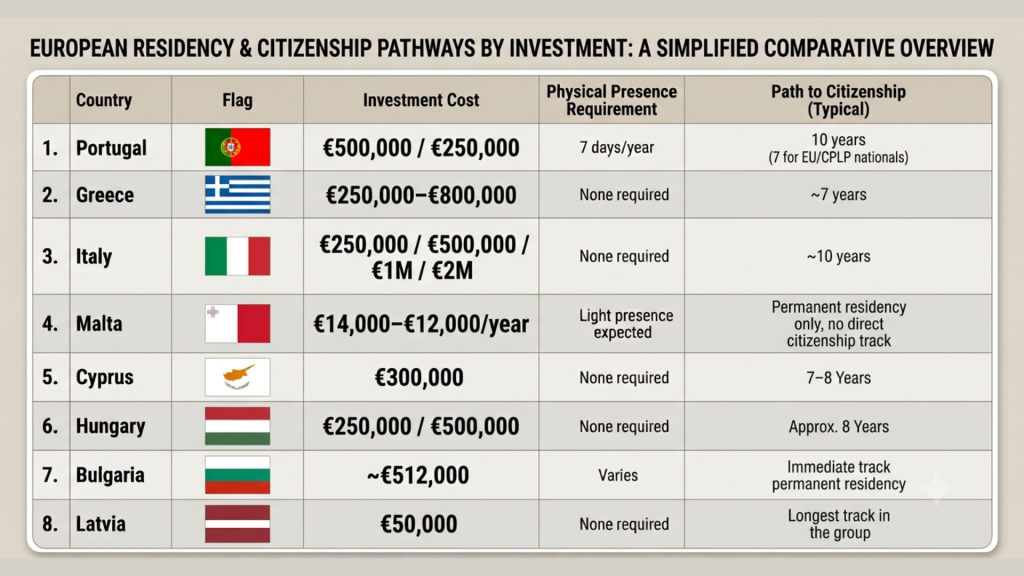
And here’s who’s closed the door: Spain ended new applications in April 2025. Ireland shut its scheme in 2023.
The UK killed its investor visa route back in 2022, citing economic crime concerns just days after Russia invaded Ukraine. If a Blog is still recommending Spain’s golden visa in 2026, that’s your sign it’s outdated.
Why is the map shrinking?
Three real reasons, not speculation: housing prices in cities like Lisbon and Athens got tangled up in political backlash against property-buying investors, EU scrutiny over money laundering and sanctions evasion increased sharply after 2022, and the European Commission has been generally hostile to any scheme that looks like it’s selling EU rights rather than earning them.
That pressure isn’t going away if anything, it’s the reason Portugal tightened its citizenship rule this year.
Also Read: Golden Visa Europe for Indian Business Owners: EU Residency, Banking & Market Entry Explained (2026)
Why Investors Actually Choose Europe (Beyond the Brochure Pitch)
Every program markets lifestyle and security, but the real reasons differ a lot depending on who’s asking:
If you’re an HNWI moving a family : this is about school systems, healthcare access, and having a genuine backup country if things get unstable at home. Italy and Malta both pull hard on this, since they combine EU healthcare access with strong expat communities and manageable relocation logistics.
If you’re a business owner or exporter : the real prize is a Euro/SEPA bank account and an EU corporate presence, not a place to live. Portugal and Italy’s zero-relocation routes exist almost entirely for this crowd. You get the banking rails and market access without uprooting your operation.
If you’re a real estate or fund investor : you’re not buying a lifestyle, you’re buying a yield and a currency hedge. Greek property has genuinely delivered here: prices were up roughly 7–8% year-on-year heading into 2026, and rental yields on golden-visa-eligible property run around 4–5%.
If you want passport diversification : the honest pitch is “insurance,” not “instant EU citizenship.” You’re buying time and optionality, and the real value shows up years down the line, not on day one.
Best Countries for Residency by Investment Country by Country
Portugal : Best for Business Owners Who Don’t Want to Relocate
Portugal’s real estate route is dead. Since October 2023, the only realistic path is the fund route: €500,000 into a regulated Portuguese venture capital or private equity fund, or €250,000 as a donation to cultural heritage projects.
The presence requirement is genuinely the lightest in Europe, about 7 days in year one, then roughly 14 days per two-year renewal cycle. That’s the whole reason business owners gravitate here: you can hold EU residency, open Euro banking, and barely set foot in the country.
The thing every article seems to have missed this year: Portugal’s Nationality Law changed on May 18, 2026. Citizenship eligibility used to sit at 5 years. It’s now 10 years for most nationalities (7 for EU and CPLP citizens).
And because that clock starts only once you actually hold your residency card, which itself can take a year or more to process, the real end-to-end timeline can stretch well past a decade.
If passport speed was your main reason for choosing Portugal, this changes the math. If EU access and Euro banking were your actual goal, nothing here really changes for you.
Greece — Best for Real Estate and Fund Investors
Greece is still the closest thing left to the “classic” golden visa: buy property, get residency, no need to live there at all.
The threshold depends heavily on location. €250,000 buys you in if you’re purchasing a converted commercial-to-residential property or a historic renovation.
Standard residential property runs €400,000 in most areas, jumping to €800,000 in high-demand zones like central Athens, Thessaloniki, Mykonos, and Santorini (with a 120 sqm minimum size in those areas).
The upside for actual investors: this isn’t just a residency fee, it’s a real asset. Greek property values were climbing around 7–8% year-on-year going into 2026, and long-term rentals can generate 4–5% annual yield.
So instead of parking €400,000 with no return, you’re holding an appreciating, income-producing asset that happens to also come with a residency card.
Real example: An investor buying a €400,000 apartment in Thessaloniki, renting it out at a 5% yield, is netting roughly €20,000/year while their residency status stays active with zero physical presence obligation.
That’s a very different value proposition than Portugal’s fund route, which is purely a residency vehicle with no property upside.
Italy — Best for HNWIs Wanting Flexibility and a Favorable Tax Setup
Italy’s Investor Visa doesn’t touch real estate at all; it’s built around startups, established companies, government bonds, or philanthropic donations, starting at €250,000 for an innovative startup and scaling up to €2 million for government bonds.
What makes Italy attractive to wealthier families specifically is the flat tax regime available to new residents, which can make Italy genuinely cheaper on worldwide income than staying put in a high-tax home country on top of the usual healthcare and lifestyle draws of actually living in Italy.
Malta — Best for Fast, Family-Focused Permanent Residency
Malta’s Permanent Residence Programme (MPRP) is worth calling out clearly: it’s a residency program, not a citizenship shortcut.
Malta does separately offer a direct citizenship-by-investment route for very high contribution levels, but that’s a different, far more expensive product. Don’t confuse the two when you’re comparing costs.
The MPRP itself is genuinely one of the more accessible entries in this list, with property leasing options starting around €14,000/year plus a government contribution, and it grants permanent residency essentially from day one rather than a temporary card that renews for years first.
For families who want EU healthcare and school access fast, without waiting through Portugal’s multi-year fund-hold requirement, this is the strongest fit on the list.
Cyprus, Hungary, Bulgaria, and Latvia — The Budget and Alternative Routes
These four don’t get the marketing spend the bigger names do, but each solves a specific problem:
Latvia is the cheapest entry point in Europe at €50,000, through a business investment route into a company with under 50 employees and meaningful turnover. It’s the option for investors who want a foothold, not a lifestyle change.
Bulgaria is the only program on this list that grants immediate permanent residency rather than a temporary permit you renew your way up from, for around €512,000.
Hungary’s Guest Investor programme runs a €250,000 real estate fund route with a flat 15% income tax rate and a 10-year permit that doesn’t need constant renewal appealing if you’re tired of paperwork.
Cyprus offers permanent residency from €300,000 in new-build property, but here’s the catch a lot of applicants miss: Cyprus is not in the Schengen Area.
If Schengen travel is the whole point for you, Cyprus residency alone doesn’t get you there it gets you EU banking and legal protections, but not visa-free hopping between Paris and Berlin.
What You'll Actually Need to Qualify
Requirements are fairly consistent across programs, even though the investment amounts vary wildly:
- Source-of-funds documentation — expect to prove exactly where your investment capital came from, with bank statements and often tax filings going back several years.
- Clean criminal record — from your home country and often anywhere you’ve lived long-term.
- Health insurance — a standard requirement almost everywhere, usually private coverage valid in the host country.
- Family inclusion — most programs let you add a spouse and dependent children (commonly up to age 25–26) on the same application, and some (Greece, Portugal) extend to dependent parents too, though usually with an added income threshold per dependent.
- Investment hold period — typically a minimum of 5 years before you can exit the investment without jeopardizing your status.
None of these programs require language tests, job offers, or degree qualifications at the residency stage that’s usually reserved for the later citizenship application.
Golden Visa vs. Citizenship by Investment: Setting Real Expectations
Worth repeating because it matters: there is currently no EU country offering direct citizenship by investment.
What you’re actually buying is a residency permit, and citizenship is a separate, later milestone with its own residence-duration clock, language requirements, and integration tests.
Here’s how that clock currently looks across the main programs:
- Greece: around 7 years
- Portugal: 7 years for EU/CPLP nationals, 10 years for everyone else (as of the May 2026 reform)
- Italy: around 10 years
- Cyprus: 7–8 years, plus a Greek language requirement
- Hungary: around 8 years
If your main goal is a second passport as fast as possible, Europe in 2026 is genuinely not the fastest lane. Caribbean citizenship-by-investment programs (a different category entirely, and not covered in this guide) still move faster, just without the EU access.
What Europe offers instead is a stronger, more globally respected passport at the end, in exchange for patience.
Tax and Banking Benefits Worth Knowing About
For business owners specifically, the banking access is often the real prize, more than the residency card itself. A few country-specific notes worth knowing:
Portugal: no wealth tax, no inheritance tax for direct-line heirs, and the IFICI regime (which replaced the old NHR scheme in January 2025) offers a 20% flat income tax rate for qualifying professionals for 10 years.
Italy: the flat tax regime for new residents can substantially reduce tax exposure on foreign income.
Greece: a non-dom option available for qualifying new residents, fixed at €100,000 annual tax regardless of foreign income level, genuinely useful if your foreign income is high.
Cyprus: long known for favorable non-dom tax treatment on dividends, even separate from its residency program.
This isn’t tax advice. Every one of these regimes has conditions and exceptions, and you should talk to a tax advisor who knows your specific country pair before assuming any of these numbers apply to you directly.
Which Route Actually Fits You?
Cutting through all of the above, here’s the shortlist by goal:
- Family relocation, fastest EU access: Malta MPRP or Italy
- EU business banking without relocating: Portugal or Italy
- Real yield-generating investment: Greece property route
- Cheapest entry point: Latvia
- Fastest to permanent (not temporary) status: Bulgaria
- Passport diversification, willing to wait: Portugal (strongest end-state passport) or Greece (fastest overall timeline with Schengen included)
Still not sure which one fits your exact situation? Book a free 15-minute consultation → and we’ll map out the right route for your goals.”
Conclusion: Choosing the Right Golden Visa in 2026
The European golden visa map is smaller and stricter than it was even two years ago, but that’s not necessarily bad news.
What’s left are eight programs that have survived EU scrutiny, housing-market backlash, and repeated regulatory tightening which, in a strange way, makes them more stable bets than the programs that got shut down.
The real decision isn’t “which country has a golden visa” anymore. It’s “which of these eight actually matches what I’m trying to achieve.
A business owner chasing EU banking access has almost nothing in common with a family relocating for schools, and both look completely different from an investor chasing Greek rental yield.
Match your goal to the program, not the other way around. That’s the single biggest mistake we see people make after skimming outdated comparison lists.
Rules here shift fast, as Portugal proved twice in the past year alone. Whatever you decide, verify current thresholds and timelines with a licensed immigration advisor before committing capital.