

A friend of mine, a backend developer from bangalore, spent three months last year convinced he didn’t meet the EU Blue Card eligibility 2026 requirements.
I bring this up because eligibility confusion is the single biggest reason qualified people never apply. Not the paperwork, not the salary, not knowing.
Understanding EU Blue Card eligibility 2026 rules the degree requirements, the salary requirements, and how they shift country to country is the difference between a five-minute self-check and three wasted months.
What Is the EU Blue Card, Really
The EU Blue Card is a residence and work permit for non-EU nationals who are, on paper, “highly qualified.” It exists because most EU countries have the same problem: aging populations, and not enough skilled workers to fill engineering, healthcare, IT, and specialist roles.
So in 2009, the EU created a shared framework later updated by Directive 2021/1883 that lets each member state issue this card under a common set of rules, with country-specific variations layered on top.
It’s valid in every EU country except Denmark and Ireland, who opted out. And here’s the part that trips people up constantly: it’s an employment permit.
It’s issued to people with a job offer and an employer, not to founders running their own company or freelancers billing multiple clients.
If that’s you, hold that thought we’ll get to your actual options a bit further down, because you do have options.
EU Blue Card Requirements 2026: The Core Eligibility Criteria
Strip away the country-specific variations and every EU Blue Card application rests on the same four pillars.
A qualifying degree or equivalent experience. You need a university degree from a program that runs at least three years, or you can substitute it with professional experience, usually five years at a comparable skill level, though this varies by country and profession.
A real job offer. Not a verbal agreement, not an internship, a signed employment contract or a binding offer letter, for a role that actually matches your qualifications.
An engineer with a job offer for a sales role, for instance, generally won’t qualify, because the position has to correspond to what you studied or have experience in.
A salary that clears the local threshold. This is the number everyone fixates on, and for good reason it’s usually the first thing that disqualifies an otherwise strong candidate.
More on this below, because the mechanics behind it are genuinely useful to understand.
Contract length. Most countries want to see at least six months to a year of guaranteed employment, though this varies: Germany asks for six months minimum, Poland for a full year.
Clear the four, and you’re in the conversation. Miss one, and it doesn’t matter how impressive the rest of your profile is.
Read This Blog: EU Blue Card 2026: Complete Guide for Skilled Professionals Moving to Europe.
EU Blue Card Salary Requirements 2026: Country-by-Country Breakdown
Here’s something almost nobody explains clearly: the salary threshold isn’t a fixed EU number. Each country sets its own, and they’re allowed to set it anywhere between 1.0 and 1.6 times their national average wage.
That’s a deliberate choice built into the directive, and it’s why the numbers look so wildly different depending on where you’re applying.
To put that in perspective, here’s where things stand for 2026:
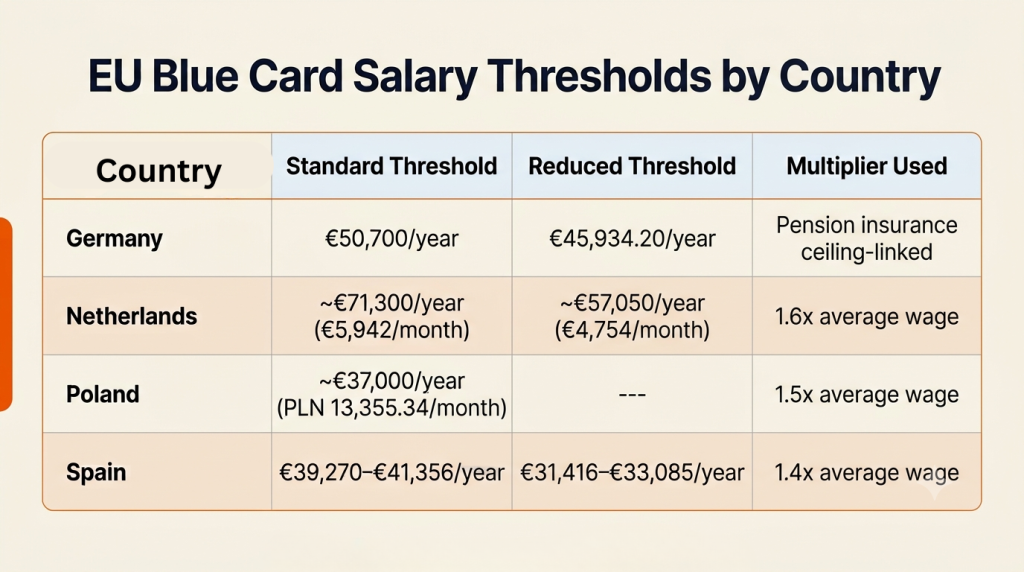
Notice the Netherlands number is nearly double Poland’s. Same card, same directive, wildly different because each government picked a different multiplier and applied it to a different national average wage.
Neither is “wrong.” The Netherlands wants the card reserved for genuinely high-paying roles; Poland is deliberately using it to attract talent it can’t otherwise compete for on salary alone.
The other thing worth knowing: these numbers move every year, and they usually move upward.
Germany recalculates its threshold based on the country’s pension insurance contribution ceiling, which itself tracks wage growth for 2026, that ceiling jumped from €96,600 to €101,400, which is why the Blue Card threshold rose along with it.
Poland ties its number to the average wage published by its statistics office for the previous year. Spain updates based on its national statistics institute’s wage survey and in 2026,
Spain actually revised its figure mid-year after new data came out, which is a good reminder to always check the current number before signing anything, not the number you read three months ago.
If you’re negotiating an offer right now, don’t just clear the threshold and clear it with room to spare.
A salary that’s technically compliant today can fall short after January’s adjustment, and I’ve seen candidates get caught out exactly that way.
EU Blue Card Without a University Degree — Who Qualifies
This is the part my developer friend missed for three months. Several countries, Germany among them, let IT specialists qualify without a university degree at all, provided they can show at least three years of relevant, academic-level professional experience within the last seven years.
“Academic-level” is doing a lot of work in that sentence, and it’s worth unpacking. It doesn’t mean you need a certificate that says so, it means the actual work you did was equivalent to what a computer science graduate would be doing.
Building and maintaining production systems, architecting infrastructure, leading technical projects. Not IT support, not junior QA testing.
What you’ll need to prove it: employment references that describe your actual responsibilities in detail, a portfolio or GitHub history if you have one, any relevant certifications, and ideally a reference letter from a previous employer that specifically confirms the seniority and technical depth of your work.
Vague job titles hurt you here “Software Engineer” with a one-line description is weaker than the same title backed by a letter explaining exactly what systems you built.
Not every country recognizes this pathway the same way, so if you’re weighing options, check the specific country page before assuming it applies everywhere identically.
Can Freelancers or Startup Founders Get an EU Blue Card?
Short answer: no, not through this card.
And I’d rather tell you that plainly now than have you spend weeks building an application around a route that structurally doesn’t fit your situation.
The Blue Card requires an employer-employee relationship. If you invoice clients, run your own agency, or freelance across multiple projects, you don’t meet the “employment contract” requirement no matter how qualified or well-paid you are.
That said, this isn’t a dead end, it’s just the wrong door. Most EU countries have a completely separate visa track built specifically for self-employed people and entrepreneurs. Germany has a freelance residence permit (Aufenthaltserlaubnis für selbständige Tätigkeit) built for exactly this.
The Netherlands has the DAFT program for eligible nationalities, plus a self-employment permit for others. Spain has an entrepreneur visa aimed at founders launching innovative businesses there.
There’s one edge case worth mentioning: founders who’ve formally structured their own company, say, a German GmbH and hold a genuine, salaried employment contract with that company, paying themselves a compliant salary, can sometimes qualify for the Blue Card through that employment relationship.
This is legally and financially more complicated than it sounds, and it’s not something to attempt without an immigration lawyer or tax advisor who’s actually done it before. If you’re in that situation, treat this as a “worth investigating,” not a “here’s your answer.”
Common Reasons EU Blue Card Applications Get Rejected in 2026
Rejections cluster around a handful of predictable mistakes, and knowing them ahead of time is the cheapest insurance you can buy.
Salary shortfall against the current threshold. This is the most common one by far, usually because the offer was negotiated against last year’s number, or because the employer didn’t realize thresholds update every January.
Misclassified shortage occupations. Employers sometimes list a role as a “shortage occupation” to access the lower salary threshold, when the actual job doesn’t meet the official criteria for that category.
Immigration authorities check this, and a mismatch here can sink an otherwise solid application.
Incomplete qualification recognition. If your degree was earned outside the country you’re applying to, it usually needs to go through a formal recognition process Germany’s ZAB, for example.
Skipping this step, or submitting it late, is a common and entirely avoidable delay.
Weak documentation for the no-degree IT pathway. Covered above, but worth repeating: vague job titles and thin references are the number one reason experience-based applications get bounced back for more evidence.
Wrong contract type. In some countries, B2B or freelance-style contracts simply don’t count toward Blue Card eligibility, even if the pay is right. Poland is explicit about this only a proper employment contract qualifies.
How to Check Your Eligibility — Step by Step
Before you spend money on legal advice or start filling out forms, run through this yourself:
- Confirm your qualification route. Do you have a recognized degree, or do you need to build the experience-based case?
- Check your job offer against the salary threshold for the specific country and year you’re applying in, not a number you saw in an old blog post.
- Verify your contract length meets the country’s minimum.
- Check whether your degree needs formal recognition, and start that process early if so it can take months.
- Decide: DIY or lawyer. If your case is straightforward, recognized degree, clean salary margin above threshold, standard employer many people handle the application themselves.
If you’re relying on the experience-based IT pathway, changing jobs mid-process, or your employer has never sponsored a Blue Card before, a consultation with an immigration lawyer is money well spent.
Always verify the current threshold on the relevant country’s official immigration authority website before you sign anything. The numbers in this guide are accurate as of 2026, but they’re not static.
EU Blue Card Germany vs Netherlands vs Poland vs Spain (2026)
If you have some flexibility in where you end up, the country you choose changes your odds and your timeline more than almost anything else. A quick way to think about it:
Higher earners with senior roles tend to find the Netherlands straightforward; the threshold is high, but so are Dutch tech and finance salaries, so it’s less of a stretch than it looks.
Early-career professionals and recent graduates often have an easier time in Poland or Spain, where thresholds sit meaningfully lower and reduced rates exist for graduates.
IT specialists without a degree should look closely at Germany, which has one of the more established experience-based pathways and a large tech hiring market to match.
Anyone prioritizing speed to permanent residency should note Germany’s fast track 21 months with B1 German, 27 months without which is faster than most alternatives.
None of this is a rule, just a pattern. Your actual best fit depends on your industry, your salary and honestly, where you’d want to live for the next few years anyway.
How Vorx Consultancy Can Help
Everything above gives you the framework but real applications rarely stay this clean. Maybe your salary is €800 short of the threshold and you’re not sure whether to renegotiate or wait for next year’s shortage-occupation list.
Maybe your degree needs recognition and you don’t know where to even start that process. Maybe you’re the founder with the GmbH situation we mentioned, and you need someone who’s actually handled that edge case before, not just read about it.
This is exactly where Vorx Consultancy comes in. We work with applicants and employers across Germany, the Netherlands, Poland, and Spain, and we handle the parts of this process that don’t fit neatly into a blog post checking your specific numbers against the current-year threshold, managing degree and qualification recognition, structuring the no-degree IT pathway documentation so it actually holds up, and guiding founders and freelancers toward the visa route that genuinely fits their situation instead of the one they assumed applied.
If you’d rather not spend the next three months figuring this out the hard way the way my friend from Lagos did get in touch with our team for a straightforward eligibility check before you commit to anything.
Conclusion:
Eligibility for the EU Blue Card usually comes down to fewer moving parts than people expect: a qualifying degree or equivalent experience, a real job offer, and a salary that clears your target country’s threshold.
The confusion isn’t in the rules; it’s in not knowing which door applies to you, like my developer friend didn’t for three months.
If you’ve made it this far, you’ve likely already got a good sense of where you stand. The next step is simple: check the current salary threshold for your specific country before you sign anything, since these numbers move every year and rarely in your favour.
And if you’re a freelancer or founder who just realized this card isn’t your route, that’s not bad news, it just means your actual path looks a little different. Either way, you’re closer to an answer than you were five minutes ago.
