
Hong Kong is one of the most business-friendly economies in the world. The region’s strategic location, effective regulation, and simple taxation procedures make it a preferred choice for startups, multinational corporations, e-commerce, investors, and entrepreneurs. Despite being a low-tax jurisdiction, many companies misunderstand how the Hong Kong tax system for business works. Some believe that corporations do not pay taxes, while others assume that all foreign firms are exempt from taxation. At the same time, the truth is somewhere in the middle.
Hong Kong’s tax rules are not as simple as some companies want them to be. One should understand what taxes apply to businesses, what profits are subject to taxation, and how to optimize the tax liabilities within the law. A company that knows how to minimize its tax obligations can benefit from a significant amount of savings. On the contrary, a business that does not comply with Hong Kong’s tax rules can be subjected to penalties and additional inspections.
If you are planning to open a company in Hong Kong, expand your international business, or relocate your regional operations to Asia, this guide will explain everything you need to know about Hong Kong corporate tax, Hong Kong tax compliance, and Hong Kong tax benefits for business.
Why Hong Kong Attracts Global Businesses?
Unlike most jurisdictions that impose taxes on worldwide income, Hong Kong operates on a territorial source basis. In other words, businesses are generally subject to taxation on profits earned from local sources only. It means that if your Hong Kong company generates taxable income from local activities, it will be subjected to Profits Tax. On the other hand, revenues from foreign operations are generally not subject to Hong Kong’s taxation, provided that a company can prove their foreign origin.
Hong Kong’s territorial tax system is especially beneficial for international trading companies, technology startups, consulting firms, holding companies, e-commerce, and cross-border service providers. At the same time, many entrepreneurs believe that establishing a company in Hong Kong makes them automatically exempt from taxation, which is not true. The Inland Revenue Department (IRD) examines where business activities actually occur—not simply where the company is registered.
Recommended Reading:
If you intend to actively operate your business while living in Hong Kong, it’s equally important to understand the eligibility requirements for the Hong Kong Business Investment Visa, which allows qualified entrepreneurs to establish and manage businesses in the region.
Understanding the Hong Kong Tax System for Business
Hong Kong’s tax system for businesses is relatively simple compared to other international business-friendly jurisdictions. Companies typically only deal with a few direct taxes, while most of the indirect taxes are either eliminated or significantly reduced. Businesses are generally pay these taxes:
- Profits Tax
- Salaries Tax (for employees)
- Property Tax (where applicable)
In general, Hong Kong’s tax code is relatively simple and easy to understand, which is one of the primary advantages of doing business in Hong Kong.
Hong Kong Corporate Tax: How Much Do Companies Pay?
When people ask about corporate tax in Hong Kong, they usually refer to Profits Tax. Profits Tax is the primary form of corporate taxation in Hong Kong, which is imposed on companies that derive income from local sources.
As of the 2026 tax framework, Hong Kong continues to apply its well-known two-tier Profits Tax regime, designed to support startups and small to medium-sized businesses while maintaining a competitive environment for larger enterprises.
For corporations:
- 8.25% on the first HK$2 million of assessable profits.
- 16.5% on assessable profits exceeding HK$2 million.
For unincorporated businesses such as sole proprietorships and partnerships:
- 7.5% on the first HK$2 million of assessable profits.
- 15% on any profits above that threshold.
It is equally important to understand what Hong Kong doesn’t tax. Unlike many jurisdictions, businesses generally benefit from:
- No VAT (Value Added Tax)
- No GST (Goods and Services Tax)
- No Capital Gains Tax
- No Dividend Withholding Tax
- No Sales Tax
This straightforward structure is one of the biggest Hong Kong tax benefits for business, particularly for companies involved in international trade, technology, consulting, e-commerce, and cross-border services. However, these attractive tax rates should never be viewed as automatic tax savings. Businesses are taxed on assessable profits derived from Hong Kong, and every deduction or exemption must be supported by proper accounting records and genuine commercial activities.
Hong Kong Business Taxes at a Glance:
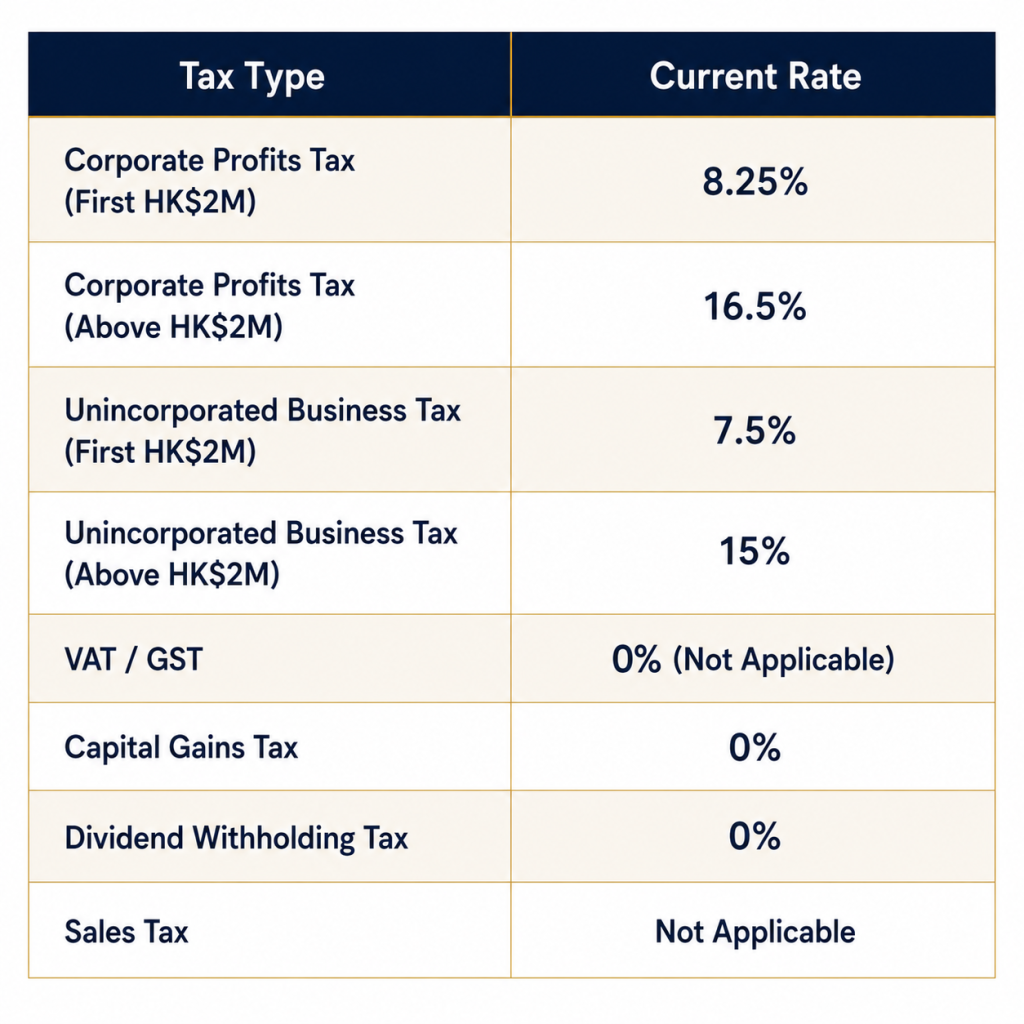
**Hong Kong’s tax policies and rates are subject to change, so companies should consult the latest information from the Inland Revenue Department or professional advisors before making any decisions.
How Does Territorial Taxation Actually Work?
Hong Kong’s territorial tax system is one of the most attractive features of this jurisdiction. It implies that businesses are generally subject to taxation on profits earned from local sources only.
The Inland Revenue Department (IRD) determines whether income is sourced from Hong Kong or overseas by examining the nature of activities and where they are performed. It means that a company’s profits are subject to taxation if they derive from:
- Management
- Sales
- Customers
- Suppliers
- Employees
- Negotiations
In other words, if your company operates in Hong Kong, it is essential to ensure that its activities and expenses are consistent with the jurisdiction of incorporation. Since every company is different, there is no universal rule that determines whether a particular expense or revenue item is Hong Kong-sourced or overseas-sourced. It is always advisable to develop a thorough international tax strategy before launching your business or expanding your operations internationally.
Planning to establish a Hong Kong company or optimize your international tax structure?
Book a Strategy Call: (Calendly Link)
Visit: www.vorxcon.com
Email: Support@vorxcon.com
What Are the Major Hong Kong Tax Benefits for Business?
One of the primary reasons why international entrepreneurs choose Hong Kong is its relatively simple and transparent tax system. Some of the major Hong Kong tax benefits for business include a territorial taxation system, no VAT or GST, no capital gains tax, and no withholding tax on dividends. On the other hand, businesses should be aware that profits from local activities are subject to Profits Tax.
Hong Kong’s tax-friendly policies, reliable banking infrastructure, and simple company formation process make this jurisdiction especially attractive for international trading companies, technology startups, consulting firms, e-commerce, and cross-border service providers. Nevertheless, it is essential to remember that tax benefits should not be the primary reason for incorporating a company in Hong Kong.
Even though Hong Kong’s tax system is relatively simple, businesses must comply with all applicable tax rules and regulations. Every company must fulfill its tax obligations, regardless of whether it has any revenues or expenses during a particular tax year.
Recommended Reading:
planning to establish a trading business, you may also want to read our guide on Hong Kong Trading Company Registration: Licensing, Banking & Compliance, which explains the incorporation process, banking requirements, and ongoing compliance obligations.
Hong Kong Tax Compliance: What Every Business Must Know?
Even though Hong Kong’s tax system is relatively simple, businesses must comply with all applicable tax rules and regulations. Every company must fulfill its tax obligations, regardless of whether it has any revenues or expenses during a particular tax year.
A business that wants to operate legally in Hong Kong should typically be aware of the following tax compliance matters:
- Renew business registration on time
- Keep statutory company records
- Respond to IRD’s notices
- Maintain statutory books and records
- Prepare financial statements
- File tax returns
Many new entrepreneurs mistakenly believe that they do not have to deal with taxes until they have some revenues. In reality, companies must comply with all applicable tax laws and regulations, regardless of their financial status. Businesses that fail to file tax returns or renew business registration can be subjected to penalties and additional inspections.
Many international entrepreneurs focus too much on the incorporation process and forget about other essential aspects of operating a business. In reality, company formation is only the beginning of the long journey toward successful entrepreneurship.
Why Every Business Needs Proper Bookkeeping?
One of the most common misconceptions about the Hong Kong tax system is that businesses do not need proper bookkeeping since they do not have many tax obligations. In reality, companies must maintain complete sets of books and records in accordance with Hong Kong’s accounting standards, regardless of their activity level.
Bookkeeping for businesses is an essential process, even for companies that are not actively operating and do not have any income and expenses. Statutory books and records are required to be kept, as they provide evidence for preparing financial statements, tax computations, and legal compliance, as well as serve as proof of the company’s existence. Businesses that do not have appropriately organized bookkeeping may struggle to gather the necessary evidence to prove their expenses and incomes in front of the tax authority in case of an audit.
Statutory books and records generally comprise all the bills, invoices, contracts, payroll records, bank statements, purchase and sales ledgers, and other relevant documents. Besides that, in most cases, good bookkeeping ensures that companies do not face any unnecessary challenges with tax compliance and do not have to defend their financial performance in front of the Inland Revenue Department.
Common Tax Mistakes Businesses Should Avoid
Many international entrepreneurs significantly underestimate the importance of proper tax planning when operating a business in Hong Kong. Most companies make mistakes not because Hong Kong’s tax system is complicated but because they do not have a thorough understanding of the applicable rules and regulations. Some of the most common mistakes include:
- Assuming Hong Kong companies never pay tax.
- Ignoring annual filing obligations because the business is inactive.
- Mixing personal and business expenses.
- Failing to maintain accurate accounting records.
- Claiming offshore income without supporting evidence.
- Delaying compliance until receiving notices from the IRD.
- Expanding internationally without reviewing tax implications.
In most cases, tax disputes can be easily avoided if companies deal with tax matters in a responsible and organized manner. Businesses should consult independent tax advisors and understand the nuances of local tax laws before making any tax-related decisions.
How Vorx Consultancy Can Help?
Understanding Hong Kong’s tax system is only one part of building a successful business. At Vorx Consultancy, we provide end-to-end support for entrepreneurs, startups, investors, and international companies looking to establish and grow their presence in Hong Kong. Our team assists with company incorporation, business registration, tax planning, compliance guidance, banking assistance, accounting support, and ongoing corporate maintenance. Whether you’re launching a new venture, expanding internationally, or restructuring your business for greater tax efficiency, we help you navigate Hong Kong’s regulatory framework with practical, business-focused solutions. From selecting the right business structure to ensuring compliance with the Inland Revenue Department (IRD) and other statutory requirements, our goal is to simplify the process so you can focus on growing your business with confidence.
Expanding internationally or planning to establish a Hong Kong company? Build the right tax structure before you launch.
Book Your Strategy Call: (Calendly Link)
Website: www.vorxcon.com
Email: support@vorxcon.com
Final Thoughts:
The Hong Kong tax system for business is one of the easiest and most advantageous systems available for a company’s development. Still, there are many obligations related to taxes that businesses should understand to operate on the territory without problems. A company can enjoy a simple system, reasonable territorial taxation, and a competitive corporate tax rate in Hong Kong. However, all of these benefits are connected with maintaining a strict order and proper bookkeeping of the firm’s operations.
Learning the rules of taxation is no less important than knowing the rates; therefore, it is essential to choose the most beneficial structure for the business. Keeping track of all the expenses and maintaining proper documentation will help the enterprise to continue its development on an international scale successfully.
For an entrepreneur who is going to organize their activity in Hong Kong or develop it further, tax planning is vital. Therefore, it is essential to consider the most significant factors at the initial stage to achieve the most substantial results for their business in the future.