

When most entrepreneurs incorporate their business in Australia, they feel that the most critical step is done. The company is formed, an Australian Company Number (ACN) is issued, and the business starts operating. However, incorporation is only the beginning, as every company needs to remain compliant with the legal requirements, including the ASIC Annual Review.
This review, however, often raises many questions and problems among overseas entrepreneurs and Indian business owners. Some people think that an ASIC Annual Review is similar to a tax return, whereas others consider it an annual government fee. At the same time, ASIC Annual Review is a process during which you need to provide information about your company to ensure that all details are correct and up-to-date and your company remains compliant with Australia’s regulator. Failure to complete this annual review may lead to additional costs, unnecessary complications, and even deregistration of your company.
This guide will provide an overview of the ASIC Annual Review Australia in simple terms. We will discuss its definition, essentiality, processes, and things to do every year to ensure your company compliance with the ASIC rules and regulations.
What Is ASIC Annual Review?
Before understanding the review itself, let understand what is ASIC Annual Review
ASIC refers to the Australian Securities and Investments Commission, which regulates and supervises Australia’s securities market. This regulatory authority is responsible for registering companies incorporated in Australia, maintaining the official company register database, and ensuring companies are operating following Australian laws and regulations.
When a company is incorporated,ASIC collects and stores company-related information such as directors, shareholders, company address, and shares allocation. Additionally, this information is used by financial institutions, government agencies, suppliers, investors, and customers. Therefore, it is of critical importance that businesses update this information with ASIC to ensure that it is current.
Why ASIC Conducts Annual Reviews?
Businesses evolve constantly. Directors resign, shareholders change, registered office addresses move, and new shares are issued. If these changes are never reflected in ASIC’s records, the public company register gradually becomes inaccurate.
This way, if any of the details change throughout the year, the company will be able to update it annually during the ASIC Annual Review. Thus, businesses must remember that ASIC Annual Review is not a process of registering the company again, but rather updating the information held by ASIC. From a regulatory perspective, an annual review allows directors to assess whether the company’s operations are compliant and profitable enough. From a company’s perspective, ASIC Annual Review ensures that the information ASIC holds about the company is correct and up-to-date.
In other words, ASIC Annual Review maintains transparency of the company, meaning it plays a crucial role in keeping the company and other stakeholders informed.
Recommended Reading:
Registering a company and maintaining ASIC compliance is only one part of expanding into Australia. If you also intend to live and operate your business there, our Australia Business Visa Requirements, Cost & Process Guide explains the available visa pathways for entrepreneurs.
Who Must Complete an ASIC Annual Review?
One of the biggest misconceptions is that only large corporations need to complete an annual review.
In reality, almost every registered Australian company is required to complete this annual compliance process, regardless of whether the business is actively trading or not. This includes companies that are:
- Proprietary Limited (Pty Ltd) companies
- Small businesses
- Start-ups
- Foreign-owned Australian companies
- Companies with a single director
- Companies operated remotely by overseas founders
Whether you live in Sydney, Melbourne, Dubai, Singapore, or India, your company’s ASIC Company Compliance obligations remain the same.
For overseas directors, this is particularly important because ASIC communicates electronically or through registered company addresses. Missing these notifications does not remove the legal obligation to comply.
What Happens After You Receive the ASIC Annual Statement?
Every year, on your company’s review date, ASIC issues an ASIC Annual Statement. Think of this document as the starting point of your annual compliance cycle rather than simply another government notice.
Instead of paying the fee immediately, directors should first review the statement carefully and verify every piece of information it contains.
The annual review generally follows this sequence:
Receive ASIC Annual Statement
↓
Review company details and director information
↓
Confirm whether all information is accurate
↓
Pass the required ASIC Solvency Resolution
↓
Update ASIC if company details have changed
↓
Pay the ASIC Annual Review Fee before the ASIC Annual Review Due Date
↓
Keep records of the completed review
Although the process appears straightforward, skipping any of these steps may result in incomplete compliance.
ASIC Annual Review Process (Step-by-Step)
The ASIC Annual Review Process is designed to ensure that every registered company continues to meet its legal obligations. Rather than treating it as a once-a-year payment, directors should approach it as an annual compliance review of the business.
The first step is reviewing the company’s details exactly as they appear in the ASIC Annual Statement. Directors should confirm that the registered office address, principal place of business, officeholders, shareholders, and share structure remain accurate. If any information has changed, the relevant updates should be lodged with ASIC within the required timeframe. Waiting until the following year’s review is not considered good compliance practice.
The next stage involves considering the company’s financial position by passing a solvency resolution. Once this requirement has been addressed, the company should pay the annual review fee before the due date and retain all compliance records for future reference.
Approaching the process in this order helps minimize errors and demonstrates responsible corporate governance.
Documents Required for the Annual Review
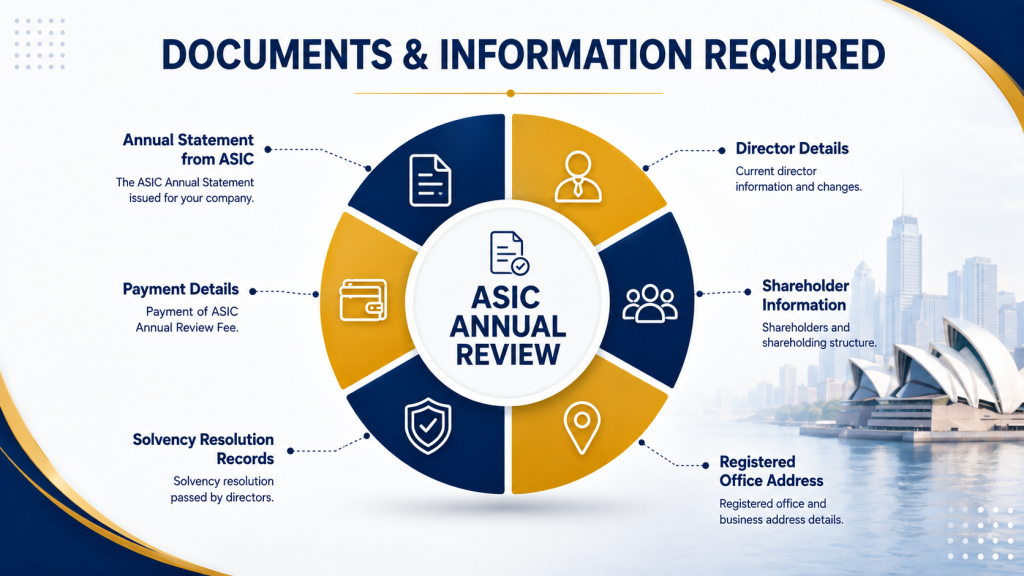
Unlike company registration, the annual review usually doesn’t require submitting a large number of documents. However, directors should have key company records readily available before beginning the review. These generally include:
- The latest ASIC Annual Statement
- Current director and shareholder details
- Registered office and principal place of business information
- Company share structure (if applicable)
- Internal company records supporting the ASIC Solvency Resolution
- Payment details for the annual review fee
Having these records organized before starting the review makes the entire process quicker and reduces the likelihood of mistakes.
Understanding the ASIC Solvency Resolution (With a Simple Example)
One of the most common misconceptions about the annual review is the ASIC Solvency Resolution. Many directors come across the term for the first time when they receive their annual statement and wrongly believe that it requires providing ASIC with extensive detail on the company’s financial status. This is completely untrue.
A solvency resolution is simply a formal declaration by the directors of whether the company can meet its liabilities as and when they fall due. In other words, it affirms the company’s financial viability. It is a critical procedural requirement because the directors are obligated to maintain an overarching awareness of the company’s financial status at any given point in time.
Consider a simple example: imagine an entrepreneur based in Jaipur decides to register a Pty Ltd company in Melbourne that offers IT consulting services. There is a steady stream of clients, and the invoices are paid on time, while the company’s expenditures match the income. As the fiscal year draws to a close, the director reviews the figures and becomes confident that the company will be able to meet its financial obligations. In this case, passing the ASIC Solvency Resolution is relatively straightforward.
On the other hand, if the company has outstanding invoices, inconsistent cash flow, and concerns about impending liabilities, an unverified declaration of solvency might cause the directors to get into trouble.
This is why the solvency resolution should never be treated as a routine checkbox. It is a legal responsibility that requires directors to make an informed decision based on the company’s actual financial condition.
Common Mistakes Businesses Make During the Annual Review
The ASIC Annual Review Process is relatively straightforward, yet businesses continue to face compliance issues because of avoidable mistakes rather than complex regulations.
One of the most common errors is assuming that paying the ASIC Annual Review Fee completes the review. While payment is mandatory, it does not replace the responsibility to verify company information or maintain accurate records. Another frequent mistake is failing to update ASIC when company details change. A director may resign, a registered office may move, or new shares may be issued during the year. If these changes are not reported promptly, the company’s ASIC records become inaccurate, creating unnecessary compliance risks.
Overseas founders also tend to overlook ASIC correspondence because the company is managed remotely. Emails may be missed, the registered office address may no longer be monitored, or reminders may never reach the directors. Unfortunately, missing a notification does not remove the company’s legal obligations.
A practical way to avoid these problems is to review your company’s records every few months rather than waiting until the annual review arrives. By treating compliance as an ongoing responsibility instead of a once-a-year task, businesses significantly reduce the likelihood of errors.
ASIC Annual Review vs Tax Return vs BAS vs Annual Financial Statements
Many first-time founders believe these obligations are part of the same process. They are not.
Although they may occur during a similar period, each requirement is administered by a different authority and serves a different purpose.
Requirement | Purpose | Managed By |
ASIC Annual Review | Confirms company details, governance, and ongoing corporate compliance | ASIC |
Company Tax Return | Reports taxable income and calculates company tax | Australian Taxation Office (ATO) |
BAS (Business Activity Statement) | Reports GST, PAYG withholding, and other tax obligations | Australian Taxation Office (ATO) |
Annual Financial Statements | Records the company’s financial performance where applicable | Company / Accountant |
Understanding this distinction is essential because meeting your tax obligations does not automatically satisfy your ASIC Company Compliance responsibilities. Likewise, completing your annual review does not replace your tax reporting obligations.
What Are the Late Fees for an ASIC Annual Review?
If you miss your ASIC Annual Review deadline, a late fee may apply.
Missing the ASIC Annual Review Due Date is more than just a missed administrative task. If your company fails to pay the annual review fee or update incorrect company details within the required timeframe, ASIC applies late fees in addition to the original annual review fee.
As of 2026, the late payment charges are:
Delay | Late Fee (AUD) |
Up to 1 month late | AUD $96 |
More than 1 month late | AUD $401 |
These late fees are charged in addition to your original ASIC Annual Review Fee, not instead of it.
Initially, missing the ASIC Annual Review Due Date may result in additional late fees being applied. If the company continues to ignore ASIC notices, the compliance issues can become more serious. Over time, persistent non-compliance may affect the company’s legal standing and, in some circumstances, ASIC has the power to begin deregistration proceedings.
Special Guidance for Overseas and Indian Founders
If you have an Australian company but live overseas, you have the same obligations as any other director of an Australian company. Distance cannot affect your responsibilities as an Australian director.
Some overseas directors think they do not have obligations because their company is not actively trading, or they receive little or no communication from ASIC. This is not true ASIC requires every company that has been formed through them to maintain up-to-date information and to perform the annual review on time.
If you have overseas control of an Australian company it is always useful to have a calendar reminder to update records, check any ASIC emails, and use a corporate service provider or compliance agent you trust to keep track of upcoming deadlines for you.
As an Indian business owner who has chosen to establish in Australia, this can save you hassle, time and potentially expensive mistakes, helping you stay compliant and not distracted from growing your business, dealing with unnecessary ASIC queries later.
The ASIC Annual Review is not just a box-ticking exercise, it is a legal obligation that keeps your company information up-to-date, ensures your directors are fulfilling duties, and keeps your company up to speed with the regulations set by Australia’s corporate watchdog.
Recommended Reading:
Entrepreneurs considering long-term expansion into Australia should also stay updated on investment migration options. Read our detailed guide on the Australia Investment Visa to understand the latest eligibility requirements and policy changes.
Annual Compliance Calendar
The annual review is only one part of maintaining an Australian company. Successful businesses typically follow a structured compliance calendar instead of reacting to deadlines at the last minute.
Compliance Activity | Recommended Timing |
Review company records | Every quarter |
Monitor ASIC correspondence | Monthly |
Complete ASIC Annual Review | On the company’s annual review date |
Lodge tax returns and BAS (where applicable) | As required by the ATO |
Update ASIC after any company changes | As soon as changes occur |
Treating compliance as an ongoing process rather than a yearly event makes it much easier to keep the company in good standing.
Practical ASIC Annual Review Checklist Australia
Before finalising your annual review, take a few minutes to confirm that the essentials have been covered.
✔ Review your ASIC Annual Statement carefully.
✔ Verify directors, shareholders, and registered office details.
✔ Check whether any company information needs updating.
✔ Pass the required ASIC Solvency Resolution.
✔ Pay the ASIC Annual Review Fee before the due date.
✔ Save copies of all records for future reference.
Following this simple ASIC Annual Review Checklist Australia can help reduce errors and make future compliance much easier.
Need expert assistance with your Australian company? Get in touch with Vorx Consultancy
Book a Strategy Call: (Calendly Link)
Website: www.vorxcon.com
Email: support@vorxcon.com
Final Thoughts
The ASIC Annual Review is not simply an exercise in annual bureaucratic filing; it is a legal requirement that ensures your company information remains up to date, your directors are meeting their ongoing obligations, and that your business maintains a clear and compliant status with Australia’s corporate guardians. Whether you are running a start-up in Australia or overseas in India, the ASIC Annual Review Requirements should be a primary concern, as it is your duty to avoid unwelcome penalties from official authorities.
Instead of thinking of it as just another yearly task, try viewing it as a chance to make sure you are on the right track. Companies that put in effort concerning their corporate requirements usually spend significantly less time worrying about compliance issues and much more time actually growing their business.
