

Founders of international organizations may consider setting up their business in Hong Kong as it offers both commercial and financial opportunities. However, besides incorporating a company there according to all regulations, one also needs to know what immigration path to choose in order to reside in Hong Kong and be able to control the firm’s operations.
In particular, the Hong Kong Government allows foreign nationals to enter the territory under the Immigration Ordinance of Hong Kong. One of such programs is called “Investment as Entrepreneurs”, which is a part of the Hong Kong General Employment Policy. This type of visa is usually requested by persons that are interested in engaging in business activities or being employed in Hong Kong.
This guide explains the details concerning the Hong Kong Entrepreneur Visa, including eligibility criteria, required documents, application procedure, business plan requirements, and other aspects relevant in 2026.
What Is the Entrepreneur Visa Route in Hong Kong?
The Hong Kong Entrepreneur Visa designed for eligible foreign entrepreneurs who want to enter and stay in Hong Kong to establish or join a business. The Immigration Department evaluates applications individually rather than approving them simply because an applicant has incorporated a company or invested money.
The route can be relevant to:
- Entrepreneurs establishing a new Hong Kong business.
- Overseas business owners expanding into Hong Kong.
- Founders joining an existing business.
- Certain startup founders supported by eligible government-backed programmes.
In addition, Hong Kong has a special immigration route for qualifying startup applicants who are engaged in a business that has received support from a government endorsed program. This visa category is open to proprietors, partners, or key researchers, subject to the specified criteria.
How Is the Entrepreneur Visa Different from the Business Investment Visa?
The terms Hong Kong Entrepreneur Visa and Hong Kong business investment visa are often used interchangeably online. However, it is important to understand the official terminology.
Hong Kong Immigration refers to the relevant route as Investment as Entrepreneurs. Its purpose is to allow a person to establish or join a business in Hong Kong.
So, rather than treating “Entrepreneur Visa” and “Business Investment Visa” as two completely separate immigration schemes, think about the purpose of your application:
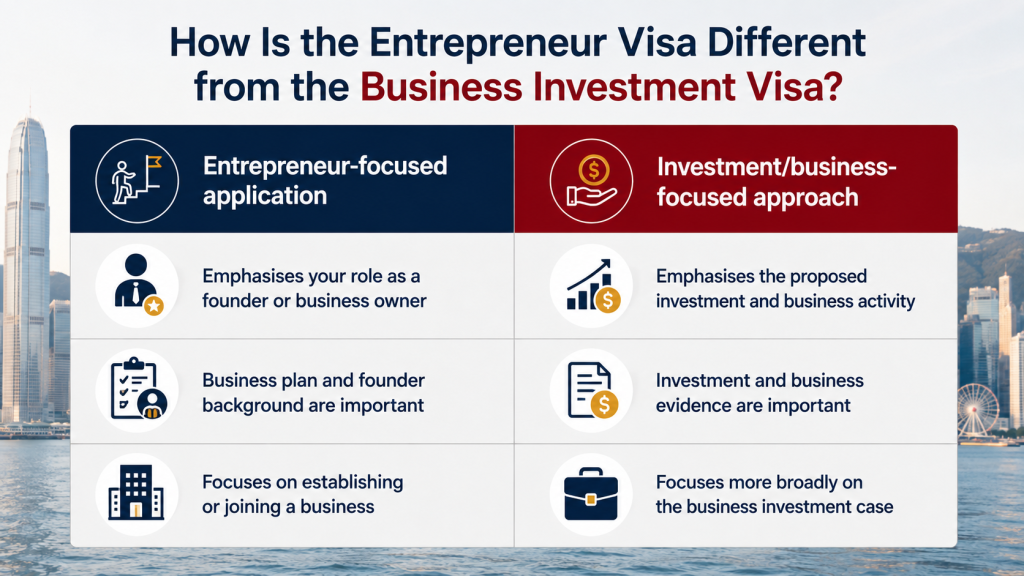
Entrepreneur-focused application | Investment/business-focused approach |
Emphasises your role as a founder or business owner | Emphasises the proposed investment and business activity |
Business plan and founder background are important | Investment and business evidence are important |
Focuses on establishing or joining a business | Focuses more broadly on the business investment case |
Recommended Reading:
If you are specifically researching Hong Kong business investment options, see our Hong Kong Business Investment Visa guide for additional context.
Is Your Business Eligible for Hong Kong’s Entrepreneur Visa?
There is no simple checklist that guarantees approval. Hong Kong Immigration considers the overall strength of the applicant and proposed business.
Your case is more likely to make sense when you can clearly demonstrate:
- A genuine and viable business model
- Relevant professional, technical or entrepreneurial experience
- Sufficient financial resources
- A realistic reason for operating the business in Hong Kong
- A credible business plan
- Potential contribution to Hong Kong’s economy
The Immigration Department may consider factors such as the proposed business plan, turnover, financial resources, investment amount, local jobs created and introduction of new technology or skills.
For startup businesses, support from an eligible government backed programme can also be relevant to the assessment.
What Does Hong Kong Immigration Require from Entrepreneurs?
The strongest applications generally connect the founder, business and financial case rather than presenting each element separately.
A credible business model:
Your application should explain what the business does, who it serves and how it expects to generate revenue.
Relevant experience:
A strong background in the proposed industry can help demonstrate that you have the skills to operate the business successfully. Hong Kong Immigration normally expects a good educational background, although relevant technical qualifications, professional abilities, experience and achievements may also be considered in appropriate cases.
Financial capacity:
You need to demonstrate that you can support the proposed business and its sustainable operation through appropriate financial evidence.
Hong Kong economic contribution:
Immigration may look at factors such as local employment, investment, business turnover and the introduction of new technology or skills.
The key is not simply to show that you want to start a business, but that there is a credible commercial case for doing so in Hong Kong.
What Documents Do You Need for a Hong Kong Entrepreneur Visa?
Preparation of the necessary Hong Kong entrepreneur visa documents is an essential element of the application process, which should help demonstrate the applicant’s credentials, the nature of the proposed business in Hong Kong, and the financial viability of the proposed enterprise. The documents can be grouped into three broad categories:
1. Personal Documents
These documents establish your identity, qualifications and relevant professional or entrepreneurial background. They help Immigration understand whether your experience and profile support the proposed business.
Key documents may include:
- Passport or travel document
- Recent photograph
- CV/resume
- Qualification certificates
- Evidence of business or professional experience
2. Business Documents
Business documents explain the proposed business and demonstrate that it is genuine, commercially viable and properly planned. The three-year business plan and financial projections are particularly important because they show how you expect the business to operate and develop in Hong Kong.
Depending on your circumstances, these may include:
- Three-year business plan and financial forecasts
- Company incorporation and Business Registration documents
- Evidence of business activities or contracts
- Office or operational arrangements, where applicable
3. Financial & Sponsor Documents
Financial documents demonstrate that you have adequate resources to support the proposed business. You will also need to provide the relevant information and supporting documents for your local sponsor in Hong Kong.
These may include:
- Bank statements and proof of available funds
- Investment or financial evidence
- Relevant financial statements
- Local sponsor’s supporting documents
The exact Hong Kong Entrepreneur Visa documents can vary based on your business model and personal circumstances. Immigration may request additional information where necessary, so all documents should be accurate, consistent and properly organized.
What Should Your 3-Year Business Plan Include?
For the Hong Kong Entrepreneur Visa, the three-year business plan is more than a description of your business idea. Hong Kong Immigration asks for it because the Government wants to understand whether your proposed business has a realistic and sustainable future in Hong Kong, rather than being only a short-term plan created for immigration purposes. Looking three years ahead gives Immigration a clearer picture of how the business is expected to operate, grow, generate revenue and contribute to the local economy.
The plan should cover the nature of the business, market analysis, market positioning, business direction, sales targets and product marketing strategy. It should also explain how the business will develop over the three-year period and why Hong Kong is a suitable base for the proposed activity.
Alongside the business plan, applicants are expected to provide three-year financial forecasts covering:
- Profit and loss
- Cash flow
- Balance sheet
These projections help Immigration assess whether the proposed business is financially realistic and sustainable. Other factors, such as the proposed investment, expected turnover, local employment and the introduction of new technology or skills, may also be considered.
In simple terms, the Government wants to see not just what your business is today, but where it can realistically go in the next three years.
Recommended Reading:
Planning your business finances alongside your visa strategy? Learn more about Hong Kong Corporate Tax and how the local tax system may affect your business.
How Does the Hong Kong Entrepreneur Visa Application Process Work?
The Hong Kong Entrepreneur Visa application process is best approached as a complete business and immigration application rather than simply filling out a visa form.
1. Prepare the business case
Develop your business plan, financial projections and supporting evidence before submitting the application.
2. Prepare the required forms
The applicant and sponsor need to complete the relevant application documentation, including the applicable sponsorship documentation.
3. Submit the application online
Applicants, accompanying dependants where applicable, and sponsors can submit the application and supporting documents online with the relevant application fee.
4. Immigration assessment
The Immigration Department reviews the applicant’s background, business proposal, financial resources, investment and potential contribution to Hong Kong.
5. Provide additional information if requested
Immigration may ask for further supporting documents or information where necessary. Applications are assessed individually, and meeting the stated criteria does not automatically guarantee approval.
6. Receive the decision
If approved, the applicant can follow the relevant arrangements for the visa/entry permit and travel to Hong Kong.
The normal processing time is around four weeks after all required documents and the relevant application fee have been received, although actual cases can vary. Approval remains at the discretion of the Immigration Department.
What Common Mistakes Can Weaken Your Entrepreneur Visa Application?
A complete application does not automatically mean a strong application. One of the biggest mistakes entrepreneurs make is treating the Hong Kong Entrepreneur Visa as a paperwork exercise instead of presenting a convincing business case. Immigration looks at the overall picture, including the applicant’s background, financial resources, proposed business and potential contribution to Hong Kong.
Some common weaknesses include:
- A generic business plan with little Hong Kong market research
- Unrealistic revenue or financial projections
- Weak evidence of available funds
- Limited explanation of why the business should operate in Hong Kong
- A mismatch between the entrepreneur’s experience and the proposed business
The better approach is to make sure your business strategy, financial evidence and immigration application tell the same story.
How Can Vorx Help With Your Hong Kong Visa Strategy?
Establishing a business in Hong Kong and preparing an entrepreneur immigration application are closely connected. Vorx Consultancy helps entrepreneurs approach both sides as one structured strategy, from understanding the appropriate business setup to preparing the documentation and business case needed for the Hong Kong Entrepreneur Visa.
Instead of treating company formation, business planning and immigration as separate tasks, Vorx focuses on creating a practical roadmap that fits the entrepreneur’s goals and proposed business activity. Whether you are expanding an existing company, launching a new venture or exploring Hong Kong as a regional business base, the aim is to help you move from an initial idea to a properly structured business and immigration plan with greater clarity.
Need Strategic Guidance?
Book a Strategy Call: (Calendly Link)
Visit: www.vorxcon.com
Email: support@vorxcon.com
Final Thought:
The Hong Kong Entrepreneur Visa can be a practical option for founders and business owners who have a genuine plan to establish or expand their business in Hong Kong. However, approval is about more than company registration or available funds. Your business model, experience, financial position, business plan and supporting documents should present one clear and credible case.
For entrepreneurs with a realistic business strategy and a genuine reason to operate in Hong Kong, the route can provide a structured pathway to build and manage a business there.
The key is to prepare the business and immigration strategy together from the beginning, rather than treating the visa as a separate step after setting up the company.