

If you’re running a SaaS product, an IT services business, or a consulting practice out of Bangalore, Pune, or Delhi and eyeing the EU market, you’ve probably had this exact conversation with yourself: “Do I really need a company in Ireland, or can I just invoice EU clients from my Indian entity?”
Here’s the honest answer. You can invoice from India for a while. But the moment you want to hire in Europe, hold funds in euros without conversion losses on every transaction, or simply look like a “real” EU vendor to a German or French enterprise client during procurement review, an Indian entity alone starts working against you. That’s usually the point founders start searching for Ireland company formation.
This guide walks through exactly what it takes, requirements, the actual step-by-step process, and the parts that specifically trip up Indian founders. No fluff about “Ireland’s rich business heritage.” Just what you need to know before you file.
Why Indian Entrepreneurs Are Choosing Ireland for Company Formation
Three reasons keep coming up when Indian founders explain why they picked Ireland over, say, Estonia or the Netherlands.
EU market access without EU bureaucracy. An Irish company gives you a single legal entity that can sell to all 27 EU member states.
For a SaaS company selling to enterprise clients in Germany or a consulting firm bidding for contracts in France, this matters more than people expect. Many EU procurement teams simply won’t engage with a non-EU vendor at the RFP stage, regardless of quality.
A 12.5% corporate tax rate on trading profits. This is still one of the lowest in the OECD.
And it’s stayed unchanged into 2026, even as global minimum tax rules kicked in. Those new rules set a 15% floor, but only for large multinationals with turnover above €750 million.
Most early-stage and growth-stage founders are nowhere near that threshold. So the 12.5% rate applies to you.
Ireland already has deep trade ties with India. This isn’t a stretch of a jurisdiction to explain to your Indian CA or to Indian clients — there’s an existing India-Ireland Double Taxation Avoidance Agreement (DTAA), a track record of Indian IT companies operating there (TCS, Infosys, and Wipro all have Irish operations), and English as the working language, so there’s no translation layer between your contracts, your accountant, and your bank.
Compare that to the Netherlands, where Dutch remains the language of a lot of official correspondence, or to Estonia, which is excellent for a one-person digital nomad setup but doesn’t carry the same weight with large European enterprise buyers.
Can Indian Citizens Register a Company in Ireland? (Eligibility)
Yes — and there’s no restriction on foreign ownership. You don’t need to be Irish, EU, or even a resident of Ireland to own 100% of an Irish company or to be its director.
But there’s one requirement that catches almost every Indian founder off guard: at least one director of the company must be resident in the European Economic Area (EEA).
If none of your directors live in the EEA which is the case for most Indian founders setting this up from India you have two options:
Appoint an EEA-resident director. This could be a co-founder, a hired local director, or a nominee director service.
Take out a Section 137 Bond. This is essentially an insurance bond that covers a fixed two-year term and protects against fines the company might incur for breaches of company law.
It’s the CRO’s way of saying “fine, no EEA director, but put down a deposit that proves you’re serious about compliance.”
Most Indian solo founders go with the bond route rather than hiring a nominee director, simply because it’s a fixed, predictable cost with no ongoing relationship to manage.
If you already have a European co-founder or are hiring a local country manager anyway, using them as the EEA-resident director is the cheaper long-term option.
Beyond that one requirement, eligibility is straightforward: you need at least one director (any nationality), a company secretary (can be a corporate service provider), and at least one shareholder.
There’s no minimum share capital — a common misconception. You can incorporate with a nominal amount of share capital, however small.
Ireland Company Formation Requirements (Full Checklist)
Here’s everything the CRO (Companies Registration Office) will actually ask for:
Company name — checked against the CRO register for uniqueness. Run this check before you get attached to a name; “Ltd” name clashes are the single most common cause of delayed filings.
Registered office address in Ireland — this has to be a real Irish address, not a P.O. box. As an Indian founder, you won’t have one, so you’ll use a registered office service (covered in the cost section below).
At least one director — subject to the EEA-residency point above.
A company secretary — mandatory for every Irish company. In a single-director company, the secretary cannot also be that same director, so you’ll need a second person or a corporate secretary.
At least one shareholder — can be the same person as the director.
A company constitution — for a standard LTD, this is a single document combining what used to be the memorandum and articles of association.
Beneficial ownership disclosure — you’ll need to file with the Register of Beneficial Ownership (RBO), declaring who ultimately owns and controls the company.
For most Indian founders who own 100%, this is simple, but it’s not optional and enforcement of RBO compliance has tightened noticeably through 2025 and into 2026.
Identity documents for every director and shareholder — a passport copy and proof of address (a recent bank statement or utility bill works).
Since these are already in English for most Indian founders, there’s no translation step requiring one less headache than you’d face incorporating in, say, Germany.
A PPS number, or an alternative for non-residents. Irish residents use a PPS number for identity verification. As a non-resident director, you won’t have one — instead, the CRO uses an Identified Person Number (IPN), assigned when you submit verified ID documents as part of the incorporation filing.
Formation agents handle this routinely; it’s not something you need to chase separately.
Need Help With Irish Company Requirements?
Not sure about the EEA director, registered office, KYC documents, or RBO requirements?
Talk to Vorx Consultancy and get clear guidance before you start your application.
Best Business Structure for Indian Founders — LTD vs Other Options
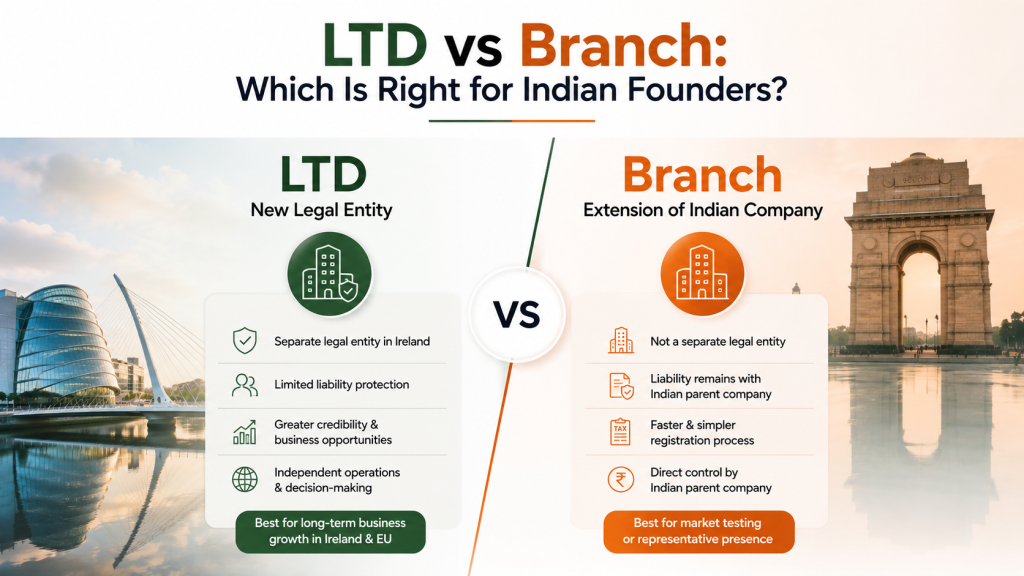
Ninety-five percent of the Indian founders reading this should register a Private Limited Company (LTD). It’s the default structure the CRO is built around, it has the lightest compliance burden of any Irish company type, and it’s what banks, clients, and payment processors expect to see.
The structure question really only branches into two scenarios:
You’re launching a new EU-facing entity (a SaaS company, a consulting arm, an e-commerce operation targeting European customers) → go with an LTD.
It’s a genuinely separate legal entity from your Indian company, which means clean liability separation and a straightforward path to opening it as a subsidiary.
You already run an established Indian company and want an Irish presence to service existing EU contracts → consider a Branch instead.
A branch isn’t a separate legal entity; it’s an extension of your existing Indian company operating in Ireland.
This matters for founders who already have revenue history, banking relationships, and credibility built up in their Indian entity and don’t want to start from zero with a new legal entity’s track record.
The trade-off is that your Indian company bears full liability for the branch’s activities; there’s no separation.
Two structures you can mostly ignore: the DAC (Designated Activity Company), which exists for regulated activities like financial services or insurance, and the PLC, which is built for companies planning to raise capital publicly or already operating at a scale most early-stage founders aren’t at. Unless you’re building a fintech or insurtech product, skip both.
Step-by-Step Process to Register a Company in Ireland from India
Here’s the actual sequence, and this is the part most founders want confirmed upfront: every single step can be completed without setting foot in Ireland.
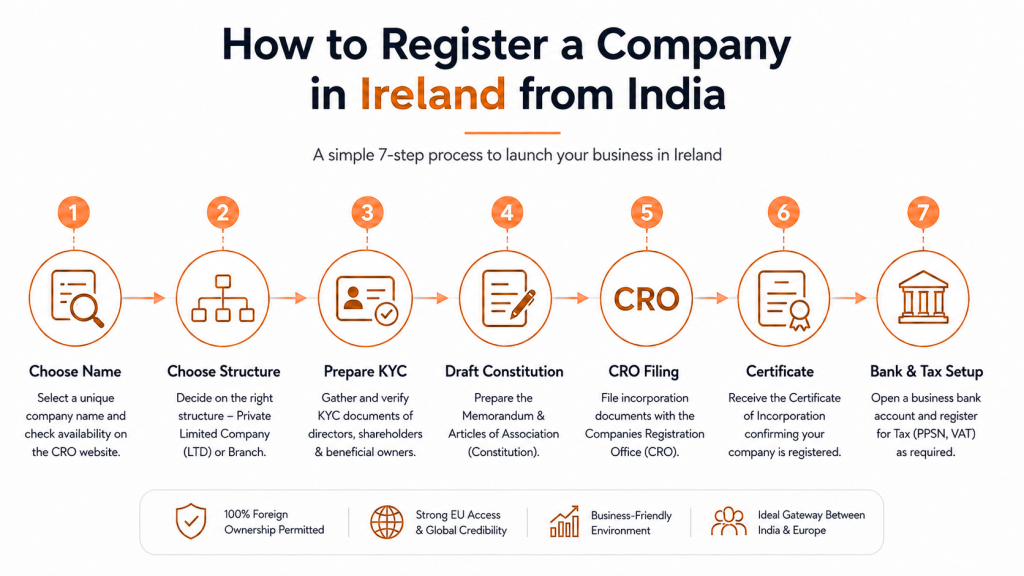
- Choose your company name and run the CRO availability check. This takes minutes on the CRO’s online portal and costs nothing. Do this before drafting any other documents.
- Decide your structure and appoint your director(s) and secretary. If you don’t have an EEA-resident co-founder, this is the point where you decide between hiring a nominee director or purchasing the Section 137 Bond.
Most formation agents that specialize in non-resident incorporations will walk you through this decision as part of onboarding it’s routine for them even if it feels like a big decision to you.
- Gather your KYC documents. Passport copy and address proof for every director and shareholder. Since Indian documents are typically already in English, there’s no certified translation required, though some formation agents will ask for notarization and check this with your chosen provider before you start, since Indian notarization and apostille processes can take a week or two if you haven’t done one before.
- Draft the company constitution. Your formation agent will usually provide a standard template suitable for a trading LTD — you don’t need a solicitor to draft this from scratch unless your shareholding structure is unusually complex (multiple classes of shares, convertible instruments, etc.).
- Submit Form A1, the constitution, and the filing fee through the CRO’s CORE online system. This is the actual incorporation filing.
- Receive your Certificate of Incorporation. Online filings typically process in 5–10 working days, which is dramatically faster than paper filings (which can take several weeks). This certificate is your proof the company legally exists.
- Handle post-incorporation setup. This is where most Indian founders hit their first real friction — not with the CRO, but with opening a business bank account.
Traditional Irish banks can take weeks to onboard a non-resident-owned company and often want to see evidence of an operational presence in Ireland before they’ll open an account.
Most founders sidestep this entirely by starting with an EMI (Electronic Money Institution) or fintech business account Wise Business and Revolut Business are the two most commonly used by non-resident Irish company owners and moving to a traditional bank later if needed.
Don’t assume banking will move at the same speed as incorporation; budget separate time for it.
Ready to Register Your Irish Company?
Complete the Ireland company formation process remotely from India with expert support at every step.
Tax Registration and Obligations for Your Irish Company
Once incorporated, you’ll need to register separately for tax with Revenue (Ireland’s tax authority) incorporation and tax registration are two different processes.
Corporation Tax registration should happen within a month of starting to trade. The 12.5% rate applies to active trading income; a 25% rate applies to passive income like investment returns, so make sure your business activity is classified correctly.
VAT registration is where SaaS and digital services founders need to pay real attention. If you’re selling digital services to consumers across the EU, you’ll likely need to register under the One Stop Shop (OSS) scheme, which lets you handle VAT for all EU sales through a single Irish registration rather than registering separately in every country your customers are in.
This is genuinely one of the more valuable things about basing a digital services company in an EU country: get your accountant to set this up correctly from day one, because retrofitting VAT compliance after you’ve already been invoicing incorrectly is a much bigger headache than doing it right at registration.
PAYE/employer registration only applies once you start hiring staff based in Ireland most solo Indian founders won’t need this in year one.
The India-Ireland DTAA is worth understanding even at a basic level, because it directly affects how much you personally pay in tax as an Indian resident owning an Irish company.
The treaty prevents the same income from being taxed twice for example, dividends you draw from your Irish company won’t be fully taxed again in India, though the exact mechanics depend on your personal residency status and how you structure your compensation (salary vs. dividends).
This is genuinely worth a one-time consultation with a CA who has handled cross-border India-Ireland structures before, rather than guessing.
Ongoing Compliance Requirements After Registration
Getting incorporated is the easy part. Staying compliant from a different time zone, with an accountant you may have never met in person, is where founders actually fall behind.
Annual Return (Form B1) must be filed with the CRO every year — this confirms your company details are current.
Corporation Tax return filed annually with Revenue.
Bookkeeping and accounts. Small companies can qualify for audit exemption, but missing your annual return deadline even once causes you to lose that exemption for two years, which means a mandatory audit you otherwise wouldn’t have needed.
This is one of the most expensive mistakes to make purely through calendar oversight.
RBO (beneficial ownership) updates whenever ownership changes.
Section 137 Bond renewal, if that’s the route you took — it needs to be renewed before it lapses, not after.
Missing the annual return deadline triggers a late fee that grows with every additional day you delay, on top of the audit exemption loss mentioned above.
For a founder managing this from India across a 4.5-hour time difference, the practical fix isn’t willpower; it’s putting a local accountant or company secretary service on a retainer that includes deadline management, so it’s not sitting on your personal to-do list next to product roadmap and client calls.
Common Mistakes Indian Founders Make When Registering in Ireland
A few patterns show up again and again in founder forums and formation agent case studies:
Assuming they can be the sole director with no EEA connection. This is the single most common surprise.
Founders research the process, get excited, start filing, and only discover the EEA-resident requirement (or bond cost) partway through.
Treating registered office and secretary services as one-time costs. They’re annual.
Founders budget for incorporation and forget these recurring line items exist, which throws off year-two cost planning.
Underestimating how long bank account opening takes. Incorporation might take 10 days; a business bank account with a traditional Irish bank can take 4–6 weeks or more for a non-resident-owned entity.
Starting with a fintech/EMI account from day one avoids this bottleneck entirely.
Getting VAT wrong on digital services. SaaS founders sometimes assume VAT registration is optional until they hit a revenue threshold, not realizing the OSS scheme has its own rules for digital services that differ from goods sales.
Missing the India tax-treaty conversation entirely. Founders set up the Irish entity, start drawing dividends, and only later find out from their Indian CA that the structure they chose creates more personal tax complexity than necessary — a quick check-in with a tax advisor before incorporation would have avoided it.
Final Thoughts
None of this is complicated once you know the shape of it — it’s just that most guides are written for European or American founders who don’t have to think about EEA residency, Indian document notarization, or the India-Ireland tax treaty.
As an Indian founder, the process is genuinely accessible: you can do all of it remotely, the costs are predictable once you know they exist, and the two things actually worth planning ahead for are the EEA-director/bond decision and your banking setup.
If you’re at the stage of picking a formation agent, ask them directly how many non-resident Indian clients they’ve handled — the difference between a generic service and one that’s done this specific setup before shows up fastest in how smoothly your document notarization and bank account transition go.
Start Your Ireland Company Formation From India
You don’t need to visit Ireland to get started. Vorx Consultancy can guide you through incorporation, compliance, tax registration and business setup. Ready to build your EU presence?
