

Canada’s financial services market has become increasingly relevant for businesses involved in payments, money transfers, foreign exchange and digital assets. But entering this space is not simply a matter of incorporating a company and starting operations. Depending on what a business actually does, it may fall under Canada’s regulatory framework for Money Services Businesses.
This is where the importance of understanding what is an MSB in Canada emerges. Depending on its nature, a business may be required to register as a Money Services Business (MSB) with FINTRAC, while also meeting specific expectations in terms of customer due diligence, record-keeping, transaction reporting, and overall compliance. For starters, the very first question international founders building an MSB as their primary business may ask themselves is whether their venture qualifies as a Canadian MSB or, alternatively, a Foreign Money Services Business (FMSB).
In this guide, you will find a high-level overview of the MSB Canada framework: who needs to register, activities covered, regulation details, differences between FMSB and MSB, and much more.
What exactly is an MSB in Canada?
An MSB (Money Services Business) is a natural person or legal entity that has a place of business in Canada and that carries out any of the following money services:
- foreign exchange dealing.
- remitting or transmitting funds.
- issuing or redeeming money orders or other negotiable instruments.
- dealing in virtual currency.
- any other prescribed services.
In other words, an MSB in Canada is a business entity that is engaged in transferring or exchanging money or virtual currencies in any form or manner prescribed by anti-money laundering laws and regulations.
The main point is that MSB in Canada is defined by the activity, which means that any business that facilitates payments or transfers of value should be considered a money services business regardless of the label or branding used.
What Does MSB Status Actually Mean for a Business?
Being classified as a Canadian MSB brings regulatory responsibilities. It does not mean that the business is a bank, nor does FINTRAC’s registration mean that FINTRAC has approved or endorsed the business.
An MSB operating in Canada generally needs to register with FINTRAC before beginning its operations. Provincial or territorial registration, where applicable, does not replace federal FINTRAC registration. Once registered, the business must maintain the systems and procedures required under Canada’s anti-money laundering and anti-terrorist financing framework.
For founders, this means MSB status should be considered during the business-structuring stage, not after the business has already started accepting customers.
Which Businesses Fall Under Canada’s MSB Rules?
A business generally falls within the MSB framework when it:
- Provides at least one regulated MSB service; and
- Has a place of business in Canada.
A place of business can exist through Canadian incorporation, a physical Canadian location, or Canadian employees, agents or branches. This means an entrepreneur should not assume that an online business is outside the Canadian framework simply because it has no traditional storefront.
The business model, services offered and Canadian presence all need to be considered together.
Which Activities Can Bring a Business Under Canada's MSB Framework?
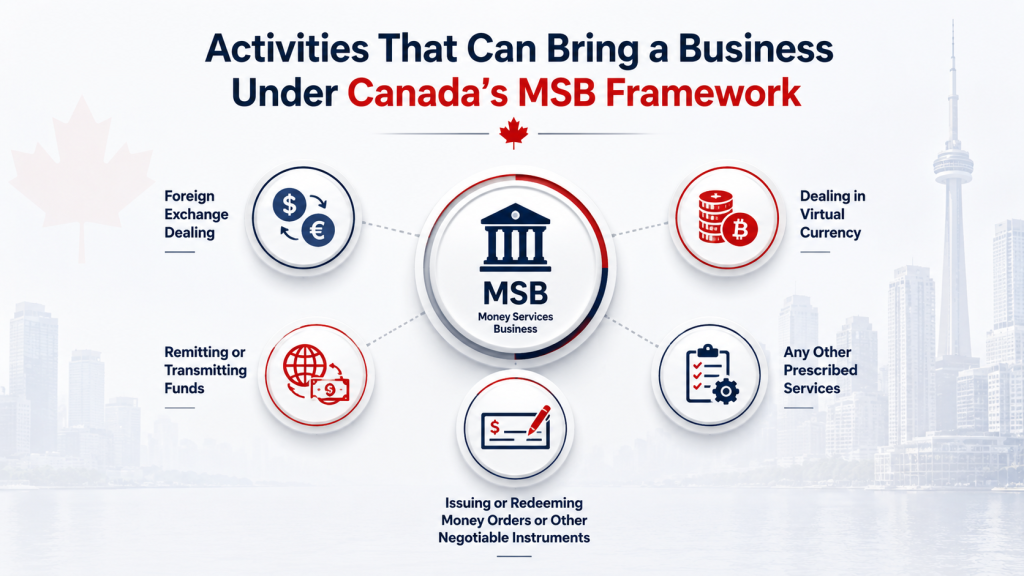
Canada’s MSB framework covers several types of activities. Depending on the business model, these can include:
- Foreign exchange dealing — exchanging one currency for another.
- Remitting or transmitting funds — transferring funds by various means or through electronic funds transfer networks.
- Money orders and similar instruments — issuing or redeeming certain money orders, traveller’s cheques and similar negotiable instruments.
- Virtual currency dealing — dealing in virtual currencies.
- Certain prescribed services — additional services may fall within the framework as regulations evolve.
FINTRAC also identifies services such as cheque cashing, private automated banking machine acquirer services, crowdfunding platform services and certain currency transportation activities within its MSB/FMSB guidance. This is why simply describing a company as a fintech, payment platform or technology company is not enough. The actual activities matter.
How Are MSBs Regulated in Canada?
The federal MSB framework is primarily administered by the Financial Transactions and Reports Analysis Centre of Canada (FINTRAC) under the Proceeds of Crime (Money Laundering) and Terrorist Financing Act and associated regulations.
FINTRAC’s role focuses on compliance with Canada’s anti-money laundering and anti-terrorist financing requirements. It does not function like a conventional financial regulator that licenses banks or guarantees a company’s services. For an MSB, regulatory responsibilities can include:
- Registering with FINTRAC before operating.
- Maintaining a compliance program.
- Conducting customer identification and due diligence.
- Monitoring certain business relationships and transactions.
- Maintaining required records.
- Filing applicable transaction reports.
- Following applicable travel rules and reporting requirements.
Recommended Reading:
If you are planning to establish a business in Canada from India, understanding the wider setup process is equally important. Read our guide on Canada Business Setup from India: The Complete 2026 Guide for a broader overview of the process.
What Compliance Rules and Penalties Apply to MSBs in Canada?
Once registered, an MSB must maintain an ongoing compliance program under Canada’s anti-money laundering and anti-terrorist financing framework. The requirements depend on the nature and risk level of the business, but generally include:
- Compliance program: Documented policies and procedures to manage AML/ATF risks.
- Compliance officer: A designated person responsible for overseeing compliance.
- Risk assessment: Regular assessment of risks linked to customers, services and geographic exposure.
- Client verification: Identifying and verifying customers where required.
- Record keeping: Maintaining prescribed client and transaction records.
- Reporting: Filing suspicious transactions and other applicable reports with FINTRAC.
- Training and review: Training relevant staff and periodically reviewing the compliance program.
Failure to meet these obligations can result in enforcement action by FINTRAC, including administrative monetary penalties. The amount depends on the type and seriousness of the violation.
MSB Penalties at a Glance
Violation | Maximum penalty under the applicable framework |
Minor violation | Up to $1,000 |
Serious violation | Up to $100,000 |
Very serious — individual | Up to $100,000 |
Very serious — entity | Up to $500,000 |
The actual penalty depends on the specific violation and circumstances.Penalty rules can change with legislative updates. For the latest requirements and enforcement guidance, always refer to the official FINTRAC website.
MSB vs FMSB: What Is the Difference?
The easiest way to understand the difference between an MSB and FMSB in Canada is to look at where the business is based and how it serves Canadian customers.
A Canadian MSB generally has a place of business in Canada and provides regulated money services such as fund transfers, foreign exchange or certain virtual currency services. An FMSB, on the other hand, is a foreign business that does not have a place of business in Canada but provides regulated MSB services to Canadian clients and directs those services toward Canada.
For example, imagine an Indian fintech company opens a Canadian office and starts providing money-transfer services to customers in Canada. Because it has a place of business in Canada, it may fall under the MSB Canada framework.
The table below highlights the key differences between an MSB and an FMSB:
MSB | FMSB | |
Where is the business based? | Has a place of business in Canada | Based outside Canada |
Canadian office/presence | Yes | No place of business in Canada |
Canadian customers | Can serve Canadian customers | Provides services to Canadian clients |
Key factor | Canadian business presence + regulated MSB activity | Foreign business + Canadian-directed regulated activity |
So, the key question is not simply “Where is the company incorporated?” A foreign company can still come within Canada’s regulatory framework if its activities are directed toward and provided to Canadian customers.
For founders, this distinction should be assessed before launching services in Canada, particularly if the business plans to operate remotely from another country.
Planning to launch a Money Services Business in Canada? Start with the right structure.
Book a Strategy Call: (Calendly Link)
Visit: www.vorxcon.com
Email: support@vorxcon.com
When Does a Foreign Business Become an FMSB?
A foreign business may fall under the FMSB Canada framework when four conditions come together:
- It provides at least one regulated MSB service.
- It does not have a place of business in Canada.
- It directs those services to Canadian persons or entities.
- It provides the services to clients in Canada.
For example, an overseas money-transfer company that has no Canadian office but actively markets its services to Canadian customers and provides those services to them may need to consider FMSB registration. Canadian-directed marketing can be an important factor. FINTRAC gives examples such as advertising aimed at Canadian customers, operating a “.ca” domain or being listed in a Canadian business directory.
Foreign businesses should therefore assess their Canadian customer journey and marketing strategy before assuming that having no Canadian office keeps them outside the framework.
Is an MSB the Same as a Bank or Payment Institution?
No. An MSB is not automatically a bank.
An MSB classification relates to specific money services and Canada’s anti-money laundering and anti-terrorist financing framework. FINTRAC itself states that registration does not mean it licenses or endorses the business. A business may therefore need to consider other Canadian regulatory requirements depending on what it actually does. Calling a business a “fintech” or “payment company” does not by itself determine its regulatory status.
The correct approach is to examine the business model, payment flows, customers, services and applicable legislation before deciding which regulatory requirements apply.
What Should a Founder Check Before Calling Their Business an MSB?
Before describing your company as a Canadian MSB, look beyond the company name and ask practical questions:
- What financial or money-related services will the business provide?
- Will it exchange currencies or transfer funds?
- Will it deal in virtual currency?
- Will it serve Canadian customers?
- Does the business have a place of business in Canada?
- Could it instead qualify as an FMSB?
- What customer identification and reporting obligations will apply?
- Does the business need additional registrations or regulatory approvals?
FINTRAC provides a specific tool to help businesses determine whether they may need to register as an MSB or FMSB.
Recommended Reading:
Canada is also strengthening its approach to financial crime, transparency and cross-border compliance. Read our guide on Canada’s Financial Crime Crackdown for Foreign Businesses to understand what these changes mean for international businesses.
Why Getting the MSB Classification Right Matters?
Getting the classification right at the beginning can prevent expensive compliance problems later. If a business is required to register but starts operating without registration, it may face penalties or other consequences. FINTRAC also requires registered businesses to keep their registration information current and renew their registration when required.
More importantly, the classification affects how the business builds its compliance infrastructure. Customer onboarding, transaction monitoring, record keeping and reporting should be designed around the actual regulatory obligations from the start.
For founders entering Canada, MSB requirements Canada should therefore be treated as part of business planning—not as paperwork to handle after launch.
What Should Founders Know Before Entering Canada’s MSB Sector?
Before entering Canada’s MSB sector, founders should understand that registration is only one part of the process. Key areas to consider include:
- Confirm your classification: Determine whether your business is an MSB or FMSB.
- Understand your activities: Check whether your services fall within Canada’s regulated MSB activities.
- Plan compliance early: Prepare customer verification, record-keeping, reporting and risk-management processes before launch.
- Assess the business structure: Make sure your Canadian presence, ownership and operating model support the intended setup.
- Keep compliance ongoing: FINTRAC requirements continue after registration and must be maintained as the business grows.
Getting these points clear at the beginning can help founders avoid unnecessary regulatory issues later.
How Can Vorx Help With MSB Setup in Canada?
Setting up an MSB in Canada involves more than incorporating a company. Founders need to understand the right structure, determine whether the business falls under the MSB or FMSB framework, prepare the required documentation and plan for ongoing compliance.
Vorx Consultancy can support this process by helping founders assess their business model, plan the appropriate Canadian structure and coordinate company formation, banking and compliance requirements. Our approach focuses on aligning the setup with the founder’s actual business activities rather than treating registration as a standalone step.
For international founders, this can also mean coordinating the wider setup—from incorporation and banking introductions to compliance planning—so the business has a clearer path from formation to operation.
Planning to launch a Money Services Business in Canada? Start with the right structure.
Book a Strategy Call: (Calendly Link)
Visit: www.vorxcon.com
Email: support@vorxcon.com
Final Thought
While understanding what is an MSB in Canada is a critical point, it is only the beginning to entering the market. In order to successfully navigate the compliance maze, founders should conduct extensive research to identify which activities their business will be engaging in, whether they fall under the MSB definition or FMSB category, and what obligations they have to the regulators. A proper assessment from the start will prevent compliance headaches and unnecessary expenditures down the road.
With that in mind, it is essential that any founder looking to establish a presence in Canada consults with experts in the field to properly understand the nuances of doing business in the region. That way, the setup will be compliant with the regulations right from day one, setting the foundations for a long and prosperous journey ahead.