


Italy is one of the more appealing entry points into the EU market for Indian entrepreneurs, a large consumer base, strong manufacturing and design ecosystems, and a legal system that, once understood, is genuinely open to foreign ownership.
What it is not, however, is simple. Between Italian incorporation rules and India’s own foreign exchange regulations, founders often end up piecing together information from half a dozen sources before they have a clear picture.
This guide brings both sides of that picture together. We’ll walk through the Italian company formation process, but also the part most articles skip entirely: what the Reserve Bank of India expects from you before you send a single euro abroad, and what happens to your profits once they’re ready to come home.
At Vorx Consultancy, we work with Indian founders and investors evaluating exactly this kind of cross-border setup, so this guide reflects the questions we’re asked most often, not just the textbook process.
Can an Indian Citizen Register a Company in Italy?
Yes. Italy does not restrict foreign ownership for most company types, and an Indian citizen can hold 100 percent of the shares in an Italian company without needing an Italian or EU partner.
This applies whether you’re setting up as an individual founder or as an Indian company opening a subsidiary.
There’s an important distinction worth making early, because it’s where most confusion starts: registering a company in Italy and being allowed to live and work there are two separate matters.
You can own and direct an Italian company entirely from India, hire an Italian accountant to manage compliance locally, and never need a visa at all as long as you don’t intend to relocate. A visa or residence permit only becomes relevant if you plan to move to Italy yourself.
Broadly, Indian founders approach this in one of three ways:
- Incorporating a new Italian entity while remaining based in India
- Opening a branch or representative office of an existing Indian company
- Relocating to Italy under a work or self-employment visa and setting up locally
The rest of this guide covers all three, along with the part that catches most first-time founders off guard the Indian regulatory side of moving investment capital abroad.
Planning to Set Up in Italy?
Not sure which Italian business structure fits your goals? Speak with Vorx Consultancy before you begin the incorporation process.
Talk to an Italy Company Formation Expert →
Types of Companies You Can Register in Italy
Italian law offers several business structures, and the right one depends on your capital, your risk appetite, and how many people are involved. Here’s a quick comparison before we go into which one usually makes sense for Indian founders.
Company Type | Simple Meaning | Liability | Best For |
S.r.l.s. | Simple version of an LLC | Limited | Solo founders & startups |
S.r.l. | Standard private limited company | Limited | Small & medium businesses |
S.p.A. | Large company with shares | Limited | Large businesses & investors |
S.a.p.A. | Hybrid company structure | Mixed | Special/rare business cases |
S.n.c. / S.a.s. | Partnership business | Higher personal liability | Small/family businesses |
Branch Office | Indian company’s Italian extension | Parent company responsible | Entering Italy without a new company |
Representative Office | Office only for research/liaison | Not applicable | Market research & networking |
For most Indian entrepreneurs, the S.r.l. (and its simplified version, the S.r.l.s.) is the practical starting point.
It limits personal liability, involves a simpler capital structure than an S.p.A., and is quicker to set up. If you’re a solo consultant or a small team testing the Italian market, the S.r.l.s. is often enough.
If you’re bringing in investors or expect meaningful early revenue, the standard S.r.l. gives you more flexibility in structuring shareholder agreements.
A branch office is worth considering if you already run an established Indian company and want an Italian presence for invoicing or logistics, without creating a separate legal entity. The trade-off is that your Indian parent company remains legally responsible for the branch’s obligations.
Vorx Consultancy Insight: We often see founders default to an S.p.A. because it “sounds more serious,” when an S.r.l. would achieve the same commercial goals with far less paperwork and complexity. The right structure depends on your growth plan, not on which name sounds more corporate.
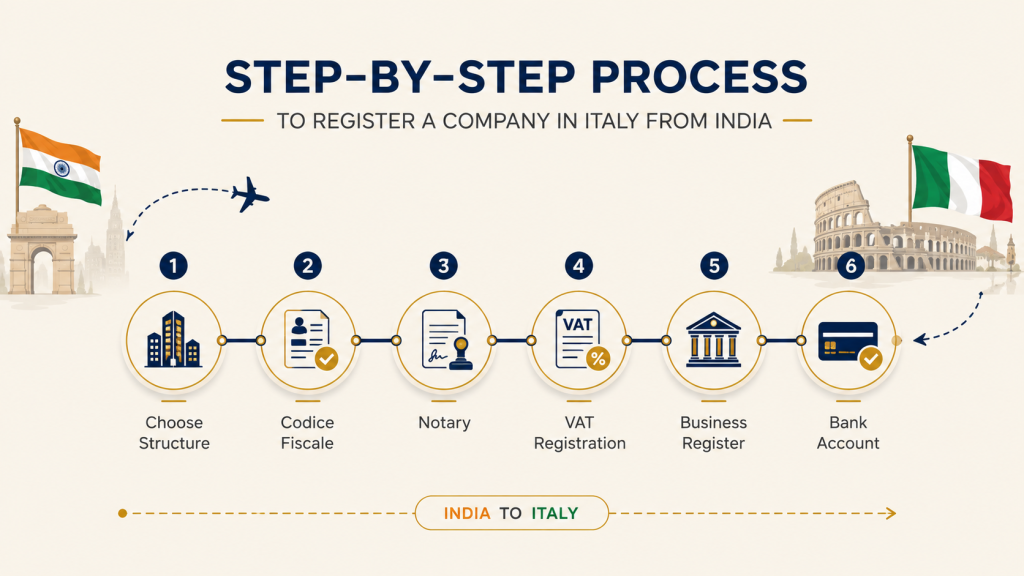
Step-by-Step Process to Register a Company in Italy from India
Once you’ve chosen a structure, the registration process itself follows a fairly consistent sequence:
- Select your company type based on liability preferences and shareholder structure.
- Appoint a notary — Italian company formation, unlike many jurisdictions, requires a notary for most entity types (S.r.l.s. is a partial exception, using a standardized template).
- Obtain a codice fiscale (Italian tax code) for each director and shareholder — required even for non-residents.
- Draft and notarize the Articles of Association and bye-laws, which set out the company’s purpose, structure, and governance.
- Fulfil the capital requirement applicable to your chosen entity type, as prescribed under Italian company law.
- Register with the Business Registry (Registro delle Imprese) at the local Chamber of Commerce, within 20 days of signing the incorporation documents.
- Apply for a VAT number (Partita IVA) through the Italian Revenue Agency.
- Register with INPS and INAIL if you plan to hire employees.
- File a SCIA (Certified Notice of Business Start) if your activity requires prior authorization — this applies to sectors like food service, retail, or certain regulated professions.
- Open a business bank account once the Certificate of Incorporation (Visura) is issued.
Here’s the question we get asked most: do you need to travel to Italy to do all this? In most cases, no. Indian founders typically complete this remotely through a Power of Attorney (POA), authorizing a local notary, lawyer, or commercialista (Italian accountant) to sign on their behalf.
For this to hold up legally, the POA along with your identity documents usually needs to be apostilled, since India is a member of the Hague Apostille Convention, and then translated into Italian by a certified translator.
This apostille and translation step is where timelines often stretch. The Italian registration itself might take 7 to 20 business days, but if you factor in preparing and apostilling documents from India, a realistic end-to-end timeline is closer to four to eight weeks, depending on how quickly your paperwork moves.
Ready to Start Your Italy Company Registration?
From documentation and incorporation to banking and cross-border compliance, get professional support throughout the process.
Start Your Consultation
example: one founder we worked with, running a design consultancy out of Pune, assumed the entire process could be handled over email in under two weeks.
The incorporation itself moved quickly once the notary had everything, but getting his POA apostilled through the correct channel in India took nearly three weeks on its own — a delay that had nothing to do with Italy and everything to do with document preparation at home.
Documents Required to Register an Italian Company from India
Requirements can vary slightly depending on which Chamber of Commerce jurisdiction you register under, but generally you’ll need:
For each individual director or shareholder:
- Valid passport copy
- Proof of residential address
- Application for codice fiscale
- Apostilled and Italian-translated identity documents (if not signing in person)
- Power of Attorney, if appointing a local representative
For the company itself:
- Proposed company name and registered office address in Italy
- Articles of Association and bye-laws
- Proof of capital contribution as required for the chosen entity type
- Business activity description (for ATECO code classification)
It’s worth confirming exact requirements with your chosen notary or commercialists before starting, since local Chambers of Commerce occasionally apply slightly different documentation standards.
RBI, FEMA, and Money Transfer Rules Indian Founders Must Know
This is the part that most guides on Italian company formation leave out entirely — and it’s often the part that determines whether your plans are actually workable.
Before you can invest in or fund an Italian company, Indian regulations govern how much you can send abroad and what compliance you’re expected to maintain afterward.
If you’re investing as an individual, you’re operating under the RBI’s Liberalised Remittance Scheme (LRS).
This allows resident individuals to remit funds abroad for permitted capital account transactions, which includes setting up a foreign business, subject to an annual limit set by the RBI.
If your plans require remitting beyond that limit, you’ll need to look at other routes or bring in additional Indian investors, each operating under their own LRS allowance.
If an Indian company or LLP is making the investment rather than an individual, it falls under the Overseas Direct Investment (ODI) Rules, 2022 instead of LRS. Indian corporates and LLPs can commit a defined percentage of their net worth (based on the last audited balance sheet) toward a foreign entity, provided that entity is engaged in a genuine business activity.
This route requires obtaining a Unique Identification Number (UIN) for the Italian entity through an Authorised Dealer (AD) bank before any funds are remitted.
A few compliance points worth knowing before you initiate any transfer:
Remittances must be routed through one designated AD bank branch, using Form A2 along with your PAN.
Funds that are remitted but not utilized for their stated purpose within 180 days are expected to be brought back to India relevant if your incorporation timeline slips.
Tax Collected at Source (TCS) applies to outward remittances above the applicable threshold. Rates are periodically revised in the Union Budget, so it’s worth confirming the current rate with your bank at the time of transfer rather than relying on a fixed figure.
If you go the ODI route, you’re expected to file an Annual Performance Report (APR) with your AD bank each year for as long as you hold shares in the Italian company.
This is easy to overlook once the business is up and running, but it’s an ongoing obligation, not a one-time filing.
What to Budget for Beyond Incorporation Itself
Setup fees are only part of the picture, and it’s easy to underestimate the ongoing layer of support a non-resident founder needs on both sides:
Notary, registration, and Chamber of Commerce formalities on the Italian side
AD bank documentation and forex processing on the Indian side for any outward remittance
Apostille and certified translation of your documents in India
A local commercialista’s retainer — since you’re not physically present to handle day-to-day Italian bureaucracy, ongoing accounting support isn’t optional in practice, even for a simple S.r.l.s.
Recurring annual filings, VAT compliance, and — if you hire staff — INPS and INAIL contributions
Exact figures vary considerably depending on your entity type, professional fees, and the complexity of your business activity, so it’s worth getting a specific quote from a notary or commercialista rather than budgeting off general figures.
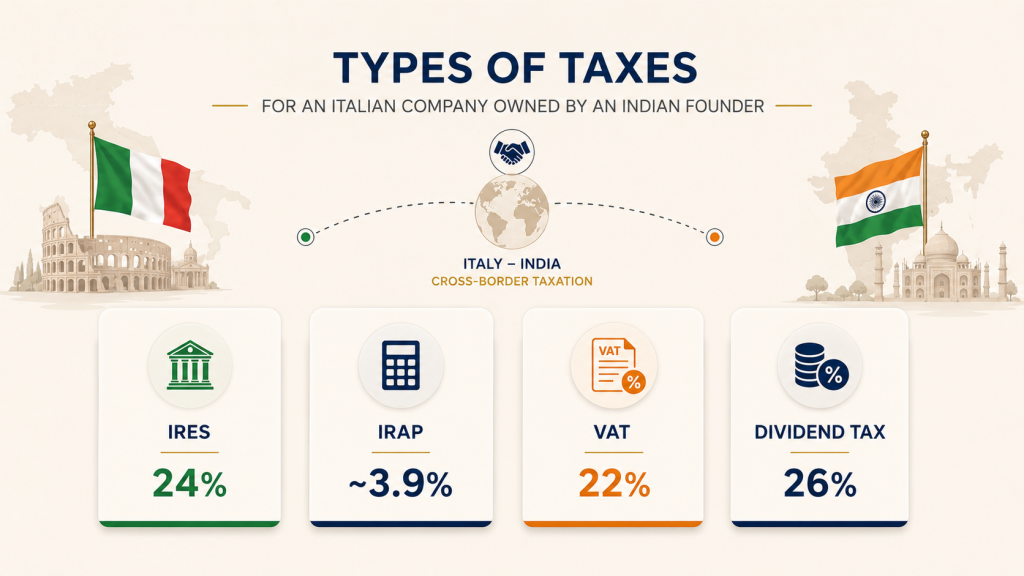
Taxes an Italian Company Owned by an Indian Founder Will Pay
Once operational, an Italian company is subject to the same tax framework regardless of where its shareholders are based:
IRES (Corporate Income Tax): standard rate of 24 percent, with a temporary reduced rate of 20 percent available for FY2025 under specific conditions (profit reinvestment, employment maintenance) introduced by Italy’s 2025 Budget Law.
Whether this incentive continues in future years depends on subsequent budget decisions, so it’s worth confirming current applicability closer to filing.
IRAP (Regional Tax on Productive Activities): roughly 3.9 percent, with some regional variation.
VAT: standard rate of 22 percent, with reduced rates of 4, 5, or 10 percent for specific goods and services.
Dividend withholding tax: 26 percent on profits distributed to shareholders.
Here’s where it gets relevant specifically for Indian founders: what happens when those profits come back to India.
Under the India-Italy Double Taxation Avoidance Agreement (DTAA), dividends repatriated to an Indian tax resident may qualify for a reduced withholding rate compared to the standard Italian rate, and Indian tax paid can often be offset using a foreign tax credit, avoiding taxation on the same income twice.
If you’re an Indian tax resident holding foreign company shares, you’re also required to disclose this holding under Schedule FA of your Indian income tax return, a compliance step that’s frequently missed simply because founders don’t realize it applies to unlisted foreign shares as much as listed ones.
This is genuinely an area where getting professional advice pays for itself. Cross-border tax treatment depends on your specific residency status, how profits are distributed, and current treaty provisions, not something to structure based on a general guide alone.
Opening a Business Bank Account in Italy from India
To open an account, Italian banks generally require the Certificate of Incorporation (Visura), your codice fiscale, proof of the company’s registered office, and identification for directors and shareholders.
Here’s the honest part: several traditional Italian banks still expect an in-person visit to complete account opening, even when the rest of incorporation was handled remotely.
This varies by bank and by how established your relationship with a local commercialista is. Some can facilitate account opening on your behalf, others can’t.
In the interim, or as a supplementary solution, many Indian founders use fintech platforms such as Wise Business or Revolut Business to receive payments and manage transactions while a full local banking relationship is being established.
These aren’t a substitute for a compliant local account long-term, but they solve a real cash-flow gap during setup.
One more point worth remembering here: any funds moving from India into this account still need to go through proper RBI-compliant channels under LRS or ODI, as covered earlier.
The banking step and the remittance compliance step aren’t separate conversations they need to happen in the right order.
Do You Need a Visa to Register or Run a Company in Italy?
To repeat the point made earlier, because it genuinely trips people up: owning an Italian company does not, by itself, grant you the right to live or work in Italy.
You can direct the company, sign documents remotely, and manage operations from India indefinitely without needing any Italian visa.
A visa becomes relevant only if you intend to relocate. The most commonly discussed route for entrepreneurs is the self-employment visa (Lavoro Autonomo), which has specific requirements — including that the company must typically have been established for at least three years, along with authorization from a local Questura and evidence of sufficient income.
This makes it more of a route for founders with an existing, established company than a day-one relocation strategy.
Italy also doesn’t currently offer a dedicated general startup or entrepreneur visa in the way some other EU countries do.
That said, there is a narrower Italy Startup Visa programme aimed specifically at innovative startups meeting defined innovation criteria worth checking eligibility for if your business genuinely fits that category, but not a general-purpose pathway for most founders.
It’s also worth noting that Italy’s broader work-permit system, including the annual Decreto Flussi quota, governs numerical limits on certain visa categories each year.
If relocation is part of your longer-term plan, timing matters these quotas open and close on government-set schedules, and missing a window can mean waiting for the next cycle.
None of this affects your ability to register and run the company itself. It only becomes relevant once personal relocation enters the picture.
Which Structure Should You Choose? A Practical Framework
Bringing everything together, here’s how the decision tends to play out for different founder profiles:
Solo consultant or freelancer testing the EU market : An S.r.l.s. is usually sufficient. Individual LRS limits are rarely a constraint at this scale, and a POA-based remote setup is realistic.
Indian company opening an EU subsidiary : A standard S.r.l. (or S.p.A. for larger operations) makes sense, funded through the ODI route rather than personal LRS, since the investment is coming from the company’s balance sheet.
Investor group raising capital in Italy : An S.p.A. offers the shareholder structure needed for larger fundraising, though it comes with meaningfully higher compliance obligations.
Testing the market without full operations : A branch or representative office avoids creating a new legal entity, useful if you’re not yet ready to commit to full incorporation.
There’s rarely a single “correct” answer here; it depends on your funding source, your growth timeline, and whether relocation is part of the picture.
This is usually the point in the process where a short consultation saves more time than it costs, simply because the right structure changes several downstream decisions: how you remit funds, what you report to the RBI, and how profits get taxed when they return to India.

Common Mistakes Indian Founders Make
A few patterns come up repeatedly with founders we’ve spoken to:
Assuming registration equals residency. As covered above, these are entirely separate processes.
Remitting funds before setting up proper AD bank documentation. This creates avoidable delays and, in some cases, compliance gaps that need correcting later.
Underestimating the ongoing role of a local commercialista. Many founders budget for incorporation but not for the recurring accounting support needed to stay compliant without being physically present.
Choosing a more complex structure than necessary. An S.p.A. isn’t inherently “better” than an S.r.l.s. — it’s better for a specific set of circumstances involving larger fundraising plans.
Missing the 180-day fund utilization rule, particularly when incorporation timelines run longer than expected due to document preparation delays in India.
Planning Your Italy Expansion?
Choose the right Italian structure, understand the India-side requirements, and plan your company formation with greater clarity.
Conclusion:
Setting up a company in Italy from India is entirely achievable, but it sits at the intersection of two regulatory systems that don’t naturally talk to each other: Italian company law on one side, and RBI/FEMA compliance on the other.
Getting the sequence right, from entity selection through to remittance documentation and eventual repatriation, makes the difference between a smooth setup and one that stalls halfway through.
At Vorx Consultancy, we help Indian founders evaluate exactly this kind of cross-border decision — matching the right Italian entity structure to the right Indian compliance route before any documents are filed.
If you’re weighing whether Italy is the right entry point into the EU for your business, that’s the conversation worth having first.
