Opening a company in Hong Kong simply means that you will have to deal with a lot of responsibilities. Not only do you have to make sure that your company fulfills all the requirements, but you also have to deal with compliance matters such as Accounting, Financial Reporting, Audit, Annual Return, Tax, Business Registration and more.
It can become overwhelming for foreign entrepreneurs, especially those who run their business from overseas. As such, knowing what you should do and when you should do it can ease the process tremendously. As mentioned above, the best way to avoid problems associated with Hong Kong company compliance is to have a good compliance calendar that you can rely on.
This guide explains the key annual compliance requirements for Hong Kong companies, including filing deadlines, accounting, audit, tax, Business Registration and ongoing corporate obligations.
What Is Annual Compliance?
Annual compliance covers the ongoing responsibilities a Hong Kong company must meet after incorporation. It is broader than simply submitting an Annual Return. Depending on the company’s structure and circumstances, compliance can involve:
- Accounting and financial records
- Financial statements and audit
- Annual Return
- Tax filings
- Business Registration
- Corporate governance and statutory updates
These obligations do not all follow the same timetable. Some are annual, while others arise when the company makes a particular change.
For foreign-owned companies, the key point is that being owned or managed outside Hong Kong does not automatically remove the company’s applicable Hong Kong compliance responsibilities.
What Are the Accounting Requirements?
Proper accounting records are the foundation of good corporate compliance. A company needs sufficient records to explain its transactions and financial position, including income, expenses, assets, liabilities and supporting documentation.
Maintaining Accounting Records:
Depending on the business, records may include invoices, receipts, bank statements, payroll information, expense records and documents supporting significant transactions. These records should be maintained throughout the year rather than collected shortly before an audit or tax filing. Hong Kong companies generally need to retain accounting records for seven years.
For overseas founders, organised digital records can also make it easier to coordinate with accountants and auditors without being physically present in Hong Kong.
Financial Statements and Reporting:
Accounting records are used to prepare financial statements, which provide a structured picture of the company’s financial position and performance. They may also form an important part of the audit and tax process:
Accounting records → Financial statements → Audit → Tax compliance
Keeping these stages organised reduces the risk of missing information or making corrections later.
Statutory Audit:
The Hong Kong Company Audit Requirements depend on the company’s circumstances and applicable Hong Kong rules. Where a statutory audit applies, the company’s financial statements and relevant accounting records are reviewed by an appropriately qualified auditor. The auditor may request supporting documents and explanations during the process.
Starting the audit early is particularly useful for companies with overseas owners because missing documents or unclear transactions can delay the wider compliance process.
What Is the Annual Return?
The Annual Return is one of the main corporate filings for a Hong Kong company. It provides the Companies Registry with updated information about the company’s corporate structure and particulars. For a local private company, Hong Kong Annual Return Filing is generally required within 42 days after the anniversary of incorporation.
Information Included:
The Annual Return can contain information relating to:
- Registered office
- Directors
- Company secretary
- Shareholders
- Share capital
Before filing, the company should check whether any of these details have changed during the year.
Filing Timeline:
For a local private company, the Annual Return must generally be filed within the prescribed period after the company’s incorporation anniversary. Late filing can result in substantially higher fees.
The filing date should therefore be added to the company’s compliance calendar well before the actual deadline to avoid unnecessary delays and additional costs.
Annual Return vs Tax Return:
These two filings are separate. Completing one does not replace the other.
Filing | Purpose |
Annual Return | Updates corporate information with the Companies Registry |
Tax Return | Reports relevant tax information to the Inland Revenue Department |
What Are the Tax Requirements?
Tax compliance is another important part of maintaining a Hong Kong company. Accounting records and financial statements provide much of the information needed to determine and report the company’s tax position.
Profits Tax Return:
The Hong Kong Profits Tax Return is used to report relevant tax information to the Inland Revenue Department. The company’s accounting records, financial statements and tax computation are important when preparing the return. Companies should follow the filing date stated by the IRD, as applicable extensions and filing arrangements can vary.
A company should also not assume that having little or no profit automatically means there is nothing to file. Its actual tax obligations depend on its circumstances.
Business Registration:
Business Registration is separate from the Annual Return and Profits Tax. A Hong Kong company generally needs to maintain the appropriate Business Registration Certificate while it remains registered and subject to the applicable requirements.
The Hong Kong Business Registration Renewal should therefore be tracked separately from the Annual Return deadline.
Recommended Reading:
Understanding your filing obligations is only one part of Hong Kong tax compliance. For a deeper look at the tax framework, rates and key considerations, read our Hong Kong Corporate Tax Guide.
What Are the AGM Requirements?
Corporate governance is another part of maintaining a Hong Kong company. The Hong Kong AGM Requirements depend on the company’s circumstances and the applicable Companies Ordinance provisions. An Annual General Meeting can involve matters such as financial statements, auditor-related matters, directors and shareholder decisions.
AGM and Shareholder Matters:
An AGM gives shareholders an opportunity to consider relevant company matters and make decisions where required. The company should also maintain appropriate records of meetings, resolutions and other corporate decisions.
Remote Participation:
For overseas founders, physical presence in Hong Kong is not necessarily the central issue. Where permitted, meetings and corporate decisions may be handled through appropriate electronic or remote arrangements. The important consideration is that the company’s governance procedures are followed and properly documented.
What Else Must Companies Report?
Annual compliance does not mean every corporate obligation happens once a year. Certain changes can create separate notification or filing requirements during the year.
Changes in Company Details:
Changes involving directors, company secretary, registered office or other corporate particulars may require separate filings. A company should not simply wait for its next Annual Return to update information when a separate notification requirement applies.
Ongoing Compliance:
This becomes especially important as a business grows. Changes in ownership, management or company details should be addressed when they happen rather than being left until the next annual compliance cycle.
How Do Foreign Owners Manage Compliance?
Hong Kong Company Compliance for Foreigners follows the same basic principle: overseas ownership does not remove the company’s applicable local obligations. A Hong Kong company can have shareholders and business owners based outside Hong Kong while continuing to maintain its local corporate, accounting, tax and filing requirements.
Managing a Company From India:
Many Indian entrepreneurs want to know whether they can manage a Hong Kong company from India. Remote management can be possible, but it should not be confused with remote compliance. A founder can manage business operations from India while the Hong Kong company continues to meet its local statutory obligations.
The practical process often involves coordination between the:
Founder → Accountant → Auditor → Company Secretary → Regulatory Authorities
Challenges of Remote Compliance:
The main challenge is coordination. Documents may be held in India while accounting, audit and corporate filings are handled in Hong Kong. A clear compliance calendar and defined responsibilities can make this process much easier for an overseas founder.
What Does the Compliance Calendar Look Like?
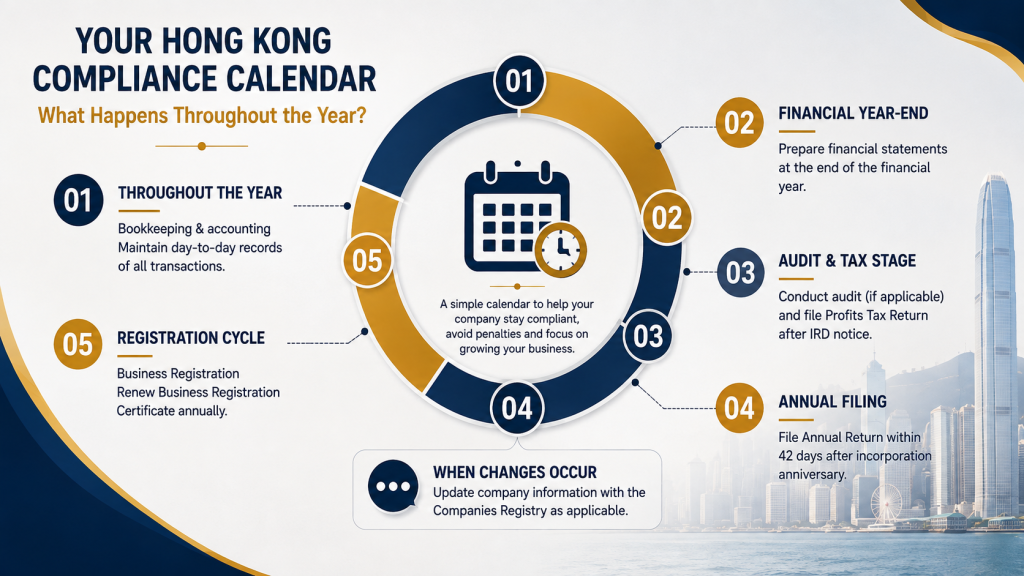
This compliance calendar image provides an overview of the key obligations a Hong Kong company needs to manage throughout the year. This image also highlights the importance of updating company information whenever changes occur.
What Are the Common Mistakes?
Hong Kong company compliance can often be a challenging task for companies, which see it as a one-time annual activity. The neglect of day-to-day maintenance and recordkeeping can lead to unnecessary complications and extra work for the company. Particularly for overseas directors, who may not have the primary administrative responsibility for the company, it is important to understand the most common mistakes in company compliance to avoid them. Among the most common mistakes includes:
- Procrastinating on bookkeeping and audit preparation, which may lead to difficulties in retrieving the necessary documents or explanations of discrepancies;
- Failing to update company details, which may require additional filings if directors’, shareholders’, secretary’s, or registered office’s details have changed;
- Believing that a dormant company does not require compliance, while such companies still have obligations in terms of statutory and filing requirements;
- Forgetting about deadlines, which can be avoided by setting reminders;
- Considering the Annual Return as the only aspect of compliance, while accounting, audit, tax, and Business Registration also require attention and have strict deadlines;
A simple compliance calendar, supported by organized records and clear responsibility for each filing, can help prevent most of these issues.
Recommended Reading:
Compliance requirements can vary depending on the structure of your business. If you are still deciding which structure fits your plans, explore our guide to the Types of Business Entities in Hong Kong.
What Are the Compliance Deadlines and Penalties?
Missing a compliance deadline can result in higher fees, penalties or other regulatory consequences. The actual consequence depends on the type of obligation and the circumstances.
Compliance Issue | Deadline / Timing | Fee or Potential Consequence |
Annual Return | For a local private company, the return should generally be submitted within 42 days of its incorporation anniversary. | Late filing can result in higher registration fees and other statutory consequences. |
Failure to file Annual Return | Applies when the company does not submit its Annual Return within the prescribed 42-day filing period. | The company and responsible officers may face prosecution and other statutory consequences. |
Business Registration | Renewal should generally be completed within one month from the issue date stated on the renewal demand note. | Failure to comply with Business Registration requirements can result in fines and other legal consequences. |
Profits Tax Return | Generally due within one month from the date the IRD issues the return; applicable extensions may be available under the Block Extension Scheme. | Penalties depend on the nature and circumstances of the tax default. |
Accounting Records | Records should be maintained throughout the year and on an ongoing basis, with the applicable retention period observed. | Failure to maintain required records can result in statutory consequences. |
Note: Compliance fees, penalties and filing requirements may change based on updates to Hong Kong regulations. Always verify the latest requirements with the Hong Kong Companies Registry and Inland Revenue Department before making a filing
How Can Vorx Support Hong Kong Compliance?
A Hong Kong company cannot be managed abroad by its founders right after its incorporation. The company needs proper corporate maintenance, accounting, audit, tax, and other services. Vorx Consultancy offers its international clients integrated corporate support solutions covering company formation and maintenance, accounting, audit coordination, and tax and compliance consultancy.
Thus, for those who want to establish a Hong Kong Company Compliance Service, Vorx can be considered an excellent option to manage various aspects of their company’s maintenance properly. It should be noted that the company is aimed to help foreign entrepreneurs, especially those based in India, take care of their business following all legal requirements.
The goal is simpleIn Vorx Consultancy removes all burdens from international company owners so that they can concentrate on the core business while the company’s compliance-related processes are handled by professionals.
Need Strategic Guidance?
Book a Strategy Call: (Calendly Link)
Visit: www.vorxcon.com
Email: support@vorxcon.com
Final Thoughts:
Maintaining a Hong Kong company is a continuous process, involving not only completing the incorporation but also a number of annual procedures, filings, reports, audits, and other matters. From both local and international perspectives, managing such operations is a challenging task, which requires professionals’ Ongoing attention and organization.
For overseas entrepreneurs, particularly those who own a Hong Kong company in India, compliance matters present additional difficulties since they should be handled on a constant basis. In this regard, having a well-structured plan and competent professionals’ support becomes essential in order to ensure nothing is missed or filed late.
It is critical to understand that compliance is not a one-time task but rather a continuous process that should be integrated into the regular operations of a business entity. Only in this way, it will be possible for overseas entrepreneurs to maintain their Hong Kong company and concentrate on more pressing matters, such as development, growth, and expansion.
