


Today Indian business owners, entrepreneurs, consultants, and even start-ups are choosing Australia as their strategic entry point to internationalize their presence and operations. With its stable economy, transparent regulations, and access to the Asia-Pacific market, Australia offers a suitable environment for businesses looking to establish their global presence.
However, registering a company in Australia is not a simple process. this process involves more than simply submitting an application. From choosing the right business structure to understanding compliance requirements, each step plays an important role in building a legally compliant business.
In this guide we include every aspect which is required to know how to Register a Company in Australia from India to help you get familiar with the process, documents, time, cost, and responsibilities.
Can an Indian Citizen Register a Company in Australia?
Yes, an Indian can register a company in Australia as a foreigner, and more often than not, there shall be an opportunity to hold 100% shares in an Australian company.
Australia is a preferred choice among Indian entrepreneurs to serve Australian clients or to enter the Asia-Pacific market and eventually globalize their brand or products.
However, there are a number of factors that one shall keep in mind before jumping into the process of registering a company in Australia.
Some of the factors include:
- Majority of the Proprietary Limited Companies (Pty Ltd) require a director who ordinarily resides in Australia.
- You need a physical address in Australia.
- You need to apply for ASIC Company Registration to commence with trading.
Before we begin the actual process of registering a company in Australia, it is important to understand the business structure and its implication on your business objectives, liabilities, tax strategy, and more.
Which Business Structure Is Right for You?
Before registering the business, it is essential to determine the preferred organizational structure. It will define the owner’s legal and fiscal liabilities, level of responsibility, degree of compliance, and influence the business’s future development. Considering the peculiarities of the Australian law, Indian investors should be aware that not all business structures are appropriate for multinational companies.
Proprietary Limited Company (Pty Ltd):
A Proprietary Limited Company (Pty Ltd) is the preferred business structure of choice for Indian entrepreneurs. It is a separate legal entity, thus providing limited liability, as well as adding to the company’s credibility, which facilitates client acquisition, attracting investment, and securing loans at a lower cost. A Pty Ltd company is usually the best option if you:
- Want to build a long-term business in Australia.
- Intend to hire employees or expand your operations.
- Need a professional business structure for international growth.
- Plan to serve Australian clients.
Sole Trader:
A Sole Trader structure is designed for individuals who run a business on their own. It involves fewer compliance requirements and is relatively simple to manage. However, there is no legal separation between the owner and the business, meaning you’re personally responsible for any debts or liabilities.
This option may suit freelancers or independent consultants but is generally not recommended for founders planning international expansion from India.
Partnership:–
A Partnership is a relationship between two or more persons who carry on a business in common with a view to sharing profits and losses. It is a simpler structure than a company and can be suitable for some smaller businesses, but offers less in the way of protection and flexibility.
For an Indian business wishing to set up in Australia, a Partnership is not typically the preferred choice over a Pty Ltd company.
Recommended Reading:
After incorporation, every company must meet its ongoing compliance obligations, including the ASIC Annual Review. Learn more in our detailed guide on ASIC Annual Review Australia.
Step-by-Step Company Registration Process
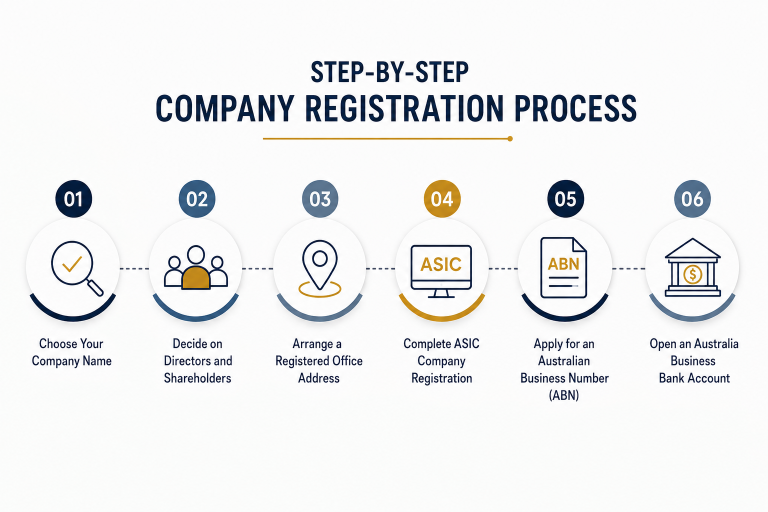
Understanding the registration process helps avoid unnecessary delays and ensures your application is completed correctly.
1. Choose Your Company Name
Start by selecting a unique business name that complies with Australian naming rules. It’s always a good idea to check name availability before preparing your application.
2. Decide on Directors and Shareholders
You’ll need to determine who will own the company and who will act as its directors. Keep in mind that Australian regulations generally require at least one resident director for a Pty Ltd company.
3. Arrange a Registered Office Address
Every Australian company must have a registered office address where official government correspondence can be received.
4. Complete ASIC Company Registration
The next step is lodging your incorporation application with the Australian Securities and Investments Commission (ASIC). Once approved, your company is officially incorporated and receives its Australian Company Number (ACN).
5. Apply for an Australian Business Number (ABN)
After incorporation, you’ll typically apply for an Australian Business Number (ABN), which is required for taxation, invoicing, and conducting business activities.
6. Open an Australia Business Bank Account
Once your company is established, opening an Australia business bank account allows you to receive payments, manage business expenses, and maintain separate company finances. The documentation required may vary depending on the bank and your business structure.
Following these steps carefully helps create a strong foundation for operating your Australian business successfully.
Documents Required from Indian Residents
Before starting the registration process, it may be helpful to compile a list of the documentation needed.
The following is a list of some of the documents that may be required to register a company in Australia:
- Proof of residential address
- Proposed company name
- Details of directors and shareholders
- Registered office address in Australia
- Description of the company’s intended business activities
- Valid passport of the directors and shareholders
Depending on your business model and regulatory requirements, additional documentation may also be requested during the registration process.
What Does It Cost to Register a Company?
The cost of company registration in Australia is determined by several factors such as the company’s structure, the professional service provider and the level of support. It is essential that prior to registering a company, budgeting is taken into account instead of only considering the incorporation cost since additional expenses should also be taken into account when running a business. The amount of money spent on registering a company depends on the following factors:
- Government registration charges
- Professional incorporation services
- Registered office or business address services
- Accounting and bookkeeping setup
- Annual compliance and reporting
- Banking and administrative expenses
Rather than choosing the lowest-cost option, focus on selecting a solution that provides long-term compliance and operational support. This approach often helps businesses avoid costly mistakes after registration.
Recommended Reading:
If you’re planning to expand your business and explore long-term opportunities in Australia, you may also be interested in our guide on the Australia Investment Visa 2026 and the latest changes for international entrepreneurs.
How Long Does the Entire Process Take?
The time needed to register a company in Australia depends on a number of factors including the preparation of documentation, the chosen business structure and the completion of the regulatory process. Even though every business is different, the incorporation process can be completed within a few weeks so long as all of the required information is submitted correctly. The process can be broken down into the following steps:
Business Planning and Documentation Preparation:
Before incorporating a business, it is vital to decide on a business name, directors and business structure as well as prepare other documentation necessary to register a company in Australia. This step ensures that no extra time is wasted due to missing or incorrect information.
ASIC Company Registration:
The next step involves submitting an application to ASIC. At this point, companies must ensure that all of the information provided is accurate since it will determine whether or not a company gets incorporated successfully. Upon successful submission of the application, companies will be issued an Australian Company Number (ACN).
Post-Registration:
At this stage, businesses must apply for an Australian Business Number (ABN), open an Australia business bank account and register for Goods and Services Tax (GST). Finally, businesses can start organising their accounting system and other relevant processes.
What Happens After Your Company Is Registered?
Registering your company is only the beginning. Before you start operating, there are a few essential steps to complete, followed by ongoing compliance responsibilities.
Immediate Next Steps
After incorporation, you should:
- Receive your Australian Company Number (ACN).
- Apply for an Australian Business Number (ABN).
- Open an Australia business bank account for business transactions.
- Register for GST, if your business is required to do so.
- Set up a bookkeeping and accounting system to manage your financial records.
Australia Company Compliance Timeline
Keeping your business compliant is just as important as registering it. Here’s a simple overview of the key obligations you’ll need to manage.
Timeline | Key Compliance Tasks |
Immediately After Registration | Receive ACN, apply for ABN, organise company records, and open a business bank account. |
First Few Weeks | Register for GST (if applicable), set up bookkeeping, and understand your tax obligations. |
Throughout the Year | Maintain financial records, update ASIC if company details change, and comply with employer obligations if hiring staff. |
Annually | Complete the ASIC Annual Review, pay applicable annual fees, and lodge tax returns with the Australian Taxation Office (ATO). |
Why Are Indian Entrepreneurs Expanding to Australia?
Australia has emerged as a favored destination for Indian investors seeking to expand their businesses outside the country. It has a stable economy and business environment and serves as a gateway to the Asian market.
Thus, it is a strategic location for setting up for startups, consultants, exporters, and expanding businesses. You can strengthen your presence in the Australian market and leverage the credibility
Common Challenges Indian Founders Face
While registering the company is a relatively uncomplicated procedure, for an Indian businessman, getting incorporated and managing the firm in Australia involves several challenges. Some most common challenges are:
Understanding the Resident Director Requirement:
A company registered in Australia as a proprietary company limited by shares typically requires at least one director to ordinarily reside in Australia. At the same time, finding a suitable candidate in a foreign country may prove challenging for an overseas businessman.
Choosing the Right Business Structure:
It is critical to understand that the choice of the business structure influences tax, reporting requirements, and other factors in Australia. Therefore, it is essential to make the correct decision on the business structure during the registration to avoid additional expenses and hassle in the future.
Opening an Australia Business Bank Account:
In some cases, financial institutions require extra steps to be taken to open a business bank account for a foreign company. To streamline the process, make sure to collect all of the documents needed for your company structure prior to the opening of the account.
Managing Ongoing Compliance:
After incorporating a company in Australia, make sure to stay on top of the mandatory responsibilities such as record-keeping, ASIC Annual Review, and tax compliance to avoid extra expenses and penalties.
How Vorx Consultancy Can Help You?
Registering a company in Australia is not a simple task that requires just filling out forms. It requires serious planning, proper documents, and compliance with the law. Vorx Consultancy has designed the whole process of incorporating a company in a manner so that you have a hassle-free experience.
We take you through the whole process of choosing the right entity structure and assist you with ASIC registration, documentation, business banking advice, and post-incorporation compliance support. Whether it is your first time setting up a business in Australia or you have incorporated a company before, our team of experts will help you make the whole process seamless.
Need Strategic Guidance?
Book a Strategy Call: (Calendly Link)
Visit: www.vorxcon.com
Email: support@vorxcon.com
Final Thoughts
Registering your company in Australia can provide a great opportunity for Indian businessmen looking out to expand their horizon. But, you can only do so efficiently and profitably if you have all the right procedures and documents in place.
We trust the Australia business registration guide has helped you get a clear view regarding How to Register a Company in Australia from India. If you plan on incorporating a company in Australia in 2026, then we believe you are now ready to take all the necessary steps to do so without any trouble.
With the right assistance, you can make sure that your Australian company establishment will be successful without any regulatory issues in the long run.
