


Expanding abroad raises a question that comes before choosing a country or filing incorporation papers: what should the overseas business be in relation to your Indian business? A subsidiary, branch and joint venture differ in ownership, control and how they operate.
A founder setting up independently faces another set of decisions. This guide compares these four options to help you identify the best business structure for Indians expanding abroad, then looks at the costs and Indian compliance obligations to check before proceeding.
Wholly Owned Subsidiary Abroad
A wholly owned subsidiary is a separate company incorporated in the destination country, with the Indian company holding all its shares. An Indian software firm, for example, might establish a subsidiary to sign contracts with local clients and hire a sales team. The Indian parent retains ownership, while the subsidiary has its own registrations, accounts and filing obligations. Transactions between the two companies also need to be documented and assessed for tax purposes.
Who should choose it? An Indian business with a clear plan for sustained local operations, enough resources to maintain a separate company, and a reason to keep full ownership and control.
Branch Office Abroad
A branch is a registered overseas presence of the Indian company itself; it is generally not a separate legal entity. For example, an Indian engineering firm may consider a branch when it wants its existing company to conduct permitted business in another market. Because the branch remains connected to the Indian parent, the business must examine the parent’s exposure, local tax treatment and branch reporting requirements. Countries also differ in which activities a foreign branch may undertake.
Who should choose it? An Indian company that wants a direct presence under its existing legal identity and has confirmed that a branch can carry out its planned activities in the destination country.
Plan your overseas setup with Vorx: www.vorxcon.com.
Joint Venture with a Local Partner
A joint venture involves an Indian business and another party sharing ownership of an overseas operation. An Indian manufacturer, for instance, may form one with a local distributor that already knows the market and has established customer relationships. The advantage depends on what the partner actually contributes. The agreement must spell out each party’s investment, management rights, profit sharing, decisions requiring joint approval and what happens if either party wants to leave.
Who should choose it? A business that needs a partner’s specific market access, capabilities or resources and is comfortable sharing decisions in exchange for that contribution.
Foreign Company Owned by an Indian Founder
A founder may incorporate and own a foreign company personally, rather than having an existing Indian company invest in it. Consider a founder building a new product for overseas customers with separate investors and finances: personal ownership may reflect that venture more accurately than a subsidiary of their Indian business. The founder still needs to assess the permitted investment route, source of funds and applicable Indian tax disclosures. Incorporating abroad does not, by itself, establish a right to live or work there.
Who should choose it? A founder creating a genuinely separate overseas venture. If the foreign operation will serve an existing Indian company, the ownership and commercial relationship between them should be reviewed before choosing this route.
Recommended Reading:
“If you decide to incorporate a separate overseas entity, read Vorx’s guide to LLC vs LLP for foreign expansion for a closer look at how the entity type affects ownership and management.”
Five Questions to Ask Before Choosing
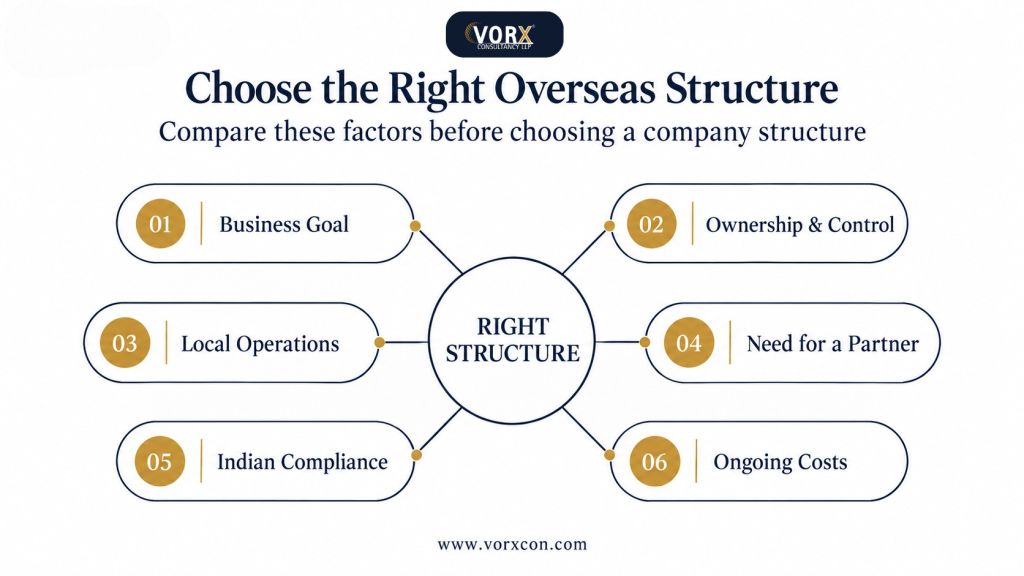
- Who should own the operation? Decide whether ownership belongs with the Indian business, an individual founder or a partner. This affects control and future investment decisions.
- What must it do locally? Identify who will sign contracts, hire employees, hold stock or provide services. Check that the proposed structure can support those activities.
- What does a partner add? If a partner brings access or expertise, define their responsibilities as clearly as their ownership share.
- How will it be funded? Establish whether the investment comes from the Indian business or the founder personally before planning remittances.
- Who will manage it each year? Assign responsibility for accounting, filings and records on both sides of the border.
Plan your overseas setup with Vorx: www.vorxcon.com.
Compare the Ongoing Cost of Each Structure
There is no reliable universal ranking from “cheapest” to “most expensive.” A useful comparison looks at what creates recurring work for each structure.
Structure | Where the recurring work sits | Cost factor to examine closely |
Wholly owned subsidiary | In a separate foreign company, alongside the Indian parent | Local accounting, company and tax filings; transactions between the two companies |
Branch office | In the overseas branch and its Indian head office | Local branch reporting, tax treatment and coordination with parent accounts |
Joint venture | In the foreign company and its shared management | Accounting and filings, plus governance, partner meetings and agreed reporting |
Founder-owned company | In the foreign company and, where applicable, the founder’s personal filings | Local company administration and Indian disclosure obligations |
A quote for incorporation tells you little about the cost of maintaining a company abroad. Ask for a list of annual obligations before deciding.
Plan your overseas setup with Vorx: www.vorxcon.com.
Indian Compliance to Check Before Expanding
- Overseas investment and remittance: Determine whether the investor is an Indian entity or a resident individual. The applicable RBI overseas investment route and reporting can differ; a branch’s operating remittances should also be assessed on their own terms.
- Reporting after investment: Where the overseas investment rules apply, incorporation may be followed by evidence and periodic reporting requirements through the designated authorised dealer bank. Build these into the compliance calendar from the outset.
- Indian income tax disclosures: An Indian resident founder with an interest in a foreign entity may need to disclose it in Schedule FA. The treatment depends on residential status and the nature of the holding; local foreign filings do not replace Indian disclosures.
Recommended Reading:
Before making an overseas investment, read our pre-registration compliance checklist to review the documents and Indian-side requirements that may apply.”
Common Mistakes When Choosing a Structure
A popular jurisdiction or low incorporation quote can make a structure look right before anyone has checked how the business will operate. Watch for three mistakes:
- Choosing by registration price: Compare annual obligations and operating needs.
- Assuming a partner solves every local challenge: Set out the partner’s contribution, authority and exit terms in writing.
- Treating incorporation as the final step: Plan for banking, contracts, accounting and reporting from the start.
How Vorx Consultancy Supports Your Overseas Business Setup?
Choosing a structure is only the first step. The ownership arrangement needs to work with your target market, planned activities and obligations in India and abroad. Vorx Consultancy helps Indian founders and businesses turn that decision into a practical setup plan.
Vorx can support you with:
- Business structure and jurisdiction selection
- Overseas company formation
- Banking documentation support
- Indian and local compliance planning
Whether you are considering a subsidiary, branch, joint venture or founder-owned company, speak with Vorx Consultancy before committing to a structure.
Choose the right structure for your overseas expansion—speak with Vorx Consultancy
Book a Strategy Call: (Calendly Link)
Visit: www.vorxcon.com
Email: support@vorxcon.com
Final Thought
The best business structure for Indians expanding abroad is the one that fits the planned business not the one that worked for another founder or appears fastest to register. A subsidiary offers separate ownership and control; a branch keeps the operation tied to the Indian company; a joint venture shares it with a partner; and a founder-owned company follows a different ownership path. Define the activities and ownership first, then compare country rules, annual work and Indian obligations before making the choice.