


However, if you have an EOOD or OOD registered in Bulgaria, 2026 will not be considered a year with unchanged compliance requirements for you.
The euro currency was introduced in Bulgaria on January 1st, 2026, several requirements were updated, and two of the most significant yearly deadlines are now due at a later date than mentioned in most of the old manuals.
This manual includes the Bulgaria company compliance checklist for a normal small or medium-size trading company.
The document clarifies what you have to file on a monthly, quarterly and annual basis, who has the responsibility, what changes depending on whether you are a foreign or Indian shareholder, and what penalty there will be for missing deadlines. Amounts are stated in euro based on regulations prevailing in November 2026.
Key Bulgarian compliance deadlines at a glance
Obligation | Deadline | Filed with |
VAT return and VIES declaration (VAT-registered companies) | 14th of the following month | National Revenue Agency (NRA) |
Payroll declarations (Forms 1 and 6) | 25th of the following month | NRA |
Corporate tax advance payments (quarterly payers) | 15 April, 15 July, 1 December | NRA |
Annual corporate income tax return + final payment | 1 March – 30 June | NRA |
No-activity declaration (dormant companies) | 30 June | Commercial Register |
Publication of annual financial statements | 30 September | Commercial Register |
Beneficial owner changes | Within 7 days of the change | Commercial Register |
For the 2026 financial year, the tax return is due by 30 June 2027 and the accounts by 30 September 2027.
Need Help Managing Your Bulgarian Company’s Compliance?
Avoid missed filing deadlines and reporting complications. Vorx Consultancy helps foreign business owners coordinate accounting, annual filings and ongoing compliance requirements.
What changed in Bulgaria's compliance requirements in 2026
Everything is now in euro: The Bulgarian transition to the Euro took place on 1 January 2026 at a fixed exchange rate of EUR 1 = BGN 1.95583. Income tax, social security and VAT filings for 2026 will be completed in Euros and threshold amounts re-converted. Make sure you update your capital and articles accordingly.
The annual filing window moved: Now, the corporate income tax form and the payment of tax become due between March 1 to June 30 of the following year.
Annual accounts are released in the Commercial Register before 30 September. Should your accountants be working around 31 March and 30 June, find out what regulations they are applying.
VAT registration works differently: The threshold has been increased to a mandatory threshold of EUR 51,130 taxable turnover per calendar year. It is to be applied within 7 days of reaching this level, rather than a certain date in the following month.
Annual filing requirements for Bulgarian companies
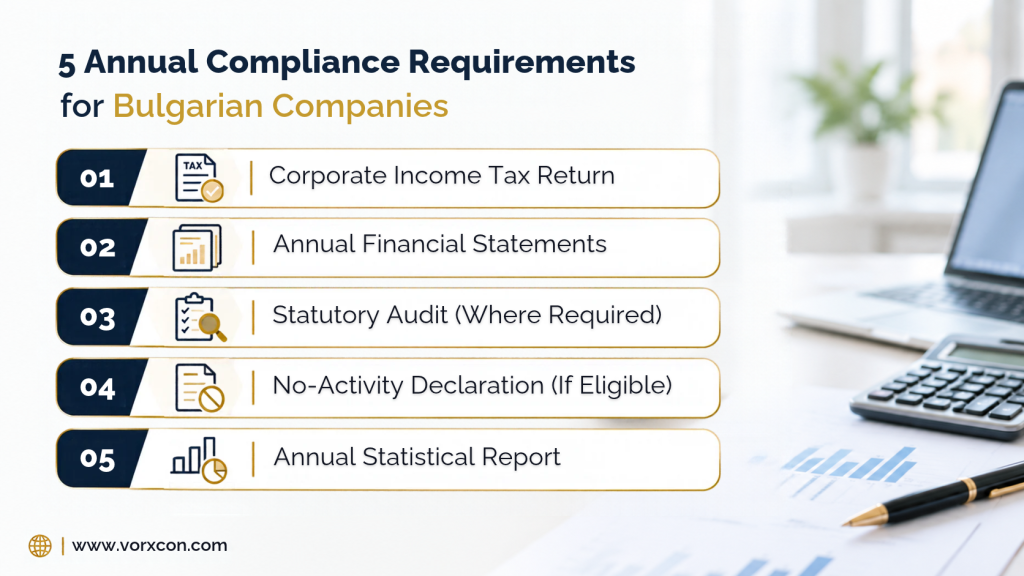
1. Annual corporate income tax return
Every corporation, whether profitable or unprofitable, makes a CIT submission to the NRA every year.
Company profits are taxed at a fixed rate of 10% in Bulgaria. The return converts the accounting profit to the taxable profit, and any outstanding tax after advance payments is paid on 30 June. Tax filing is done electronically using the QES (qualified electronic signature).
2. Annual financial statements
The preparation of your company’s annual financial statements will be made under Bulgarian Accounting Standards or IFRS, depending on requirements.
They are formally adopted by the shareholders or the single owner of an EOOD, and the company makes them public in the Commercial Register by 30 September.
However, small companies which do not require a statutory audit have been given some respite since they are not required to disclose their income statement or management statement.
Another difference between a branch of a foreign company and a branch of a local company is that a branch of a foreign company makes an additional filing.
3. Do you need a statutory audit?
These companies must have their accounts audited by a registered auditor:
- medium-sized and large companies
- public-interest entities
- small companies that exceed at least two of three size criteria: balance-sheet assets, net revenue and 50 average employees
The asset and revenue ceilings were expressed in euro in 2026, so check out the current numbers with your accountant instead of using old tables with BGN. Most young EOODs are comfortably under these.
4. Dormant companies: the no-activity declaration
In case your company was inactive during the year, you have an option to submit a free no-activity statement in the Commercial Register before 30 June. There are two warnings that can be made:
- A dormant company that is VAT registered continues to make monthly VAT returns.
- No activity’ is restrictive: If you issue invoices, pay expenses via your company, or enter into any contract agreements, you may not qualify.
Failing to meet the deadline of 30 June means you need to publish full statements instead.
5. Annual statistical report
Companies also file an annual activity report for the National Statistical Institute. The Bulgarian government is putting all these reports together in one submission point; therefore, in reality, your accountant will submit them as one set of papers.
Monthly and quarterly obligations
VAT returns
After registering for VAT, a firm submits a VAT return every month on the 14th of the following month.
The return goes with sales and purchase ledgers and, if the company trades with other EU businesses, a VIES declaration. The standard rate is 20%. You file every month, even when there are no transactions.
Payroll
Employers submit Form 1 (one filing for each employee) and Form 6 (aggregate filing). Payment of social security contribution and withholding tax is made on the 25th day of the following month. The self-insuring proprietor could also have the same filing procedure every month.
Corporate tax advance payments
Whether you pay advances, and how often, depends on the company’s net sales revenue in an earlier reference year:
Net revenue (reference year) | Advance payments |
Up to approx. EUR 153,388 | None required |
EUR 153,388 – 1,533,876 | Quarterly: 15 April, 15 July, 1 December |
Above EUR 1,533,876 | Monthly, by the 15th |
Newly incorporated companies don’t pay advances in their first year.
Dividend withholding tax
Dividends paid to individuals and most non-resident shareholders carry 5% withholding tax. It is declared and paid within the month following the quarter in which the dividend was paid.
Dividends paid to companies domiciled in the EU or EEA are exempt from tax. There had been a proposal to increase the tax rate to 10% in the draft 2026 budget, but this was not implemented.
Read this guide: Bulgaria Corporate Tax guide in 2026.
SAF-T reporting
Bulgaria is introducing monthly SAFT accounting reports, which is basically a computer-readable export of accounting information from a company’s books.
The initiative began in 2026, with only large organizations meeting particular requirements involved. Small/medium-sized companies will be joining in starting in 2029.
Most readers have no need for such knowledge right now, but it might be helpful to keep it in mind while selecting accounting software.
Beneficial ownership and register updates
Every Bulgarian company must declare its ultimate beneficial owners (UBOs), the individuals who ultimately own or control it, in the Commercial Register.
Any change must be registered within 7 days. Changes to the manager, registered address or capital also need Commercial Register filings.
Foreign-owned companies should follow one rule. If the company has no legal representative who is permanently resident in Bulgaria, it must name a contact person with permanent residence in Bulgaria in the register. This is often your accountant or a service provider.
Can a non-resident director run a Bulgarian company?
Yes. The Bulgarian legislation does not oblige the manager of EOOD or OOD to be a Bulgarian national or be a resident in Bulgaria. It is just the non-resident director who influences the form but not the content of the filing.
Remote signing: You must have a QES or a duly notarized power of attorney to allow for remote signing of the documents.
Contact local: You need the Bulgarian contact person mentioned above.
Banks: Due Diligence will be more enhanced if the managers/UBOs are not residing within the EU.
Place of management: The place where the business is really managed may present issues of tax residence and permanent establishment in your own country. Seek advice before you conduct your board meetings and decision-making overseas.
Read this guide: Bulgaria Company Formation for Foreigners: A Complete 2026 Guide
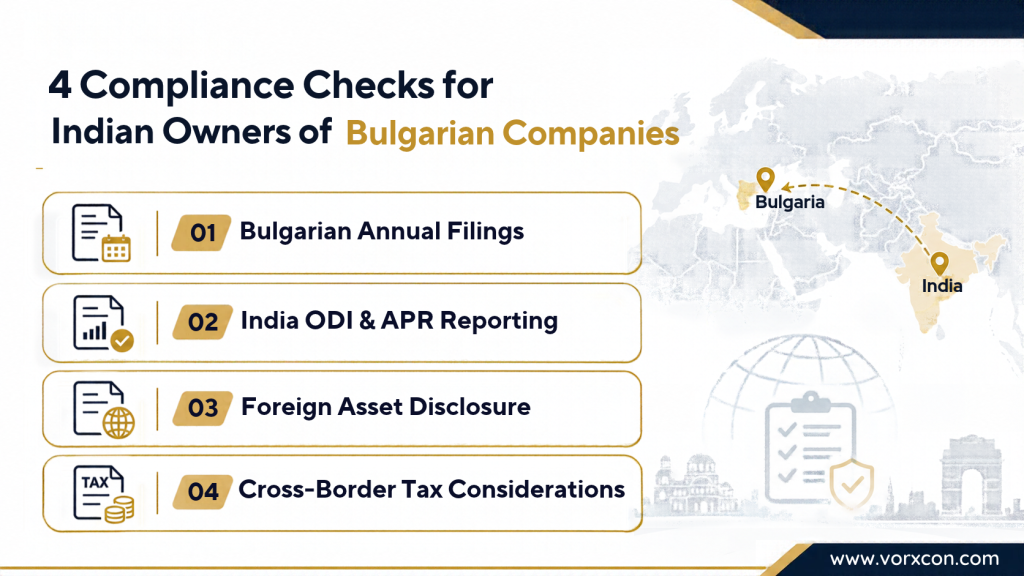
Indian founders: Bulgarian deadlines feed Indian ones
Those Indian citizens who own a Bulgarian enterprise also have their compliance calendar, which is related to the Bulgarian one.
Annual Performance Report (APR): The APR filing process for India under its overseas investment regulations requires that the APR form be filed via the authorized dealer bank by an Indian resident having interest in a foreign firm.
This document relies on the foreign enterprise’s financial statements; hence, a delayed filing of Bulgarian accounting statements results in an incomplete and difficult-to-file APR.
Tax Return form: Indian residents file their foreign stock investments in FA schedule while filing Form 67 to get tax credits from Bulgaria.
Dividends: There is an India-Bulgaria Tax Treaty in place, but the 5% withholding tax rate prevailing in Bulgaria is quite low in itself.
Example (hypothetical): In March 2026, a founder based in Pune registers a Bulgarian EOOD for selling software in the EU. The sales exceed EUR 51,130 in October, and the business needs to apply for VAT within 7 days and also register their monthly returns. For the year 2027, their tax return needs to be completed by 30 June and the accounts by 30 September. If this happens earlier, the founder’s Indian APR by 31 December becomes regular work.
Managing a Bulgarian Company from India?
Stay on top of Bulgarian filing obligations and India-side reporting requirements. Vorx Consultancy helps Indian entrepreneurs coordinate cross-border business compliance.
Watch list for 2027
On 23 September 2026, the Ministry of Finance published draft tax bills. Among other changes, they would raise the VAT registration threshold to EUR 75,000 from 1 January 2027. These are just proposals until Parliament accepts them, so for now operate under the existing laws.
Conclusion:
Bulgarian compliance is easy to handle once you approach it as a schedule: VAT and payroll every month, advance payments for those who have higher income, tax return by 30 June, and accounts by 30 September.
The danger lies in the gaps. It could be a company that is not quite dormant, failure to meet the VAT threshold, or Bulgarian accounts completed after the deadline for Indian filing.
Vorx Consultancy assists foreign and Indian entrepreneurs in incorporating and managing companies in Bulgaria. These include accounting coordination services and annual compliance requirements.
Keep Your Bulgarian Company Compliant with Vorx
From annual filings to accounting coordination and regulatory compliance, Vorx Consultancy supports foreign-owned businesses with their ongoing Bulgarian compliance needs.
