


You have a Ghanaian company, or you are about to set one up, and now you need a business bank account in Ghana to pay staff, receive customer payments and bring in capital from abroad.
The documents are the easy part. The harder part in 2026 is identity: Ghana’s central bank now expects every foreign director or shareholder who signs on the account to be verified with a Ghana-issued identity card.
This guide explains who can open an account, which account type fits a foreign-owned business, the documents banks ask for, and where applications usually stall.
Can a Foreign Company Open a Business Bank Account in Ghana?
Yes, but the account is opened for an entity registered in Ghana, not for your overseas company as it stands. Ghanaian banks do business with Ghanaian legal persons. This could be done via three options, namely:
A Ghana-incorporated subsidiary: You register the company in the Office of the Registrar of Companies (ORC) where it is wholly or partly foreign-owned. This is the most common method, and the banks prefer this one most.
A registered external company (branch): Your overseas company registers in Ghana as an external company and operates through a local branch. The bank will review both the Ghana registration and the parent company’s records.
No Ghana entity: If you have not registered anything in Ghana, a local corporate current account is generally not available. Your options are cross-border payments from your home-country account or registering first.
One point has changed for the better. The Ghana Investment Promotion Authority Act 2026 (Act 1173), which took effect on 15 July 2026, eliminated the general minimum foreign capital for non-trading joint ventures and foreign firms.
However, trade companies will still be required to have US$500,000 in cash equity and employees consisting of 75% skilled Ghanaians.
That matters for banking, because under the old law many founders opened an account mainly to deposit and evidence their minimum capital.
Read this guide: Ghana Company Tax Guide in 2026.
Types of Business Bank Accounts in Ghana
Most foreign-owned firms require two accounts: a cedi account for local transactions and a foreign exchange account for cross-border transactions.
Cedis is the only legal currency of Ghana, so all local suppliers and payments are in cedis.
Ghana has two kinds of foreign currency accounts, and confusing them is a common planning mistake.
Account | What funds it | Typical use for a foreign-owned company |
Cedi business current account | Local receipts and converted funds | Payroll, rent, suppliers, taxes |
Foreign Currency Account (FCA) | Money transferred in from outside Ghana | Receiving capital or shareholder funding from the parent company |
Foreign Exchange Account (FEA) | Foreign currency earned inside Ghana | Holding US dollar receipts from local exporters or clients paying in foreign currency |
The distinction has consequences. Since 2014, Bank of Ghana regulations have banned transfers from FEA to FCA accounts, while any transfer from Ghana from either account requires documentation such as invoices or contracts.
The use of cash withdrawal facilities and cheque books is still permitted in May 2025 on both.
Which should you choose?
If your parent company will fund the Ghana entity, ask for an FCA alongside a cedi current account. If your Ghana company will earn foreign currency locally, ask about an FEA. Confirm in writing which type the bank is opening for you before you sign.
Example (hypothetical): A Bengaluru software firm sets up a Ghana subsidiary to serve West African clients.
The Indian parent sends quarterly funding in US dollars to the subsidiary’s FCA. The subsidiary converts what it needs into its cedi account to pay three local employees and office rent.
Documents Required to Open a Corporate Bank Account in Ghana
Each of the banks has its own checklist, but all the corporate applications for credit in Ghana use the same basic list. Here’s what you need to supply.
Company documents
- Certificate of incorporation (or external company registration) from the ORC
- Company constitution or regulations
- Company profile or registry extract showing directors, secretary and shareholders
- Beneficial ownership information, matching what was filed with the ORC
- GIPA registration documents, where your company is required to register
- Tax Identification Number (TIN) issued for the company
Authority to open the account
- Board resolution approving the account and naming authorised signatories and their signing rules
Individuals
- Identification for directors, signatories and significant shareholders (see the Ghana Card rules below)
- Proof of residential address for each person
- Passport photographs, where the bank still asks for them
For foreign corporate shareholders
- Parent company’s certificate of incorporation, constitution and a current registry extract
- A group structure chart down to the individuals who ultimately own or control the business
- Translations and certification or apostille of foreign documents, if the bank requests them
Business and source of funds
- Description of activities, expected monthly volumes and main countries you will pay or receive from
- Evidence of where the initial funding comes from, such as parent company bank statements or a shareholder loan agreement
- Ghana business address (a lease or digital GPS address)
Absa Ghana’s published corporate checklist, for instance, includes group structure, audited financials where applicable and GIPC (now GIPA) details.
Check your chosen bank’s current list before preparing anything, because requirements differ by bank and by risk profile.
Are Your Ghana Banking Documents Ready?
Avoid application delays. Vorx Consultancy LLP helps foreign businesses prepare and review their banking documents.
How to Open a Business Bank Account in Ghana: Step by Step
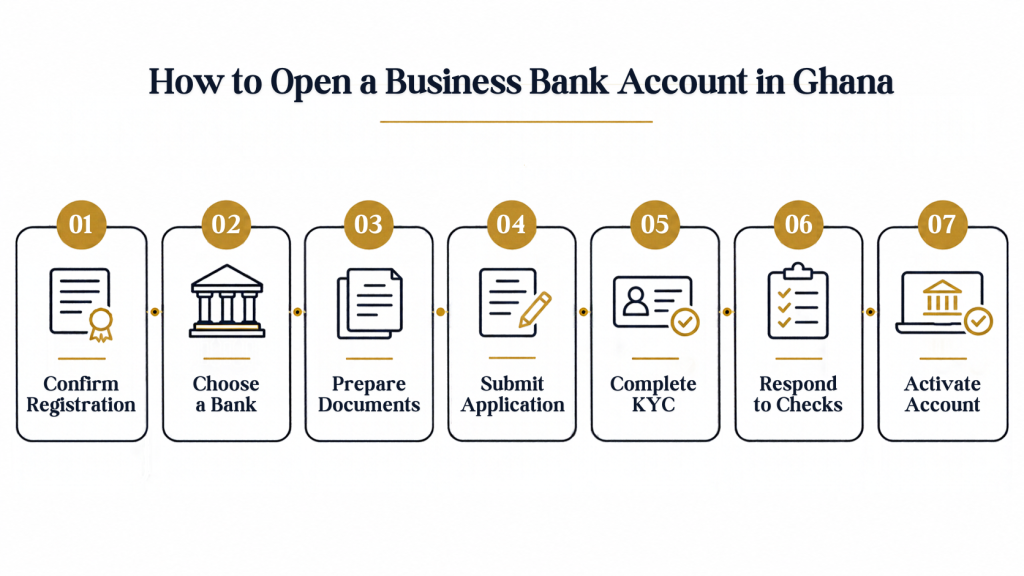
Ensure that the Ghana business is all set: Ensure your ORC Registration, Beneficial Ownership Declaration, Company TIN and possibly GIPA Registration have been completed. A bank won’t open a bank account for a business that is undergoing the registration process.
Deciding on the signatories: Select signatories that can undergo Ghana Card verification. This single decision makes all the difference to your timeline (discussed further in the next section).
Choose banks: Pair banks with your requirements: international money transfer, foreign currency accounts, trade finance, payroll solutions or an association with your domestic bank.
Request the bank’s checklist and application form: Request the same from your relationship officer at the corporate onboarding package and inquire particularly about the guidelines that are necessary for non-residents.
Prepare and check your documents: Names, addresses, shares, and directors’ details should be the same in the ORC record, board resolution, IDs, and application form.
Verification process to be completed and submitted: The bank does KYC, beneficial ownership, source of funds verification, and biometric verification of the identity card of each signatory.
Answer follow-up questions: Compliance officers will often request clarification regarding ownership chain, transaction flow, or source of funds. Immediate and consistent responses will move the file along.
Funding and Activation: After approval, make the first deposit, get your online banking details, and set the signing mandate.
Read This Guide: Ghana Company Formation for Foreigners in 2026.
Can You Open a Business Bank Account in Ghana Remotely?
You can usually start the application remotely, but fully remote opening is difficult when every signatory lives abroad. The reason is Ghana’s identity rule.
Guidance Note of the Bank of Ghana on the usage of Ghana Card, which explains Notice BG/GOV/SEC/2025/36 of 13 November 2025, mandates that banks must verify foreign directors, shareholders, or non-residents who act as signatories by employing the Ghana Card only when opening an account.
For those who are not Ghanaians, it will be the Non-Citizen Identity Card (also referred to as non-citizen Ghana Card).
Three details in the note matter for foreign founders:
On-line onboarding is no easier: when signing up for mobile and online banking services, there is no risk-based approach to verification. The bank needs to verify the ID card and conduct a liveness test.
Passport application is limited: Passport can be used by foreign non-residents in Ghana who visit the country for less than 90 days for individual transactions like money transfers and card transactions, but not for account opening.
Verification failure locks the account: In the event of the new client’s failed verification, the bank will mark the account as post-no-debit account with 90 days available to correct the status.
Practical ways to structure signatories
- It will be necessary to appoint a signatory or resident director who is already the holder of the Ghana Card or Non-Citizen’s Card.
- Plan one trip to Ghana for the foreign director to register for the card and attend bank verification.
- Reduce the number of foreign signatories. More signatories mean an extra process of verification.
There is variation in how banks apply these requirements, so consult your bank on how it will treat non-resident foreign signatories.
Opening a Ghana Business Account From Abroad?
Non-resident directors and foreign signatories may face additional verification requirements. Vorx Consultancy can help you prepare your documentation and plan the application process.
Banks Commonly Used by Foreign-Owned Companies in Ghana
No single bank is the best bank for all foreign firms. The choice will depend on the origin of your funds and the destination.
The table below compares the groups behind five widely used banks; it says nothing about approval odds, which no bank guarantees.
Bank | Parent group | Often worth considering if… |
Standard Chartered Ghana | UK-headquartered international group | You need links to Asian, Middle Eastern or UK markets |
Stanbic Bank Ghana | Standard Bank Group, South Africa | You operate across southern and eastern Africa |
Absa Bank Ghana | Absa Group, South Africa | You want a published, detailed corporate checklist to plan against |
Ecobank Ghana | Ecobank Transnational, pan-African | You trade across several West and Central African countries |
GCB Bank | Ghanaian, majority state-owned | You need a wide domestic branch network and government-facing payments |
When you speak to banks, compare:
- Which foreign currencies they offer on FCA and FEA accounts
- Cost and speed of outward international transfers
- How they handle non-resident foreign signatories
- Online banking with multi-user approval for companies
- Minimum balance and monthly fees, taken from their current published tariff
Compliance Checks and Why Applications Stall
Banks in Ghana conduct KYC and anti-money laundering checks at the time of onboarding and through the course of the relationship.
For a foreign business, the bank requires clear answers to the following four questions: Who owns the business? Who controls the business? Where does the money come from? What will the account be used for?
After opening an account, cross-border transactions are checked and have to be documented.
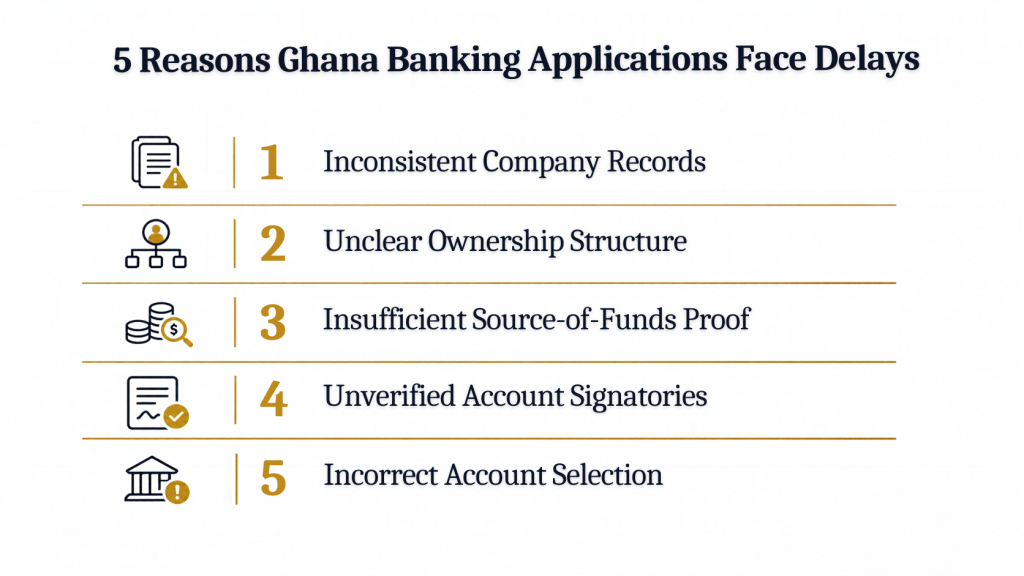
Most delays trace back to a handful of avoidable problems:
Records that don’t match: A director listed at the ORC but missing from the board resolution, or a shareholding that differs between documents.
Opaque ownership chains: Layers of holding companies with no chart showing the individuals at the top.
Vague source of funds: “Investment from parent” without bank statements or agreements to back it.
Signatories who can’t be verified: Foreign directors without a non-citizen card, discovered only at submission.
The wrong account type: An FEA opened when the business needed an FCA for funds from abroad.
Read This Guide: Ghana Company Compliance Requirements in 2026.
How Vorx Consultancy Can Help
Vorx Consultancy works with foreign founders, including Indian entrepreneurs, on the steps around a Ghana bank application:
- Reviewing your structure and documents for bank readiness before you apply
- Coordinating company formation and registration requirements
- Preparing the board resolution, ownership chart and source-of-funds pack
- Helping you plan signatories and the Ghana Card process
The bank makes the final decision on every application, and no adviser can guarantee approval.
Preparing for Business Banking in Ghana
A Ghana business bank account is very simple when these three factors align: a registered Ghana business, consistency in all records, and signatories capable of Ghana Card verification. The first issue to address is the signatory, since this will determine your time frame.
Planning to Open a Business Bank Account in Ghana?
From company documentation to banking compliance preparation, Vorx Consultancy LLP supports foreign-owned businesses through the application process.
