

Operating a Money Services Business (MSB) in Canada comes with ongoing regulatory responsibilities. Canada MSB compliance requirements cover much more than simply establishing the business. An MSB needs to build appropriate controls for anti-money laundering (AML), know your client (KYC), transaction monitoring, record keeping, and reporting.
For entrepreneurs penetrating the Canadian market, the knowledge of the requirements at an early stage may ease the day-to-day operations by allowing them to organize their compliance process. Particularly, a proper compliance framework will enable an MSB to assess and mitigate risks, collect relevant client information, detect suspicious transactions, and meet its reporting obligations.
If you’re planning to operate an MSB in Canada or want to understand the compliance requirements before getting started, this guide will walk you through the key AML, KYC, monitoring, and reporting obligations you need to know.
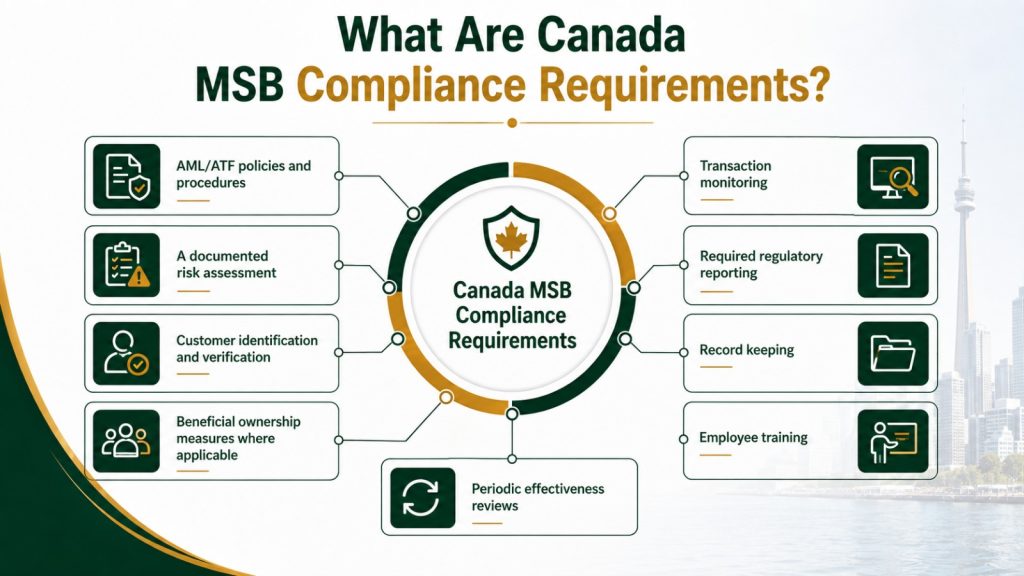
What Should an MSB Include in Its AML Compliance Program?
An AML compliance program provides the foundation for managing money laundering and terrorist financing risks. It should be tailored to the MSB’s actual business model instead of relying on a generic policy.
Compliance Officer
An MSB should designate a compliance officer who is responsible for overseeing the compliance program and ensuring that appropriate procedures are implemented.
Written Policies
The business should maintain clear written policies covering areas such as KYC, transaction monitoring, reporting, record keeping, training, and risk management.
Risk Assessment
The MSB should assess the risks connected to its customers, services, products, delivery channels, and geographic exposure. This helps determine where stronger controls may be needed.
Employee Training
Employees and relevant personnel should understand their compliance responsibilities and know how to identify and escalate potential risks.
Program Review
The compliance program should be reviewed for effectiveness. FINTRAC requires the effectiveness review to be conducted at least every two years and documented.
A strong MSB AML requirements Canada framework therefore focuses not only on having policies, but also on making sure those policies work in practice.
What Are the KYC Requirements for MSBs in Canada?
KYC, or Know Your Client, is an important part of the MSB compliance process. It helps the business establish and verify the identity of customers when the applicable rules require it.
FINTRAC’s MSB guidance sets out a number of situations where identity verification is required. These can include certain large cash or virtual currency transactions, suspicious transactions, foreign currency exchange transactions of CAD $3,000 or more, and certain funds transfer transactions of CAD $1,000 or more. For KYC purposes, an MSB should have clear procedures for:
- Identifying customers when required
- Verifying identity using an approved method
- Collecting required customer information
- Understanding the customer’s activities and risk
- Addressing beneficial ownership requirements where applicable
- Keeping relevant information and records up to date
KYC should not be treated as simply collecting an identification document. It should form part of the MSB’s wider risk-management process.
What Reporting Requirements Apply to Canadian MSBs?
Reporting is a major part of Canadian MSB compliance. The type of report and deadline depend on the transaction or activity involved.
Suspicious Transaction Reports
An MSB must submit a Suspicious Transaction Report when it has reasonable grounds to suspect that a transaction or attempted transaction is related to money laundering or terrorist activity financing.
Large Cash Transaction Reports
A large cash transaction can trigger a reporting obligation when the applicable threshold is reached. For transactions subject to the large cash reporting requirement, the report is generally due within 15 calendar days.
Electronic Funds Transfer Reports
Certain electronic funds transfers are also subject to reporting requirements. Applicable reports generally need to be submitted within the prescribed timeframe, including the five-working-day reporting period for relevant reportable transactions.
The important point is that an MSB should have internal procedures that identify reportable activity and ensure the correct information is submitted on time.
Recommended Reading:
Before starting the registration process, it is important to understand the applicable requirements. This guide covers the key FINTRAC MSB registration requirements and process.
How Often Must an MSB Meet Compliance Requirements in Canada?
MSB compliance is not something that happens only once a year. Different obligations apply at different times. Identity verification may be required when a specific transaction or activity reaches a regulatory trigger. Transaction monitoring and record keeping are ongoing activities, while certain reports must be filed when a reportable transaction occurs.
Compliance Activity | Timeline / Trigger |
KYC & Identity Verification | When a transaction or business relationship meets the applicable verification requirement |
Transaction Monitoring | Ongoing throughout the customer relationship |
Suspicious Transaction Reporting | When reasonable grounds to suspect money laundering or terrorist financing arise |
Large Cash Transaction Reporting | Generally due within 15 calendar days when the applicable reporting threshold is met |
Certain Electronic Funds Transfer Reporting | Generally within 5 working days when the reporting obligation is triggered |
AML Compliance Program Review | At least once every 2 years |
Record Keeping | Ongoing; applicable records are generally retained for at least 5 years, depending on the record type |
What Are the Penalties for MSB Non-Compliance in Canada?
Non-compliance with AML, KYC and reporting obligations can result in Administrative Monetary Penalties (AMPs) or, in certain cases, criminal consequences. The actual amount depends on the violation, its seriousness, compliance history and the applicable penalty framework.
AML Compliance Violations
Failure to maintain an effective AML compliance program can lead to an administrative monetary penalty. Under the current framework, penalties can reach up to CAD $500,000 per violation for an entity, depending on the applicable violation and circumstances.
KYC Compliance Violations
Failing to properly identify or verify clients when required can result in an administrative monetary penalty. Under FINTRAC’s penalty framework, a very serious violation for an entity can range from CAD $1 to CAD $500,000 per violation. The actual amount depends on the nature and seriousness of the KYC failure and other relevant factors.
Reporting Compliance Violations
Reporting failures can carry significant penalties. For example, FINTRAC’s published guidance has prescribed penalties of up to CAD $500,000 for certain violations involving suspicious transaction reporting.
In serious cases, non-compliance can also result in criminal fines and imprisonment under the applicable provisions of Canadian law.
What Are the Common MSB Compliance Mistakes in Canada?
Even a well-established MSB can face compliance issues when its internal processes are incomplete, outdated, or inconsistently followed. Some of the most common mistakes include:
- Using outdated AML policies and procedures
- Incomplete KYC or identity verification
- Failing to identify beneficial owners when required
- Weak transaction monitoring systems
- Missing applicable reporting deadlines
- Inaccurate or incomplete regulatory reports
- Poor record keeping and documentation
- Not updating customer information when required
- Inadequate employee compliance training
- Failing to conduct the required compliance effectiveness review
- Not updating the risk assessment when the business changes
How Can an MSB Stay Compliance-Ready?
For an MSB, compliance is a continuing process and program. Several of these steps were highlighted throughout this course, and they should be performed on a regular basis to ensure continued compliance-readiness.
- Keeping AML Policies Up-to-Date
- It should be done in accordance with significant changes in MSB’s business, its customers’ needs, and regulations.
- Following KYC Procedures
- It should be carried out by consistently and thoroughly completing the required customer identification and verification procedures and keeping the necessary information on file.
- Monitoring Transactions on a Regular Basis
- It should be done by reviewing customers’ transactions for suspicious patterns or any other compliance issues.
- Keeping Records and Meeting Reports
- It should be ensured that records are maintained in an accurate and orderly manner and that all required reports are completed and submitted promptly.
- Reviewing the Compliance Program Itself
- It should be done periodically to spot areas of improvement and bring them up to date.
In other words, compliance should not be viewed as a one-time act or something that is only done when regulators knock on the MSB’s door. Instead, it should be a continuous process and an ongoing program that is always updated and improved.
Recommended Reading:
If you are still at the planning stage, understanding the registration process can help you prepare for the compliance requirements that follow. Explore our complete guide on how to register an MSB in Canada.
How Can Vorx Help With MSB Compliance in Canada?
Managing AML, KYC, transaction monitoring, reporting, and record-keeping requirements can be challenging for businesses entering the Canadian market. Vorx Consultancy helps entrepreneurs understand these compliance responsibilities and organize the processes needed to operate their MSB in a structured manner.
From compliance planning and documentation to understanding customer verification and reporting requirements, Vorx provides practical guidance based on the nature and requirements of the business. This allows business owners to focus on their operations while maintaining a more organized approach to Canadian MSB compliance.
With the right structure in place, entrepreneurs can approach Canadian MSB operations with greater clarity and better day-to-day compliance management.
Planning to launch a Money Services Business in Canada? Start with the right structure.
Book a Strategy Call: (Calendly Link)
Visit: www.vorxcon.com
Email: support@vorxcon.com
Final Thoughts
Canada MSB compliance entails a company’s responsibilities that are continuously performed to ensure that the business’s processes are adequate.
Every aspect of the money service business, including anti-money laundering policies and procedures, customer due diligence, transaction monitoring, reporting, and recordkeeping, plays a critical role in an MSB’s ability to mitigate financial crime risks and meet its compliance obligations.
MSBs must understand and comply with the requirements for operating in Canada. A clear understanding of the rules and regulations will enable entrepreneurs to avoid compliance mistakes and ensure that their operations run smoothly in the long term.
With the right policies, monitoring, reporting, and documentation in place together with professional assistance, an MSB will be well positioned to achieve compliance readiness.
