


The Moment That Changed Everything
The moment Mr. Ankush decided to enter Australia, he wasn’t moving alone.
He was moving a company.
Five core team members. Active client contracts. Intellectual property. Payroll obligations. Expansion timelines.
This wasn’t immigration.
This was strategic relocation at scale.
And it had to be done fast.
Within six months, Mr. Ankush secured permanent residency through the Subclass 858 National Innovation Visa, formed an Australian Pty Ltd entity registered with the Australian Securities and Investments Commission, obtained Standard Business Sponsorship approval, and successfully relocated five skilled professionals under the Subclass 482 Skills in Demand Visa.
All approvals.
First attempt.
Zero compliance breaches.
This is how it happened.
Executive Snapshot
Executive Summary
When Mr. Ankush — a technology founder based in India — decided to expand into Australia, the objective was clear: establish a compliant Australian entity and relocate his leadership and operational team without disrupting business continuity.
The complexity?
Two separate visa pathways.
Corporate registration dependencies.
Sponsorship approvals.
Salary thresholds.
English requirements.
Skills assessments.
Health checks.
And a tightly managed six-month window.
Vorx Consultancy designed a dual-pathway strategy:
• Permanent residency for the founder via the Subclass 858
• Employer-sponsored visas for the team via Subclass 482
• Company incorporation structured to support immigration compliance from day one
The result:
A fully operational Australian company within six months — with all six individuals legally authorised to work and reside in Australia.
Key Results at a Glance
Total Individuals Relocated:
6 (Mr. Ankush + 5 team members)
Project Timeline:
6 months (end-to-end execution)
Visa Strategy:
Subclass 482 (Skills in Demand) + Subclass 858 (National Innovation Visa)
Company Formation:
Australian Pty Ltd registered with ASIC
Approval Rate:
100% — all applications approved on first submission
Scope of Services Delivered:
Company formation
Director Identification Number coordination
Standard Business Sponsorship approval
Nomination filings
Visa lodgements
Compliance strategy
Settlement guidance
Vorx Pro Tips
Pro Tip #1: Start With Structure, Not Visas
Most founders think visas come first. They don’t.
Without a compliant corporate structure, sponsorship collapses before it begins.
Pro Tip #2: Dual Visa Strategy Reduces Risk
Different profiles require different pathways. Treating every team member the same can delay the entire project.
Pro Tip #3: Parallel Processing Saves Months
Australian immigration law allows sponsorship, nomination, and visa applications to run concurrently. Strategic sequencing can cut timelines in half.
Pro Tip #4: Compliance Is Now Data-Driven
Payroll, tax records, and visa conditions are cross-checked regularly. Precision documentation isn’t optional — it’s survival.
Call to Action (Conversion Section)
Visti Here: www.vorxcon.com/contact-us
The Client Profile
Who is Mr. Ankush?
Mr. Ankush is not a first-time founder testing international waters.
He is a seasoned India-based technology entrepreneur who built a high-performing IT services company serving global clients across software development, digital transformation, and enterprise solutions.
Background: India-Based Tech Founder
Operating out of India, Mr. Ankush led a team of specialised engineers and project managers delivering scalable tech solutions to international clients. The company had stable revenue, strong delivery systems, and a loyal client base.
But global demand was shifting.
Growth Trigger: Australian Client Demand
A growing concentration of Australian clients changed the equation.
Projects were increasing. Contracts were extending. On-ground presence was becoming a commercial advantage — not just a prestige move.
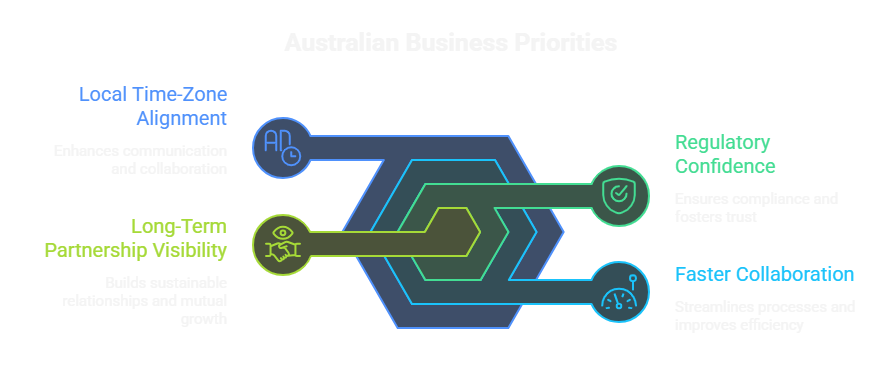
Australian businesses wanted:
• Local time-zone alignment
• Faster collaboration
• Regulatory confidence
• Long-term partnership visibility
Expansion was no longer optional. It was strategic.
Strategic Goal: APAC Expansion
Australia wasn’t just another market.
It was a gateway to the Asia-Pacific region — stable legal system, strong innovation ecosystem, investor credibility, and access to skilled migration pathways.
The objective was clear:
Establish a compliant Australian entity.
Relocate leadership.
Deploy the core technical team.
Scale without disrupting delivery.
Why Relocate the Entire Team?
Relocating only the founder would have been simpler.
But simpler does not mean smarter.
Operational Continuity
Mr. Ankush’s five team members were not replaceable hires.
They were embedded in systems, code architecture, client communication flows, and proprietary workflows.
Replacing them locally would have meant:
• Delays
• Knowledge transfer risks
• Training cycles
• Client dissatisfaction
Continuity demanded physical relocation.
IP Protection
When intellectual property, proprietary software frameworks, and technical architecture form the backbone of your company, control matters.
Relocating the original team preserved:
• Product integrity
• Security protocols
• Process confidentiality
Speed to Market
Hiring locally in a new country takes time.
Visa relocation — when strategically executed — can be faster than recruitment.
By moving his existing specialists, Mr. Ankush ensured immediate operational readiness in Australia.
Vorx Pro Tip
Expansion isn’t about geography. It’s about control.
If your competitive edge sits inside your existing team, relocation may outperform local hiring — both in speed and execution quality.
4. The Strategic Problem
Why This Was Not a Simple Expansion
On paper, this looked like two parallel processes:
• Register a company
• Apply for visas
In reality, it was a dependency chain with legal sequencing rules.
One misstep. One delay.
The entire six-month timeline collapses.
4.1 Dual Visa Complexity
This was not a single-visa project.
It required two fundamentally different immigration strategies.
Founder → Subclass 858 National Innovation Visa
Mr. Ankush qualified under the Subclass 858 National Innovation Visa — a permanent visa designed for internationally recognised individuals contributing to Australia’s innovation economy.
This pathway required:
• Evidence of exceptional achievement
• Sector alignment
• A qualified nominator
• High-income threshold positioning
It is profile-driven. Not employer-driven.
Team → Subclass 482 Skills in Demand Visa
The five team members required employer sponsorship under the Subclass 482 Skills in Demand Visa.
This visa demands:
• An approved Standard Business Sponsor
• A legally operating Australian entity
• Genuine nominated positions
• Salary compliance with AMSR
• Occupation alignment with CSOL
It is employer-driven. Not achievement-driven.
The Dependency Chain
Here’s where complexity escalates:
No company → No sponsorship.
No sponsorship → No nomination.
And No nomination → No 482 visa application.
Meanwhile, the founder’s 858 visa required parallel preparation — but did not depend on sponsorship.
Two pathways.
Different criteria.
Shared timeline.
This required surgical sequencing.
Vorx Pro Tip
Never apply the same visa logic to every individual.
Founders, senior engineers, and specialists often require different pathways. Strategic separation reduces refusal risk and accelerates approvals.
4.2 Company Formation Dependencies
Before a single sponsorship application could be lodged, the Australian entity had to be fully compliant.
That meant registration with the Australian Securities and Investments Commission.
But ASIC registration isn’t a single click.
It requires:
Director Identification Number (DIN)
Each director must apply for a DIN — a process that can take up to 56 business days.
Delay here = project delay everywhere.
ABN / TFN / GST
An Australian Business Number.
Tax File Number.
Goods and Services Tax registration (if applicable).
Without these, financial credibility and sponsorship eligibility weaken.
Resident Director Requirement
Australian company law requires at least one resident director for a Pty Ltd company.
This is often overlooked by foreign founders — and can stall incorporation entirely.
Vorx Pro Tip
Start DIN applications on Day One.
In multi-stage expansion projects, the smallest compliance step can become the biggest bottleneck.
4.3 Timeline Compression Challenge
Each stage triggered the next.
Company registration → Sponsorship approval → Nominations → Visa lodgements → Health & character checks → Grant decisions.
Any request for further information (RFI) from the Department of Home Affairs could push timelines by weeks.
In expansion strategy, time is not neutral.
Delays mean:
• Lost contracts
• Increased payroll exposure
• Opportunity cost
• Market-entry disadvantage
This project required parallel processing wherever legally permissible — without compromising compliance.
Vorx Strategic Advantage
Most consultants process steps sequentially.
Vorx maps the entire immigration + corporate dependency chain before submission begins.
That is how six months became realistic — instead of aspirational.
Planning Your Own Expansion?
If you are:
• An Indian tech founder targeting Australia
• Managing a team relocation
• Considering Subclass 482 sponsorship
• Evaluating Subclass 858 eligibility
Your strategy must be structured before your applications are lodged.
Book a strategic expansion consultation with Vorx Consultancy.
Because in global expansion, sequence determines success.
The Vorx Roadmap
(The Core Case Study Engine)
Six months.
Two visa pathways.
One company formation.
Zero margin for sequencing errors.
This was not paperwork.
This was orchestration.
Phase 1 (Months 1–2)
Company Formation + 858 Strategy
This phase laid the legal and immigration foundation simultaneously.
Pty Ltd Incorporation
Vorx incorporated a proprietary limited company registered with the Australian Securities and Investments Commission.
Why a Pty Ltd?
• Limited liability
• Recognised structure for sponsorship
• 100% foreign ownership permitted
• Investor-ready governance framework
The company had to exist — and be compliant — before sponsorship could begin.
DIN Initiation
Every director must hold a Director Identification Number (DIN).
Processing can take up to 56 business days.
Vorx initiated DIN applications immediately upon engagement — eliminating what is often the largest hidden bottleneck in foreign-led incorporations.
Nominator Strategy (For Subclass 858)
Mr. Ankush’s application under the Subclass 858 National Innovation Visa required a credible Australian nominator with national reputation.
Vorx:
• Identified a qualified nominator
• Structured alignment between achievements and national interest
• Prepared Form 1000 nomination documentation
This was not a generic endorsement. It was positioning.
EOI + UIN Preparation
The Expression of Interest (EOI) had to demonstrate:
• International recognition
• Sector alignment (DigiTech / ICT innovation)
• Contribution to Australia’s innovation economy
• Income threshold capacity
Once assessed favourably, Mr. Ankush received a Unique Identifier Number (UIN) — unlocking the 60-day window to lodge the full application.
Timing here was critical.
Income Threshold Positioning
The 858 pathway requires meeting — or demonstrating the capacity to meet — a high-income benchmark (approx. AUD 162,000 annually).
Vorx prepared:
• Revenue projections
• Client contracts
• Salary modelling
• Market benchmarking
This converted potential into evidence.
Vorx Pro Tip
Permanent visas built on “future potential” fail when documentation lacks financial architecture.
Projections must be defensible — not optimistic.
Phase 2 (Months 2–4)
Standard Business Sponsorship (SBS)
With the entity live, Vorx moved to secure sponsorship eligibility.
Without SBS approval, no team relocation could occur.
Sponsorship Approval Mechanics
The business had to prove:
• Lawful operation
• Genuine need for skilled workers
• Financial capacity
• Commitment to sponsorship obligations
Vorx structured the application to anticipate compliance scrutiny — not react to it.
AMSR Compliance
The Annual Market Salary Rate (AMSR) requirement ensures overseas workers are paid fairly relative to Australian workers.
This meant:
• Benchmarking local salaries
• Structuring employment contracts correctly
• Avoiding underpayment risk
Australian authorities now cross-match payroll data with visa records regularly. Accuracy is survival.
Core vs Specialist Stream Positioning
Under the Subclass 482 Skills in Demand Visa framework, two relevant streams applied:
• Core Skills Stream (AUD 73,150 threshold)
• Specialist Skills Stream (AUD 135,000+ threshold)
Vorx assessed each team member individually and aligned nominations strategically — not uniformly.
Financial Documentation Strategy
Newly formed companies face enhanced scrutiny.
Vorx strengthened the SBS application with:
• Business plans
• Cash flow forecasts
• Executed client contracts
• Service agreements
The narrative was simple:
This is a genuine expansion — not a shell structure.
Vorx Pro Tip
For newly incorporated entities, sponsorship approval is won on credibility.
Financial modelling must align with visa salary commitments.
Phase 3 (Months 3–5)
Subclass 482 Applications for 5 Team Members
Once sponsorship and nominations were positioned, visa applications were lodged.
Parallel processing reduced idle time.
Work Experience Positioning
Each applicant required at least 12 months of relevant experience within the past five years.
Vorx:
• Aligned job descriptions with ANZSCO standards
• Structured reference letters strategically
• Eliminated ambiguity in role progression
Clarity prevents Requests for Further Information (RFIs).
Skills Assessments
Where required, approved assessing authorities evaluated qualifications and experience.
Vorx coordinated submissions to avoid documentation gaps that often delay processing.
English Requirements Update (Sept 2025 Flexibility)
As of September 2025:
• English test validity extended to 3 years
• Scores from multiple sittings may be combined
Vorx leveraged this flexibility for candidates close to threshold requirements — reducing retest delays.
Health + Insurance Compliance
Each team member completed:
• Medical examinations
• Police clearance certificates
• Overseas health insurance arrangements
No submission was lodged incomplete.
Concurrent Processing Leverage
Australian migration regulations allow sponsorship, nomination, and visa applications to run simultaneously.
Vorx structured submissions to maximise concurrency while maintaining compliance integrity.
This compressed what could have been 12 months into six.
Vorx Pro Tip
Time compression is not about speed.
It’s about sequencing lawfully — and knowing which steps can overlap.
Phase 4 (Months 5–6)
Approvals + Settlement Execution
Then came the outcome phase.
All applications were approved on first submission.
Grant Outcomes
• Mr. Ankush: Permanent residency under Subclass 858
• Five team members: Subclass 482 visas granted
Six approvals.
Zero refusals.
Arrival Sequencing
Travel planning ensured:
• Founder presence aligned with company activation
• Team onboarding synchronised with client commitments
Expansion without downtime.
Superannuation Compliance
Employers in Australia must contribute to superannuation funds for eligible employees.
Vorx guided setup of compliant payroll systems to avoid post-arrival breaches.
Fair Work Compliance
Workplace rights and obligations were structured under the Fair Work Act 2009.
Employment contracts were reviewed to align with:
• Minimum wage standards
• Leave entitlements
• Workplace protections
Compliance doesn’t end at visa grant.
Banking & Tax Onboarding
Vorx assisted with:
• Australian bank account setup
• ABN & GST activation confirmation
• Payroll system structuring
• Tax registration clarity
Immigration success transitioned seamlessly into operational execution.
Vorx Pro Tip
Most migration advisors stop at visa grant.
True expansion support begins after arrival.
6. Strategic Breakdown
Subclass 482 vs Subclass 858 — At a Glance
| Feature | Subclass 482 (SID) | Subclass 858 (NIV) |
| Visa Type | Temporary (up to 4 years) | Permanent from day one |
| Sponsor Required | Yes | No (Nominator required) |
| Pathway to PR | After 2 years via Subclass 186 | Already permanent |
| Salary Threshold | AUD 73,150+ (Core) / AUD 135,000+ (Specialist) | Approx. AUD 162,000+ or future earning potential |
| Occupation List | Core Skills Occupation List | No occupation list |
| Work Experience | 12 months in past 5 years | Internationally recognised achievement |
| English Requirement | Competent English | Functional English |
The Strategic Insight
Not every founder qualifies for Subclass 858.
Not every team member fits the same 482 stream.
Migration success depends on profile mapping — not assumption.
Planning a Multi-Member Relocation to Australia?
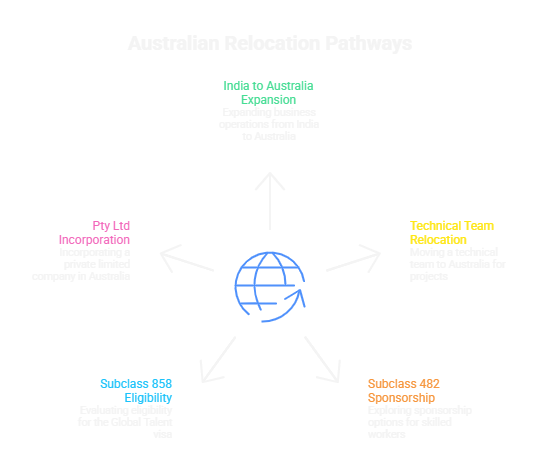
If you are:
• Expanding from India to Australia
• Relocating a technical team
• Exploring Subclass 482 sponsorship
• Evaluating Subclass 858 eligibility
• Incorporating an Australian Pty Ltd
Vorx Consultancy integrates company formation and immigration into one strategic roadmap.
Book your expansion assessment today.
Because global growth rewards those who plan — not those who rush.
Why It Worked
(Lessons for Founders Expanding to Australia)
This was not luck.
It was structure.
International expansion fails when sequencing fails.
This project succeeded because the architecture was designed before the first form was lodged.
Here’s what founders should learn.
1. Start Company Formation First
DIN Bottleneck Prevention
Many foreign founders assume visas are the first step.
They’re not.
Without a registered entity under the Australian Securities and Investments Commission, there is no sponsorship.
Without sponsorship, there are no Subclass 482 nominations.
The Director Identification Number (DIN) alone can take up to 56 business days.
Vorx initiated DIN applications on Day One — preventing the most common hidden delay in Australian expansion projects.
Vorx Pro Tip
The smallest regulatory requirement can derail the largest strategic plan.
Always map compliance dependencies before initiating immigration steps.
2. Parallel Processing Is Everything
Australian migration law allows sponsorship, nomination, and visa applications to run concurrently — when structured correctly.
Sequential processing can turn a six-month strategy into a twelve-month delay.
Vorx overlapped:
• Company registration
• Subclass 858 preparation
• Sponsorship documentation
• Nomination drafting
Time compression came from legal concurrency — not rushed submissions.
Vorx Pro Tip
Speed without structure increases refusal risk.
Speed with lawful sequencing accelerates approvals.
3. Custom Visa Mapping Per Individual
Mr. Ankush qualified for the Subclass 858 National Innovation Visa — a permanent visa built for internationally recognised innovators.
His team required employer sponsorship under the Subclass 482 Skills in Demand Visa.
One founder. Five specialists. Two different pathways.
Applying a uniform visa strategy would have increased complexity — not reduced it.
Vorx Pro Tip
Visa strategy should reflect profile differences, not organisational hierarchy.
Call to Action (Conversion Section)
Visti Here: www.vorxcon.com
4. Compliance Is Non-Negotiable
Australia’s integrity settings are tightening.
Payroll systems are cross-checked.
Salary thresholds are monitored.
Sponsorship obligations carry penalties.
From AMSR benchmarking to employment contract structuring under the Fair Work Act 2009, compliance was embedded into the project — not treated as an afterthought.
Vorx Pro Tip
If your salary modelling and visa documentation don’t align perfectly, future audits will expose it. Build compliance in from day one.
5. Settlement Planning = Long-Term Retention
Relocation does not end at visa grant.
Superannuation setup.
Payroll compliance.
Banking onboarding.
Tax clarity.
Workplace rights education.
When teams feel supported post-arrival, productivity accelerates and attrition risk drops.
Vorx delivered operational readiness — not just immigration approvals.
Vorx Pro Tip
The real ROI of migration is measured in retention, not visa grants.
Outcome
A New Chapter in Australia
Six months after engagement began:
Mr. Ankush
Permanent residency secured under Subclass 858.
Immediate stability.
Clear pathway toward Australian citizenship.
The Team
Five specialists granted Subclass 482 visas.
Lawfully employed.
Clear pathway to permanent residency through Subclass 186 after two years.
The Company
Australian Pty Ltd operational.
Serving clients across Australia and the Asia-Pacific region.
Structured for compliance, scale, and investor credibility.
No refusals. No compliance breaches. And No lost contracts during transition.
What began as a cross-border challenge became a controlled expansion.
Ready to Architect Your Own Australian Expansion?
If you are:
• An Indian founder targeting Australia
• Planning multi-member team relocation
• Exploring Subclass 482 sponsorship
• Assessing Subclass 858 eligibility
• Registering an Australian Pty Ltd
Vorx Consultancy integrates company formation and immigration strategy into one coordinated roadmap.
Book your strategic expansion consultation today.
Because in global business, the winners don’t move fast.
They move correctly.
Founder Takeaway
(The Conversion Engine)
This case study is not just about Mr. Ankush.
It’s a blueprint.
If you’re reading this, the real question is:
Does this structure apply to you?
Who This Strategy Is For
Tech Founders
If your intellectual capital sits inside your existing team — not just your idea — relocation must preserve operational continuity.
Funded Startups
If investors expect market entry timelines, regulatory compliance, and scalable hiring pathways, immigration cannot be improvised.
It must be engineered.
IT Service Exporters
If Australian client demand is rising and time-zone alignment improves retention, onshore presence becomes a revenue strategy — not an expense.
Innovation-Led Businesses
If you qualify for high-impact visa pathways such as the Subclass 858 National Innovation Visa while your team requires employer sponsorship under the Subclass 482 Skills in Demand Visa, a dual-structure roadmap can accelerate expansion without compromising compliance.
When a Dual Visa Strategy Makes Sense
A dual visa strategy works when:
• The founder qualifies for a permanent pathway based on achievement
• The team holds specialised roles aligned with approved occupation lists
• The company must be incorporated before sponsorship
• Expansion timelines are commercially sensitive
• Investor or client contracts require local presence
It does not work when applied blindly.
It works when profiles are mapped individually and sequenced strategically.
Vorx Pro Tip
If your expansion involves more than one visa applicant, assume complexity.
Multi-member relocation is never “copy-paste immigration.”
It is a systems exercise.
Sources & Legal References
This case study is informed by publicly available resources and official Australian government guidance, including:
• Department of Home Affairs — Skills in Demand Visa (Subclass 482)
• Department of Home Affairs — National Innovation Visa (Subclass 858)
• Australian Securities and Investments Commission — Company Registration Requirements
• Fair Work Act 2009 — Workplace Compliance Obligations
• Australian Taxation Office (ATO) — GST and payroll compliance guidance
• Official migration program updates (2024–2026)
Readers are encouraged to consult official sources or seek professional advice for case-specific eligibility.
Ready to Build in Australia — Properly?
Relocating a founder is paperwork.
Relocating a company is strategy.
If you are considering:
• Australian company formation
• Standard Business Sponsorship approval
• Subclass 482 visa applications
• Subclass 858 permanent residency pathway
• Multi-member team relocation
Vorx Consultancy delivers integrated corporate and immigration structuring — not fragmented services.
Your Next Step
Strategic Assessment
Understand which visa pathways apply to you — before you apply.
Company Formation Roadmap
Build the corporate foundation required for sponsorship and compliance.
Visa Eligibility Review
Map each team member individually. Eliminate refusal risk before submission.
Book your consultation with Vorx Consultancy today.
Because expansion into Australia isn’t about moving fast.
It’s about moving correctly.
Call to Action (Conversion Section)
Visti Here: www.vorxcon.com
