

Expanding into a new country may not always require you to start from zero. As companies grow within their jurisdiction, their needs may change in terms of commercial, regulatory or long term strategic purposes. Company redomiciliation can sometimes be an important option to consider
Whether it’s to expand internationally, restructure, improve market access or have a more favorable regulatory environment, moving a company’s legal domicile can be a challenging endeavor and require a thorough assessment of factors such as taxes, compliance, contracts and operations.
This guide explains what is company redomiciliation, how the process works, the key requirements, countries that allow it, expected costs and timelines, and the factors businesses should consider before making the move.
What Is Company Redomiciliation?
Company redomiciliation, also known as corporate redomiciliation or the redomiciliation of a company, allows an eligible company to change its legal jurisdiction, continuing its corporate existence in the new jurisdiction
In most cases, the original company remains the same legal entity rather than having to dissolve and create an entirely new company, which can provide continuity in terms of contractual obligations as well as existing assets, business connections and corporate history based on jurisdictions’ rules, but this depends on countries’ specific regulations. Not all jurisdictions allow a company to perform either outgoing or incoming redomiciliation, which is why it’s important to assess a country’s eligibility prior to considering such a transaction
Why Do Companies Redomicile?
As companies grow, their original jurisdiction may not always be conducive to their needs any longer, which is why business redomiciliation can be considered as a way to get a different legal, regulatory or commercial environment without having to rebuild the business from scratch. Common reasons include:
- International expansion: Moving closer to important customers, investors or global markets.
- Better regulatory fit: Choosing a jurisdiction whose corporate framework better suits the company’s activities.
- Tax and financial planning: Reviewing the company’s tax structure and overall cost of doing business.
- Business restructuring: Aligning the company’s legal domicile with a wider group reorganisation or long-term growth strategy.
Which Countries Allow Company Redomiciliation?
Redomiciliation is available in several jurisdictions, but the rules differ significantly. Some countries permit companies to migrate into or out of the jurisdiction, while others allow only certain types of companies or impose specific conditions.
Jurisdiction | Redomiciliation Availability | Typical Considerations |
UAE | Available in certain structures | Entity type, licensing and regulatory requirements |
Malta | Available | Corporate approvals and regulatory compliance |
Cyprus | Available | Continuation procedures and supporting documents |
Singapore | Available in specific circumstances | Eligibility and statutory requirements |
Luxembourg | Available | EU corporate and legal considerations |
Cayman Islands | Available | Corporate continuation requirements |
Recommended Reading:
Before moving an existing company to another jurisdiction, it is important to understand the compliance obligations that may apply in both countries. Our compliance checklist for registering a company abroad covers key areas such as tax, FEMA/ODI, documentation, banking and ongoing reporting.
Is Company Redomiciliation Right for Your Business?
Before starting the company redomiciliation process, businesses should first determine whether moving the existing company is actually more beneficial than creating a new entity. However, redomiciliation may not be suitable where the existing jurisdiction does not permit an outward migration, the target country does not accept the company’s structure, or the cost and compliance requirements outweigh the benefits. A practical assessment should consider:
- Whether both jurisdictions legally permit the migration
- The company’s existing structure and shareholder profile
- Impact on contracts, licences and banking relationships
- Tax residency and potential exit tax exposure
- Regulatory and substance requirements in the new jurisdiction
- The cost and time involved compared with setting up a new company
Company Redomiciliation Process: Step by Step
- Check eligibility: Confirm that both the current and proposed jurisdictions permit the intended migration.
- Choose the destination: Assess the legal, commercial and tax environment before selecting the new jurisdiction.
- Review corporate documents: Articles, shareholder arrangements, licences and existing obligations should be examined.
- Obtain approvals: Depending on the jurisdiction, shareholder or director approvals and regulatory permissions may be required.
- Prepare and submit documents: The required applications and supporting records are submitted to the relevant authorities.
- Complete registration: Once approved, the company is registered as a continuing entity in the new jurisdiction.
- Update compliance records: Banking, tax registrations, licences, contracts and other corporate records may need to be updated.
Recommended Reading:
If you are comparing jurisdictions for an international business move, our guide to the cheapest countries for Indians to start a business abroad explores factors such as taxation, business structure, market access and long-term expansion potential.
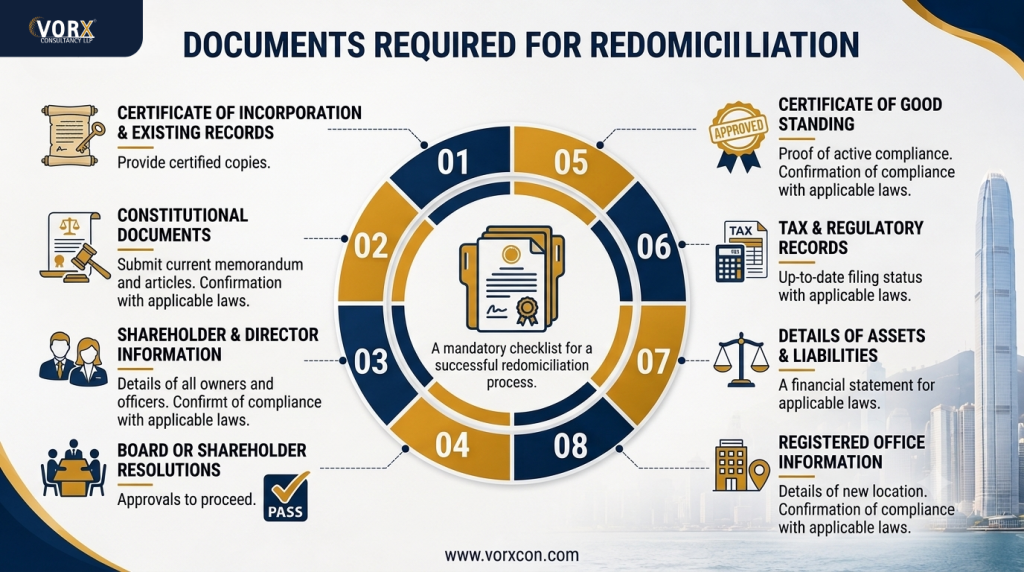
Documents Required for Redomiciliation
How Much Does Redomiciliation Cost?
Cost:
The company redomiciliation cost depends largely on the countries involved, the company’s structure and the level of professional and regulatory work required. Instead of one fixed fee, businesses should usually plan for costs across several areas:
- Government and corporate registry filings
- Legal and professional advisory support in one or both jurisdictions
- Document preparation, notarisation, legalisation or apostille
- Tax, accounting and compliance reviews
- Licence amendments or regulatory approvals, where applicable
- New substance or operational requirements in the destination country
What is Processing Time for Redomiciliation?
A typical timeline may look like this:
Stage | Average Time |
Initial eligibility review and planning | 1–3 weeks |
Document preparation and corporate approvals | 2–6 weeks |
Application and review in the new jurisdiction | 4–10 weeks |
Exit procedures and final compliance updates | 2–8 weeks |
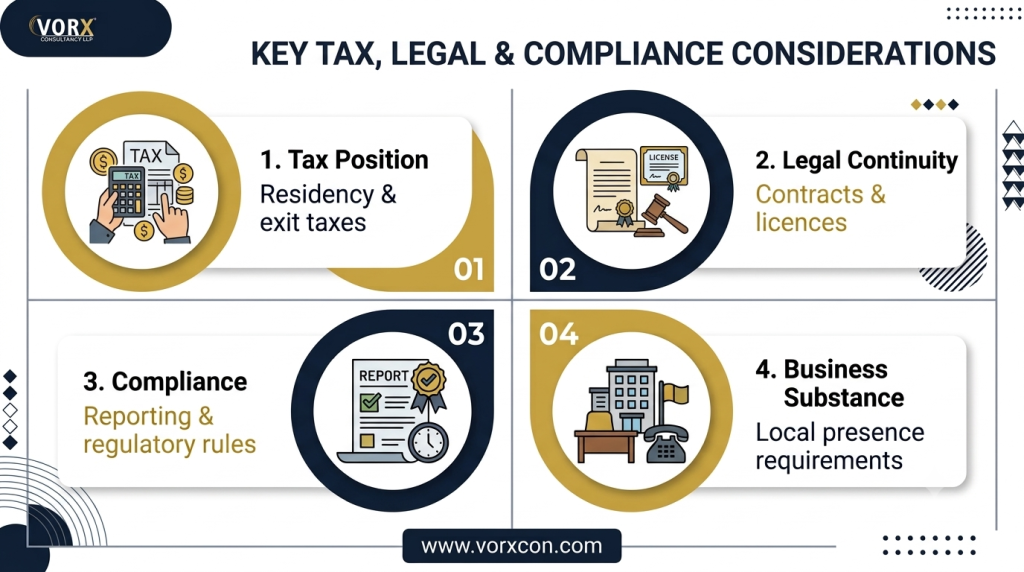
Key Tax, Legal & Compliance Considerations
Redomiciliation vs Setting Up a New Company
Factor | Redomiciliation | New Company |
Existing legal entity | May continue | New entity created |
Corporate history | Generally preserved | Starts again |
Existing contracts | May continue, subject to review | May require transfer |
Compliance | Migration-related requirements | New registration requirements |
Complexity | Can be legally complex | Often simpler to establish |
Best suited for | Eligible established businesses | New ventures or restructuring |
The choice between company redomiciliation vs new company depends on the company’s objectives, existing structure and the laws of the jurisdictions involved.
How Vorx Can Help with Company Redomiciliation?
Vorx Consultancy helps businesses assess whether redomiciliation fits their existing structure and future objectives. We assist with jurisdiction comparison, company redomiciliation requirements, and the key legal and compliance factors that need to be considered before migration.
From documentation and coordination to tax and regulatory considerations, our approach focuses on making the transition structured and practical. This helps businesses move forward with greater clarity while maintaining continuity during the international company redomiciliation process.
Plan your company’s international with Vorx Consultancy.
Book a Strategy Call: (Calendly Link)
Visit: www.vorxcon.com
Email: support@vorxcon.com
Final Thought
What is company redomiciliation ultimately comes down to more than moving a company from one country to another. It is a strategic corporate decision that can affect taxation, compliance, contracts, banking and future expansion.
For businesses considering international company redomiciliation, the right approach is to evaluate the legal and commercial implications before making the move. A well-planned migration can support international growth while avoiding unnecessary restructuring and compliance complications.