

Cyprus is a practical option for founders who want an EU-based company without moving first.
It suits consultants serving European clients, software and e-commerce businesses, holding structures, and Indian entrepreneurs looking for a European base. Cyprus company formation for foreigners is fairly simple on paper.
The harder questions come afterwards: how the company will be taxed, whether it has enough substance, and whether a bank will open an account.
At Vorx Consultancy, we help founders work through those questions before anything is filed. This guide covers what changed in 2026, what you need, and where founders most often get caught out.
Can Foreigners Open a Company in Cyprus?
Yes. Neither shareholders nor directors need to be Cypriot or resident in Cyprus, 100% foreign ownership is permitted, and the whole incorporation can be handled remotely through a power of attorney granted to Cyprus counsel.
The law sets conditions on directors’ and members’ age and number, not on nationality or residence, so a non-resident can hold all the shares and be the sole director.
Being allowed to do it and it being a good idea are different things. A company that exists on paper but is run entirely from elsewhere, with no local presence, tends to raise questions with banks and tax authorities. We come back to this below.
What Changed in 2026?
If you’re reading an older guide, check the tax section first. Cyprus enacted a reform effective 1 January 2026:
- The corporate income tax rate rose from 12.5% to 15%.
- Companies incorporated in Cyprus are now deemed Cyprus tax resident unless a double tax treaty provides otherwise.
- The special defence contribution on dividends paid to Cyprus tax-resident and domiciled individuals dropped from 17% to 5%, and deemed dividend distribution was abolished for profits from 1 January 2026.
- The tax loss carry-forward period was extended from five to seven years.
- Documents filed with the Registrar no longer attract stamp duty.
The higher rate applies to every Cyprus company, not just large groups. Cyprus is still competitive within the EU, but it’s no longer the 12.5% jurisdiction many websites still describe.
Your total tax outcome depends on where you live, where decisions are made and how profits are paid out, so take advice on your own case.
What Are the Main Requirements?
A Cyprus private limited company needs:
A shareholder: One is enough, and it can be an individual or a company of any nationality.
A director: At least one director and one company secretary are required. Directors don’t have to live in Cyprus, although tax and economic substance considerations may make resident or locally managed directors preferable.
A registered office: This must be a physical address in Cyprus, not only a mailbox.
Beneficial ownership disclosure: All ultimate beneficial owners must be registered, in line with EU anti-money laundering rules.
An approved company name and constitutional documents (the Memorandum and Articles of Association).
What Documents Do You Need?
Exact lists vary by provider and applicant, but expect to prepare:
- Certified passport copies for each shareholder, director and beneficial owner
- Proof of residential address (usually a recent utility bill or bank statement)
- A short description of your business activity and expected income sources
- Source-of-funds or source-of-wealth information
- For corporate shareholders: incorporation documents, a register of directors and shareholders, and often a certificate of good standing
Documents issued outside Cyprus usually need certification or an apostille. Start gathering these early. A missing apostille on a single passport copy can hold up an entire filing.
How Does the Registration Process Work?
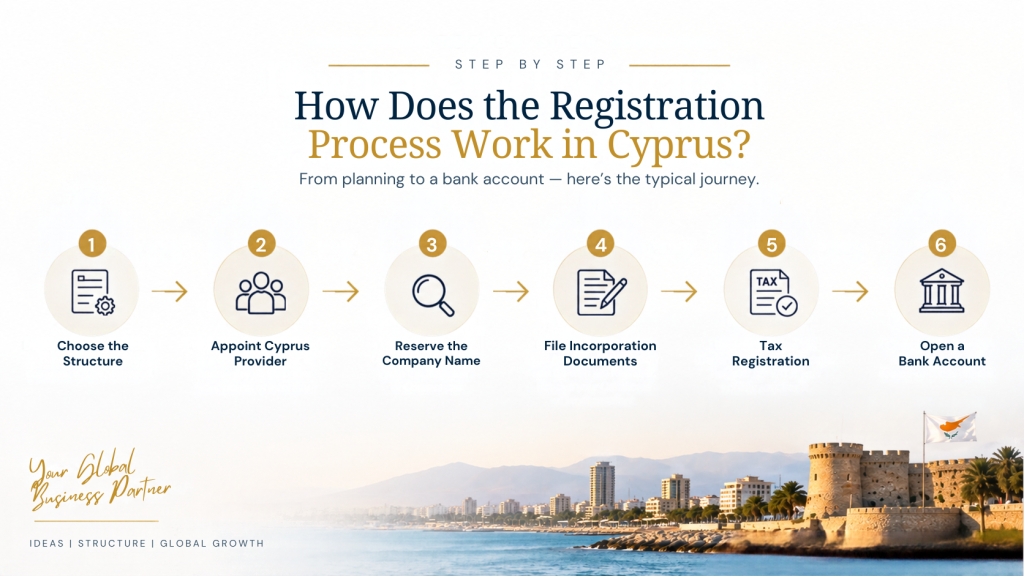
Choose the structure: Decide who will be shareholder and director, and how the company will actually be managed.
Appoint Cyprus counsel or a licensed provider: They handle the filings and act under your power of attorney.
Reserve the company name.
Draft the Memorandum and Articles, and file with the Registrar of Companies: You then receive the Certificate of Incorporation.
Register with the Tax Department: Companies must register with the Tax Department within 60 days after incorporation. Register for VAT if your activity requires it.
Open a bank account.
Incorporation itself typically takes a few weeks with clean documents. Banking is where timelines stretch.
The practical hurdle for non-residents is usually the bank, which applies full source-of-funds and substance checks to foreign-owned new companies.
Many founders start with an EU electronic money institution and add a Cyprus bank account once the company has a trading history.
Does Your Company Need Substance?
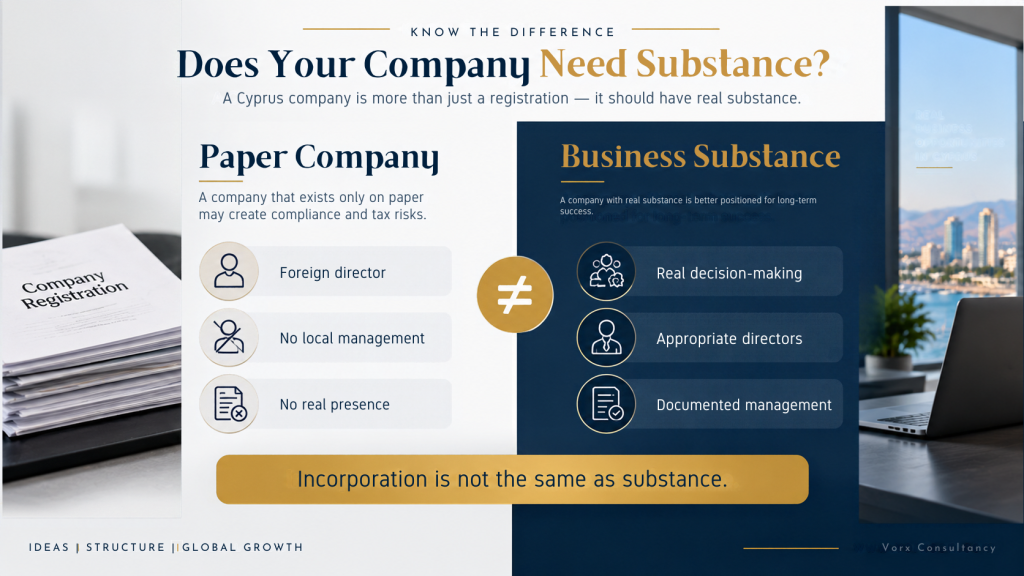
Substance means the company is genuinely managed and operated from where it says it is: real decision-making, appropriate directors, and a credible presence.
There’s no single formula. It depends on your activity and on your home country’s rules.
An illustrative example. Imagine an Indian software founder who forms a Cyprus company to invoice European clients. He stays in India, is the only director, and makes every decision there. On paper, it’s a Cyprus company.
In practice, a bank may ask why a Cyprus company has no Cyprus presence, and Indian authorities may ask whether its effective management is really in India.
A better-planned version might add a Cyprus-resident director, hold board meetings in Cyprus, and keep documented decision-making there. It costs more, but the structure holds together.
Vorx Consultancy Insight: the cheapest structure at formation is often the most expensive one to defend two years later.
Can Indian Entrepreneurs Open a Cyprus Company?
Yes, but Indian residents have obligations on the Indian side that many Cyprus-focused guides skip.
This is general information, so have a chartered accountant or FEMA specialist confirm your position.
Funding limits. Resident individuals can remit up to USD 250,000 per financial year under the Liberalised Remittance Scheme, and investing through a company structure follows the Overseas Direct Investment route, which involves filing Form FC with your Authorised Dealer bank.
Reporting even without sending money. Even a zero-cash foreign incorporation must be reported as ODI through an AD bank if the Indian resident holds control over the entity.
Permitted activities. Individuals investing under LRS can invest only in operating entities, and the foreign entity cannot be in the financial services sector.
Sequence matters. A Unique Identification Number must be allotted before remittance or acquisition of shares.
Round-tripping is prohibited. FEMA prohibits remitting money abroad only for the foreign entity to invest it back into India.
Tax residency of the company. Place of effective management rules can tax an offshore company as an Indian resident if effective management stays in India.
Disclosure. Foreign assets must be disclosed in your income tax return, and under the Black Money Act, a ₹10 lakh penalty per asset applies for non-disclosure, regardless of the asset’s value or whether it earned income.
Planning a Cyprus company from India? Get your structure, ODI requirements, and compliance reviewed before you proceed.
Vorx Consultancy Insight: for Indian entrepreneurs, the key consideration is usually not the Cyprus filing. It’s getting the Indian-side sequence right, so ODI reporting, remittance, and tax disclosures are in order before the company starts trading.
India and Cyprus have a tax treaty, but how it applies depends on your structure and where profits arise. Confirm this before relying on it.

How Does Cyprus Compare With the UAE, UK and Estonia?
There’s no universal winner. The right choice depends on your customers, where you live, and how much substance you can support.
Cyprus | UAE | UK | Estonia | |
EU market access | Yes (EU member) | No | No | Yes (EU member) |
Tax approach | 15% corporate rate from 2026 | Low-tax regime, with conditions | Higher headline rate | Generally taxed on distributed profits |
Best suited to | EU presence, holding structures, service exports with real substance | Businesses serving the Middle East and Asia | Businesses that value UK credibility | Small digital businesses |
Rules in all four jurisdictions change, and the conditions attached to low-tax regimes matter. Compare on your actual business model, not on the headline rate alone.
Not sure whether Cyprus is the right jurisdiction for your business? Vorx Consultancy can help you compare your options based on your business model and expansion goals.
Does a Cyprus Company Give You Residency?
No. Company formation, residence permits, visas, permanent residence and citizenship are separate legal matters.
Owning a Cyprus company doesn’t by itself give you the right to live or work there. Depending on your circumstances, residency may involve a separate application, such as a work permit, a visa route, or another category, and requirements differ by applicant.
If relocation is part of your plan, look at it as a parallel workstream, not an assumed benefit.
What Are the Ongoing Compliance Requirements?
Forming the company is the easy part. Each year you can expect:
- Annual returns filed with the Registrar of Companies
- Financial statements, with an audit where required
- Corporate tax returns and any VAT or payroll filings
- Keeping the registered office, secretary and beneficial ownership records current
Budget for this from the start. Official filing fees are modest. Professional fees for accounting, audit and secretarial services are usually where the real ongoing cost sits. Ask any provider for a clear annual cost breakdown, not only the setup price.
Is Cyprus Right for Your Business?
Cyprus tends to work well when you have a real reason to be in the EU, such as European clients, a holding structure, or a base for expansion, and you’re willing to support the company with genuine substance. It tends to work poorly when the goal is only to lower tax on paper while everything happens elsewhere.
Before you commit, work out where the company will be managed, how it will be banked, and how your home-country rules apply.
If you’d like a second opinion on that structure, this is exactly the kind of review Vorx Consultancy does for founders considering Cyprus.
Conclusion
Cyprus company formation for foreigners is straightforward to start and easy to get wrong later.
Non-residents can own and direct a company remotely, but the 2026 reform means the 15% tax rate, the incorporation test for tax residency, and a bank’s expectations all need planning before you file anything.
Before you commit, settle four things:
- Where the company will actually be managed, and whether that supports the substance you’ll need.
- How you’ll bank. Plan for the account to take longer than incorporation.
- What your home-country rules require. For Indian founders, that means ODI reporting, remittance sequence and foreign asset disclosure.
- What it costs each year, not just at setup.
A Cyprus company is a good fit when there’s a real business reason behind it. It works far less well as a structure that exists only on paper.
If you’re weighing Cyprus against other jurisdictions, or want a second opinion on your structure, Vorx Consultancy can help you evaluate your options before you file.
Ready to explore Cyprus company formation?
Speak with Vorx Consultancy about your structure, registration, banking, and ongoing compliance requirements.
