

Although the idea of living abroad while working from home has many attractive aspects, the financial consequences of making such a move must not be ignored. Specifically, Indian citizens who are thinking of migrating on a Digital Nomad Visa should be conscious of possible tax residency problems, the requirements for keeping foreign bank accounts, and the difficulties involved in proving one’s income and carrying out international transfers.
The most common worries can be dealt with by taking the right steps well before you leave. Before you move overseas, you should research your tax obligations, submit the necessary documents, and check over the banking regulations that may apply to your case.
Planning to expand internationally? Contact Vorx Consultancy to discuss which jurisdiction aligns with your business objectives.
Understand Your Indian Tax Residency Before You Leave
purposes. Your status depends on how long you stay in India and which residency conditions apply to your circumstances.
For tax years starting on or after 1 April 2026, the Income-tax Act, 2025 applies. The basic residency tests remain based on your days of stay in India. The Income Tax Department explains these rules in its official non-resident FAQs.
Residency test | What to check |
182-day test | Whether you stayed in India for 182 days or more during the relevant tax year |
60-day plus 365-day test | Whether you stayed for at least 60 days in that year and 365 days across the preceding four years |
Special conditions | Whether an exception or modified test applies to your circumstances |
These are general tests, not a complete determination of your status. Special provisions apply in certain situations, and leaving India to work remotely is not automatically the same as leaving for overseas employment. Keep travel records and seek professional advice if your position is unclear.
Recommended Reading:
Before planning your relocation, understand what is a Digital Nomad Visa including eligibility criteria, application documents and key steps to prepare for working remotely from another country.
Check How Your Remote Income Will Be Taxed
The tax treatment of your overseas income depends on your tax residency status in India, the type of income and the tax laws in the country where you reside.
If you are employed in India, determine whether your employment terms, including payroll deductions and employer responsibilities, change when working outside India. If you are a freelancer or business owner, find out if and how your income will be taxed in your new country of residence and whether you are required to file tax returns there as well. Additionally, you may be responsible for paying social security contributions to the country of your residence. These taxes are usually separate from income tax and depend on your employment status.
Double Taxation Avoidance Agreement (DTAA) may provide relief in cases of dual-taxation, but it is not automatic. Determine whether you are eligible for tax exemptions or credits under the DTAA that applies to you, if any. You may have to file tax returns in both countries if you meet the criteria for foreign tax credit in India.
Planning to expand internationally? Contact Vorx Consultancy to discuss which jurisdiction aligns with your business objectives.
Prepare Your Indian and Overseas Bank Accounts
Having the right bank accounts in both India and your country of residence facilitates receiving payments, paying rent and other expenses. Before leaving India:
- Notify your bank of your intended change in residential status.
- Determine whether your existing account needs to be redesignated
- Find out about fees for international transfers and online banking
- Ensure that your PAN and other records are up-to-date, if required
According to RBI guidelines, when a person’s residential status changes to someone who is a non-resident in India for the purposes of FEMA, a resident bank account needs to be redesignated (typically to an NRO account). Clarify with your bank the account type that applies to your particular circumstances, as your tax residency and FEMA residency can be different.
Recommended Reading:
Learn how to prepare employment contracts, bank statements and other documents to prove your remote income when applying for a Digital Nomad Visa.
Build a Reliable Income and Source-of-Funds Paper Trail
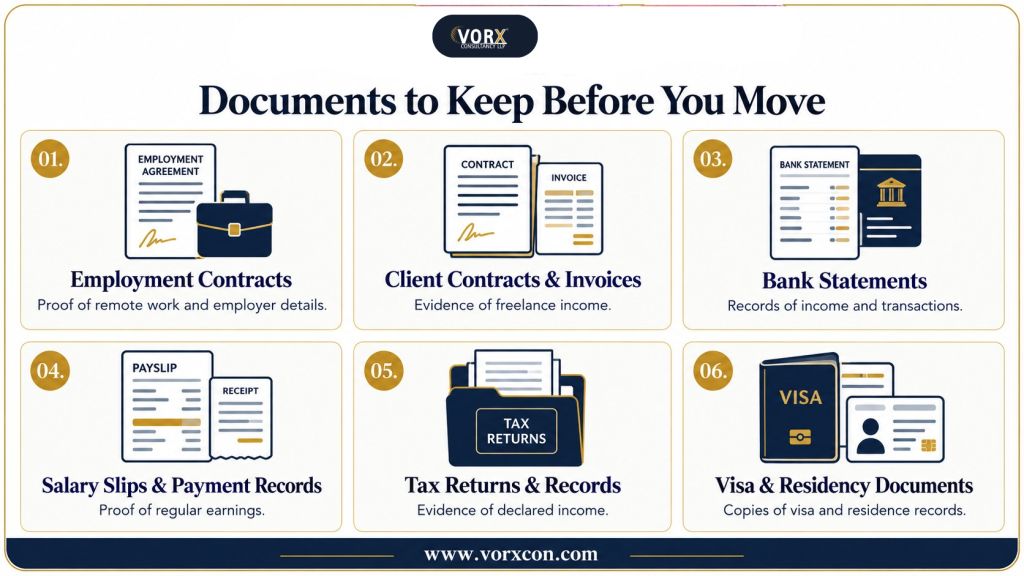
Banks and immigration authorities may ask for evidence that your income is genuine, regular and sufficient for your stay. Keeping your Digital Nomad Visa income proof organised can make applications and future financial checks easier.Prepare these remote work income proof documents:
- Employment contracts or client agreements
- Recent salary slips and payment records
- Freelance invoices and proof of client payments
- Personal bank statements showing income credits
- Tax returns and relevant tax payment records
Keep copies of these source of funds documents in a secure digital folder, with physical copies where practical. Make sure the names, payment amounts and transaction dates are consistent across your records.
If you receive payments from multiple clients or countries, maintain a simple record explaining the source of each major credit. This can help answer questions from banks during account opening or routine compliance checks.
Planning to expand internationally? Contact Vorx Consultancy to discuss which jurisdiction aligns with your business objectives.
Review Foreign Exchange and International Transfer Rules
When transferring funds between India and another country, factors beyond currency exchange rates come into play. The rules that apply to you depend on your FEMA residential status, the nature of the transaction and the banks involved in the transfer
The Reserve Bank of India’s Liberalised Remittance Scheme generally allows resident Indians to remit up to USD 250,000 per financial year for eligible transactions, subject to certain conditions. Do not assume that the same limits and conditions apply after your residency status changes. Contact your authorised dealer bank to determine the requirements that apply to you before making large transfers.
Consider transfer fees, intermediary-bank charges, exchange rate margins and any documentation your bank may require. Retain receipts and statements so that transfers between your accounts can be documented.
How Vorx Consultancy Can Help with Your Digital Nomad Visa Application?
Planning an international move involves more than securing a visa. Vorx Consultancy helps applicants understand the documentation and practical steps involved in preparing for relocation. Our support can include:
- Digital nomad visa pathway assessment
- Application and supporting-document guidance
- Remote income documentation preparation
- Relocation planning support
- Guidance on coordinating company, banking and compliance requirements
Tax treatment and banking eligibility depend on individual circumstances and the rules of the countries involved. Where specialist tax advice is needed, consult a qualified tax professional.
Planning your move? Connect with Vorx Consultancy for guidance on your digital nomad visa journey.
Book a Strategy Call: (Calendly Link)
Visit: www.vorxcon.com
Email: support@vorxcon.com
Final Thoughts
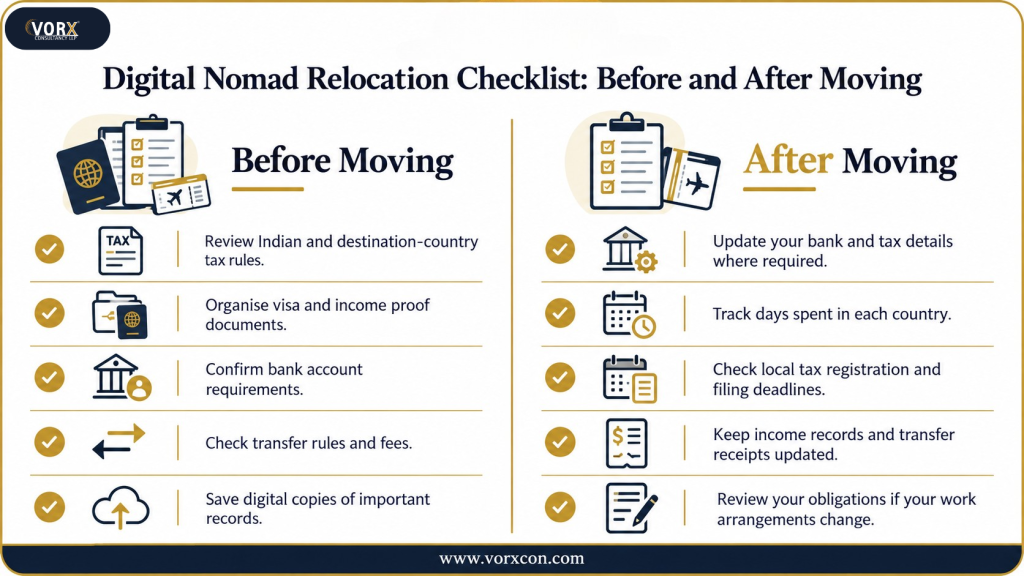
Going overseas is not a matter of getting the right visa and buying a plane ticket. When Indian citizens are thinking about staying abroad for an extended period of time they should be aware of their tax obligations, the rules concerning banking, and the requirements regarding income documentation. Fortunately, almost all of these problems can be avoided if the right steps are taken well before you leave. The paragraphs that follow give a summary of the financial considerations that should be looked at both before and after moving.
