


If you’re an Indian founder eyeing France as your entry point into Europe, here’s the short version: yes, you can do it, you don’t need to move there, and you don’t need a French partner or director.
What trips people up isn’t the French paperwork, it’s everything happening on the Indian side while that paperwork is being filed. RBI rules, remittance limits, tax treaties. Most guides skip that part entirely. This one doesn’t.
Can an Indian Citizen Register a Company in France? (Quick Answer)
Yes. There’s no restriction stopping an Indian citizen or an Indian company from owning and running a French business.
France doesn’t require a local resident director, and foreign founders Indian or otherwise can hold 100% of the shares and manage the company from anywhere.
Here’s the distinction that confuses most people: registering a company and relocating to France are two completely separate decisions.
You can incorporate, get your SIRET number, open a French bank account, and run the whole thing from Bangalore or Mumbai without ever applying for a visa. A visa only becomes necessary if you plan to physically live and work in France.
So the real project has two tracks running in parallel:
- The French registration process (structure, documents, Guichet Unique filing)
- Your Indian compliance obligations for moving money out of the country (LRS or ODI, depending on who’s investing)
Miss either one and you’ll either have a company that can’t legally receive funding from India, or a remittance that puts you on the wrong side of FEMA. We’ll walk through both.
Why Indians Are Expanding into France
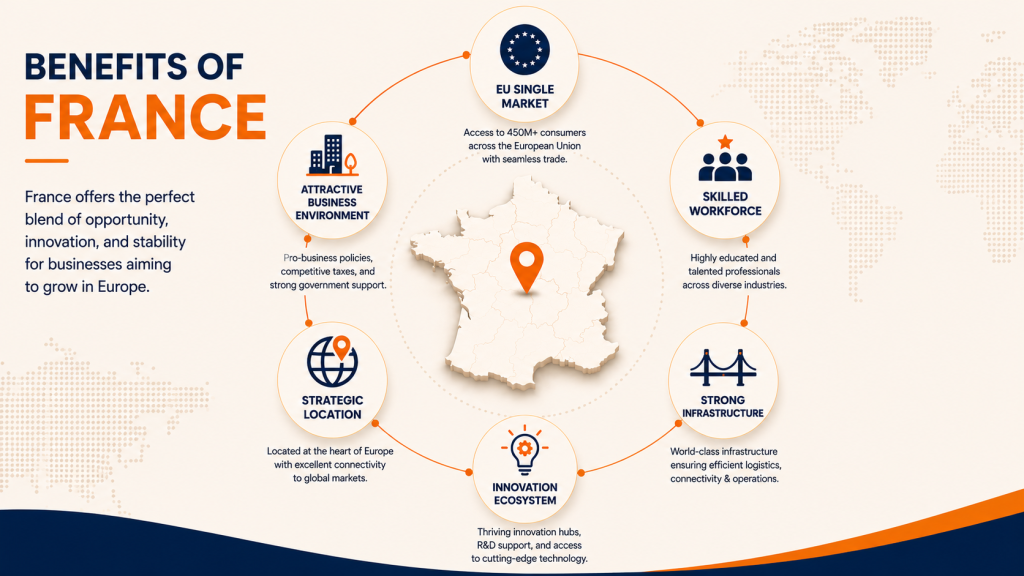
France isn’t a random pick. It’s the second-largest economy in the EU, gives you a foothold in the entire single market, and sits at the center of Western Europe’s logistics network useful if you’re shipping goods or need proximity to Germany, Spain, and the Benelux countries.
For different segments, the pull looks different:
SaaS and IT companies want an EU legal entity to sign contracts with European clients who won’t work with an offshore vendor, and to handle GDPR and data residency requirements cleanly.
Export-import and manufacturing businesses use a French entity to hold inventory closer to European buyers and reduce customs friction inside the EU.
E-commerce brands need a local presence for EU VAT registration and faster fulfillment.
Consultants and agencies serving European clients often find invoicing through a French entity simplifies tax and payment collection.
HNIs and investors use France as a diversification play, sometimes paired with the R&D tax credit (Crédit d’Impôt Recherche) if the business has an innovation angle.
Whatever your reason, the mechanics of getting there are largely the same. Let’s get into them.
Types of Business Structures Available in France
France gives you several legal structures to choose from, and picking the right one matters more than most guides let on.
It affects your liability, how much paperwork you’ll deal with every year, and how easy it is to raise money later.
SASU (Société par Actions Simplifiée Unipersonnelle) — a single-shareholder version of the SAS. This is usually the best fit if you’re a solo founder or a small startup team.
It’s flexible on governance, easy to convert into a multi-shareholder SAS later if you bring in co-founders or investors, and doesn’t lock you into rigid management rules.
SAS (Société par Actions Simplifiée) — same structure as SASU but with multiple shareholders from the start.
Popular with startups because investors are comfortable with it and the shareholder agreement can be customized freely.
EURL (Entreprise Unipersonnelle à Responsabilité Limitée) — the single-owner version of the SARL.
Common among freelancers and small consultancies who want limited liability without the complexity of a share-based structure.
SARL (Société à Responsabilité Limitée) — a solid choice for MSMEs and family-run businesses.
It’s more rigid than an SAS in terms of governance rules, but that rigidity comes with simplicity. Decisions follow a clear, prescribed process, which some smaller businesses actually prefer.
Branch office (succursale) — if you already run a company in India and don’t want to set up a brand-new legal entity, a branch lets you extend your existing company into France.
It’s not a separate legal person, which means your Indian parent company carries the liability, but it’s faster to set up if you already have an established business.
A quick comparison:
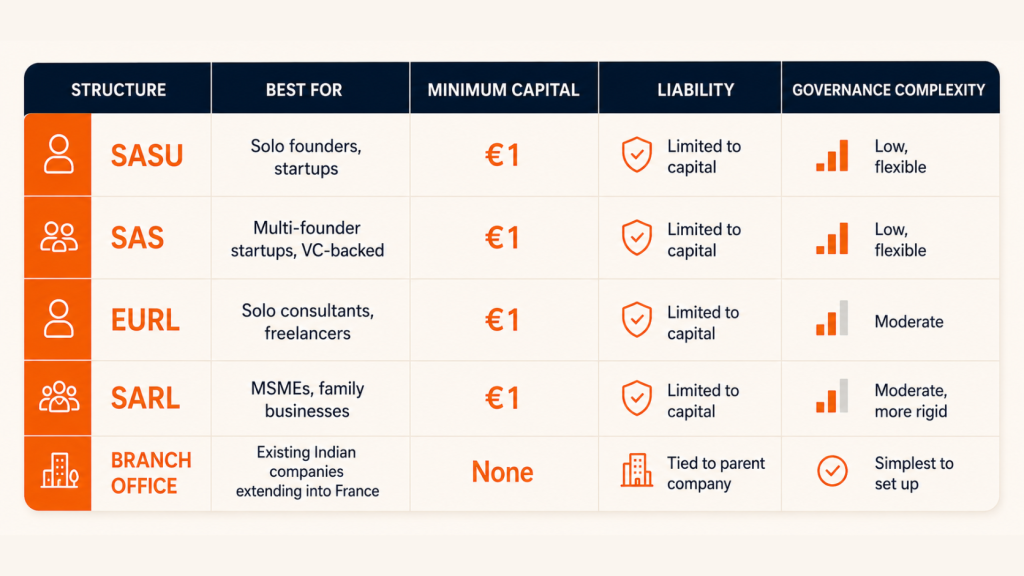
One thing worth noting for MSME owners specifically: none of these require heavy starting capital.
You can technically incorporate an SAS or SARL with €1 in share capital, though in practice most founders deposit a more realistic working amount to cover early operating costs and project credibility to banks and clients.
Also Read: What is the Process to Register a Company in Europe (Greece, Poland, Netherlands & Germany)?
Step-by-Step Process to Register a Company in France from India
Here’s how the registration actually plays out, start to finish.
- Choose your structure and check your company name. Decide between SASU, SAS, EURL, SARL, or a branch office based on your situation, then verify your proposed company name is available through the INPI or Infogreffe database.
- Draft the Articles of Association. These have to be in French and signed by all founders. If you can’t be physically present, you can sign electronically or grant power of attorney to someone handling the filing on your behalf; this is standard practice for non-resident founders and not a workaround.
- Secure a registered French address. Since you likely don’t have office space in France yet, a domiciliation service handles this; it gives you a legitimate business address without requiring a physical lease.
- Open a business bank account and deposit share capital. This is where things get interesting for non-residents. Traditional French banks tend to run extensive compliance checks on foreign directors, which can slow things down.
Fintech banking options like Qonto or Shine have built remote onboarding specifically for this kind of situation and are usually faster.
Once the capital is deposited, you’ll receive an attestation de dépôt de fonds . You need this to complete registration.
- Publish a legal notice. French law requires you to publish an avis de constitution (formation notice) in an authorized legal journal.
You’ll get a certificate of publication once it’s done, which goes into your registration file.
- File everything through the Guichet Unique. Since January 2023, every company registration in France goes through this single online portal, run by the INPI.
It replaced the old system of dealing separately with the Commercial Court, tax authorities, and social security bodies; now it’s all one submission.
- Get your SIREN, SIRET, and K-bis. Once approved, you’ll receive your SIREN (company identification number), SIRET (establishment number), and a K-bis extract.
This last one is essentially your company’s official proof of existence in France, and you’ll need it constantly for banking, contracts, and compliance.
With complete documentation, most companies get through this process in 2 to 4 weeks. The single biggest cause of delay isn’t the French bureaucracy’s incomplete or improperly certified translations of Indian documents.
If your passport, address proof, or any supporting paperwork needs a French translation, get it done by a certified translator before you submit, not after the Guichet Unique flags it.
Documents Required from Indian Founders
Keep these ready before you start:
- Passport copy
- Proof of address in India
- A declaration of non-conviction (confirming no criminal record or prior bankruptcy)
- Certified French translations of the above, where required
- Proof of your registered French address (domiciliation contract)
- Capital deposit certificate from your French bank
If your existing Indian company is the one investing rather than you personally you’ll also need a board resolution authorizing the investment, plus the FEMA-related documentation covered in the next section.
This is a step people frequently miss because it sits outside the “French registration checklist” mentality; it’s an Indian corporate governance requirement, not a French one.
RBI, FEMA & Indian Compliance — What Nobody Tells You
This is the part that decides whether your French company can legally receive money from India and it’s the part almost every guide on this topic skips entirely.
There are two completely different regulatory routes, and which one applies to you depends on who is making the investment.
If you’re investing as an individual, you’re working under the Liberalised Remittance Scheme (LRS). This lets resident Indians remit up to USD 250,000 per financial year (April to March) for permissible purposes, including setting up or investing in a foreign company.
You’ll need a PAN, a KYC-compliant bank account, and a completed Form A2 filed through your authorized dealer bank.
The cap is consolidated meaning if you use $150,000 of it for your French company, you have $100,000 left for everything else that year, including travel or education expenses. It resets on April 1st and doesn’t carry forward.
If your existing Indian company is making the investment, LRS doesn’t apply to you at all; companies use the Overseas Direct Investment (ODI) route instead.
Under FEMA’s Overseas Investment Rules, most ODI transactions go through the automatic route, meaning no prior RBI approval is required, as long as you stay within the net worth-linked ceiling. Your Authorized Dealer bank verifies compliance and processes the remittance.
A distinction worth repeating because it trips people up constantly: LRS is for you personally, ODI is for your company.
Commingling the two say, using your personal LRS allowance to fund a company-level investment that should’ve gone through ODI creates exactly the kind of regulatory headache that’s expensive and slow to untangle later.
A few compliance details that are easy to overlook:
- Form A2 is mandatory for LRS remittances, filed through your bank.
- Annual Performance Report (APR) — if you’ve gone the ODI route, this is due by December 31st every year. Miss it, and the RBI blocks all future remittances to that entity until it’s filed.
This is one of the most common (and most preventable) compliance failures among Indian founders with overseas subsidiaries.
- TCS (Tax Collected at Source) applies to remittances above the exempted threshold. It’s not an extra cost — it’s an advance tax payment you can adjust against your final tax liability when you file your Indian returns.
Which route should you use? If you’re a solo founder without an existing Indian company, LRS is your only option and it’s genuinely simple — Form A2, stay under $250K, done.
If you already run an Indian business and want it to hold equity in the French company (rather than you personally), ODI is the correct route, and it’s worth involving a CA or FEMA compliance advisor early, since the paperwork is more involved and the annual filing obligation doesn’t go away after year one.
Opening a Business Bank Account as a Non-Resident Indian Founder
This step deserves its own section because it’s where non-resident founders lose the most time.
Traditional French banks are built around in-person relationships and tend to run heavier compliance checks on foreign, non-resident directors expect more document requests and slower turnaround.
Fintech alternatives like Qonto and Shine were built with remote founders in mind and generally onboard faster, without requiring a branch visit.
Whichever you choose, remember that your capital deposit certificate is a prerequisite for completing registration; you can’t finish the Guichet Unique filing without it.
Sort out your banking relationship early in the process, not as an afterthought once everything else is ready.
Tax Obligations and the India-France DTAA
Once your company is operational, you’ll owe French corporate tax on profits earned in France, and you’ll need to register for VAT once you cross the applicable revenue threshold.
If you hire employees, social charges apply on top of salaries; these are notably higher in France than in India, so factor them into your hiring budget early.
The India-France Double Taxation Avoidance Agreement (DTAA) matters here because, without it, income earned through your French entity could theoretically be taxed in both countries.
The treaty exists specifically to prevent that, allocating taxing rights between the two countries and allowing credits for tax already paid abroad.
How exactly this applies to your situation: dividend repatriation, permanent establishment risk, withholding tax rates depends on your specific structure and income flows, so this is genuinely a conversation to have with a cross-border tax advisor rather than something to self-diagnose from a blog post.
Do You Need a Visa to Register a Company in France?
For most people reading this: no. If you’re running the French entity remotely and don’t plan to physically relocate, registration and ongoing operation don’t require a visa at all.
A visa becomes relevant only if you intend to actually live and work in France.
In that case, you’d be looking at either the Entrepreneur / Profession Libérale visa or one of the Passport Talent categories, depending on your role as founder, investor, or management.
These are separate immigration processes with their own document and financial requirements, distinct from the company registration itself, so don’t let visa research slow down your registration timeline if relocation isn’t actually part of your plan.
Post-Registration Compliance Checklist
Once you’re registered, compliance runs on two separate tracks, French and Indian and it’s easy to stay on top of one while missing the other.
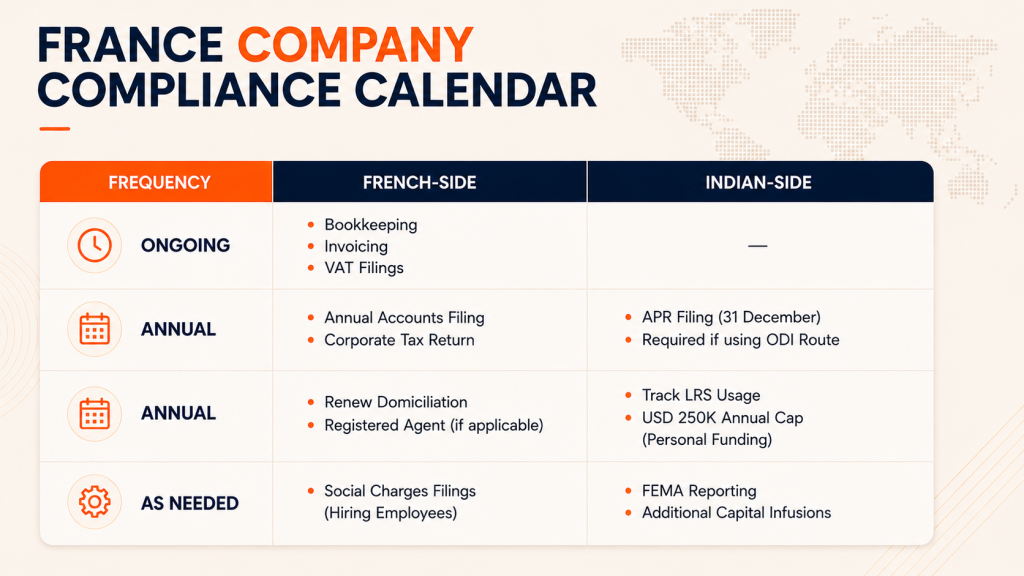
Treat this as a single calendar, not two separate ones. The most common failure point is founders who diligently track their French obligations and completely forget the Indian side once the initial remittance is done.
Common Mistakes Indian Founders Make When Registering in France
- Mixing personal LRS remittances with company-level ODI investments. Decide upfront whether you or your Indian company is the investing entity, and stick to the correct route.
- Submitting uncertified or incomplete translations, which is the most frequent cause of Guichet Unique rejections for foreign founders.
- Defaulting to a traditional bank when a fintech option would onboard faster and with less friction for a non-resident.
- Forgetting the APR deadline entirely after the initial investment, only to discover future remittances are blocked.
- Confusing registration with relocation, and spending time on visa research that isn’t actually necessary for their situation.
Conclusion:
Registering a company in France from India isn’t one process, it’s two running in parallel, and the Indian side is the one most guides leave out entirely.
If you’re ready to move forward, get clear on your structure choice and your remittance route (LRS or ODI) before you file anything, since that decision shapes almost everything downstream from which bank account you open to which annual filings you’ll owe.
If you’d rather not manage both tracks yourself, that’s exactly the kind of cross-border setup worth handling with someone who does this regularly, get in touch and we’ll walk through your specific situation.
Also Read: What is the Process to Register a Company in Europe (Portugal, Spain, Malta & Cyprus)?