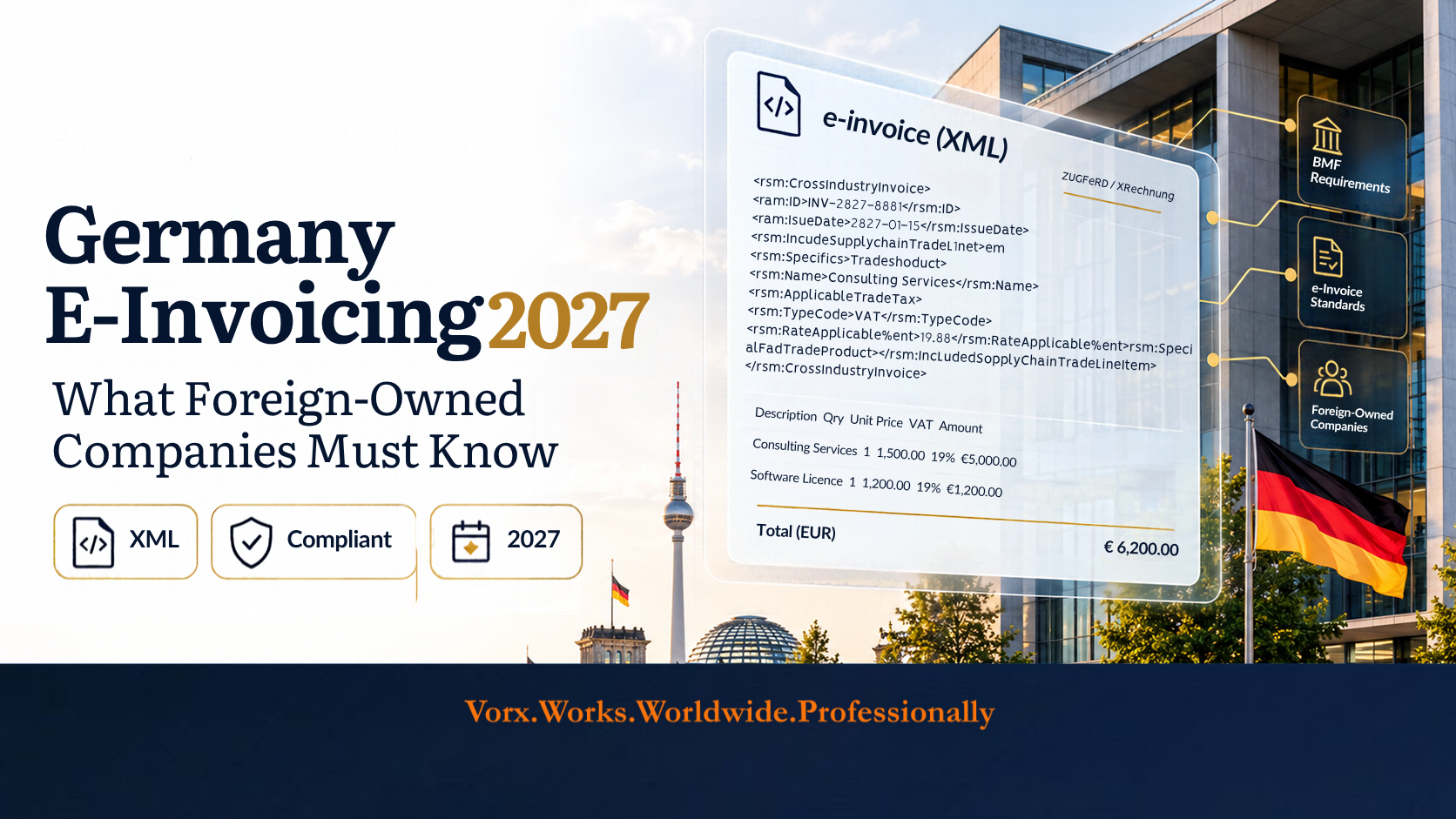
The deadline of 1 January 2027 is important if you operate a GmbH, UG, or a German subsidiary. From that point on, invoices issued by German companies should be in structured format, and emailing invoices in the form of PDF will not qualify anymore.
Most foreign founders land in one of two camps. Some assume the rule covers every invoice they send.
Others assume it only affects “German companies” and so doesn’t touch them. Both are wrong, and this guide shows you where you actually stand.
The short version:
- e-Invoice Germany 2027 refers to domestic B2B invoicing where both supplier and client are set up in Germany.
- For businesses with annual income exceeding €800,000 in 2026, mandatory use of e-invoices begins on 1st January 2027. For everyone within the scope, this obligation starts from 1st January 2028.
- From 1st January 2025, any company operating in Germany needs to be capable of receiving e-invoices.
- Your location doesn’t determine that. What counts is where your company is set up.
Read this guide: Company Formation in Germany for Foreigners: Complete 2026 Guide
What counts as an e-invoice in Germany?
The e-invoice is an electronically generated file that is based on XML according to the European standard EN 16931. This file can be read and processed by software without any re-entering of figures.
The PDF is simply an image of an invoice. A scan or a Word file doesn’t qualify either.
If you’ve worked with India’s GST e-invoicing, here’s the key difference. In India, invoices go through a government portal that validates them and returns an IRN and QR code. Germany has no central portal.
Invoices go straight from supplier to customer. Nobody checks them in real time, so you are responsible for getting them right.
Germany e-invoicing timeline
Date | What happens |
1 Jan 2025 | All businesses established in Germany must be able to receive e-invoices. Paper and PDF are still allowed for issuing. |
1 Jan 2027 | Businesses with 2026 turnover above €800,000 must issue e-invoices for in-scope invoices. |
Through 31 Dec 2027 | Businesses at or below €800,000 can still issue paper or PDF (with the recipient’s consent for non-structured formats). Older EDI setups that aren’t EN 16931-compliant can also continue. |
1 Jan 2028 | Everyone in scope must issue e-invoices. |
Does it apply to your foreign-owned company?
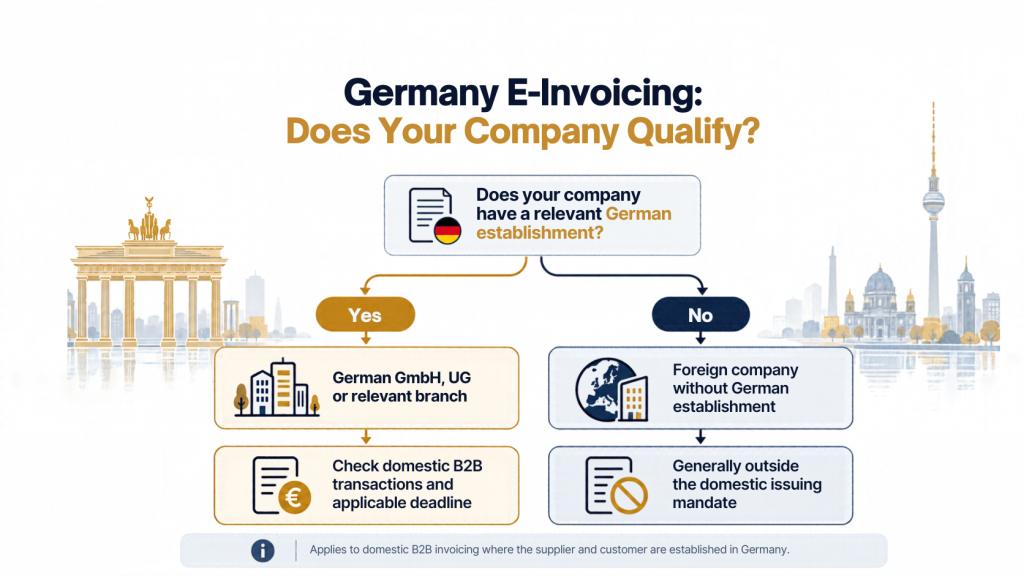
This is where most guides stop too early. The rule applies when both the supplier and the customer are established in Germany.
“Established” means the company has its registered office, its management, or a fixed establishment (permanent establishment) involved in the supply in Germany.
Here’s how that plays out for common structures:
Your situation | Must you issue an e-invoice? |
Indian or foreign company with no German presence, invoicing German customers | Generally no. You can keep using formats allowed in your home country. |
Foreign company with a German VAT number but no German establishment | No issuing obligation. Indicate your non-established status on the invoice. |
German GmbH or UG owned by a foreign parent | Yes, if you pass the turnover test. The GmbH is a German company, whoever owns it. |
German branch or permanent establishment of a foreign company | Yes, where the branch is involved in the supply. |
Foreign supplier under reverse charge | Generally no, because the supplier isn’t established in Germany. |
Two cases need extra care:
Intercompany invoices. An invoice from your parent in India to your German GmbH is cross-border, so the German mandate generally doesn’t apply. An invoice between two German group entities is domestic, so it does.
Hidden establishment. A foreign company can become “established” in Germany without meaning to. Suppose an Indian IT firm opens a Berlin office, and a German-based employee negotiates and signs contracts.
That setup can create a permanent establishment, and with it, German invoicing obligations. If your structure isn’t clean, ask a German tax advisor (Steuerberater) to assess it.
Unsure If Your German Company Must Comply?
Understand your e-invoicing obligations and get expert guidance on German business compliance.
The €800,000 threshold, explained
The test looks at your previous year’s turnover. For 2027, that means your 2026 figures.
For the GmbH having sales revenue of €1.2M in 2026, the requirement for e-invoicing would apply from January 1, 2027.
The same requirement for the UG having sales revenue of €400,000 in 2026 would apply from January 1, 2028.
The case for a new company which doesn’t have a history of 2026 is an uncertain case. Consult with your advisor and plan accordingly.
The test needs to be applied for each German legal entity within the group.
Don’t treat the transition as a reason to wait. Your German customers may ask for e-invoices earlier, and your suppliers will start sending them to you.
Receiving e-invoices: the obligation you may already be missing
Receiving has been mandatory since January 2025, for every business established in Germany, whatever its size.
The tax ministry has confirmed that a working email inbox is enough to meet the basic requirement.
But the real question is what happens after that. The XML file finds its way into the general email box, your outsourced accounting department cannot open the file, and hence the invoice is not processed at all.
If you outsource your bookkeeping, make sure that your outsourced department is capable of handling XML files. All you need is a separate accounts payable email box and software to read structured invoices.
If your bookkeeping is handled abroad, check that your team can handle XML files. A dedicated accounts-payable inbox and software that reads structured invoices will solve most of this.
Is Your German Business Ready for E-Invoicing?
Prepare for Germany’s 2027 requirements with professional tax and compliance guidance from Vorx.
XRechnung vs ZUGFeRD: which format?
Two formats cover most needs:
- XRechnung is pure XML. It’s the standard for invoices to public-sector customers.
- ZUGFeRD (also called Factur-X) is a PDF with XML embedded inside. The XML is the legal invoice. The PDF is just a readable copy for humans.
Most small and mid-sized businesses choose ZUGFeRD because the PDF makes it familiar.
Choose Rechnung if you invoice government bodies. Be aware that the lowest ZUGFeRD profiles don’t carry full invoice data and don’t qualify.
What makes an e-invoice valid?
The normal structure of the German invoices remains the same: name of the supplier and buyer, tax number or VAT ID, date of the invoice, the description of the goods/services, net price, tax percentage and total tax price. If you have a public sector buyer, a special code – Leitweg-ID – will be required as well.
According to the BMF recommendations of October 2025, it’s necessary to remember one thing: not all mistakes are created equal.
The mistakes such as invalid file format and the ones which don’t allow reading VAT information via software will make your invoice not an e-invoice anymore.
Other mistakes will make your invoice correct but wrong in its content. In both cases, it’s the supplier who’s responsible.
How to fix everything? Just validate each invoice.
Many accounting systems have one built in, and free validators exist too.
Archiving: keep the XML, not just the PDF
The structured XML file is the legal original. However, if you have only PDF format, then it will violate the German principles of bookkeeping regulations referred to as GoBD, because the invoices should be full, non-modifiable, readable, and machine-readable.
The period of retention of accounting documentation was reduced in accordance with recent legislation reducing the bureaucracy in Germany; therefore, consult your advisor about the correct duration of retention now.
The accounting documentation stored in a foreign cloud may become the problem for the German auditor.
Who is exempt?
- Small businesses (Kleinunternehmer) don’t have to issue e-invoices, but they must still be able to receive them.
- Invoices up to €250 are exempt.
- Certain tax-exempt supplies fall outside the requirement.
- Tickets and similar documents are also covered by exemptions.
- B2C invoices and invoices to non-business customers are out of scope.
What happens if you get it wrong?
No dedicated e-invoicing fine regime has been published so far. It does not mean there are no risks involved:
The invoice might not be considered as a proper invoice and the customer will not be able to deduct the VAT.
There will be difficult discussions.
The customer might refuse the invoice or delay payment.
It may be uncovered in an audit and require correction.
The actual cost for smaller firms is their cash flow and their customers’ trust.
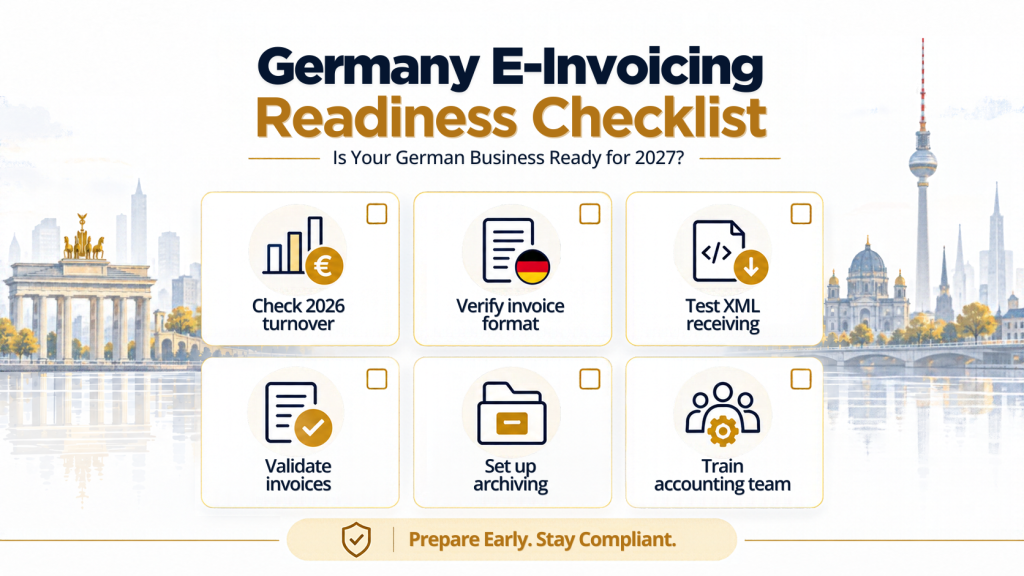
The bigger picture
Like the rest of the EU, Germany too is headed in the direction of digital invoicing under the Digital Age (ViDA) initiative.
Other nations like France, Poland, and Belgium all have their own deadlines. In case you bill from other European countries besides Germany, it’s better to get a system that works for more than one country. Always check the deadlines for different countries before you decide.
This article is general information, not tax or legal advice. Rules and guidance change, so check your specific situation with a German tax advisor (Steuerberater) before acting.
Stay Ahead of Germany’s Compliance Requirements
From company formation to ongoing tax and regulatory compliance, Vorx helps international businesses navigate German requirements.
