


However, if you glanced at Ghana a few years back and left due to the US200,000 to US1 million capital requirements, it is high time for a re-look.
Ghana investment registration in 2026 works very differently. President John Mahama signed the Ghana Investment Promotion Authority Act, 2026 (Act 1173), on July 15, 2026.
This is in lieu of the 2013 GIPC Act and abolishes the minimum capital provision for all foreign companies.
But the new law is not a free pass. It remains difficult for trading businesses; now it happens every year and there is stricter compliance. Here is what changed, what did not, and what to do next.
What is the GIPA Act 2026?
This act changes the Ghana Investment Promotion Centre to become the Ghana Investment Promotion Authority. The name change matters. A “Centre” mainly promoted investment. An “Authority” also regulates, monitors and penalises.
GIPA now runs a National Investment Registry, carries out annual compliance reviews, regulates technology transfer, and acts as Ghana’s focal point under the AfCFTA investment protocol.
For investors, this means easier entry but closer oversight once you are in.
Read this guide: Ghana Company Formation for Foreigners in 2026.
GIPA minimum capital requirements: old vs new
This is the change most people are searching for.
Business type | Under GIPC Act 2013 | Under GIPA Act 2026 |
Joint venture with a Ghanaian partner | US$200,000 | No general minimum |
Wholly foreign-owned (non-trading) | US$500,000 | No general minimum |
Foreign-owned trading company | US$1,000,000 | US$500,000 in cash equity |
Portfolio investment | Exempt | Exempt |
Two smaller changes are worth knowing. Former Ghanaians who lost citizenship by taking another nationality are exempt from the foreign capital minimum.
And the old route of registering through a Ghanaian spouse to avoid capital rules is no longer available.
One caution: “no general minimum” does not mean no rules. Banking, mining, insurance, telecoms and other regulated sectors still set their own capital and licensing conditions.
The trading company exception
If your business buys and resells goods in Ghana, you are a trading enterprise. You need US$500,000 in cash equity.
Goods brought in as capital no longer count. At least 75% of your skilled employees must also be Ghanaian, replacing the old rule of employing 20 Ghanaians.
Planning to Invest in Ghana?
Understand how the new GIPA capital and ownership rules apply to your business before taking the next step.
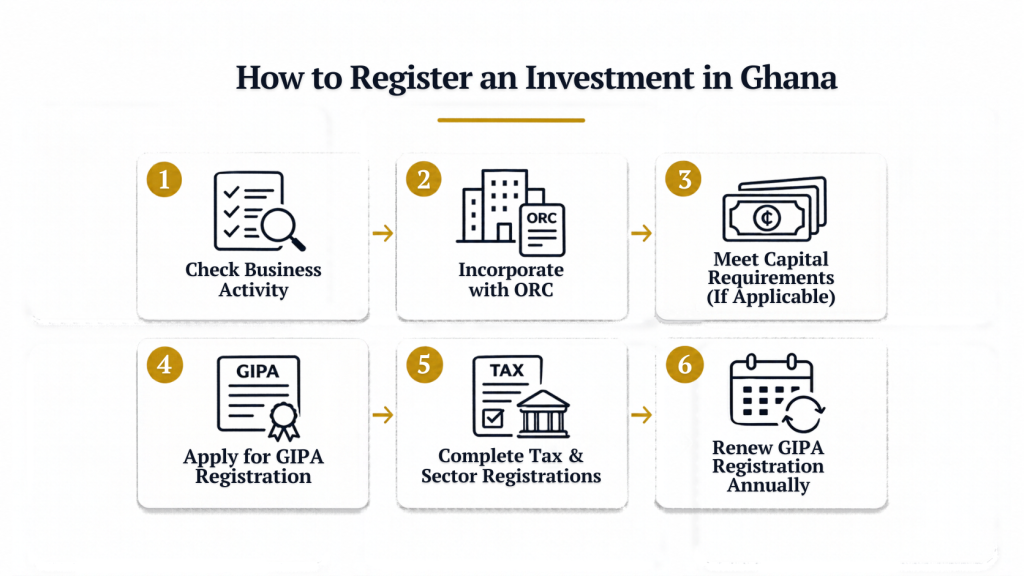
GIPA registration process in Ghana: step by step
The order of steps is set by the Act. Your company must be incorporated first and registered with GIPA before it starts operating.
Check your activity: Confirm it is not reserved for Ghanaians and note any sector licence you will need.
Incorporate the company with Ghana’s Office of the Registrar of Companies.
Bring in capital if required:Trading companies must show the US$500,000 cash equity.
Register with GIPA and obtain your registration certificate.
Apply for sector licences, tax registration and any expatriate quota through the relevant bodies.
Renew your GIPA registration every year.
GIPA has not yet published updated fee schedules or processing times under the new Act on the pages we reviewed. Confirm both directly before you budget.
If you are setting up from India or elsewhere and want the incorporation, banking and GIPA steps handled together, our foreign company formation team can map this out for your activity.
Need Help with GIPA Registration?
Get professional assistance with Ghana company incorporation, investment registration and regulatory documentation.
Other new GIPA rules that affect your business
Annual renewal
GIPA registration now renews every year instead of every two years. Missing a renewal can lead to penalties of up to 10,000 penalty units, suspension of GIPA services or loss of incentives.
A bigger expatriate quota
The old cap was four expatriate positions. The new scale runs from 2 to 12, depending on how much you have invested.
Capital invested | Maximum expatriates |
US$50,000 – 500,000 | 2 |
US$500,000 – 1 million | 4 |
US$1 million – 3 million | 6 |
US$3 million – 6 million | 8 |
US$6 million – 10 million | 10 |
Above US$10 million | 12 |
Quotas are granted on application for up to five years and can be renewed. Work permits are applied for through GIPA to the Ghana Immigration Service.
Technology transfer agreements
Licensing, franchise and management agreements with a foreign party must be registered with GIPA.
An unregistered agreement cannot be enforced, and banks will refuse to pay royalties or fees under it. Registrations now last five years.
Reserved activities and anti-fronting
Six categories of business remain reserved for Ghanaians. Pool betting and lotteries are among those removed from the old list.
The Act also makes “fronting” a criminal offence, meaning using a Ghanaian nominee to hide foreign ownership in a reserved sector.
Already registered with GIPC? What to do now
Your existing registration does not simply carry on unchanged. Work through this list:
- Confirm with GIPA when your first annual renewal falls due.
- If you are a trading company, check that your capital meets the US$500,000 cash rule and the 75% local staffing rule.
- Compare your current and planned expatriate headcount with the new scale.
- Register any unregistered technology transfer agreements before your next royalty payment.
- Review any structure that relied on a Ghanaian spouse or nominee shareholder.
Example: entering Ghana under the new rules
Hypothetical scenario. Priya runs a software services firm in Pune. She wants a wholly owned subsidiary in Accra to serve West African clients.
Under the old law, she needed US$500,000. Under the GIPA Act 2026, there is no general minimum for her non-trading business.
She still needs to incorporate, register with GIPA, register for tax and renew every year. If she later decides to import and resell hardware, that part of the business could be treated as trading. The US$500,000 cash rule would then apply.
Next steps
Under the GIPA Act of 2026, Ghana becomes more accessible to those working in services, technology, and non-trade business ventures. The Act demands yearly renewal, accurate reporting, and legitimate ownership structure.
Before making any commitment, verify three items: if your business is categorized as trading, what kind of licenses apply to your sector, and your requirements under the expatriate quota.
Vorx Consultancy helps founders handle Ghana company formation, GIPA registration, banking and ongoing compliance. Book a consultation to get a plan for your specific business.
Start Your Ghana Business Expansion with Confidence
From company formation to GIPA registration and ongoing compliance, Vorx Consultancy helps you navigate Ghana’s investment requirements.
