


Hong Kong is an attractive place for entrepreneurs to establish a business if they want to enter the Asian market and operate globally. Hong Kong is famous for its robust financial system, an international business-friendly environment and a simple incorporation process.
However, foreign businesspersons should be aware that there are still many specificities related to the incorporation process. There are certain requirements that must be fulfilled before incorporation in relation to the choice of structure, preparation of statutory documents, registered address and company secretary appointments. Post-incorporation compliance obligations are also mandatory.
This guide covers the steps involved when registering a company in Hong Kong, from choosing a structure and completing registration to managing the company after incorporation.
Why Register a Company in Hong Kong?
Hong Kong can be a strategic location for businesses that want an international presence in Asia.
Some of the key reasons entrepreneurs consider starting a business in Hong Kong include:
- International business environment: Hong Kong has an established commercial and financial infrastructure.
- Foreign ownership: Foreign entrepreneurs can generally own 100% of a Hong Kong company.
- Access to Asian markets: Its location makes it useful for businesses targeting markets across Asia-Pacific.
- Established legal framework: Companies operate under a well-developed corporate and regulatory system.
- Territorial tax approach: Hong Kong generally taxes profits arising in or derived from Hong Kong, subject to applicable rules.
However, Hong Kong should not simply be viewed as a “tax-free” jurisdiction. The tax treatment of a business depends on its activities, source of profits and individual circumstances.
Which Company Structure Is Right for You?
One of the first decisions when setting up a business in Hong Kong is choosing the right structure. The right structure depends on whether you are starting a new business, expanding an existing overseas company or simply testing the Hong Kong market.
1. Private Limited Company: Best for Most New Businesses
A private company limited by shares is generally the most suitable structure for entrepreneurs starting a new business in Hong Kong. It can be a good fit if you want to:
- Operate a full commercial business
- Have limited liability
- Bring in one or more shareholders
- Maintain foreign ownership
- Build a long-term presence in Hong Kong
For most international founders, this is the structure to consider first.
2. Branch Office: For Existing Overseas Companies
If you already have a company outside Hong Kong and want to establish a presence there, a branch office may be an option.
Unlike a new subsidiary, a branch is an extension of the foreign parent company rather than a completely separate local company.
It can therefore make sense when the goal is to expand an existing business into Hong Kong.
3. Representative Office: For Market Exploration
A representative office is generally more limited. It can be useful when a foreign company wants to explore the Hong Kong market, conduct promotional activities or develop business relationships before making a larger commitment.
However, it is not designed for carrying out normal profit-making commercial activities.
4. Subsidiary: For a Separate Hong Kong Entity
An overseas company may also establish a Hong Kong subsidiary, typically as a locally incorporated company. This can be useful when the parent company wants:
- A separate legal entity
- Local operations
- A clearer separation between the Hong Kong business and parent company
- A platform for regional expansion
Quick Comparison
Structure | Best suited for |
Private Limited Company | New entrepreneurs and operating businesses |
Branch Office | Existing foreign companies expanding to Hong Kong |
Representative Office | Market research and promotional activities |
Subsidiary | Foreign companies wanting a separate local entity |
For most entrepreneurs launching a new business venture, a private limited company is often their preferred choice at least initially. That being said, the decision of which organizational form to adopt ultimately comes down to the nature of your operations, ownership structure, level of risk exposure, and future growth strategy.
What Are the Hong Kong Company Registration Requirements?
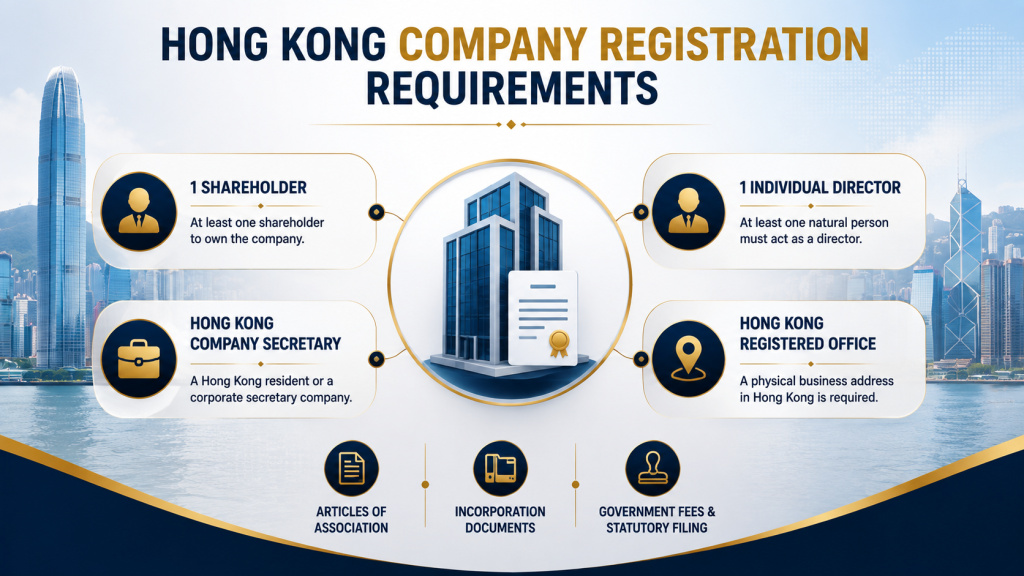
Before starting the Hong Kong incorporation process, you need to meet several basic requirements. A typical private company limited by shares needs:
- At least one shareholder
- At least one natural-person director
- A Hong Kong company secretary
- A Hong Kong registered office
- Articles of Association
- Required incorporation and business registration documents
The shareholder and director can generally be foreign nationals. A Hong Kong-resident director is not generally required.
The company secretary has separate eligibility requirements and plays an important role in maintaining the company’s statutory compliance.
Before starting the Hong Kong incorporation process, you need to meet a few basic requirements. For a typical private limited company, the setup is relatively straightforward, and foreign entrepreneurs can generally own and manage the company.
The minimum requirements include:
- At least one shareholder and one individual director — they can generally be foreign nationals.
- A Hong Kong company secretary — the company secretary must meet the applicable local eligibility requirements.
- A Hong Kong registered office — the company must maintain an official address in Hong Kong for statutory correspondence.
- Company documents — including the Articles of Association and the relevant incorporation form and supporting information.
There is generally no requirement for a Hong Kong-resident shareholder or director, which makes the structure accessible to many overseas founders. However, additional documents or KYC information may be required depending on the company’s ownership and business activities.
What Documents Do You Need?
Once your company structure and ownership are decided, the next step is preparing the required documents. For a standard Hong Kong private limited company, the paperwork is generally straightforward. You will typically need:
- Identification documents — Passport or ID of the directors and shareholders.
- Address proof — Residential address details or supporting proof for the individuals involved.
- Company details — Proposed company name, business activities, shareholder information and shareholding structure.
- Incorporation documents — Articles of Association and the relevant incorporation form, such as Form NNC1 for a company limited by shares.
Additional KYC/AML documents may be requested depending on the ownership structure, business activity or service provider handling the incorporation.
How Do You Register a Company in Hong Kong?
The actual process is fairly structured. Here’s what registering a company in Hong Kong generally involves.
1. Choose Your Company Structure:
First, decide whether a private limited company, branch or another structure fits your business.
2. Choose and Check the Company Name:
Select a suitable name and check it against the Companies Registry’s records. The name must comply with applicable naming requirements.
3. Decide Your Shareholders and Directors:
Determine who will own the company, who will manage it and how the shares will be distributed.
4. Appoint a Company Secretary and Registered Office:
A Hong Kong company must maintain a registered office and appoint a company secretary who meets the applicable requirements.
This is where the Hong Kong registered office requirements and Hong Kong company secretary requirements become particularly important.
5. Prepare the Incorporation Documents:
For a private company limited by shares, the incorporation application includes Form NNC1, the Articles of Association and relevant supporting information.
6. Submit the ApplicationL
The application can be submitted electronically through the Companies Registry’s e-Services or through the applicable paper process.
7. Receive the Certificates:
Once approved, the company receives its:
- Certificate of Incorporation
- Business Registration Certificate
At this point, the company has been incorporated, but there are still post-incorporation responsibilities to complete.
Is Company Registration the Same as Business Registration?
No. They are two different processes, although Hong Kong provides a one-stop service for them. Company registration is handled through the Companies Registry and establishes the company as a legal entity.
Business registration is administered by the Inland Revenue Department and results in a Hong Kong Business Registration Certificate. In a simple comparison:
Company Registration | Business Registration |
Companies Registry | Inland Revenue Department |
Incorporates the company | Registers the business |
Certificate of Incorporation | Business Registration Certificate |
For a new local company, the relevant applications can generally be handled together through Hong Kong’s one-stop registration service.
Can a Foreigner Register a Company in Hong Kong?
Yes. Setting up a business in Hong Kong as a foreigner is generally possible. Foreign entrepreneurs can generally own shares in a Hong Kong company, including 100% ownership, and can act as directors without being Hong Kong residents. This makes foreign ownership of Hong Kong companies particularly attractive for international founders.
However, incorporation should not be viewed in isolation. Foreign entrepreneurs also need to consider banking, tax, accounting and ongoing compliance.
For example, an Indian entrepreneur may establish a Hong Kong company for regional expansion, but the company’s structure should reflect its actual business activities and target markets.
Recommended Reading:
If you’re planning to establish a business in Hong Kong and also explore your immigration options, you can learn more about the Hong Kong Entrepreneur Visa and its eligibility requirements.
Can You Register a Hong Kong Company Remotely?
In many cases, yes.
You do not necessarily need to travel to Hong Kong simply to incorporate a company. Electronic filing and professional support can make the incorporation process manageable from overseas. However, there is an important distinction between company incorporation and bank account opening. Banks conduct their own KYC checks and may ask about:
- Business activities
- Ownership structure
- Source of funds
- Expected transactions
- Supporting business documents
Therefore, remote incorporation does not necessarily mean every part of the business setup will be completed remotely.
What Happens After Incorporation?
Once your company is incorporated, you need to move from registration to actual business operations. Some important post-incorporation tasks include:
Corporate banking: Set up a suitable business bank account and complete the bank’s KYC requirements.
Accounting and tax: Maintain proper accounting records and understand the company’s applicable tax obligations.
Statutory compliance: Keep company records updated and meet applicable filing requirements.
Company secretary and registered office: Maintain these arrangements throughout the company’s operation.
This is why incorporation should be considered the starting point of your Hong Kong business setup, rather than the final step.
Recommended Reading:
Once your company is incorporated, understanding its ongoing tax obligations is equally important. For a detailed overview of Hong Kong’s tax system, rates and filing considerations, read our Hong Kong Corporate Tax Guide.
How Long Does Hong Kong Company Registration Take?
The overall process of registering a standard private limited company can generally take between 1-5 working days assuming you have all of your documents in order and there are no issues with the company name or application. The timeline usually looks like this:
- Document preparation: 1–2 working days, depending on how quickly the founder provides the required information.
- Government incorporation: Electronic applications can be processed much faster, with straightforward applications potentially completed within 1 hour after approval.
- Certificate issuance: Once approved, the Certificate of Incorporation and Business Registration Certificate are issued electronically.
- Additional setup: Bank account opening, KYC checks and other post-incorporation tasks can take additional time.
So, for a straightforward case, planning for a few working days is a practical estimate, while the actual government incorporation may be completed much faster.
What Mistakes Should Foreign Founders Avoid?
Foreign founders often focus on getting the company incorporated quickly and overlook the requirements that come after registration. One common mistake is choosing a structure without considering the actual business model or future expansion plans. Founders should also avoid assuming that incorporation automatically guarantees a corporate bank account, as banks conduct separate KYC and due-diligence checks.
It is equally important to maintain a compliant registered office and company secretary, keep proper accounting records and stay on top of annual filings and tax obligations. Finally, don’t assume that a Hong Kong company is automatically tax-free; the company’s activities and source of profits can affect its tax position.
How Can Vorx Help With Hong Kong Company Registration?
Registering a company in Hong Kong is only one part of establishing an international business presence. Vorx Consultancy helps entrepreneurs plan the setup around their actual business goals, from choosing a suitable structure and preparing incorporation documents to coordinating registered office and company secretary requirements.
We can also assist with corporate banking, compliance and international business expansion, helping foreign founders manage the practical steps involved in moving from incorporation to business operations. Whether you’re an Indian entrepreneur entering the Hong Kong market or an established company expanding into Asia, Vorx can help you build a setup designed for your long-term plans.
Need Strategic Guidance?
Book a Strategy Call: (Calendly Link)
Visit: www.vorxcon.com
Email: support@vorxcon.com
Final Thoughts:
Hong Kong can be the best choice for ambitious entrepreneurs who want to establish their business presence in the Asian region. This city’s company formation process is quick and straightforward, and foreigners are able to incorporate and run a Hong Kong company remotely.
Nevertheless, it is crucial to understand that the work does not end once the company is legally registered. Choosing the appropriate entity structure, preparing all required documents, arranging for a registered office and company secretary, and opening bank accounts are just some of the steps that must be taken to ensure your business’s success.
Therefore, if you are considering how to register a company in Hong Kong, make sure to consider all details at the earliest stages so that nothing detrimental to your business interests is overlooked.
