


For Indian entrepreneurs interested in expanding their business to international markets, Canada emerges as a promising destination due to its stable business environment and high desirability among global investors. However, prior to international expansion, an obvious question is: how to register a company in Canada from India.
The good news is that Indians can establish a Canadian company even if they are not Canadian residents, but the process involves choosing the right entity, federal/provincial incorporation, arranging a registered office, and more.
This guide aims to provide an overview of company registration in Canada from India in 2026, including requirements, documents, process, time frame, and cost.
Can Indians Register a Company in Canada?
Canadian corporate law generally allows foreign entrepreneurs to own shares in Canadian corporations. However, you are not necessarily required to change your residency in Canada simply to be able to own a Canadian company. Nevertheless, there is one point you should be aware of the fact that ownership and directorship are not always the same. Some incorporation options have residency requirements for directors, although such requirements may vary depending on the type of incorporation (federal vs. provincial).
Consequently, an Indian founder should research the applicable jurisdiction prior to launching the incorporation process.
Which Business Structure Should You Choose?
The structure you choose affects ownership, liability, taxation, reporting, and future expansion.
Business Structure | Best Suited For | Key Point |
Corporation | Entrepreneurs planning to build a scalable business | Separate legal entity and limited liability |
Sole Proprietorship | Individual/small local businesses | Simple but no separate legal identity |
Partnership | Two or more business owners | Shared ownership and responsibilities |
Limited Partnership | Certain investment and business arrangements | Liability can differ between partners |
For most Indian entrepreneurs planning an international business, a corporation is often the structure worth considering because it creates a separate legal entity and can provide a more established structure for contracts, banking, investment, and expansion.
Federal vs Provincial Company Registration in Canada: What’s the Difference?
You can generally incorporate federally or under a particular province or territory. The better choice depends on where you plan to operate and how you intend to expand.
Federal Incorporation | Provincial Incorporation |
Incorporate under federal corporate law | Incorporate under provincial/territorial law |
Can provide broader name protection across Canada | Often suitable for businesses focused on one province |
Useful for businesses planning wider operations | Requirements vary by province |
Federal corporate compliance applies | Provincial corporate compliance applies |
The choice between federal vs provincial incorporation Canada should therefore be based on your business plans rather than simply choosing the cheapest or fastest option.
Recommended Reading:
If your Canadian business will provide money transfer, foreign exchange, payment, or virtual currency services, you should also understand MSB requirements in Canada.
How Much Does It Cost to Register a Company in Canada?
For an Indian entrepreneur, the overall Canada company registration cost may also include expenses related to name registration, a Canadian registered office, provincial registration, tax accounts, and professional assistance. Here are the main costs you should consider:
Cost Component | What It Covers |
Government Incorporation Fee | Fee charged by the federal or provincial authority to incorporate the company |
Name Search / Name Registration | Cost of checking or reserving a proposed business name, where applicable |
Registered Office Address | A Canadian address may be required for corporate records and official correspondence |
Provincial Registration | May apply if a federally incorporated company carries on business in a particular province |
Business Licences & Permits | Additional licences may be required depending on the nature of your business |
Tax Registrations | Certain businesses may need registrations such as GST/HST or payroll accounts |
Professional Services | Optional fees for incorporation, accounting, tax, compliance, or corporate administration support |
The amount you actually spend will depend on your chosen jurisdiction, business activity, registered office arrangements, and the level of professional support you need.
What Is the Step-by-Step Process?
The Canada company registration process is generally straightforward when the structure and jurisdiction have been decided in advance.
1. Choose the Business Structure
Decide whether a corporation, sole proprietorship, partnership, or another structure fits your business.
2. Select the Jurisdiction
Choose between federal incorporation and provincial/territorial incorporation based on your business plans.
3. Choose a Company Name
Select an appropriate name and complete the required name search or approval process, depending on the incorporation route.
4. Prepare Corporate Information
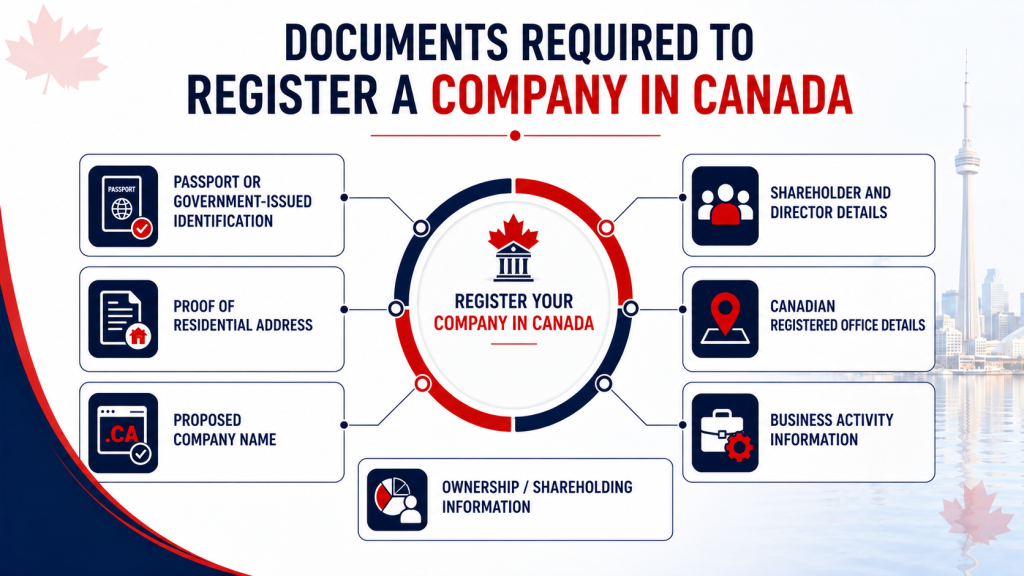
Provide director, shareholder, registered office, share structure, and business activity details.
5. File the Incorporation Application
Submit the required incorporation documents to the relevant Canadian authority.
6. Receive Corporate Documents
Once approved, you receive the company’s incorporation documents and corporate identification details.
7. Complete Additional Registrations
Depending on the business, you may need tax accounts, provincial registrations, licences, permits, or other registrations.
8. Set Up Business Banking and Accounting
After incorporation, establish suitable banking and accounting arrangements and put a system in place for ongoing compliance.
How Long Does It Take to Register a Company in Canada?
For a straightforward application, the company incorporation itself may take around 1–5 business days, depending on whether you choose federal or provincial registration and how quickly your documents are prepared. For an Indian entrepreneur, a practical timeframe can look like this:
- Document preparation: 1–2 business days
- Company incorporation: 1–5 business days
- Tax/business registrations: 2–10 business days, depending on requirements
- Banking setup: Usually additional time and depends on the bank
Overall, you can generally plan for around 1–3 weeks for the broader setup, while more complex cases may take longer.
What Happens If You Don't Follow Canadian Company Requirements?
Following Canadian corporate, tax, and employment rules is important after incorporation. Non-compliance can lead to financial penalties, operational restrictions, and reputational problems. Common consequences include:
- Financial Penalties: Late filings, unpaid taxes, or regulatory violations can result in fines, interest, or additional charges.
- Loss of Good Standing: Missing required corporate filings can affect the company’s status and ability to obtain certain corporate documents.
- Hiring Restrictions: Employers that violate applicable foreign-worker requirements may face temporary or permanent restrictions on hiring foreign workers.
- Government Inspections: Non-compliant businesses may be subject to audits, reviews, or inspections.
- Legal Action: Serious or deliberate violations can lead to prosecution and, in certain cases, imprisonment.
The exact penalty depends on the type and seriousness of the violation. Therefore, maintaining corporate, tax, and employment compliance should be part of your ongoing Canada company setup from India.
Recommended Reading:
Businesses operating in regulated financial activities may also have additional compliance obligations, such as FINTRAC requirements for MSBs in Canada.
How Vorx Consultancy Supports Your Canada Company Setup?
Starting a business overseas may seem challenging from India with incorporation, documentation, tax, banking, and compliance needs.
Vorx Consultancy aims to help Indian entrepreneurs get an idea about the essential steps they should consider for Canada incorporation for Indians. From choosing the appropriate routes to documentation and other post-incorporation needs, it can help make the process smooth and organized.
The focus is not only on incorporating the company but also on making the structure ideal for the planned business activity and international footprint.
Ready to expand your business to Canada? Let Vorx Consultancy simplify your company setup from India.
Book a Strategy Call: (Calendly Link)
Visit: www.vorxcon.com
Email: support@vorxcon.com
Final Thoughts
For Indian entrepreneurs, the question: how to register a company in Canada from India, is not only about filing the application but also involves the right jurisdiction, business structure, director requirements, documentation, tax registrations, and ongoing compliance
Whether it is a startup or expanding the existing Indian business, the process of how to incorporate a company in Canada from India needs careful planning to avoid unnecessary challenges. Therefore, if it is a matter of how to start a company in Canada from India, it is advisable to go through the rules applicable for the intended business activity before filing the incorporation request.
