


Introduction
When Global Expansion Meets Immigration Complexity
Global expansion looks clean on paper.
New market. New entity. And New revenue stream.
But the reality? Expansion is rarely about paperwork alone. It is about mobility — specifically, whether the right decision-maker can legally step into the new market and lead from the front.
In this case, an Indian–US director-led company was preparing to create operations in Australia. The strategic resolved was clear: tap into the Australian market as a gateway to the Asia-Pacific region, build local partnerships, & anchor long-term commercial presence.
The missing piece was not incorporation.
It was leadership mobility.
The company’s director — central to operational execution and strategic oversight — needed lawful, compliant, and scalable entry into Australia. Remote oversight would not suffice. Investor confidence, regulatory alignment, and early-stage execution required boots on the ground.
That is where immigration complexity intersected with corporate strategy.
Australia’s immigration framework is structured and compliance-driven. Businesses cannot simply transfer leadership at will. Every visa pathway requires alignment between business structure, genuine position requirements, salary benchmarking, labour market testing, and regulatory scrutiny.
For this expansion, the appropriate route was the Subclass 482 visa — also known as the Temporary Skill Shortage visa. Designed to allow Australian businesses to sponsor skilled overseas workers in eligible occupations, the Subclass 482 offers up to four years of lawful work authorization when executed correctly.
But “correctly” is doing a lot of work in that sentence.
The challenge was layered:
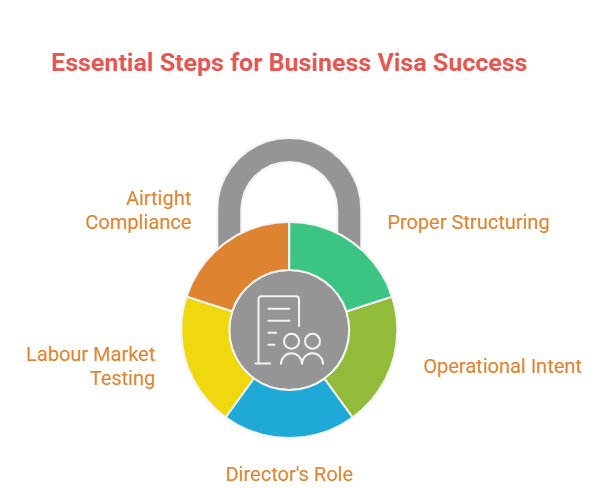
- The Australian entity first needed to be properly structured and compliant.
- The business had to demonstrate genuine operational intent.
- The director’s role had to align with an occupation on the skilled list.
- Labour market testing had to be conducted and documented.
- The nomination and visa application required airtight compliance.
In director-led sponsorship scenarios, scrutiny is often heightened. Regulators examine whether the role is genuine, whether salary meets market rate, and whether the expansion is commercially credible.
This was not a case for fragmented advice — where one consultant handles company formation, another manages tax, and a third files visa paperwork.
It required integrated strategy.
Vorx Consultancy stepped in not merely as an immigration service provider, but as a global expansion advisor. The engagement focused on aligning business formation, compliance structure, and visa eligibility into a cohesive pathway.
Because in cross-border expansion, immigration is not a side process.
It is infrastructure.
And when infrastructure is built strategically, leadership mobility becomes an enabler — not
a bottleneck.
The Expansion Objective – Why Australia?
Australia was not chosen by accident.
For an Indian–US director-led company looking to scale internationally, Australia represented something strategically rare: market maturity combined with regional leverage.
From a commercial standpoint, Australia offers:
- Direct access to the Asia-Pacific corridor
- A stable regulatory environment
- Strong investor protection laws
- Transparent corporate governance standards
- A skilled, English-speaking workforce
For businesses operating across India and the United States, Australia becomes a natural third pillar — geographically positioned between East and West, commercially aligned with both.
But entering Australia is not just about registering a subsidiary.
It is about establishing operational credibility.
The company’s leadership understood one critical fact early: expansion without executive presence weakens momentum. Early-stage operations require decision-making agility, relationship-building, regulatory navigation, and cultural integration — all of which demand on-ground leadership.
Remote management might work for oversight.
It does not work for expansion.
Key contracts, partnerships, banking relationships, compliance reviews — these are not managed effectively across time zones when the market entry phase is sensitive.
And that is where immigration strategy becomes central.
Many companies treat immigration as a post-registration task — something to address after combination.
That approach often leads to delays, compliance gaps, or visa refusals.
Global expansion requires immigration planning at the same level as tax structuring & corporate formation. The ability to legally position leadership in the target country is not administrative — it is strategic.
For this expansion, the Subclass 482 visa was identified as the most viable pathway to achieve lawful, compliant, & scalable executive mobility into Australia.
Understanding the Subclass 482 Visa Framework
Before diving into how the process unfolded, it is important to understand the structure of the Subclass 482 visa.
Australia’s immigration system is rules-based, documentation-heavy, & compliance-focused. Clarity around the framework determines success.
What Is the Subclass 482 Visa?
The Subclass 482 visa — commonly referred to as the Temporary Skill Shortage (TSS) visa and now aligned under the Skills in Demand stream — allows approved Australian businesses to sponsor skilled overseas workers to fill positions they cannot source locally.
It is an employer-sponsored visa.
That distinction matters.
An individual cannot independently apply for this visa without a sponsoring Australian entity.
Depending on the occupation & stream, the visa can be decided for up to four years, allowing the sponsored individual to live and work in Australia for the approved employer.
For expanding companies, it provides a structured pathway to transfer vital leadership or specialized expertise into the Australian market.
However, approval is not automatic.
The process is sequential and strictly regulated.
The Three Mandatory Stages
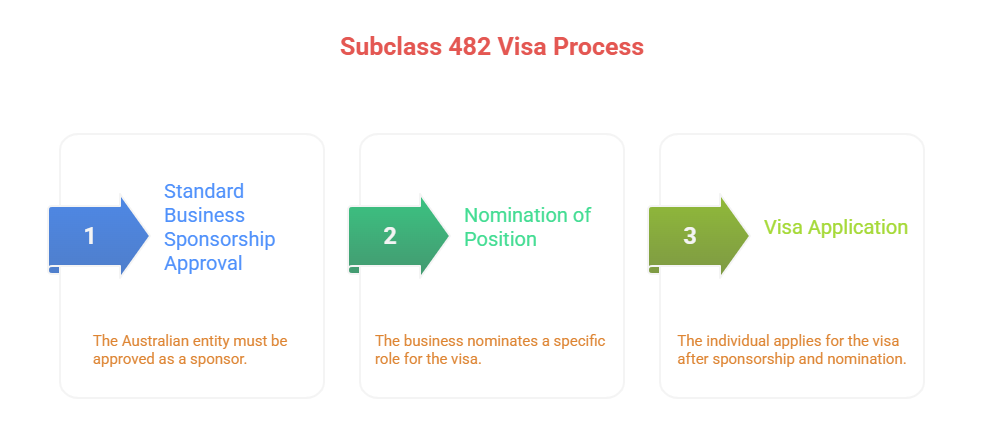
The Subclass 482 pathway involves three distinct and interdependent stages:
1. Standard Business Sponsorship (SBS) Approval
The Australian entity must first be approved as a Standard Business Sponsor. This requires demonstrating lawful operation, financial viability, and genuine business activity.
Without SBS approval, nomination and visa stages cannot proceed.
2. Nomination of Position
The sponsoring business must nominate a specific role that appears on the relevant skilled occupation list. The nomination must demonstrate that the position is genuine, necessary for operations, and paid at market salary rates.
3. Visa Application
Only after sponsorship approval and nomination acceptance can the individual apply for the visa. This stage includes character checks, health requirements, and evidence that the nominee meets skill and experience thresholds.
Each stage must align perfectly with the others. A weakness in one can derail the entire process.
Core Requirements
Beyond the three stages, several core compliance pillars determine eligibility.
Genuine Position Requirement
The role must be real, commercially necessary, & aligned with the business’s operational needs. Authorities assess whether the position makes sense given the company’s scale & activities.
In director-led sponsorship cases, scrutiny often increases to ensure the role is not created solely for visa purposes.
Labour Market Testing (LMT)
Before nominating a foreign worker, the company must demonstrate that it attempted to hire locally. This involves advertising the position in approved channels & maintaining detailed indication of recruitment efforts.
Failure to conduct proper Labour Market Testing is one of the most common reasons for refusal.
Skills Assessment (If Applicable)
Depending on the nominated occupation, a formal skills valuation may be required to verify qualifications and experience.
Market Salary Rate Compliance
The sponsored employee must be paid at least the market rate for that occupation in Australia & meet the Temporary Skilled Migration Income Threshold. Underpayment risks refusal and future sponsorship penalties.
In short, the Subclass 482 visa is not merely an application.
It is a compliance ecosystem.
Understanding that environment is the difference between delay & approval — and it is precisely where strategic advisory becomes critical.
The Expansion Objective – Why Australia?
Australia was not chosen by accident.
For an Indian–US director-led company looking to scale internationally, Australia represented something strategically rare: market maturity combined with regional leverage.
From a commercial standpoint, Australia offers:
- Direct access to the Asia-Pacific corridor
- A stable regulatory environment
- Strong investor protection laws
- Transparent corporate governance standards
- A skilled, English-speaking workforce
For businesses operating across India & the United States, Australia becomes a natural third pillar — geographically positioned between East & West, commercially aligned with both.
But entering Australia is not just about registering a subsidiary.
It is about establishing operational credibility.
The company’s leadership understood one critical fact early: expansion without executive presence weakens momentum. Early-stage operations require decision-making agility, relationship-building, regulatory navigation, & cultural integration — all of which demand on-ground leadership.
Remote management might work for oversight.
It does not work for expansion.
Key contracts, partnerships, banking relationships, compliance reviews — these are not managed effectively across time zones when the market entry phase is sensitive.
And that is where immigration strategy becomes central.
Many companies treat immigration as a post-registration task — something to address after incorporation.
That approach often leads to delays, compliance gaps, or visa refusals.
Global expansion requires immigration planning at the same level as tax structuring & business formation. The ability to legally position leadership in the target country is not administrative — it is strategic.
For this expansion, the Subclass 482 visa was identified as the most viable pathway to achieve lawful, compliant, & scalable executive mobility into Australia.
Pro Tips – Strategic Expansion into Australia
1. Align Visa Planning With Entity Formation
Do not register the company first and “figure out” the visa later. Immigration documentation often requires business activity evidence that must be structured from day one.
2. Build a Commercial Narrative
Immigration authorities assess whether the expansion is genuine. Prepare a clear business plan, projected contracts, & operational forecasts.
3. Budget for Compliance, Not Just Registration
Sponsorship obligations continue after visa approval. Ongoing reporting and salary compliance must be factored into financial planning.
4. Position Leadership as Operationally Essential
Authorities scrutinize director-level sponsorships. Demonstrate why on-ground presence is commercially necessary — not merely convenient.
Understanding the Subclass 482 Visa Framework
Before diving into how the process unfolded, it is essential to understand the structure of the Subclass 482 visa.
Australia’s immigration system is rules-based, documentation-heavy, & compliance-focused. Clarity around the framework determines success.
What Is the Subclass 482 Visa?
The Subclass 482 visa — commonly referred to as the Temporary Skill Shortage (TSS) visa & now aligned under the Skills in Demand stream — allows approved Australian businesses to sponsor skilled overseas workers to fill positions they cannot source locally.
It is an employer-sponsored visa.
That distinction matters.
An individual cannot independently apply for this visa without a sponsoring Australian entity.
Depending on the occupation and stream, the visa can be granted for up to four years, allowing the sponsored individual to live and work in Australia for the approved employer.
For expanding companies, it provides a structured pathway to transfer important leadership or specialized expertise into the Australian market.
However, approval is not automatic.
The process is sequential and strictly regulated.
The Three Mandatory Stages
The Subclass 482 pathway involves three distinct and interdependent stages:
1. Standard Business Sponsorship (SBS) Approval
The Australian entity must first be approved as a Standard Business Sponsor. This requires demonstrating lawful operation, financial viability, and genuine business activity.
Without SBS approval, nomination and visa stages cannot proceed.
2. Nomination of Position
The sponsoring business must nominate a specific role that appears on the relevant skilled occupation list. The nomination must demonstrate that the position is genuine, necessary for operations, & paid at market salary rates.
3. Visa Application
Only after sponsorship approval and nomination acceptance can the individual apply for the visa. This stage includes character checks, health requirements, & evidence that the nominee meets skill and experience thresholds.
Each stage must align perfectly with the others. A weakness in one can derail the entire process.
Core Requirements
Beyond the three stages, several core compliance pillars determine eligibility.
Genuine Position Requirement
The role must be real, commercially necessary, and aligned with the business’s operational needs. Authorities assess whether the position makes sense given the company’s scale and activities.
In director-led sponsorship cases, scrutiny often increases to ensure the role is not created solely for visa purposes.
Labour Market Testing (LMT)
Before nominating a foreign worker, the company must demonstrate that it attempted to hire locally. This involves advertising the position in approved channels and maintaining detailed evidence of recruitment efforts.
Failure to conduct proper Labour Market Testing is one of the most common reasons for refusal.
Skills Assessment (If Applicable)
Depending on the nominated occupation, a formal skills assessment may be required to verify qualifications and experience.
Market Salary Rate Compliance
The sponsored employee must be paid at least the market rate for that occupation in Australia and meet the Temporary Skilled Migration Income Threshold. Underpayment risks refusal and future sponsorship penalties.
In short, the Subclass 482 visa is not merely an application.
It is a compliance ecosystem.
Understanding that ecosystem is the difference between delay and approval — and it is precisely where strategic advisory becomes critical.
Pro Tips – Subclass 482 Visa Strategy
1. Treat SBS Approval as a Due Diligence Audit
Immigration authorities review your business structure, finances, and operational legitimacy. Prepare documentation as if you are facing investor scrutiny.
2. Draft Role Descriptions With Precision
Generic job descriptions weaken nomination strength. Align responsibilities clearly with the selected occupation code.
3. Document Labour Market Testing Meticulously
Keep screenshots, invoices, job ad dates, and applicant records. Evidence gaps are a common refusal trigger.
4. Benchmark Salaries Against Market Data
Do not rely on internal salary benchmarks from India or the US. Australian market rates determine compliance.
5. Ensure Cross-Consistency Across All Documents
Business plans, nomination forms, employment contracts, and financial statements must tell the same story. Inconsistencies raise red flags.
Because in global mobility, precision is power.
Stage 1 – Establishing the Australian Entity
Before a single immigration form was drafted, the foundation had to be built.
Because sponsorship in Australia does not begin with a visa application.
It begins with legitimacy.
For the Indian–US director-led company, expansion into Australia required more than incorporating a name and securing an ABN. The entity had to be structured to withstand regulatory scrutiny — not only from corporate authorities but from immigration assessors who would later evaluate its authenticity.
Company Formation in Australia
The first step was formal incorporation under Australian corporate law, ensuring:
- Proper director appointments
- Registered office compliance
- Shareholding clarity
- Corporate constitution alignment
But this was not a paperwork exercise. The structure had to reflect genuine commercial intent — not a shell created solely to facilitate a visa outcome.
Regulatory Alignment
Australia operates within a tightly regulated corporate ecosystem. Business registration alone does not demonstrate operational credibility.
The entity required:
- Industry-relevant registrations (if applicable)
- Clear operational scope
- Alignment between stated activities and actual business objectives
- Governance documentation supporting expansion
Every detail would later be assessed during sponsorship review.
Corporate Structuring
Because the company was director-led across India and the United States, cross-border structuring required careful design.
Ownership alignment, reporting relationships, and operational authority had to be documented clearly. Immigration authorities evaluate whether the sponsored individual’s role makes commercial sense within the broader corporate structure.
Ambiguity invites scrutiny.
Clarity builds confidence.
Tax Registration and Compliance Setup
Before applying for sponsorship, the Australian entity was positioned for compliance through:
- Tax registrations
- Payroll system setup
- Accounting framework alignment
- Superannuation readiness
This ensured the business could demonstrate readiness to employ staff lawfully and meet salary obligations under Australian standards.
And this is where Vorx’s positioning becomes clear.
Vorx was not operating as an immigration filing agency.
They functioned as expansion architects — aligning legal structure, tax compliance, and immigration strategy into one cohesive plan.
Because sponsorship approval depends on the strength of the foundation beneath it.
Vorx Pro Tips – Setting Up for Sponsorship Success
1. Incorporation Is Not Proof of Operation
Authorities look beyond registration certificates. Prepare to show contracts, forecasts, and business activity evidence.
2. Align Corporate Documents With Immigration Strategy
Director roles, shareholding structure, and operational authority must match the nominated position narrative.
3. Prepare Payroll Systems Before Sponsorship
Being operationally ready to pay Australian market salaries strengthens credibility.
4. Structure First. Sponsor Second.
Attempting SBS approval before full compliance setup increases rejection risk.
Stage 2 – Securing Standard Business Sponsorship (SBS)
With the Australian entity structured and compliant, the next phase was obtaining Standard Business Sponsorship approval.
This is the gatekeeping stage.
Without SBS approval, no nomination — and no visa — can proceed.
For a newly expanding company, this stage often becomes the most scrutinized.
Demonstrating Genuine Business Operations
Immigration authorities must be satisfied that the business is lawfully operating and genuinely requires overseas talent.
For this case, documentation was built strategically around three pillars:
Proof of Active Trading
Evidence included commercial agreements, client communications, projected revenue pipelines, and operational readiness documentation.
Even for newly established entities, showing credible commercial momentum is critical.
Expansion Strategy Documentation
A structured expansion plan was prepared outlining:
- Market entry rationale
- Revenue projections
- Hiring roadmap
- Role justification
Authorities assess whether the sponsored role fits within a realistic growth trajectory.
Financial Viability
Financial records, capital allocation details, and funding structure were presented to demonstrate the company could sustainably meet salary and compliance obligations.
SBS approval is not about size.
It is about sustainability.
Addressing the Director-Led Structure
One of the most complex elements in this case was the dual role dynamic: the sponsored individual was also a director of the company.
This scenario invites heightened scrutiny.
Authorities must be satisfied that:
- The position is genuine
- The salary reflects market standards
- The arrangement is commercially necessary
- The sponsorship is not self-serving
The strategy focused on clearly separating governance responsibilities from operational duties.
The nominated position was defined with measurable responsibilities aligned to an eligible occupation, supported by market salary benchmarking and organizational charts.
Compliance was reinforced through:
- Arm’s-length employment contracts
- Market-aligned remuneration
- Clearly defined reporting structures
The narrative was not built around ownership.
It was built around operational necessity.
That distinction matters.
The core challenge was proving legitimacy — demonstrating that the company’s Australian presence required executive leadership physically located in the country.
Through structured documentation and alignment between business plans, financials, and corporate governance, that legitimacy was established.
Vorx Pro Tips – Navigating SBS Approval
1. Treat SBS as a Credibility Audit
Immigration authorities evaluate commercial authenticity. Present structured expansion documentation, not generic statements.
2. Separate Ownership From Employment
If the sponsored person is also a director, ensure clear employment terms and market-based remuneration.
3. Build a Coherent Story Across All Documents
Financial statements, business plans, and nomination drafts must align without contradiction.
4. Anticipate Heightened Scrutiny in Director Cases
Prepare additional evidence showing why local hiring was not viable and why executive presence is commercially critical.
5. Legitimacy Is Demonstrated, Not Assumed
Every claim must be supported by documentation.
Because in Australia’s sponsorship framework, structure creates credibility — and credibility secures approval.
Stage 3 – Position Nomination & Labour Market Testing
Once Standard Business Sponsorship was secured, the process moved into a far more technical stage: position nomination.
This is where many applications begin to unravel.
Because this stage demands precision.
Selecting the Appropriate Occupation
The first step was identifying the correct occupation from Australia’s Skilled Occupation List relevant to the Subclass 482 framework.
This decision is not cosmetic.
The selected occupation must:
- Accurately reflect the role’s responsibilities
- Align with the company’s expansion objectives
- Correspond with the nominee’s qualifications and experience
- Justify market salary benchmarking
A mismatch between duties and occupation code is one of the most common refusal triggers.
In director-led cases, authorities often scrutinize whether the nominated role is truly operational — or merely a title designed for migration purposes.
The occupation had to reflect commercial reality, not hierarchy.
Conducting Labour Market Testing (LMT)
Before nominating an overseas professional, Australian regulations require evidence that no suitable local candidate is available.
This involves:
- Advertising the position on approved platforms
- Running ads for the mandated duration
- Ensuring advertisements include salary range (where required)
- Maintaining detailed records of applications received
Documentation must include screenshots, publication dates, applicant summaries, and recruitment outcomes.
It is not enough to say the market was tested.
It must be proven.
Salary Benchmarking to Australian Standards
Market Salary Rate compliance is non-negotiable.
The sponsored employee must receive:
- At least the Australian market rate for the occupation
- Compensation equal to what an Australian worker would earn in the same role
- Salary meeting or exceeding the Temporary Skilled Migration Income Threshold
Importantly, benchmarking cannot rely on Indian or US salary frameworks.
Australian market data determines compliance.
For director-level roles, benchmarking becomes even more sensitive. Overinflation can appear artificial. Underpayment results in automatic refusal.
Precision matters.
Challenge & Resolution
The Compliance Risk
This stage is where many businesses fail.
Not because their case is weak — but because their documentation is inconsistent.
Common failure points include:
- Generic job descriptions copied from online templates
- Insufficient Labour Market Testing evidence
- Salary ranges that do not align with industry standards
- Contradictions between business plans and nominated duties
Immigration officers do not assess intent.
They assess documentation.
And documentation gaps create doubt.
Vorx’s Strategic Documentation Approach
Vorx approached this stage as a regulatory architecture exercise.
Every element of the nomination was structured to align across three pillars:
1. Evidence Structuring
Role descriptions were drafted to reflect measurable operational responsibilities. Each duty aligned directly with the selected occupation code.
2. Regulatory Alignment
Labour Market Testing materials were documented meticulously — screenshots, timestamps, applicant logs, and recruitment summaries were compiled in an audit-ready format.
3. Avoiding Refusal Triggers
Cross-check reviews were conducted to ensure consistency between:
- Business expansion plans
- Organizational charts
- Employment contracts
- Salary benchmarking reports
The goal was not merely to submit documents.
It was to submit a cohesive, credible narrative.
Vorx Pro Tips – Position Nomination Mastery
1. Draft Duties Before Choosing the Occupation Code
Define real responsibilities first. Then match the occupation — not the other way around.
2. Treat Labour Market Testing Like Evidence in Court
Maintain full documentation trails. Missing screenshots can weaken credibility.
3. Benchmark Using Independent Australian Sources
Rely on reputable salary databases and industry reports to support compliance.
4. Ensure Narrative Consistency Across All Submissions
Inconsistencies are often more damaging than weak evidence.
5. Never Underestimate Director-Level Scrutiny
Prepare stronger documentation when ownership and sponsorship overlap.
Stage 4 – Visa Lodgment & Risk Mitigation
With nomination approved, the process moved to the final — and often most nerve-wracking — phase: visa lodgment.
This is where personal eligibility meets corporate compliance.
Document Preparation
The visa application required comprehensive documentation, including:
- Qualifications and employment history evidence
- Professional reference letters
- Employment contract
- Sponsorship and nomination approval documentation
Every document had to align with the previously submitted nomination details.
Discrepancies between nomination and visa documentation are common refusal triggers.
Consistency remained critical.
Skills Assessment (If Required)
Depending on the nominated occupation, a formal skills assessment may be required.
This involves independent verification that the applicant’s qualifications and experience meet Australian standards.
If required, this step was handled proactively — ensuring assessments were secured before submission timelines became critical.
Health and Character Requirements
All Subclass 482 applicants must satisfy:
- Health examinations
- Police clearance certificates
- Character declarations
Delays at this stage often stem from incomplete background documentation or expired clearances.
Preparation prevents processing slowdowns.
Processing Strategy
Timing was structured strategically.
Submission sequencing, documentation bundling, and response-readiness were planned in advance to minimize back-and-forth with immigration authorities.
When expansion timelines are commercially sensitive, processing strategy is not administrative.
It is operationally critical.
Minimizing Refusal Risks
In director-led sponsorships, additional scrutiny is almost inevitable.
The strategy focused on anticipating objections before they were raised.
Anticipating Concerns
Authorities may question:
- Whether the role is genuinely required
- Whether the director is self-sponsoring for convenience
- Whether local hiring was sufficiently attempted
Proactive evidence was embedded into the application to address these concerns.
Addressing Director Sponsorship Scrutiny
Clear separation between ownership and employment obligations was maintained.
Remuneration was benchmarked objectively.
Operational responsibilities were defined precisely.
The case was framed around business necessity — not personal mobility.
And that framing matters.
Vorx Pro Tips – Visa Lodgment Excellence
1. Audit the Entire File Before Submission
Review sponsorship, nomination, and visa documents together — not separately.
2. Anticipate Officer Questions in Advance
Address potential concerns proactively within supporting documents.
3. Ensure Reference Letters Mirror Nominated Duties
Inconsistencies between job history and nominated role create red flags.
4. Prepare for Director-Level Scrutiny
Document commercial necessity with objective evidence.
5. Precision Reduces Processing Delays
Well-structured applications minimize additional information requests.
Because at the final stage, success is not about optimism.
It is about preparation.
Key Challenges in Director-Led Sponsorship Cases
Director-led sponsorships under Australia’s Subclass 482 framework are inherently more complex than standard employee sponsorships.
Why?
Because when ownership and employment intersect, scrutiny intensifies.
Below are the primary barriers businesses face in such cases:
- Conflict-of-Interest Perception
When a director is also the sponsored employee, authorities may question whether the arrangement is commercially genuine or structured purely for migration advantage. - Genuine Position Scrutiny
Immigration officers assess whether the role truly exists within the business structure — or if it has been artificially created. - Salary Compliance Sensitivity
Director-level salaries must meet Australian market standards. Underpayment triggers refusal. Overcompensation may raise authenticity concerns. - Business Scale Concerns
A newly incorporated or small-scale entity must justify the need for a senior executive role. - Expansion Authenticity
Authorities evaluate whether the Australian presence reflects real commercial expansion — not a nominal setup.
Each of these concerns, if not addressed systematically, can derail sponsorship approval.
How Vorx Consultancy Navigated Each Barrier
Rather than reacting to objections, Vorx structured the case to pre-empt them.
1. Conflict-of-Interest Perception → Governance Separation
Problem: Director self-sponsorship may appear self-serving.
Solution: Vorx established clear separation between ownership rights and employment obligations. Employment contracts were drafted at arm’s length, remuneration was benchmarked independently, and operational responsibilities were clearly defined.
Ownership did not substitute employment legitimacy.
2. Genuine Position Scrutiny → Operational Justification
Problem: Authorities question whether the role is commercially necessary.
Solution: A structured expansion roadmap was submitted, showing revenue projections, partnership development plans, and operational milestones requiring executive oversight in Australia.
The role was positioned as business-critical — not optional.
3. Salary Compliance → Independent Market Benchmarking
Problem: Salary inconsistencies can invalidate nomination approval.
Solution: Vorx relied on Australian market salary data to justify remuneration. Documentation demonstrated parity with local professionals in comparable roles.
Compliance was objective, not internally determined.
4. Business Scale Concerns → Financial Viability Evidence
Problem: Smaller or newly formed entities struggle to justify senior roles.
Solution: Capital allocation records, funding structure, and projected revenue models were presented to show sustainability and capacity to support executive compensation.
Scale was framed within growth trajectory — not just current size.
5. Expansion Authenticity → Evidence-Based Narrative
Problem: Immigration authorities assess whether the expansion is real.
Solution: Contracts, market entry research, and operational documentation were structured into a cohesive narrative that aligned across sponsorship, nomination, and visa stages.
The story was consistent. The documentation supported it.
Vorx Pro Tips – Director Sponsorship Strategy
1. Separate Ownership From Employment in Documentation
Even if the individual is a director, employment terms must reflect arm’s-length standards.
2. Define Measurable KPIs in Role Descriptions
Generic leadership language invites doubt. Specific operational duties build credibility.
3. Benchmark Salaries With Third-Party Data
Avoid internal salary logic from other jurisdictions.
4. Present Growth Trajectory, Not Just Current Size
Expansion cases are evaluated based on forward-looking viability.
5. Anticipate Scrutiny — Don’t React to It
Prepare documentation assuming heightened review.
The Outcome – Expansion Secured, Compliance Intact
The result was not framed as a migration victory.
It was a compliance milestone.
Standard Business Sponsorship was approved.
The nominated position met regulatory standards.
The Subclass 482 visa was granted.
The director was lawfully positioned in Australia to lead operations.
Most importantly, the Australian entity was operational — with governance frameworks intact, salary compliance aligned, and sponsorship obligations clearly understood.
No shortcuts were taken.
No exaggerated structuring was required.
The expansion moved forward with:
- Approved sponsorship status
- A secured work visa
- Operational readiness in Australia
- Ongoing compliance mechanisms embedded
This is what strategic immigration advisory looks like when integrated with corporate structuring.
Not just movement across borders.
But expansion with legitimacy.
Vorx Pro Tips – Sustainable Expansion Beyond Visa Approval
1. Visa Approval Is the Beginning, Not the End
Ongoing sponsorship obligations must be monitored consistently.
2. Maintain Market Salary Compliance Annually
Adjust remuneration if industry benchmarks change.
3. Document Business Activity Continuously
Future renewals or permanent pathways require operational proof.
4. Build Governance That Withstands Audit
Director-led structures must remain transparent and compliant.
5. Expansion Success = Structure + Strategy + Compliance
When all three align, international growth becomes sustainable.
Because in global expansion, credibility is the ultimate currency.
Why Immigration Strategy Must Align with Business Structure
Global expansion fails quietly.
Not because markets reject the business — but because internal structuring is fragmented.
Too often, companies approach expansion in layers:
First, incorporate the entity.
Then, speak to a tax advisor.
Later, consider immigration.
By the time the visa strategy begins, the corporate architecture is already misaligned.
In Australia — particularly under the Subclass 482 framework — immigration approval depends heavily on business structure integrity.
Visa pathways must reflect:
- Corporate governance design
- Ownership and employment separation
- Financial sustainability
- Operational necessity
- Tax and payroll readiness
If a company’s architecture does not support the nominated role, the visa will not survive scrutiny.
Immigration is not an isolated legal function.
It intersects directly with:
- Corporate structuring
- Director responsibilities
- Market salary compliance
- Tax registration systems
- Payroll implementation
- Ongoing sponsorship obligations
When tax advisors, corporate lawyers, and immigration consultants operate independently, inconsistencies emerge.
And inconsistencies create risk.
Expansion failure often stems not from regulatory hostility — but from fragmented advisory.
This is where Vorx differentiates itself.
Vorx operates as an integrated global expansion specialist.
Entity formation.
Corporate structuring.
Tax compliance.
Immigration execution.
All aligned under one strategic framework.
Because when immigration strategy mirrors business structure, approval becomes predictable — not accidental.
Vorx Pro Tips – Integrated Expansion Strategy
1. Design Structure With Immigration in Mind
Before incorporation, clarify who will relocate and under which visa pathway.
2. Align Director Titles With Operational Duties
Immigration officers assess function — not prestige.
3. Ensure Payroll and Tax Systems Are Immigration-Ready
Visa compliance depends on salary execution, not just salary promises.
4. Avoid Multi-Advisor Silos
Fragmented advisory increases contradiction risk across submissions.
5. Treat Expansion as a Single Strategic Project
Corporate, tax, and immigration planning must move together.
Lessons for Global Companies Expanding to Australia
For director-led companies considering Australian expansion, the roadmap is clear — if structured correctly.
- Secure the Entity First
Sponsorship cannot proceed without a compliant Australian business foundation. - Align Director Roles Carefully
Define operational responsibilities clearly and separate ownership from employment. - Prepare Labour Market Testing Properly
Advertise correctly. Document thoroughly. Maintain evidence trails. - Structure Salary at Market Rate
Use independent Australian benchmarks. Avoid underpayment or artificial inflation. - Avoid Template Documentation
Generic job descriptions and copied business plans undermine credibility.
Expansion into Australia is not difficult.
But it is procedural.
And procedure rewards preparation.
Vorx Pro Tips – Australia Expansion Readiness
1. Build Documentation Before You Need It
Proactive structuring reduces processing delays.
2. Maintain Cross-Document Consistency
Your business plan, nomination, and visa file must tell the same story.
3. Prepare for Director-Level Scrutiny
Expect higher evidentiary standards when leadership is sponsored.
4. Think Long-Term Compliance
Future renewals or permanent pathways depend on present-day documentation quality.
5. Structure With Strategy — Not Speed
Fast expansion without compliance alignment creates future vulnerability.
Because in international growth, the strongest structure is the one built deliberately.
When Should a Business Consider Subclass 482?
The Subclass 482 visa is not for every company.
But for the right profile, it becomes a powerful strategic tool.
Businesses should consider this pathway when they fall into one (or more) of the following categories:
- Expanding Foreign Companies
Overseas businesses entering Australia that require trusted leadership or specialist expertise to establish operations locally. - Director-Led Subsidiaries
Parent companies setting up Australian entities where a founder, executive director, or senior decision-maker must be physically present to lead market entry. - Skill Shortage Industries
Companies operating in sectors where local talent availability is limited and specialist skills are essential for growth. - Short-to-Medium-Term Leadership Transfers
Organizations needing executive relocation for structured expansion, operational stabilization, or project-based deployment.
The Subclass 482 visa works best when the relocation is commercially necessary, strategically timed, and structurally aligned with the business model.
It is not a workaround.
It is a regulated mobility framework.
Vorx Pro Tips – Is Subclass 482 Right for You?
1. Evaluate Operational Necessity First
If leadership can realistically operate remotely, authorities may question the sponsorship.
2. Confirm Occupation Alignment Early
Not all executive titles align automatically with eligible occupation codes.
3. Assess Long-Term Pathways
If permanent residency is the goal, structure the initial sponsorship accordingly.
4. Ensure Financial Readiness
Market salary compliance and sponsorship obligations require sustainable capital planning.
5. Integrate Immigration Into Market Entry Strategy
Visa timing should align with launch milestones — not lag behind them.
Conclusion – Expansion Is Strategy, Not Paperwork
International expansion is not an administrative exercise.
It is infrastructure.
Global mobility is part of that infrastructure.
The ability to position leadership lawfully within a target market determines whether expansion accelerates — or stalls.
Immigration, when treated as an afterthought, becomes a bottleneck.
When integrated into corporate strategy, it becomes an enabler.
Compliance defines credibility.
And credibility determines sustainability.
Subclass 482 sponsorship, particularly in director-led structures, demands alignment between governance, tax, operational necessity, and immigration law.
That alignment does not happen by accident.
Vorx Consultancy builds expansion pathways — not just visa files.
Because real global growth is structured deliberately, executed precisely, and sustained compliantly.
Vorx Pro Tips – Final Expansion Guidance
1. Structure Before You Submit
Strategic preparation reduces regulatory friction.
2. Think Beyond Initial Approval
Sponsorship obligations continue long after visa grant.
3. Maintain Documentation Discipline
Today’s records support tomorrow’s renewals or permanent pathways.
4. Align Immigration With Corporate Vision
Mobility planning should reflect long-term market objectives.
5. Treat Compliance as a Competitive Advantage
Well-structured expansion builds investor confidence and regulatory trust.
Expansion is not paperwork.
It is positioning.
