


Hungary has the lowest corporate income tax rate in the European Union: a flat 9%. That single number is why so many founders shortlist the country.
But if you are planning a Hungarian company from India, the UAE or anywhere else, 9% is only the starting point.
Your company will usually also pay a local business tax calculated on gross margin rather than profit. A minimum tax rule can apply in low-profit years.
And when you take profits out, the tax depends entirely on whether the shareholder is a company or an individual.
This guide walks through Hungary corporate tax in 2026 layer by layer, from company profit to the money that reaches you, with a worked example and notes for Indian entrepreneurs.
Hungary Corporate Tax 2026 at a Glance
Tax | Rate (2026) | Charged on | Who pays |
Corporate income tax (CIT) | 9% | Adjusted accounting profit | All Hungarian companies; foreign companies on Hungarian branch income |
Local business tax (HIPA) | Up to 2% (set by each municipality) | Revenue minus cost of goods, materials and subcontractors | Companies with a seat or establishment in the municipality |
Innovation contribution | 0.3% | Same base as local business tax | Medium and large companies (micro and small firms exempt) |
Small business tax (KIVA) | 10% | Mainly payroll plus profit distributions | Optional alternative to CIT for qualifying smaller firms |
Dividend tax – foreign company owner | 0% | Dividends paid abroad | No Hungarian withholding |
Dividend tax – foreign individual owner | 15%, reducible by treaty | Dividends paid | Withheld by the Hungarian company |
VAT | 27% standard | Sales of goods and services | VAT-registered businesses |
If you are benchmarking Hungary against other locations, you can compare corporate tax rates across 60+ countries on our global rates page.
Planning a company in Hungary?
Get a free estimate of your set-up costs and yearly tax, based on your own business model. Get My Free Estimate →
Corporate Income Tax: How the 9% Works
Hungary’s CIT has been a flat 9% since 2017, and the summer 2026 tax package did not change it.
The tax base starts from the company’s accounting profit before tax and is then adjusted for items such as tax depreciation, provisions and carried-forward losses.
Who pays
A company incorporated in Hungary, or managed from Hungary, is tax resident and pays CIT on its worldwide income.
A foreign company that operates through a Hungarian branch or permanent establishment pays CIT only on the income of that Hungarian operation.
Most foreign founders use a Hungarian limited liability company, the Kft. It is a separate taxpayer, so the 9% applies to its profit regardless of where the owners live.
The minimum tax base
This is the rule competitors rarely mention, and it catches many start-ups. If a company’s pre-tax profit (or its CIT base, whichever is higher) falls below 2% of its adjusted total revenue, the company has two options:
- Pay CIT on the 2% minimum base anyway, or
- File an additional disclosure statement with its return explaining its finances. The tax authority uses this to decide whether to audit.
The rule does not apply to a company’s first tax year and certain other defined cases. In practice, most genuine loss-making start-ups choose the disclosure statement, but you should expect closer scrutiny.
Tax losses
Losses can be carried forward for five years. Each year, they can offset no more than 50% of that year’s tax base, and older losses must be used first. Losses cannot be carried back, except for agricultural businesses.
The Taxes on Top: Local Business Tax and Innovation Contribution
This is where the 9% headline starts to rise.
Local business tax is set by each municipality, capped by law at 2%. Many municipalities charge the full 2%, so check the rate where your company is registered.
Its base is net sales revenue minus the cost of goods sold, materials, subcontractor costs and mediated services. Salaries, rent and general overheads are generally not deductible.
That means a service business with a large payroll can owe a meaningful local business tax even in a year with modest profit. The good news: local business tax is deductible when calculating CIT.
Innovation contribution is 0.3% of the same base. Micro and small enterprises are exempt, but the size test is applied at group level. If you’re Hungarian, Kft. belongs to a larger Indian group, it may not qualify as “small” even if it has five employees.
KIVA: The 10% Alternative for Smaller Companies
Hungary’s Small Business Tax (KIVA) offers qualifying businesses a 10% alternative to the standard corporate income tax system. It replaces the 9% corporate income tax and the 13% employer social contribution tax.
KIVA Eligibility Requirements in 2026
To qualify for KIVA, businesses generally must meet these entry conditions:
Employees: No more than 100 employees.
Annual Revenue: Maximum HUF 6 billion.
Balance Sheet Total: Maximum HUF 6 billion.
Related Companies: Revenue and employee thresholds must account for relevant affiliated companies.
Businesses already using KIVA can generally remain in the system until their own annual revenue exceeds HUF 12 billion or their employee count exceeds 200, subject to other termination rules.
KIVA is particularly worth considering for companies with substantial payroll expenses that plan to reinvest profits instead of distributing them.
However, KIVA is not simply a 10% tax on company profits. Its calculation depends on payroll-related amounts, dividend distributions and other statutory adjustments. Local business tax and applicable VAT obligations still require separate consideration.
Foreign-owned Hungarian companies may also qualify, provided they meet the eligibility requirements.
Taking Profits Out: Dividend Tax for Foreign Owners
This is the part most guides skip, and it is often what decides your structure.
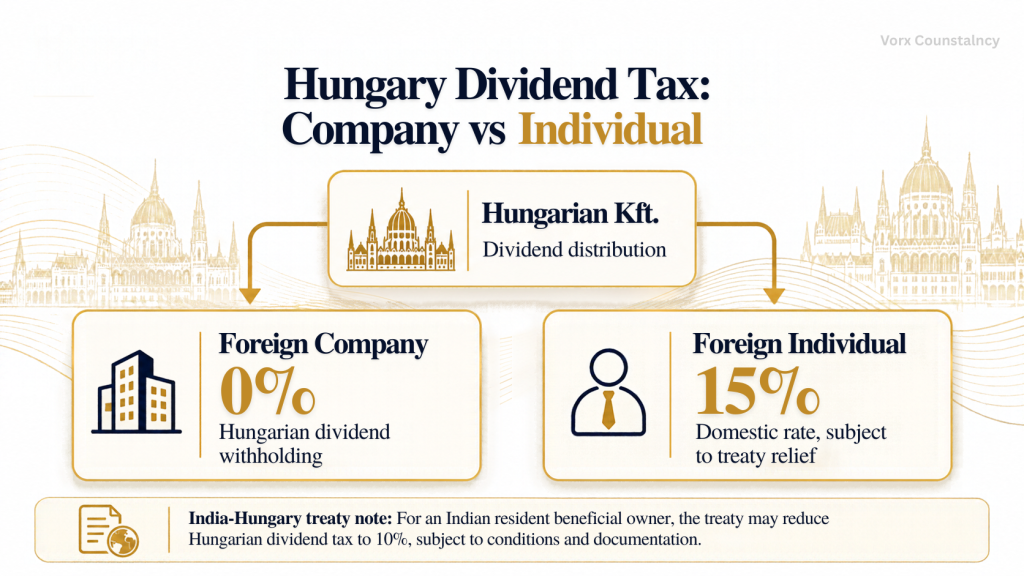
If the shareholder is a foreign company
Hungary charges no withholding tax on dividends, interest or royalties paid to companies, whether or not the recipient’s country has a tax treaty with Hungary. A dividend from a Hungarian Kft. to an Indian private limited company, a UAE company or a Dutch holding leaves Hungary without Hungarian tax.
The receiving company is then taxed under the rules of its own country.
If the shareholder is a foreign individual
Dividends paid to individuals are subject to Hungarian personal income tax at 15%, withheld by the company. A tax treaty can reduce this. To claim the lower rate, the shareholder usually provides a certificate of tax residence from their home country before payment.
Indian shareholders and the India–Hungary DTAA
The India–Hungary tax treaty caps Hungarian tax on dividends paid to an Indian resident beneficial owner at 10%. India then taxes the dividend as part of the shareholder’s income, and the Hungarian tax can generally be claimed as a foreign tax credit, subject to Indian rules and documentation.
Two points Indian founders often overlook:
- FEMA rules apply on the Indian side. Investing in a Hungarian company is an overseas direct investment, with its own reporting and approval rules.
- Holding versus direct ownership is a real decision. Owning the Kft. through an Indian company changes how and when profits are taxed in India. It is worth getting international tax structuring advice before incorporation, because changing ownership later can trigger costs.
Company or personal ownership?
The right structure changes how your profits are taxed in Hungary and India. Decide it before you incorporate, not after.
Worked Example: An Indian-Owned Kft. in Budapest
Consider an Indian entrepreneur operating a Hungarian Kft. with HUF 100 million in annual revenue. Assume the company has HUF 40 million in qualifying local business tax deductions and HUF 40 million in other operating expenses, leaving HUF 20 million in profit before HIPA and corporate income tax.
Tax Calculation | Amount |
Annual Revenue | HUF 100 million |
Qualifying HIPA Deductions | HUF 40 million |
Local Business Tax Base | HUF 60 million |
Local Business Tax (2%) | HUF 1.20 million |
Corporate Tax (9% × HUF 18.8m) | HUF 1.692 million |
Total Company Tax | HUF 2.892 million |
In this simplified example, the company’s combined tax burden is approximately 14.46% of its HUF 20 million profit, rather than just 9%.
Important: Local business tax deductions are limited to qualifying expenses, such as eligible materials, subcontractor services, intermediated services and direct R&D costs. General software subscriptions, salaries and administrative expenses do not automatically reduce the HIPA tax base.
The calculation assumes no additional corporate tax adjustments. Dividend taxation depends on the shareholder’s ownership structure, tax residency and applicable treaty provisions.
VAT and Employer Costs in Brief
Hungary’s standard VAT rate is 27%, with reduced rates of 18% and 5% applying to qualifying goods and services.
For most cross-border B2B services supplied to VAT-registered businesses in other EU countries, VAT is generally accounted for in the customer’s country under the reverse-charge mechanism.
However, the reverse charge does not automatically apply to every EU business transaction. Different VAT rules may apply to goods, domestic transactions and certain services, including those connected with immovable property.
Companies should verify their customers’ VAT status, apply the correct invoicing treatment and maintain appropriate transaction records.
The VAT exemption limit for small enterprises in Hungary has been increased to HUF 20 million of annual turnover in 2026.
Local employment incurs a charge of 13% as a social contribution tax based on gross salary. Employees have to pay 15% tax on their income, along with 18.5% social security contributions.
What Changed in 2026, and What Is Still Moving
Hungary’s tax rules have changed more than usual this year, partly because of the change of government in 2026.
Already in force for 2026:
- The ceiling limit for CIT advance payments was raised from HUF 5 million to HUF 20 million of previous year’s tax. Consequently, many SMEs pay quarterly now.
- KIVA entry and exit thresholds roughly doubled (see above).
- The energy suppliers’ income tax fell from 41% to 31%. This only affects the energy sector.
Adopted on 28 July 2026 (the “summer tax package”):
- The growth tax credit will be abolished from 1 January 2027.
- Certain CIT allowances for historic buildings will be phased out from 2027.
- The rarely used municipal tax will be abolished from 2027. Local business tax is not affected.
- There have been no changes to the 9% CIT rate, nor any introduction of a two-tiered CIT system.
Outstanding: the government has announced that future tax reforms would be enacted through the autumn 2026 tax reform package, which includes reducing tax benefits for multinational companies among its objectives. Please check for developments prior to implementation of any strategy.
For larger entities: The global minimum tax (Pillar Two) rules according to the OECD framework apply to Hungary’s corporate groups whose consolidated revenue exceeds EUR 750 million.
Local business tax and the innovation contribution count towards the 15% effective rate test.
Filing and Compliance Calendar
For a company using the calendar year:
- 31 May: CIT, local business tax and innovation contribution returns are due, along with final payment for the previous year.
- During the year: CIT progresses on a quarterly basis, or a monthly basis in the case that the taxes paid in the previous year exceeded HUF 20 million.
- Transactions between related parties: All fees, lending, or licensing of intellectual property between your Kft. and the Indian parent company need to be priced on an arm’s-length basis and should be evidenced.
The tax authority can generally audit five years after the end of the year in which the return was due. Reliable annual compliance and bookkeeping matters more than any single tax rate.
Common Mistakes Foreign Owners Make
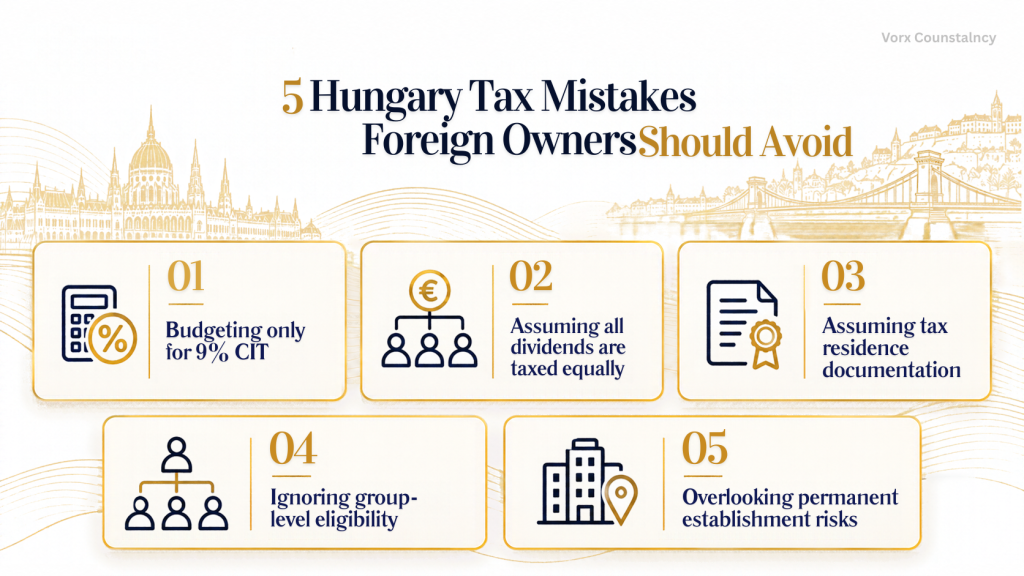
Budgeting for 9% only: As the example shows, local business tax can push the effective rate well into double digits.
Assuming dividends are taxed the same for everyone: Company shareholders pay no Hungarian withholding; individuals do.
Forgetting the residence certificate: Without it, an individual may suffer 15% instead of the treaty rate and have to reclaim the difference.
Ignoring group size: Belonging to a larger group can remove the innovation contribution exemption and affect KIVA eligibility.
Running the business from abroad without an entity: An Indian company with staff or a fixed place of business in Hungary can create a taxable presence without realising it.
Is Hungary the Right Base for Your Company?
The 9% CIT rate of Hungary, along with zero tax withholding from dividends paid to corporations and treaty limit of 10%, makes it an attractive choice among EU jurisdictions.
However, the actual tax expense will be determined by factors like your margin structure, payroll size, suitability of KIVA, and shareholding.
The practical next step is to model your own numbers before you incorporate. You can compare Hungary with other jurisdictions using our free tool. Or book a consultation with Vorx for help with Hungarian company set-up, ownership structuring and ongoing tax compliance.
This article is general information based on rules in force as of October 2026. It is not tax or legal advice. Hungarian tax law is changing in 2026, so confirm current rules with a qualified adviser before acting.
Know Your Actual Hungary Corporate Tax Liability
Hungary’s 9% corporate tax is only the starting point. Vorx Consultancy helps foreign entrepreneurs understand company taxation, ownership structures and ongoing compliance.
Book Your Free Tax Consultation
